what is AGI, really?
General Intelligence is the ability to know true things without having learned them.
Let's be clear on what AGI *isnt*:
* bigger model
* more training data
* more energy/compute
What it is:
The ability to apply principles, and learn new truths, even without observation/experiment/empiricism. Those can be useful for proving/convincing others of new truths, but not for attaining them. They can be useful for proving/convincing others about your axioms/rules, but not for running the rules against the axioms.
Ex:
Before the first rocket reached space, we had no observations of a rocket reaching space (duh). We did not get there by running billions of experiments in parallel, or observing spacefaring from somewhere else. We got there by applying physics knowledge, to know true things about our physical world.
What AGI is *SPECIFICALLY*:
A Turing Machine with flexible axioms/rules. That's it.
It doesn't need to be superhuman. It can be significantly *sub-human*, like, paramecium-level AGI (doesn't know a lot of facts), but it needs the right architecture.
btw, this is the full code describing a simple Turing Machine:
data Expression =
Var String
| Lambda String Expression
| Apply Expression Expression
That (plus beta-reduction) is all we need, or some analogous architecture that's more compatible with tensor/backprop based compute.
(see: Untyped Lambda Calculus, one of the most elegant TM formulations)
History of Neural Turing Machines:
They were paying off big time in the '15s, before Transformers unseated them by being able to train quicker, and more stabley. They are still more capable than Transformers for reasoning OOD. But Transformers are giving payoffs in other ways so this branch of academia has atrophied.
(see: Neural Turing Machine (NTM) and Differentiable Neural Computer (DNC))
Hypothesis:
Current pretrained LLMs (RWKV/Llama/Mistral/Qwen/Deepseek) are useful as compressed knowledge bases. Their architecture can be augmented, and then continue-pretrained (for far cheaper than initial pretraining), and become AGI, nicely, now with free knowledge bases. You can take a 0.5B model, and it can be AGI. The 0.5B-3B-7B range is nice for experimentation, and probably all you'll ever need anyway.
Neuro-justification:
Most of your cerebrum is used for pattern matching. This is your reflex-type knowledge: see-x-do-y. Homo Sapiens evolved a large prefrontal cortex with specific regions, in specific loops (through the basal ganglia/NAcc/SNc, thalamus, back to PFC), that have a *novel architecture* compared to the rest of the cerebrum. From a computational neuro lens, I believe this operates as a Turing Machine. It's metabolically expensive to operate, and has limited payoff since habit loops are typically enough to "get the job of life" done. But it does offer unique payoffs too, which is why this circuit's regions have inflated over evolutionary time.
This circuit takes advantage of the baked-in habit-type knowledge of the rest of the cerebrum, but offers the unique and new ability of Turing Completeness: you can apply principles in new and unexpected ways, and arrive at new truths;
Even just sitting in an arm chair and running thought experiments
Like what the world would look like riding on a photon of light, for instance.
@elonmusk@nypost having plentiful cheap goods means they'll also cost way less
IE rent=$2, groceries=$1, etc
the key for markets to drive prices down is to *REMOVE* market distortions, not *INTRODUCE MORE*
IE break up monopolies, ban gov handouts, let the market work, everyone buys robots
Victor "Nathaniel" Rothschild is a literal Bond villain
he was lifetime member of the House of Lords but yet only spoke to the Chamber on two occasions
(both were in 1946)
what were the topics?
>allowing Jewish migration in Palestine
>pasteurizing raw milk
A physics-informed GNN that learns Newton's laws from data—and extrapolates to systems 35× larger
Most neural networks for physics simulation are data-hungry and brittle. Train them on one configuration, and they fall apart when you change the boundary conditions, scale up the system, or run long rollouts. The fundamental issue: these models learn correlations, not conservation laws.
Vinay Sharma and Olga Fink take a different approach with Dynami-CAL GraphNet. Instead of hoping the network discovers physics, they embed it directly into the architecture. The key insight: Newton's third law guarantees that internal forces conserve linear and angular momentum—even when energy dissipates through friction or inelastic collisions.
They achieve this through a novel edge-local reference frame that is SO(3)-equivariant, translation-invariant, and antisymmetric under node interchange. Forces decoded from edge embeddings are automatically equal and opposite. Angular momentum gets the same treatment: the network predicts both internal torques and the point of force application, isolating spin from orbital contributions.
The results are striking. Trained on just five trajectories of 60 colliding spheres in a stationary box, the model extrapolates to a rotating cylindrical hopper with 2,073 particles—maintaining stable, physically consistent rollouts over 16,000 time steps. On constrained N-body systems, human motion capture, and protein molecular dynamics, it outperforms specialized baselines while requiring less data.
The message: when you bake conservation laws into the architecture rather than the loss function, you get models that generalize across scales, geometries, and boundary conditions—because they've learned the right inductive bias from the start.
Paper: https://t.co/1FsIj3DwRs
@__el__toro__ why's everyone trippin, a chamfer endmill cant do this
the cleanest you could get would be to refixture the part and use a square endmill, one pass
at the edges the angle would be a bit longer than 45deg, and you'd get a bit of a fillet from the tool's radius
whats your trick?
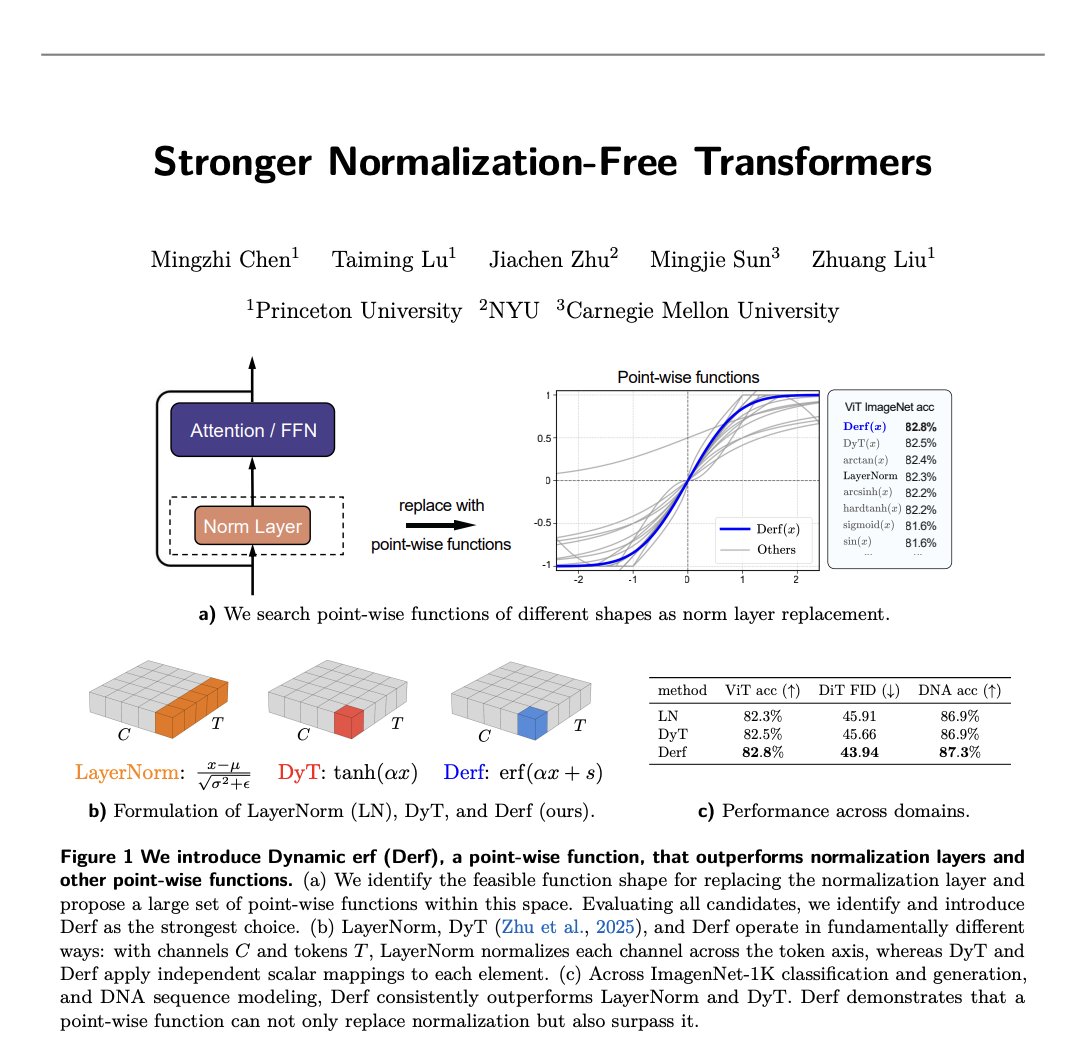
Stronger Normalization-Free Transformers – new paper.
We introduce Derf (Dynamic erf), a simple point-wise layer that lets norm-free Transformers not only work, but actually outperform their normalized counterparts.
@hive_echo appreciated. I've done a lot along these lines, but I think the right approach is use "program-as-inputs" not "program-as-weights" approach
ie a universal turing machine
you want an "attention" inductive bias, so you put in softmax attention
you want a "language" bias so you put in discrete dictionary of tokens
you want a "reasoning" bias, yet you ignore the Turing Completeness