At @neuroinklab, we are a community of neuroscience enthusiasts exploring the complex links between vision, perception, and behavior. Through collaboration and critical thinking, we aim to deepen understanding in these fields.
👨🏻💻 This was presented by @RFhosseinizadeh, a https://t.co/5psdvZLUOC. Student in Cellular and Molecular Biology at Ferdowsi University of Mashhad.
💻 The session has been recorded, and you can watch the offline video on the NeuroInk YouTube channel: https://t.co/fCg0wui34d
🧠 At the 36th session of the Journal-Ink series, we reviewed: "Rhythmic attentional scanning"
Part 2
📝 Authored by: Pascal Fries
#neuroinklab#neuroscience
🔑 Key Highlights:
1- Behavior is systematically coupled with neural oscillations, especially low-frequency rhythms like theta.
2- Perception varies with the phase of neural oscillations.
🌐 Link: https://t.co/cBtACcKQyj
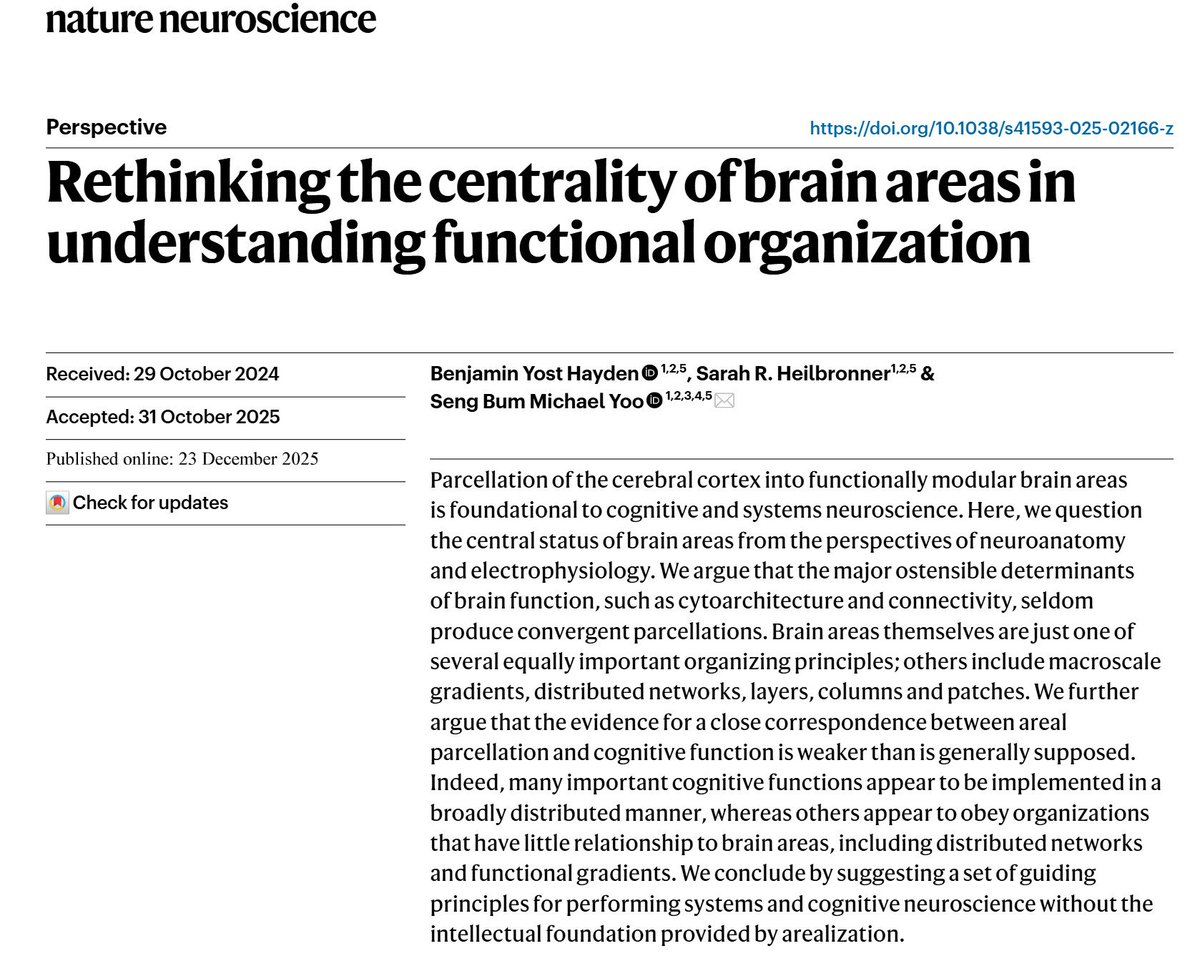
𝗥𝗲𝘁𝗵𝗶𝗻𝗸𝗶𝗻𝗴 𝘁𝗵𝗲 𝗰𝗲𝗻𝘁𝗿𝗮𝗹𝗶𝘁𝘆 𝗼𝗳 𝗯𝗿𝗮𝗶𝗻 𝗮𝗿𝗲𝗮𝘀
New paper I anticipate will become a classic in neuroscience and a must-read for students at all levels.
Understanding brain function beyond brain areas.
https://t.co/OjQPX87cfw
👨🏻💻 This was presented by @ZynabNosrattalab, a https://t.co/5psdvZLmZ4. Student in Cellular and Molecular Biology at Ferdowsi University of Mashhad.
💻 The session have been recorded, and you can watch the offline video on the NeuroInk YouTube channel: https://t.co/IIs5TOViuT
🧠 At the 35th session of the Journal-Ink series, we reviewed: "Hemifield Specificity of Attention Response Functions during Multiple-Object Tracking"
📝 Authored by: @MaechlerMarvin, eunhye choe, @patrickcav124, Peter j Kohler, peter u tse
#neuroinklab
🔑 Key Highlights:
1- Early visual areas are contralaterally biased; attention areas respond bilaterally.
2- Capacity limits stem from visual, not bilateral attention, areas.
🌐 Link: https://t.co/TV5Fjc2Sys
👨🏻💻 This was presented by @ZynabNosrattalab, a https://t.co/5psdvZLmZ4. Student in Cellular and Molecular Biology at Ferdowsi University of Mashhad.
💻 The session have been recorded, and you can watch the offline video on the NeuroInk YouTube channel: https://t.co/mhwz3cCK72
🧠 At the 34th session of the Journal-Ink series, we reviewed: "When periphery rules: Enhanced sampling weights of the visual periphery in crowding across dimensions"
📝 Authored by: @AmirYashar, @carrasco_lab#neuroinklab
🔑 Key Highlights:
1- Crowding asymmetry reflects greater sampling weight on the outer flanker across features.
2- Orientation and SF tasks show outer-flanker dominance, whereas color exhibits minimal asymmetry.
🌐 Link: https://t.co/1YMLFzwG3j
👨🏻💻 This was presented by Zahra Abolhassani, MSc in Animal Physiology at Ferdowsi University of Mashhad.
💻 The session have been recorded, and you can watch the offline video on the NeuroInk YouTube channel: https://t.co/oS6yRj99sB
🧠 At the 33th session of the Journal-Ink series, we reviewed: "whether short-latency face preference in the primate superior colliculus depends on the visual cortex."
📝 Authored by: @gongchen_yu,
@Leorkatz, Christian Quaia,
@adam_messinger, Richard J Krauzlis
#neuroinklab
🔑 Key Highlights:
1- SC neurons respond much more to faces, and this boost appears 40 ms after stimulus onset in both SC layers.
2- SC face response happens only with cortical input; blocking LGN stops it.
🌐 Link: https://t.co/3wKguJYDC3
👨🏻💻 This was presented by @RFhosseinizadeh, a https://t.co/5psdvZLUOC. Student in Cellular and Molecular Biology at Ferdowsi University of Mashhad.
💻 The sessions are recorded, and you can watch this one by clicking on this link: https://t.co/oupDrHqUSQ
🔑 Key Highlights:
1. Attention operates rhythmically at theta, cyclically selecting stimuli in sync with oculomotor activity.
2. Stimulus selection and gain enhancement arise via gamma oscillations and inter-regional synchronization (CTC, feedforward coincidence detection).
👨🏻🏫 This was presented by Arshia Ahmadzadeh, a https://t.co/5psdvZLUOC. students in Cellular and Molecular Biology at Ferdowsi University of Mashhad.
💻 The sessions are recorded, and you can watch this one by clicking on this link: https://t.co/Zirtjq28lk
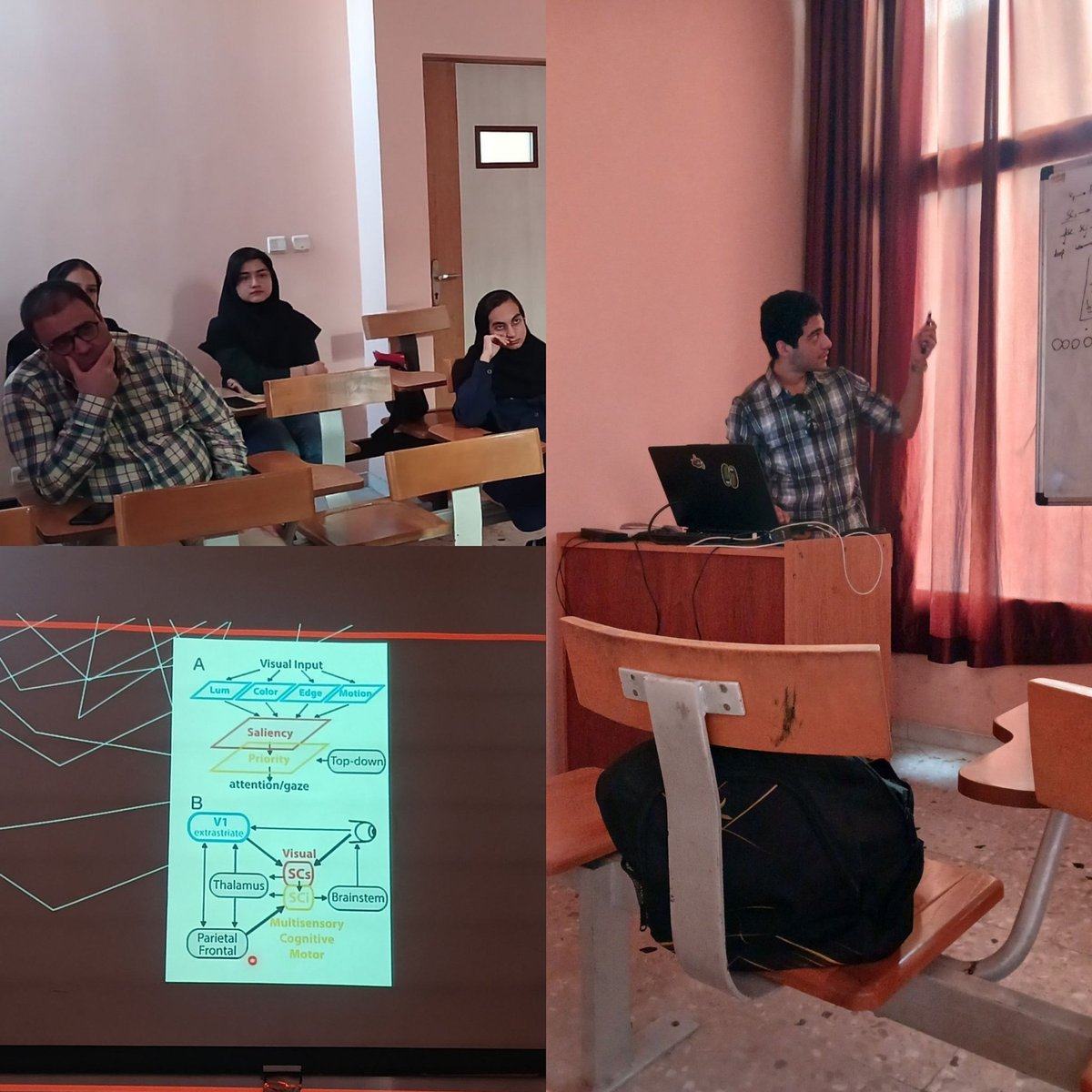
🧠 At the 31st Session of Journal-Ink, we reviewed the article: "Superior colliculus encodes visual saliency before the primary visual cortex"
📝 Authored by: Brian J White , Janis Y Kan, Ron Levy, Laurent Itti, Douglas P Munoz
🌐 Link: https://t.co/AWa4HZpQFM
#neuroinklab
🔑 Key Highlights:
1. The superior colliculus detects visual saliency earlier and stronger than V1, implying V1 is not the primary saliency source.
2. Its intermediate layers integrate saliency with task relevance, forming a priority map rather than a purely sensory one.
👨🏻💻 This was presented by @RFhosseinizadeh, a https://t.co/5psdvZLmZ4. Student in Cellular and Molecular Biology at Ferdowsi University of Mashhad.
💻 The sessions have been recorded, and you can watch the offline videos on the NeuroInk YouTube channel: https://t.co/ANLmRV0kGr
🧠 At the 5th session of the Method-Ink series, we explored the concept of microsaccades and eye-tracking data analysis in MATLAB and we reviewed “Microsaccades are triggered by low retinal image slip.”
📝 Authored by: Ralf Engbert , Konstantin Mergenthaler
#neuroinklab
🔑 Key Highlights:
1- Microsaccades are triggered by reduced retinal slip, supporting an active mechanism for visual stability.
2- They both cause and correct fixation errors, briefly increasing slip but stabilizing gaze over time.
🌐 Link: https://t.co/38gyalnno1