sometimes thinking, but not much
manual & algorithmic trader. new one in the city @Darwinexzero. my track record in a few time WLFQ
Early $HIMS, $NAUT, $SPCX
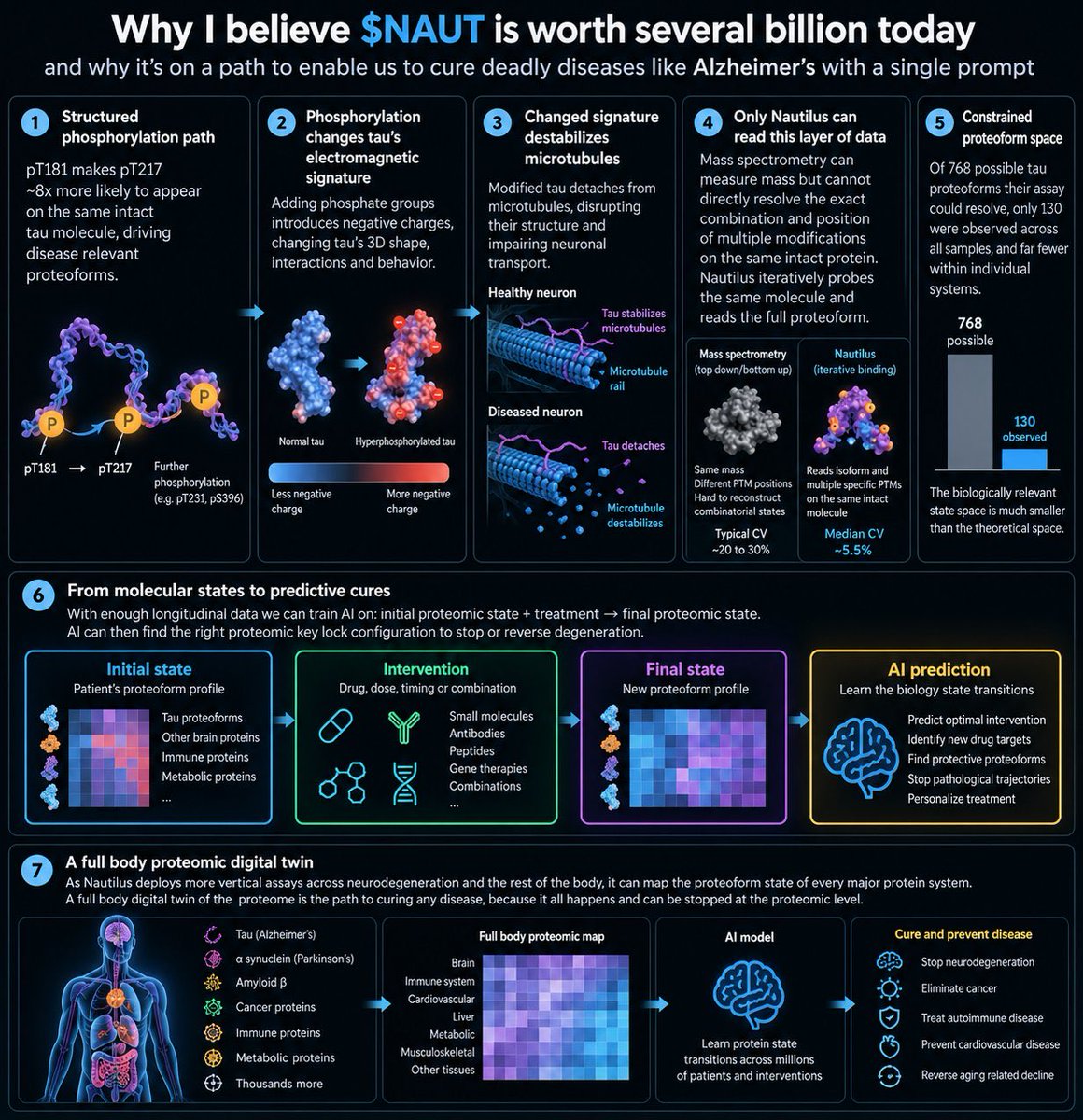
I believe $NAUT is worth several billion today, because it's on a path to enable us to cure deadly diseases like Alzheimer's with a single prompt by 2027-2028.
The breakthrough is not better protein measurement.
It is reading the state machine of human biology.
In Nautilus' tau paper, they found that phosphorylation is not random.
pT181 makes pT217 about 8x more likely to appear on the same intact tau molecule.
That matters because adding PO4 groups changes tau's charge distribution, which changes its conformation, which changes how tau binds microtubules.
Microtubules are the rails neurons use to move mitochondria, vesicles and proteins over enormous distances.
Tau helps stabilize those rails.
Change tau's molecular configuration enough and:
tau detaches → microtubules destabilize → transport breaks → neurons degenerate
Alzheimer's may therefore not be "too much phosphorylated tau."
It may be a progression through specific molecular states:
tau A → pT181 → pT217 → additional PTMs → pathological proteoform
And until now we largely could not read that combinatorial layer cleanly.
Mass spectrometry measures mass and charge extremely well, but two intact tau molecules can have the same mass while carrying the same phosphate at different positions.
Same atoms.
Same mass.
Very different biological behavior.
Fragmentation can help, but reconstructing the exact PTM configuration of millions of intact molecules becomes difficult.
Nautilus instead repeatedly interrogates the same intact protein with different probes.
Its tau assay currently reads isoform plus 7 phosphorylation sites, creating hundreds of potential molecular states, while reporting about 5.5% end to end CV versus about 25% cited by management as an industry benchmark.
And here is where this gets insane.
Biology does not appear to occupy every theoretically possible state.
Of 768 tau proteoforms their assay could resolve, they observed only 130 across all samples, and far fewer within individual biological systems.
That means the real state space may be highly constrained.
Now collect enough longitudinal data:
initial proteomic state + treatment → final proteomic state
Do that across millions of patients and interventions and AI stops being merely descriptive.
It becomes predictive.
Given molecular state X, what intervention moves the system toward healthy state Y?
That is effectively a biological key:lock search problem.
For tau alone, that could mean finding the intervention that prevents the proteoform trajectory that causes tau to abandon and damage the neuronal microtubule system.
But tau is just one vertical assay.
Add alpha synuclein.
Amyloid beta.
Cancer proteins.
Immune proteins.
Metabolic proteins.
Thousands more.
Eventually:
genome + proteoform state + treatment history → full body molecular state transition model
A genuine digital twin of human biology.
The endgame is not simply detecting disease earlier.
It is asking:
given this person's current molecular state, what intervention moves them back toward the healthy state?
And having an AI trained on billions of measured biological transitions produce the answer.
That is why I think $NAUT is building something much larger than a proteomics machine.
It is building the data layer required for AI to learn how to steer human biology.
$ASTS has no competition and is is building a network that will likely print billions of $ of free cash flow practically overnight.
Watch this video to learn everything you need to know about $ASTS.
Whether you’re an AI bull or bear be thrilled so many investors think you’re dead wrong. The gap between what AI believers and skeptics see has never been bigger. And current valuations leave plenty of room for either side to be spectacularly right or wrong. That’s where the opportunity is.
Stop getting pissed at people who disagree with you. If you’re right those people are the reason there’s still so much money to be made.
Anyway happy Friday everyone. life is good. Hook ’em
Anthropic signs a $35B AI compute deal with $NVDA backed Lambda.
$HUT / DC, with Lambda / GPUs.
Frontier model demand is rapidly outpacing the ecosystem's ability to build capacity.
It also looks like Anthropic is securing more compute... Which neocloud/colo player is next?
$NAUT is a science project with meaningful odds of evolving into a $10T company
Proteoform assays are the basis for actual precision medicine / longevity as a service and no one is even close to $NAUT
$SPCX just revealed what its new Starbase, Louisiana spaceport is expected to look like.
The scale is absolutely insane and shows how aggressively SpaceX is building for much higher Starship launch cadence.
Find yourself a woman who deserves your full commitment
Build a family
Take on more responsibility than you think you can handle and fulfil it daily
And most of all
Lever your networth on Hyperliquid during the golden bull run
Since people are having fun speculating on $SKHY CPO roadmap supply chains.
I'm gonna do my own guess and say SK Hynix is evaluating Celestial/Ayar. Then doing heavy evaluation into microLEDs past first-gen deployments.
Both have been kinda working on it for awhile.
- Ayar shown up in SK hynix's own website in the context of optical <-> memory links.
- Marvell is actively working with SK Hynix in custom memory solutions (and guess who owns Celestial now).
Celestial/Ayar are both also cited in SK Hynix's linked Nature Paper, which helps a bit with technical relevance:
(121): Stojanovic, V. A UCIe optical I/O retimer chiplet for AI scale-up. In 2025 IEEE Hot Chips 37 Symposium (HCS) 1–22 (IEEE, 2025)
- This is Ayar reference (Ayar’s teraphy optical I/O chiplet), Stojanovic is Ayar Lab's co-founder btw.
(123): Winterbottom, P. Photonic interconnect for accelerated computing celestial AI photonic fabric module (cough cough Celestial)
There's more breadcrumbs out there, but wanted to keep this relatively short-form.
For more upstream beneficaries:
-> I still think $SIVE is the cleanest read through since they're likely supplying to both Celestial/Ayar.
The interposer/packaging IP layer... People were speculating $POET, but Marvell probably vertically integrated players them out this year after the announcement.
Given they've had their own SiPH interposer tech/integration IP before Celestials acquisition (eg. presented a silicon-photonics interposer back in 2023)
-> AMS Osram (which I don't own), seems like they're co-developing in this area given they randomly went out of their way this year to say HBM <-> optics was a TAM increase for them.
TLDR: I see Ayar/Celestial as candidates for SK Hynix's CPO roadmap, then microLEDs being commercialized past gen-1 maybe 2029. (this is all speculation)
Just to throw a bone to quantum dot bros, this got cited like 5 times.
🚨 NEXT WEEK COULD DECIDE THE FUTURE OF CRYPTO IN AMERICA.
Bipartisan crypto negotiators are preparing a final round of meetings next week to lock in key parts of the bill before the Senate runs out of time ahead of the August recess.
Lawmakers are now trying to finalize:
• SEC vs CFTC jurisdiction
• Token classification rules
• Stablecoin language
• DeFi treatment and crypto exchange regulation
This is one of the biggest crypto regulation moments the US has seen in years.
For years, crypto companies in the US have been operating in a legal grey area where nobody fully knows:
• Which tokens are securities
• Which regulator has authority or what rules exchanges actually fall under.
The CLARITY Act is supposed to finally define that.
A huge part of the current negotiations is focused on the CFTC side of the bill, which would oversee:
• Bitcoin spot markets
• Commodity-style tokens and large parts of the exchange industry.
If negotiators can reach an agreement, the US could move much closer to a proper federal crypto framework with clear rules for exchanges, tokens, and digital asset markets.
If talks fail, major crypto legislation could get delayed until 2027.
Next week could become one of the most important weeks for US crypto regulation in years.