.@JacobTref runs the science program at Open Philanthropy, directing about $100m/year in philanthropic funding.
For @newscienceorg, we ended up talking about academia, peer review, grant-making; and also about love, the meaning of life, and our personal histories.
Enjoy!
Timestamps
0:00:00 - Introduction
0:01:11 - On Open Philanthropy's decision process
0:06:48 - Is it possible to make expected value calculations for basic scientific research?
0:16:27 - Non-profit funding vs for-profit funding
0:17:19 - Why the NIH rejects grants
0:19:39 - Jacob's "PhD" working side-by-side with biochemists for 5 years
0:25:22 - Today's system of federal funding are not supporting generalists
0:28:34 - How will AI affect the pace of scientific progress?
0:41:53 - AI Baumol Disease
0:54:41 - Can AI speed up aging research?
0:58:20 - The wisest people Jacob & Alexey know
1:13:31 - The future of science in academia
1:19:26 - How Open Philanthropy uses neglectedness to make funding trade-offs
1:35:16 - Jacob's advice for a talented 20 year old watching this
1:45:24 - Jacob's favorite joke
"Peer review...for centuries the standard tool to determine an academic paper’s suitability for publication".
https://t.co/G7kuGKxTa5
No. The term is only a few decades old and Nature itself didn't it routinely until the 1970s. 1/3
I think if you're a v busy founder trying to learn technical topics, it's sooo silly not to use Anki - i.e. you have 10 hrs/week to learn stuff, and they're off hours (nights + partial recovery wknds)
(would love counterexamples / other suggestions!)
Are you a recent college grad or early career researcher who is looking to get more mol bio/biochemistry experience in the lab? New role open for a Research Associate @ArcadiaScience, please share 🙏 https://t.co/YBombTvY7j
happy February from New Science! Our updates from January -- we launched our site for research results, shared bios + project descriptions of our most recent fellows, and a bit about where we are headed next. (link in thread)
Can we tear chloroplasts from their eukaryotic hosts and enable them to flourish, on their own, once again?
This summer, a Fellow explored tools to transfer DNA into the organelle's genome, thus making progress toward a "free-living chloroplast."
https://t.co/2mMRyCbQbR
Pathogens constantly evolve. We funded a fellow to design small peptides that target various sites on SARS-CoV-2 & fuse them to nanobodies. The goal is to build a "universal immunotherapy" that retains efficacy against new viral strains.
Our second essay: https://t.co/f9CoQmhrgb
Studying organisms in isolation — as in cell culture — destroys the myriad signals, from neighbors and surroundings, that maintain a cell's identity.🧫
Our historical focus on individual cells has led to amazing discoveries, but we can do better. https://t.co/PwEOHi0jSw
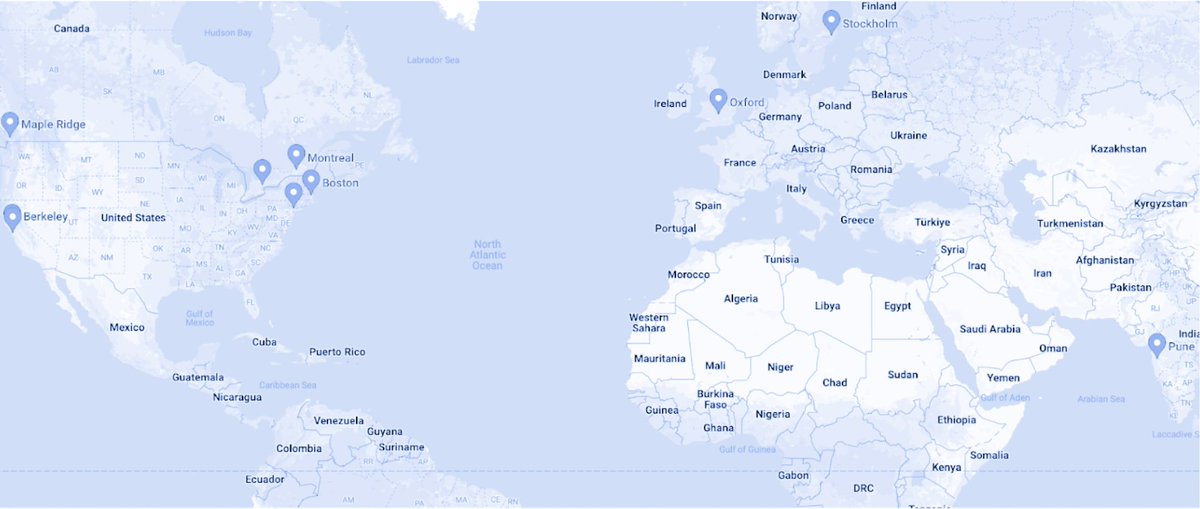
We funded five young scientists this summer. Each joined a lab in Boston or Berkeley. Their high-risk biology projects explored the potential for free-living mitochondria, universal immunotherapies, and more. This week, we're sharing their projects with you. 🎉
To improve academic science, let's study the law. New essay by @NikoMcCarty explains how Consequences, Evidence, and Adversaries could all bolster reproducibility. #AcademicTwitter https://t.co/hfQaMe9mdr
In the dozen years after solving DNA’s structure, all but one of the 18 scientists who received a Nobel Prize in molecular biology were supported by Rockefeller Foundation funds.
Learn more about their funding principles and history in our latest essay: https://t.co/lFRNZ1tP13
Thanks for reading the essay, which can be cited using doi: 10.56416/480pmz. If you have ideas for an essay about the history of science, please email us: https://t.co/1QVEVdfsT5 // https://t.co/lFRNZ1KS33
In the dozen years after solving DNA’s structure, all but one of the 18 scientists who received a Nobel Prize in molecular biology were supported by Rockefeller Foundation funds.
Learn more about their funding principles and history in our latest essay: https://t.co/lFRNZ1tP13
This essay by @SamirUnni includes advice for modern science philanthropies, like @ArcadiaScience, @Convergent_FROs and ourselves. It draws directly from Rockefeller archives, program officer diaries, and a slew of other materials.