🚨 OCTOBER 12 COULD TRIGGER ONE OF THE WORST MARKET SELLOFFS OF 2026
Monday's U.S. market open could get VERY ugly.
And I think most investors are watching the wrong market.
Everyone is focused on stocks and Bitcoin.
I'm watching U.S. TREASURIES.
Because if the bond market loses control, the damage won't stop at Wall Street.
Here's what has me concerned:
→ Japan and China reducing Treasury exposure
→ Rising pressure on U.S. borrowing costs
→ The Iran conflict threatening global energy supplies
→ Oil prices adding to inflation risks
→ Higher yields putting pressure on risk assets
Now imagine these pressures hitting at the SAME TIME.
Oil rises → Inflation fears return → Bond yields climb → Liquidity tightens → Stocks and crypto get sold.
That's the chain reaction I'm watching.
And it could happen much faster than people expect.
When yields spike, investors don't always sell what they WANT to sell.
They sell what they CAN.
That's how a bond-market problem can turn into a full-blown liquidation across stocks, Bitcoin, and other risk assets.
I'm not saying a crash on Monday is guaranteed.
I'm saying the conditions for a violent selloff deserve serious attention.
I've been studying markets for more than 12 years.
And I'm watching this setup VERY closely.
Save this chart before Monday's open.
Follow + turn notifications on.
If the selloff begins, I'll post the levels I'm watching here FIRST.
**Don't wait for the panic to start paying attention.**
$SPX BLACK SWAN COMING SOON
- Dot-com bubble
- Housing bubble
- AI bubble
ALL OF THEM HAVE ONE THING IN COMMON
Stocks keep pushing higher until the market starts pricing in a future that can’t live up to expectations
Different eras, different narratives, but this pattern appears again and again
Look what do we have now:
Since March 30, the S&P 500 has risen 23%
But just 10 companies accounted for 70% of that gain
Nvidia alone accounted for 13%
Micron, Apple, and Microsoft each contributed 9%
And the remaining 490 stocks? Just 30% of the growth.
In other words, for a significant correction, all it might take is some reporting issues or negative news surrounding a few companies from the top 10
That would cause the S&P 500 to crash
Don't believe me?
SASVE THIS AND CHECK BACK LATER
Tom Lee still sees pessimism in the market and I think he’s spot on.
We have trillions of dollars sitting on the sidelines as we head into mid terms and we could see some of that flow back into the market in a big way after that uncertainty passes.
When it comes to higher interest rates, that slows the markets growth (the money velocity).
I think if we see rates stay where they are and for a longer amount of time, we could see the market look beyond that and get back to equities in a heavier way.
Tech is opening up so much TAM for the economy it’s insane.
If you’re sitting on the sidelines during the bull cycle, you’re not thinking about the long term future in my opinion.
🚨BREAKING
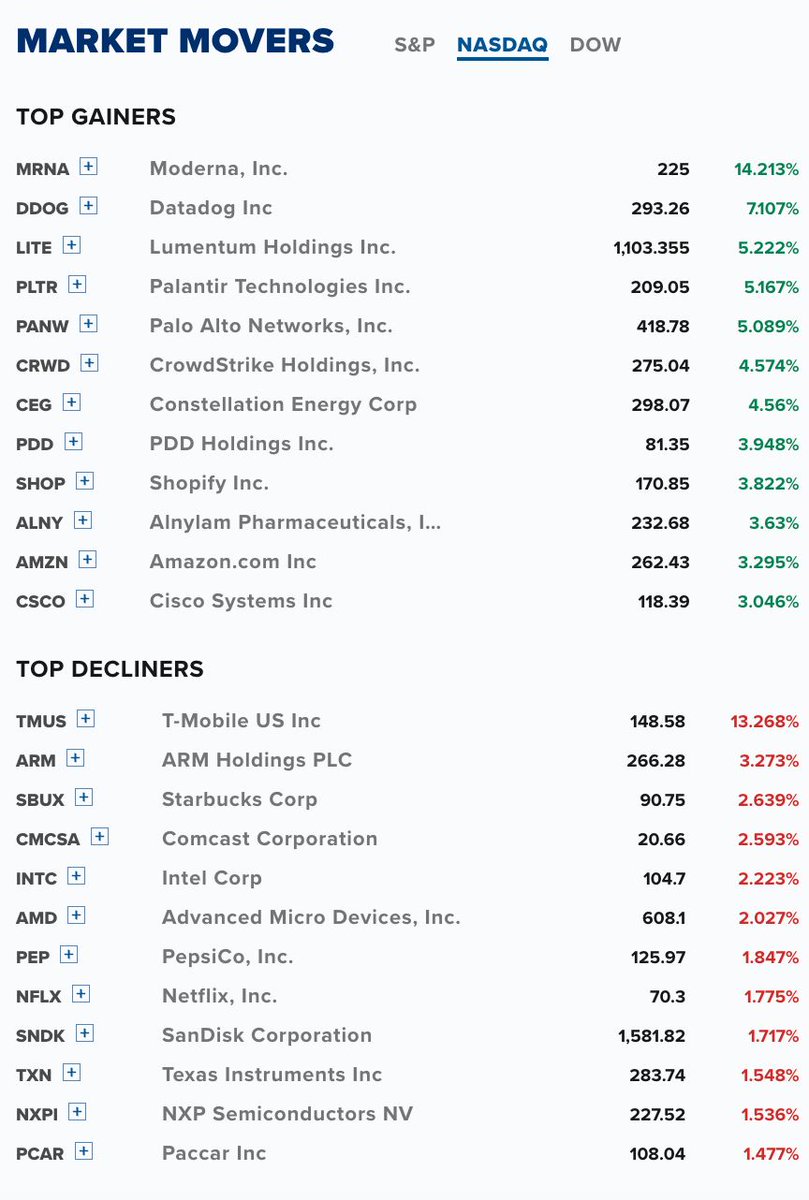
Cybersecurity stocks keep climbing as analysts expect AI to generate new attacks and increase demand for security.
Pelosi invested in CrowdStrike at ~$30 a share, it’s up 810% since. 4.3% today.
She also invested in Palo Alto at ~$178, it’s up 134% since. 5% today.
Many investors fear that we're an AI bubble.
@fundstrat’s Tom Lee sees two catalysts that could change that view: Q3 earnings and the midterms.
The names in focus heading into them - live with Tom and @MarkNewtonCMT, Oct. 28 at 2 p.m. ET: https://t.co/5ughixckRq
I think bank stocks could be heading into some serious trouble and the bond market is one of the biggest reasons why.
The 10 year Treasury yield has now climbed above 5.2%, and that's creating a pretty interesting problem for banks. When Treasury yields rise, the value of existing bonds falls. That's a problem because banks hold enormous amounts of Treasury bonds and mortgage backed securities that were purchased when interest rates were much lower.
For example, imagine a bank bought billions of dollars worth of bonds paying 3% interest. Now investors can buy newly issued bonds paying over 5%. Those older bonds become less attractive, so their market value drops. And we're already seeing the damage. U.S. banks were sitting on nearly $330 billion in unrealized securities losses at the end of Q2 2026 but it gets worse.
Higher Treasury yields also mean banks have to compete harder to keep customer deposits. Why leave your money in a savings account paying very little when you can earn around 5% in government bonds or other non traditional banks that are paying much more ? That forces banks to offer higher deposit rates, increasing their costs. At the same time, higher borrowing costs can slow mortgage demand, hurt businesses, and eventually increase loan defaults. So banks could find themselves dealing with falling bond values, higher funding costs, and weaker lending demand all at once.
And we're already seeing investors react, just look at bank stocks. $JPM is down nearly 11%, $BAC is down almost 19%, $WFC is down 18%, and $C is down nearly 15%, even as Wall Street expects some of the biggest banks to report strong earnings.
Now, I'm not saying we're heading into another 2022 banking crisis. Banks are generally better positioned today, and rising rates can still benefit some lenders but I do think the bond market is flashing a warning sign that investors shouldn't ignore, especially when it comes to smaller regional banks. If you enjoyed reading this, make sure to follow me @MelvinInvests for more.
A TON OF THINGS HAPPENED IN THE STOCK MARKET TODAY.
Here's a full recap:
1. OpenAI told investors its annualized revenue was approaching $50B at the end of September, according to the Financial Times, below the roughly $70B figure that had been widely reported last month. The discrepancy reportedly reflects differences in accounting methods, with Anthropic including revenue generated through cloud partners such as AWS and Google Cloud, while OpenAI does not. Investors had attempted to adjust OpenAI’s figures to make them comparable with Anthropic’s, contributing to the higher estimate. The report weighed on AI infrastructure sentiment, with several semiconductor stocks falling roughly 5–7% as investors reassessed near-term AI spending expectations. OpenAI declined to comment.
2. The September FOMC meeting minutes showed that most Federal Reserve officials expect another interest rate hike by year-end, reinforcing the central bank’s higher-for-longer stance. All 19 Fed officials supported the September rate hike, reflecting unanimous concern that inflation remains above target. The minutes also said almost all policymakers believe inflation risks remain tilted to the upside, with several officials warning that the accelerating AI investment boom could increase demand faster than supply, adding to inflationary pressures.
3. Elon Musk said today that he sees an extraordinary long-term future for $SPCX SpaceX, writing: “This will sound super crazy, but I see a path to SpaceX being worth orders of magnitude more than the current Earth economy.”
4. Goldman Sachs upgraded Palantir $PLTR to Buy with a $230 price target, while Barclays initiated coverage with a Buy rating and a $265 price target. Goldman argued that Palantir’s total addressable market is entering another step-function expansion, driven by the rise of sovereign AI, bespoke enterprise AI applications, and the company’s increasing verticalization strategy. The firm also highlighted Palantir’s Forward Deployed Engineer (FDE) model as a key competitive advantage, noting that its tight feedback loop between customer deployments and product development has become so refined that Palantir is now able to automate portions of the FDE workflow with AI-powered FDEs. Goldman believes these dynamics further strengthen Palantir’s long-term competitive position as enterprise AI adoption accelerates.
5. Zeta $ZETA unveiled AthenaOS, an enterprise intelligence operating system designed to dynamically organize AI, applications, and workflows around a specific business objective by combining proprietary enterprise knowledge with intelligence from the Zeta Data Cloud. The company also introduced Athena MCP, which allows Athena’s intelligence to plug directly into existing enterprise tools, including ChatGPT, Claude, and Gemini, while preserving enterprise data governance and control. Zeta also launched the Athena Inference Model (AIM), a suite of specialized AI models built with Fireworks using NVIDIA Nemotron, and said it has begun developing a specialized AI chip and supporting data center infrastructure with a leading semiconductor partner through a capital-light approach. AthenaOS is currently in limited internal beta, with a public beta planned later this year and general availability targeted for Q1 2027.
6. Starbucks $SBUX has reportedly explored a potential takeover of Chipotle $CMG in what would rank among the largest restaurant acquisitions ever. A combination could significantly accelerate Chipotle’s international expansion by leveraging Starbucks’ global network of more than 41,000 stores, established licensing partners, and extensive real estate relationships. At the same time, any transaction would face substantial financing, integration, and execution challenges given the size of the deal and the complexity of combining two of the world's largest restaurant brands.
7. The top 10 most active options today by contracts traded were $NVDA with 2.9M contracts, $TSLA with 1.3M contracts, $INTC with 1.2M contracts, $MU with 1.1M contracts, $AAPL with 1.0M contracts, $SPCX with 1.0M contracts, $PLTR with 927K contracts, $AMZN with 635K contracts, $ORCL with 635K contracts, and $IREN with 612K contracts.
8. The U.S. Pentagon has reportedly instructed the military to complete preparations for a potential resumption of major combat operations against Iran, according to Axios. U.S. and Israeli sources told the outlet that renewed operations could occur before the midterm elections, while a White House official said President Trump “has all options available at any time.” The report also said Trump's national security team met at Camp David on Friday to discuss possible scenarios for restarting large-scale military operations. The developments come as the administration continues weighing both military and diplomatic options in its approach toward Iran.
9. Broadcom $AVGO is reportedly seeking more than $50B in financing for OpenAI’s custom AI chip program, according to the Wall Street Journal, with Apollo and Blackstone among the firms approached to participate. The financing could support several gigawatts of custom AI chip capacity, with a transaction targeted before year-end, though discussions remain preliminary and the size could change. OpenAI’s internally developed chip initiative, known as “Nexus,” includes its first two generations, “Jalapeño” and “Serrano,” and builds on the companies’ previously announced plan to deploy 10 GW of custom AI chips using Broadcom’s networking technology between the second half of 2026 and 2029.
10. Bitcoin $BTC fell to around $81,000 down roughly 3% on the day and about 6–8% from the $87,000 highs reached earlier this week, with an intraday low near $80,300. The selloff appears to be a broad risk-off move rather than the result of a single headline, driven by Brent crude above $105, rising inflation concerns, expectations for another Fed rate hike after the September FOMC minutes and comments from Governor Christopher Waller, and a 10-year Treasury yield near 5.3%. Pressure was compounded by roughly $485M in U.S. spot Bitcoin ETF outflows on October 7, approximately $1–1.16B in crypto liquidations, mostly long positions, and blockchain data showing wallets linked to the U.S. government moving about 12,267 BTC from a seized Bitfinex wallet, adding to concerns about potential future supply. Altcoins underperformed Bitcoin throughout the session, consistent with a broader leverage-driven unwind across the crypto market.
11. Since the start of 2025, U.S. nonfarm payrolls have been revised lower in 16 of the last 20 months, removing a cumulative 793,000 jobs from previously reported figures, an average downward revision of roughly 39,650 jobs per month. The latest revisions reduced July and August payrolls by a combined 60,000 jobs, continuing a pattern of consistent downward revisions that has persisted since 2023. If that average revision were applied to the initially reported 29,000 jobs added in September, it would imply a decline of roughly 10,650 jobs instead. That would mark the third monthly contraction in payrolls during 2026, following declines of 156,000 in February and 10,000 in July.
12. SpaceX $SPCX has agreed to acquire Grain Management’s nationwide portfolio of 800 MHz low-band spectrum licenses, a move Elon Musk called “the last critical piece of the spectrum puzzle” needed for Starlink to become a major U.S. mobile carrier. The company plans to combine its satellite network with a terrestrial mobile network, using the newly acquired low-band spectrum alongside Starlink’s existing 2 GHz holdings to improve indoor coverage and expand service into areas with weak or no cellular reception. Separately, the FCC approved a new constellation of 15,000 SpaceX satellites for direct-to-device mobile services, further advancing Starlink’s wireless ambitions. The announcement pressured telecom stocks after hours, with AT&T $T falling 6.75%, Verizon $VZ down 5%, and T-Mobile $TMUS declining 5.4%, as investors weighed the prospect of a new nationwide competitor. The spectrum acquisition remains subject to FCC approval and other customary closing conditions, with financial terms undisclosed.
WALL STREET IS THE GREATEST SHOW ON EARTH.
We are about to witness one of the biggest disruptions in the history of the telecom and internet industry.
For decades, telecom and internet giants have dominated the industry with limited competition, slow innovation, and increasingly mediocre service.
SpaceX, $SPCX, is about to change that.
This is a clear wake up call to the current giants of the industry.
Evolve or you will be left behind.
I don’t know all the facts about this OpenAI $50B vs $70B ARR story, but what is becoming apparent once again is that this entire semi trade is levered against OpenAI and Anthropic and it is fragile AF. Any narrative on slowing growth and the street loses their mind.
The AI bubble is so ridiculous.
Anthropic is a cash incinerator: it lost $42 billion in 2025, with just $4.6 billion in revenue.
But Anthropic is going full steam ahead with its IPO, and wants a ridiculous $2 TRILLION valuation. Insiders hope to cash out before the bubble pops.
Meanwhile, analysts say Anthropic should really only be worth $150 billion, calling this the "most ridiculous IPO of 2026" and an "unprecedented test of investor gullibility".
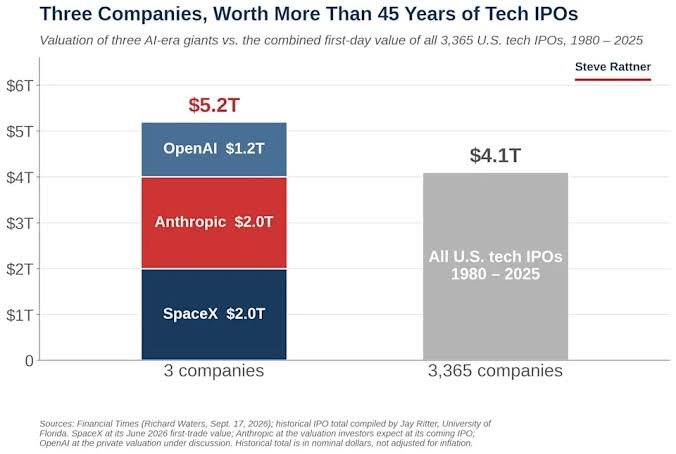
The AI bubble is so bonkers that the IPOs of Anthropic, OpenAI, and SpaceX are estimated to be worth $5.2 trillion, which is more than 45 years of past tech IPOs COMBINED, including the IPOs of Google, Microsoft, Amazon, Facebook, etc.
🚨 OPENAI MISSED THE STREET’S REVENUE EXPECTATIONS BY $20B.
That could spell trouble for these 5 AI stocks: 🧵👇
1. $ORCL — ORACLE ☁️
Huge OpenAI exposure. A large portion of Oracle’s massive backlog is tied to OpenAI.
Evidence of how leveraged the entire tech sector is to OpenAI & Anthropic: an FT story about OpenAI's revenue's being less than initially reported is spurring a more than 5% drop in Oracle shares, exacerbating losses from Nvidia and AMD to Microsoft https://t.co/8rhQ9dvxXM.
I’ve had countless people on this app argue with me that Anthropic has a $65BN ARR.
Here’s a quick lesson on the discrepancy between venture capital power point math and real accounting math.
OPEN AI IS MINUS $20BN AND THEY ARE NOT YET PCOAB AUDITED.
Privately, I made a bet with several people on this app, payable in pushups, that Anthropic would see a $20BN revenue write down. Remember the difference, OpenAI is not PC audited (yet) and Anthropic is, their 2026 numbers won’t be reported until April-ish in 2027.
The fact that Open AI voluntarily abandoned fake venture math power point accounting for some real accounting means they are getting ahead of it and Sam Altman is an operator. This is bite one. A PC audit will drive them down further. Maybe as much as $10BN more.
No, Oracle and NVIDIA coupons are not revenue. No, they are not arms length transactions.
Where Anthropic reports $65BN run rate for 2026, I expect it to be $45BN or less. If I’m right, the other guys do 100 pushups. If I’m wrong, I do 100 pushups.
There’s also something important to learn about companies spending at Anthropic - a lot of this is one time CAPEX. Reports have come out about how Facebook and Microsoft used Claude to build their product (in essence, vibe coding), but now the competing products are built and the spend is getting pulled. That’s either a one time CAPEX or an R&D expense.
Don’t get me wrong, Anthropic has built incredible technology, so good that their competition uses it.
No one that relies on Anthropic will direct the same level of spend towards them in the future. Use Anthropic to build your tech, then pivot to a lower cost open source model to run the technology.
I know multiple founders that are getting $20k /month in value from Anthropic for $1k/month, subsidized by Anthropic investors. They are racing to build their product before Anthropic hikes prices.
Do you think they are ever coming back as customers once their product is built and they have to pay $20k / month? Not a chance.
So where does this all land? Anthropic will have a large IPO (not $2TN) and will be the premier frontier AI model.
The market will have to adjust their pricing on the stock to account for a significant portion of Anthropic’s revenue to be one time spend in lieu of ARR.
Open AI will watch carefully and fix what they can ahead of their own IPO.
Debt providers and long term contract holders of the AI data centers will have to restructure because they can’t afford for either company to fail.
For me to buy the Anthropic stock directly, I’m going to need to see that 2026 PCAOB audit first.
Frontier models will be unprofitable for a long-long time.
The only people that turn a profit in this whole thing are the contractors and developers who built the data centers.
H/t: @RobertMSterling