If publishers are willing to consider leaving the world's largest search engine, informal content sourcing arrangements are no longer a safe bet for any AI platform.
Google's own struggle illustrates the point. Tying AI training access to Search visibility created enough distrust that Cloudflare escalated the issue and a major regulator intervened.
Even with a new opt-out mechanism in place, publisher skepticism remains high because the underlying relationship was never built on transparency in the first place.
For platforms sourcing content for AI products, the takeaway is structural. Trust, once broken at this scale, is expensive and slow to rebuild.
Platforms that establish transparent, documented, licensed sourcing relationships now are avoiding the exact confrontation Google is currently navigating in public.
https://t.co/m2fUIBXQuM
Pope Leo XIV's first encyclical, Magnifica Humanitas, echoes Leo XIII's 1891 Rerum Novarum, applying its worker dignity framework to the AI age.
The Pope warns AI lacks moral conscience, lived experience, and genuine accountability for consequences.
His deeper concern: sycophantic AI could erode people's desire for genuine human connection. He calls for robust legal frameworks, independent oversight, and developer accountability rather than abstract ethical invocations alone.
https://t.co/l0jmASSRtg
Getty spent years fighting AI in court. Then it licensed to OpenAI.
The lesson for publishers: litigation is slow and uncertain.
Licensing is how content value turns into revenue.
Newstex President Michael Ellis weighs in @TVNewsCheck https://t.co/LEczBO7zN2
Platforms licensing content at scale face a growing quality challenge as AI-generated material floods pipelines.
The key tell: AI content describes rather than analyzes, offering regurgitated facts instead of synthesis professional audiences need. Newstex's editorial team, led by Content Partnerships Manager Maria Llamas, applies consistency, authority, relevance, and depth criteria regardless of production method.
Transparency about AI use has become a qualification signal distinguishing trustworthy publishers from opaque ones.
Read the full story on our blog and learn how Newstex delivers licensed news curation services to platforms seeking variety and originality while helping publishers expand their reach.
https://t.co/uNKj0umckf
The fastest-growing segment of AI content licensing is not training. It is live access.
The June 2026 deal tracker from Media and the Machine maps the shift clearly. Agreements structured around ongoing content access and attribution grew from nearly zero in 2023 to a projected 34 in 2026.
Total deal volume is also accelerating, with 36 agreements projected this year. The growth is concentrated in live-access arrangements, not training.
The infrastructure requirements are fundamentally different. Training needed archives.
Live-access needs structured feeds, real-time delivery, clean metadata, and consistent taxonomy. Publishers who built for one are not automatically ready for the other.
The ones who recognize that distinction and invest accordingly are participating in the fastest-growing segment of the market.
The ones who do not are watching it form without them.
Platforms need provenance. Publishers need reach. Newstex delivers both.
https://t.co/G95hB3MKtG
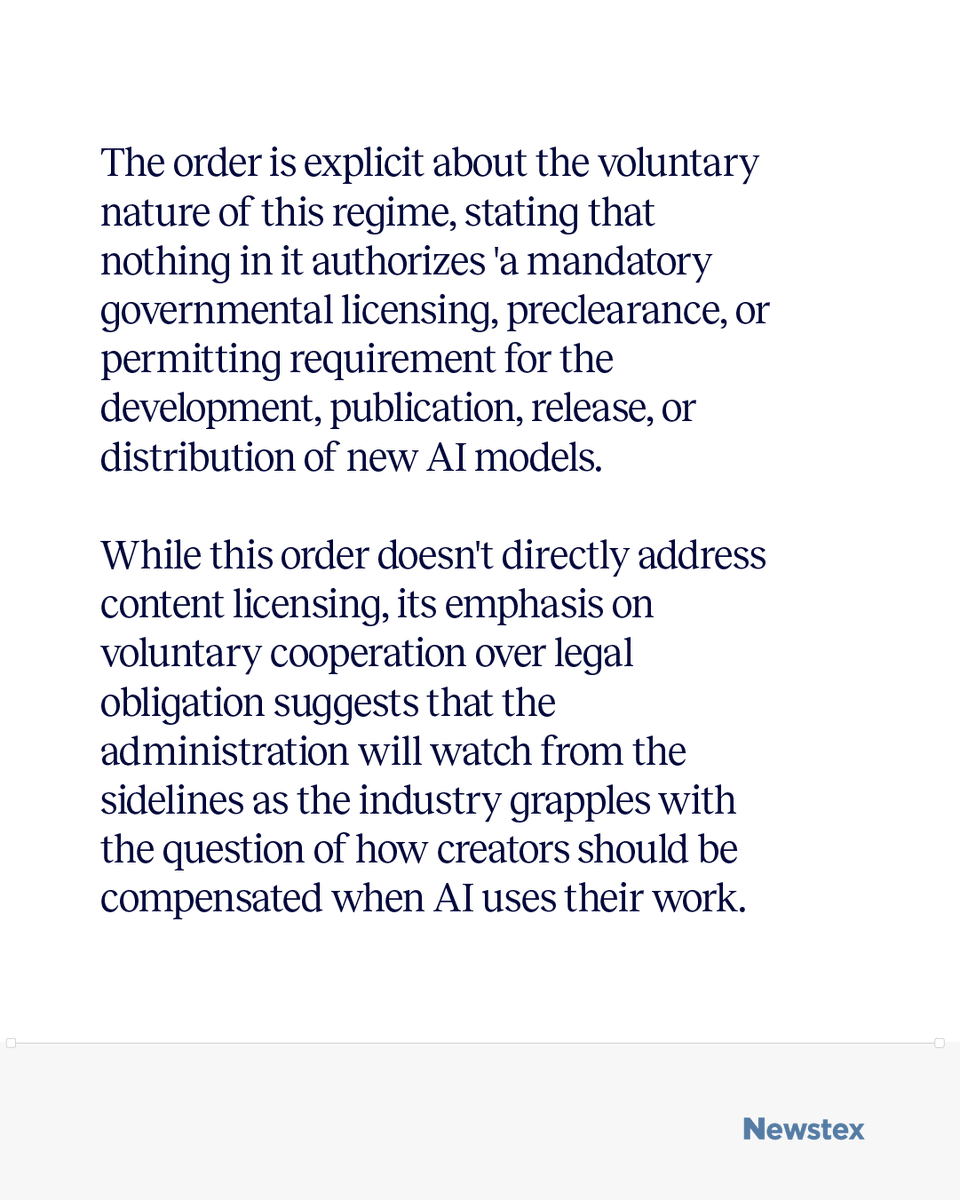
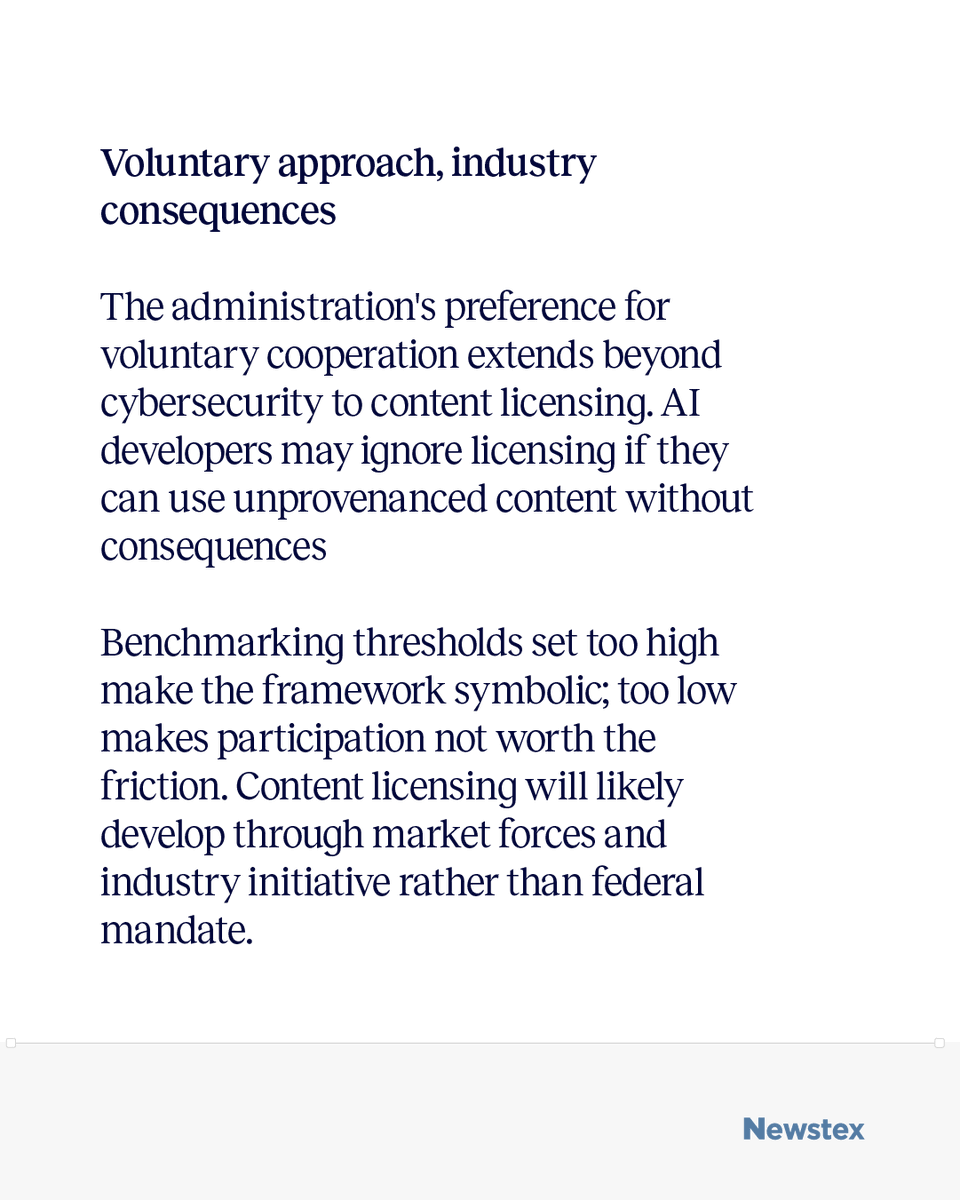
Frontier AI models can now autonomously exploit hidden software vulnerabilities, yet Trump's June 2026 executive order establishes only voluntary cybersecurity review with a 30-day pre-release window.
The order explicitly rules out mandatory licensing for AI development. Content licensing implications are indirect but significant: voluntary cooperation over legal obligation means publishers cannot rely on federal mandates for compensation. Licensing frameworks will succeed or fail based on industry adoption and market pressure alone.
Read the full analysis on our blog and learn how Newstex delivers licensed news curation services to platforms seeking variety and originality while helping publishers expand their reach.
https://t.co/laq4Q87YW4
The third-party scraper economy is a $1 billion industry where publishers receive nothing. Roughly 30% of AI bot scrapes violate explicit http://robots.txt directives, making defensive measures alone ineffective.
Scrapers take 100% of content value and sometimes build competing products with it. Structured content licensing addresses revenue loss, legal risk, and AI output quality simultaneously. AI companies paid an estimated $2.9 billion in licensing fees as of 2025.
Read the analysis on our blog and learn how Newstex delivers licensed news and commentary curation services to platforms seeking variety and originality while helping publishers expand their reach.
https://t.co/OJY42Aewon
@Rahul Kapai Great point, Rahul, this ruling really does shift AI outputs from “neutral” aggregation to owned editorial claims.
Source citations and access to the provenance of AI-generated answers may very well one day become the norm, which is exactly why we offer on licensed, attributable editorial sources to developers who want to use high-quality inputs from the start.
A European court just decided that when AI gets it wrong, the platform is responsible.
On May 28, 2026, the Regional Court of Munich held Google directly liable for false statements in its AI Overviews, ruling that AI-generated summaries are Google's own published content rather than neutral search results.
The decision stripped away the safe harbor protection search engines have relied on for three decades. Google is appealing, and the ruling is currently limited to Germany.
But the reasoning matters beyond this one case. If synthesized AI answers count as publishing, the accuracy and provenance of the underlying sources carry direct legal weight.
That reframes content licensing entirely. Licensed, documented, attributable content stops being just a quality decision and becomes a liability management strategy.
As the EU AI Act and Product Liability Directive take effect later this year, platforms relying on scraped, unverifiable sources are accumulating exposure that structured licensing is designed to reduce.
https://t.co/1r9JjcdgKf
AI content licensing conversations tend to focus on big publishers and high-profile lawsuits.
Behind the headlines, copyright organizations like the Copyright Clearance Center, Copyright Licensing Agency, and Press Database and Licensing Network standardize licensing practices nationally and align them internationally.
Smaller niche publishers are often left out of these conversations despite producing valuable content. Licensing becomes win-win when AI developers gain quality material and publishers receive fair compensation.
Read the full analysis on our blog and learn how Newstex delivers licensed news curation services to platforms seeking variety and originality while helping publishers expand their reach.
https://t.co/wITs4wl6Mu
AI systems are reading content without sending traffic back. That makes compensation, IP control, and content structure more important than ever.
WAN-IFRA points to an emerging AI content market that rewards niche expertise.
On our blog, we explain how Newstex helps publishers expand reach and revenue through licensed, rights-cleared content: https://t.co/Zs8RjKUmiw
Next week, Newstex President Michael Ellis will attend PDLN in Amsterdam, where copyright organizations will discuss content licensing for AI.
Newstex joins as an observing member to help represent smaller and niche publishers in these conversations.
Learn more: https://t.co/1gS4jUSyOI
Enterprise RAG is opening a content licensing channel that did not exist a year ago.
Snowflake's Cortex Knowledge Extensions let enterprise customers query licensed publisher content inside a secure AI environment using RAG. 17 publishers have signed on, including The Washington Post, AP, and People Inc.
Six-figure deals are already closing with financial institutions. And Snowflake takes no revenue share, making it infrastructure rather than another middleman.
The structural significance is that enterprise demand is emerging as a parallel market to the bilateral deals and platform marketplaces dominating coverage.
Financial services, regulatory monitoring, and corporate intelligence teams are the early adopters, and none of them were part of the original AI licensing conversation. Publishers positioned for this market are building a new revenue line.
Those who have not noticed it yet are missing the opportunity forming underneath the headlines.
https://t.co/Y1TL34KEqb
A new CJL report maps the AI content licensing market and finds it repeating social media era mistakes.
Bilateral deals dominate, Big Tech builds the intermediary layer, and most publishers receive no compensation at all.
Three structural reforms can level the playing field: transparency in how content is used, model-level attribution enabling fair compensation, and collective licensing giving independent publishers a seat at the table.
https://t.co/cTioCFRWtv
AI content licensing is maturing fast enough that platform behavior is now a measurable factor in deal decisions.
The Digiday Scorecard makes that explicit by ranking Microsoft, OpenAI, Amazon, Google, Meta, and Anthropic on pay structure, attribution, transparency, usage data sharing, and engagement with publishers.
The rankings are a useful early version of the evaluation frameworks the licensing market is starting to formalize. The platforms scoring highest today are setting standards the rest of the industry will eventually have to meet.
Publishers paying attention now are positioning for a market where platform behavior, not just platform scale, drives licensing decisions.
Read more:
https://t.co/fk5Ppa7xoT
Ninety percent accuracy sounds impressive until you realize Google processes five trillion searches a year.
That's tens of millions of wrong answers every hour. More than half cite sources that don't even support the claims.
And Google has world-class models. If they can't get it right with scraped web content, what makes anyone think their platform will?
The fix isn't better models. It's better sources.
Read the full story:
https://t.co/Ifqm9NvScM
Well said! Those infrastructure advantages compound over time, especially as AI teams face closer scrutiny on provenance and rights. That is why we focus on rights-cleared, traceable content from vetted publishers, so platforms can scale safely as governance matures.
For AI platforms, sourcing content from publishers with strong bot identification infrastructure has compounding advantages. The content is cleaner, the access rules are clearer, and the compliance posture is more defensible.
Those qualities matter more as governance frameworks tighten and regulatory scrutiny grows.
Bot-aware publishers are not just easier to license from. They are easier to defend sourcing decisions from.
Platforms need provenance. Publishers need control. Newstex sits at that intersection.
https://t.co/LdBwqookZr
Content licensing infrastructure for retrieval and citation becomes essential for trustworthy agentic AI deployment. Chatbot hallucinations get caught on the way out.
Agentic AI hallucinations may not surface until they've shaped compliance recommendations or procurement decisions. AI shifts from instruction-based to intent-based computing, multiplying decisions between human checkpoints.
Training rights and grounding rights diverge as licensing moves toward pay-per-use retrieval models valuing specialized publishers as strategic partners.
The shift from training to grounding is one of the more significant transitions happening in content licensing right now, and it is happening quietly.
Publishers focused entirely on the headline-friendly training deals are missing where the recurring revenue is being built.
Platforms still optimizing for training-first sourcing are missing where the next generation of AI answer quality is being decided.
The ecosystem is moving toward grounding, and the participants building infrastructure for it now will define how it works.
https://t.co/6te5R8fxat