Introducing Claude Fable 5: a Mythos-class model that we’ve made safe for general use.
Its capabilities exceed those of any model we’ve ever made generally available.
Our internal data shows Claude is accelerating AI development—a possible path to recursive self-improvement, or AI autonomously building a more capable successor.
It’s happening faster than we thought, and the implications deserve greater attention. https://t.co/OVVPJO7VQx
Head of Claude Code: "agents don't fail because they're dumb, they fail because you're vague"
these 11 minutes explain what most people using AI are getting wrong without knowing it
the distance between an idea and a working product is collapsing
Spotify proved it with one background agent merging 1,000+ PRs a month and cutting migration time by 90%
most people use AI for small tasks and wonder why nothing changes
the real power is when the model becomes part of your planning, execution, and review
model capabilities are growing on an exponential while adoption is still linear
his advice is to write the routine, describe the outcome, and then let it cook
stop prompting back and forth and let Claude prompt itself
understanding this is step one
knowing which Claude features actually let you build those systems is step two
the article below covers everything most people have never found
The courtroom scene in the finale of Margot’s Got Money Trouble was amazingly good. As a payoff having watched the rest of the series it was perfect, so well done.
The teams seeing the biggest wins from AI are completely changing how they work, not speeding up what they already do. What steps can you delete, what handoffs go away, what can an agent just own end to end. Great to see Salesforce go this deep. Shoutout to Srini, @Benioff & team.
Full writeup: https://t.co/3Rbdj9K8YN
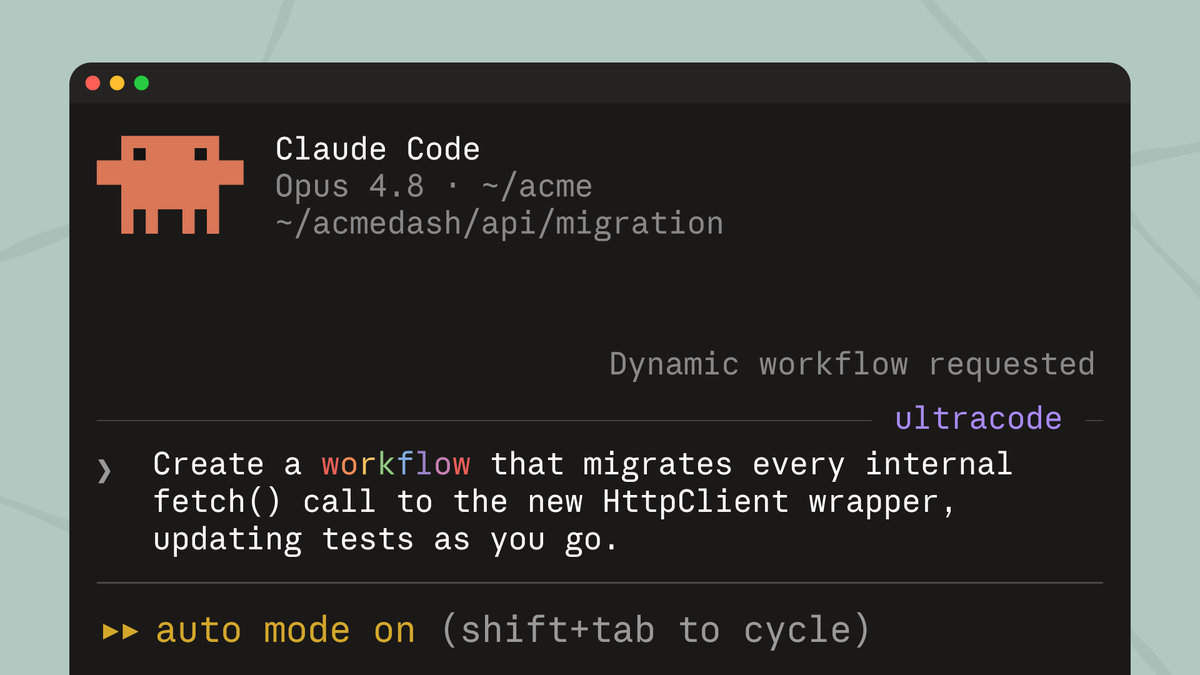
New in Claude Code (research preview): dynamic workflows.
Claude writes an orchestration script on the fly, then spins up a large fleet of coordinated subagents in parallel to take on your most complex tasks.
Use the word "workflow" in a prompt to get started.
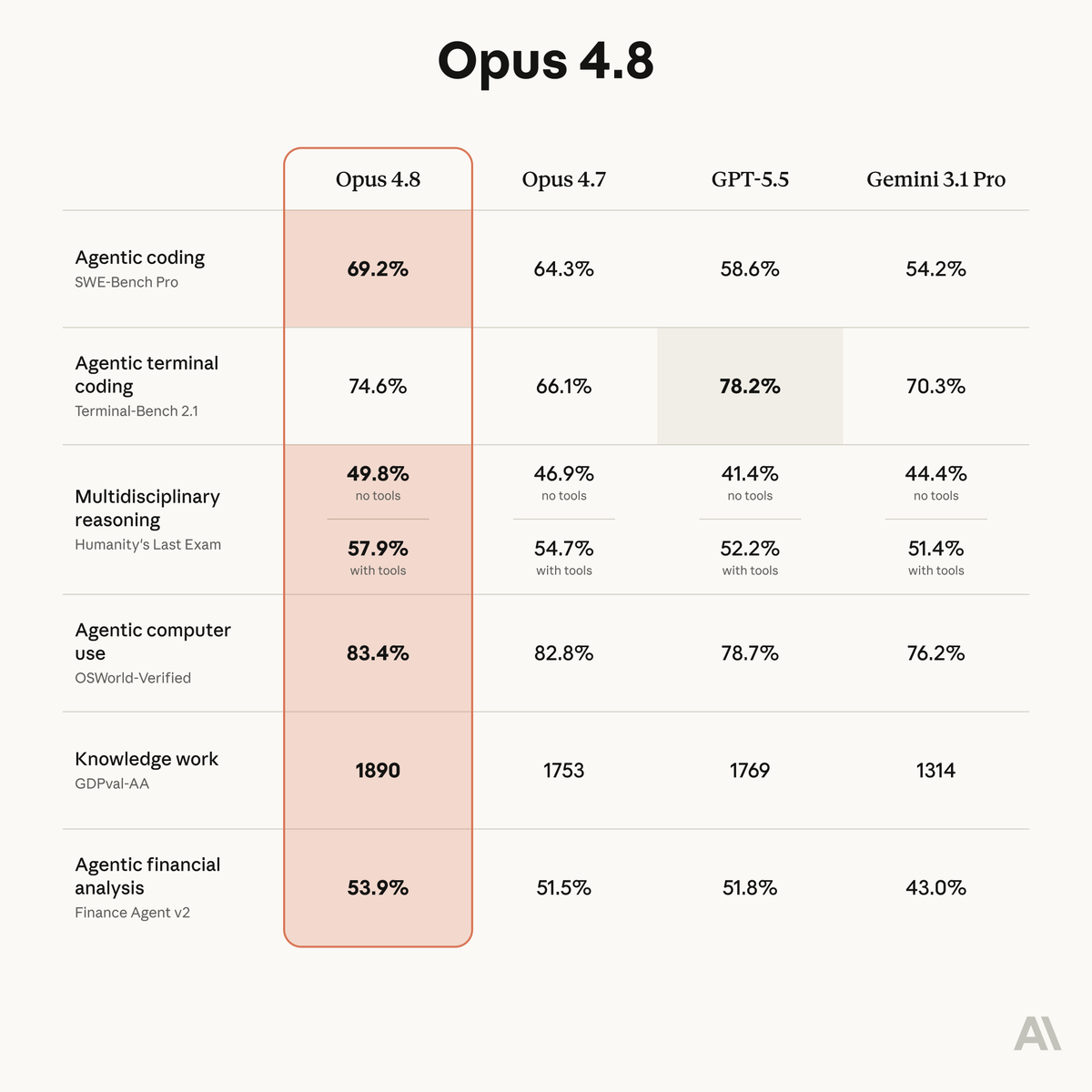
Introducing Claude Opus 4.8: it builds on Opus 4.7 with sharper judgment, more honesty about its own progress, and the ability to work independently for longer than its predecessors.
Available today at the same price.
Token costs will become a dominant topic in enterprises going forward with AI. Just got out of a dinner with many Fortune 500 enterprise CIOs and this was the most heated topic.
A mix of strategies are being employed, but basically no one feels like they have the right solution. A mix of: figuring out how to prioritize workloads to different models, giving out access to better or worse agents by user type, setting different spend caps by team, having teams justify AI by their use-case, and some just having unfettered access.
Everyone is trying to figure out a semi/predictable model right now in a world where the underlying tech and cost models are constantly evolving.
Introducing OpenAI Guaranteed Capacity: a new offering that enables customers to guarantee long-term access to OpenAI compute.
We’ve made long-term investments in infrastructure, partnerships, and capacity planning to help customers scale reliably.
Now, Guaranteed Capacity helps customers plan ahead for critical workloads in a compute-constrained world.
https://t.co/TN4OkZr2Uo
“They wrote plan.md. Now have the agent misinterpret half the tasks. Good. Have it burn tokens implementing the wrong thing. Now have it pass the tests anyway.
They’re testing it. Figuring out they built the wrong thing. More tokens refactoring. Nice.
But now there’s an undefined state they totally missed. Their users won’t.
Cancelations coming in better than expected.
Let them spend two weeks figuring out requirements analysis would have caught all of this.”
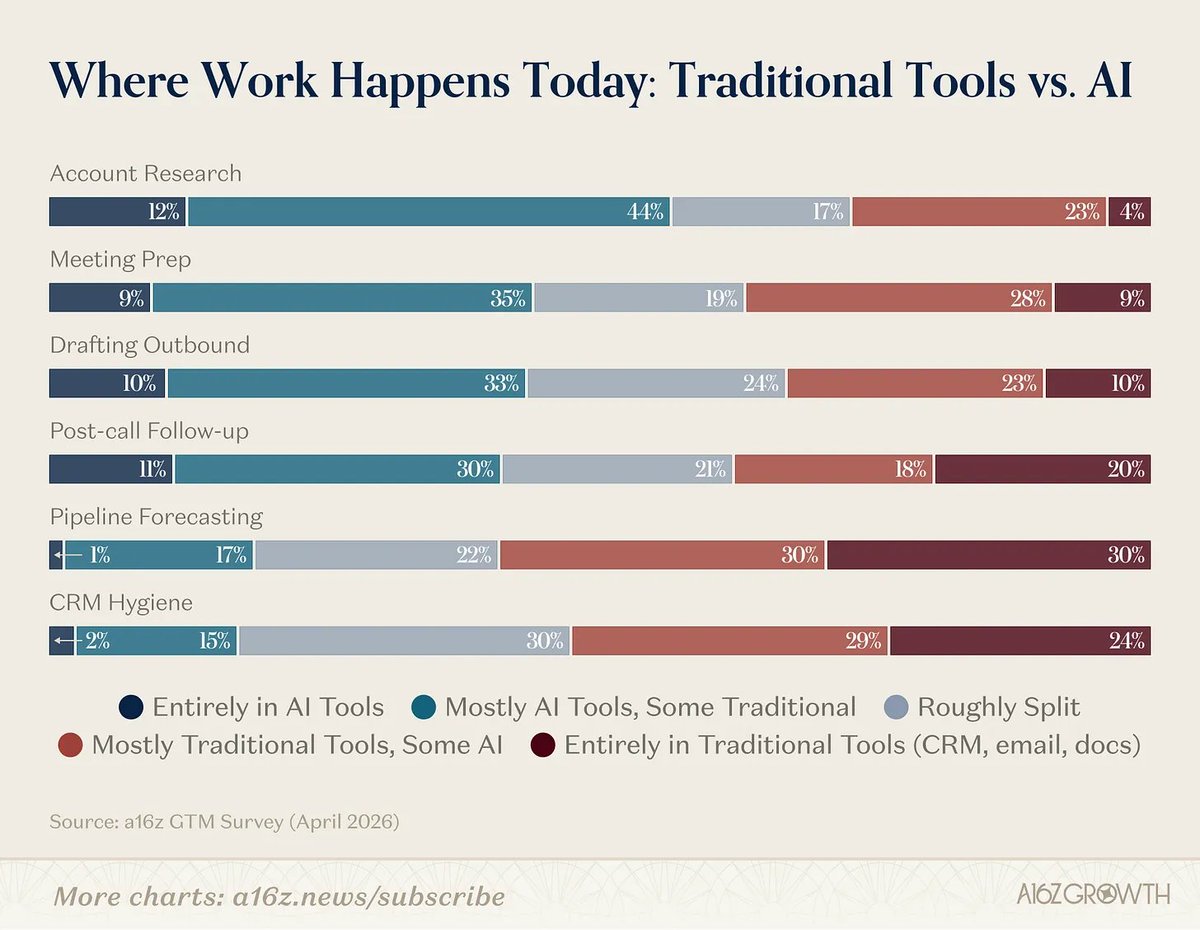
From "System of Record" to "System of Intelligence"
In the next decade, you want to own the system of intelligence that pulls from the system of record, becomes the user’s one-stop shop for gaining context and taking action, and turns the SoR into something that’s primarily consumed at the API layer.
The reasoning layer that sits above the database is where a new generation of companies is being built, and it’s where the majority of the next decade’s enterprise value of GTM software will end up.
Full piece from a16z's Gio Ahern, Steph Zhang, and Alex Immerman: https://t.co/2udG6l6SSx
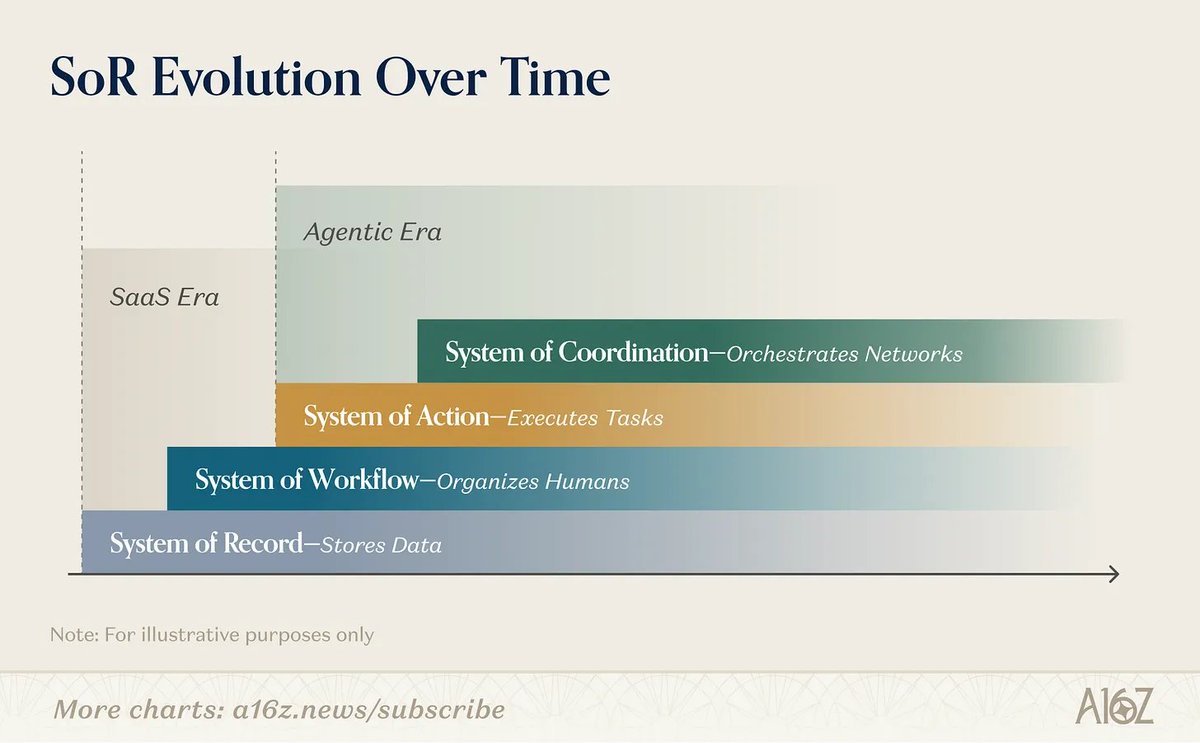
As system of record incumbents shift to headless agents, they are making an implicit bet that the data layer will remain the source of value.
Startups will compete on a new set of factors, like proprietary data, owning the action layer, real-world execution, and selling to technical buyers.
The next generation of systems of record is already starting to look agentic such that they capture the context, initiate the work, and record the data exhaust.
Full piece from a16z's Seema Amble: https://t.co/8hOj26bPuf
Introducing Googlebook, the first laptop designed for Gemini Intelligence. It’s crafted for heavyweight performance, built with Gemini at the core and perfectly synced with your Android phone. Coming this fall. 💻✨
#TheAndroidShow
Forward deployed engineers, or equivalent, are about to become one of the most in-demand jobs in tech. And one of the most important functions for AI rollouts.
Deploying agents is far more technical of a task than most people realize, often far more involved than deploying software. Software generally works the same way every time, and generally for the past few decades has been updated versions of an existing technology or concept (which basically means easier for the enterprise to update their workflows on a newer system).
With agents, you’re actually deploying the equivalent of work output within the enterprise. The customer is effectively using you as a professional services provider for a task, which they expect to get solved nearly end-to-end now. This means you need to actually deeply understand the business process as a vendor, and get the customer from the current to the end state seamlessly.
Companies need help figuring out which models will work best for their workflows, they need extensive evals setup often, they need change management support for workflows, they need to get their data setup for the agents, and constant tuning of the agentic system for their process.
Massive role in tech now. And another example of the kind of highly technical work that AI is creating.
The Claude Platform on AWS is now generally available.
AWS customers get the full set of Claude API features, with AWS authentication, billing, and commitment retirement.
Introducing the OpenAI Deployment Company, which will help businesses maximally succeed with their deployments of AI.
Starting with 150 Forward Deployed Engineers and Deployment Specialists, and $4 billion of initial investment from 19 partners.
We’ve also agreed to acquire Tomoro, which will bring 150 experienced Forward Deployed Engineers and Deployment Specialists to the OpenAI Deployment Company from day one.
Today we’re launching the OpenAI Deployment Company to help businesses build and deploy AI.
It's majority-owned and controlled by OpenAI. It brings together 19 leading investment firms, consultancies, and system integrators to help organizations deploy frontier AI to production for business impact. https://t.co/GnyjGFaLLA