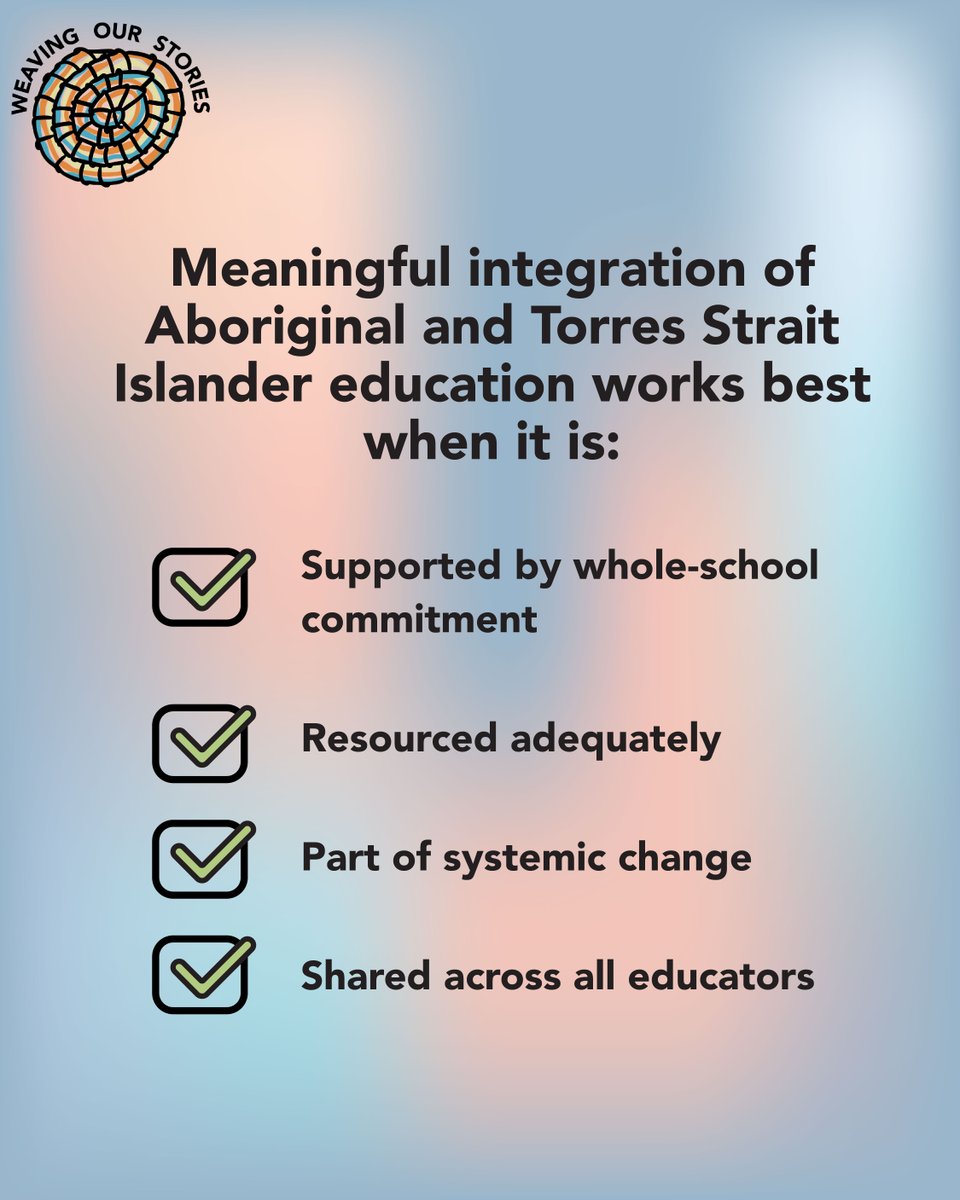
Protecting Indigenous Cultural Intellectual Property is an essential aspect of safeguarding Aboriginal and Torres Strait Islander Knowledges. Ngarrngga collaborated with Terri Janke & Co to develop a framework to guide and inform our work as a program: https://t.co/euXFdniePr
Curriculum can be a critical site for transmission, helping sustain and revitalise languages for future generations. In this position paper, we explore the importance of safeguarding Indigenous languages and knowledge systems and education’s role: https://t.co/31uQqwok6m
Last week, Ngarrngga team members, Glen Hayres and Dr Lucy Buzacott attended the @TeachforAu Expo. It was wonderful to meet the future generation of secondary educators and share about the work of Ngarrngga.
Prepare for #scienceweek by attending ‘Where to from here? Science and Sustainability’! This panel (Professor McKenzie, Professor Sambono & A/Prof Hamacher) will discuss how Indigenous Knowledges can strengthen scientific practice and stewardship: https://t.co/HhkQY1NofP
We’re calling it “colonial load” to name the root cause.
Shifting the language moves the focus to systems and colleagues who can help reduce the burden, not to culture itself. Reflect and educate yourself further by reading our latest position paper: https://t.co/idP52xHZwN
To reduce the burden of Colonial Load, Educators must engage in ongoing reflexive practice supported by professional development & access to reliable resources. This isn't about individual teachers carrying the load - it's about institutional investment: https://t.co/fGPPFWdEdj
In ‘The Comfort of Method’, Professor Anderson highlights that without funded and systemic strategies, the Colonial Load on Indigenous staff members in education only increases. Institutions, including schools and universities need to be held accountable: https://t.co/LtQUKOmbx6
Professor Bunda speaks with Professor Hogarth about how non-Indigenous people need to do their research; to ensure their engagement with community is mutually beneficial. Learn more about Rethinking Reliance on Communities in our latest position paper: https://t.co/fGPPFWdEdj
Colonial Load refers to the expectations & additional workload undertaken by Indigenous people to guide or help non-Indigenous people in the workplace. We explore how educators can alleviate this load through developing their own cultural responsiveness: https://t.co/fGPPFWdEdj
Systematic pressures can roadblock even the most passionate educators when it comes to integrating Indigenous perspectives in the classroom. Dr Rachel Pollitt reflects on these challenges and how best to navigate them in our latest blog article: https://t.co/ear9dKeuL5
Dr Matthew Keynes reflects on Ngarrngga's position paper, Navigating Uncertainty and Fear, and shares his journey to Sápmi in our latest blog article: https://t.co/QcsS1ZcPFN #WeavingourStories
Ngarrngga is seeking educators nation-wide to participate in our Flexible Curriculum Trial across Terms 3 & 4. Expressions of interest close 1 July 2026, submit here: https://t.co/LtfM9g1iXi. Find out more information here: https://t.co/ajzktvOREV
If you are an educator interested in learning more about how you can appropriately showcase Indigenous Knowledges within the curriculum and promote reconciliation, discover Ngarrngga’s professional development offerings: https://t.co/4DLssYFxSM
Our latest position paper, Navigating Uncertainty and Fear, explores the apprehensions that educators face when including Aboriginal and Torres Strait Islander perspectives in their teaching and how these can be overcome with adequate support: https://t.co/4DLssYFxSM #NRW2026
In Ngarrngga’s latest position paper, Navigating Uncertainty and Fear, we unpack how training, access to high quality resources and ongoing support can help educators navigate these fears and successfully meet the professional standards in their practice: https://t.co/yByKmuWAzH
Shelley Faulds reflects on Melbourne Grammar Grimwade House’s journey into improving inclusion of Indigenous Knowledges into the school’s pedagogy and practice, and how they embraced the challenges and opportunities presented along the way. https://t.co/Pg2iAAB6Id
Educator Leah Avene speaks with Professor Melitta Hogarth and Dr Tiriki Onus about how educators need to recognise their own cultural positioning in the classroom. This self-awareness is key to reconciling the cultural gap, outlined in our position paper: https://t.co/2pd1bmsBLx
Professor Hogarth, Dr Doolah and Dr Wilkey examine how a paradigmatic shift that recognises the complexity of Indigenous Knowledges in education can support reconciliation and enrich learning for all students in their chapter: https://t.co/QM2dj66jGV.
Much like seedlings, students thrive when conditions are right. Without adequate teacher training and resourcing, educators may inadvertently narrow everyone’s education. Centering Indigenous Knowledges is essential for all students to flourish. Read now: https://t.co/2pd1bmsBLx
We are seeking Victorian Government primary schools in regional, rural and outer-metro areas to participate in a program combining professional development and curriculum resource trials in terms 2-4. Learn more & apply here: https://t.co/KQvAlTOe7C