Congratulations to Luis Nagua (@ngluchofer) for defending his PhD Thesis “Design, modeling and implementation of a soft robotic neck for humanoid robots” 👏👏👏@uc3mRoboticsLab@uc3m@EPS_UC3M @ciencia_uc3m @uc3m
BREAKING: First-Ever Full Tour of Figure's Humanoid HQ
CEO Brett Adcock
Exclusive look through every department on their San Jose campus:
BotQ Factory, Testing, Design, Demos & more.
Brett walks us through how Figure is built:
- System integration lab: where robots are stress-tested with software faults & physical pushes
- Helix AI: team floor where the controls & neural network engineers train the vision-language-action model that runs onboard every Figure robot
- Reinforcement learning & stability testing: where Figure demos the Vulcan project — surviving a lost knee mid-task
- Home: environment where Figure 03 autonomously tidies a living room using their Helix neural network (no teleoperation)
- BotQ: manufacturing facility where heads, batteries, and limbs come together on the assembly line, including the custom-built battery line & end-of-line burn-in bays
- Industrial design studio: (opened publicly for the first time) housing every generation of Figure robot ever built, including: Figure 01 with its Frankenstein forearms, Figure 02, & the sleek Figure 03 that recently appeared at the White House, plus the evolution of Figure's hands & feet
Brett shares why he believes humanoid robots may achieve AGI before any other form factor, why Figure pivoted entirely from hand-coded controls to neural networks, & teases that Figure 04 will be their "iPhone 1 moment."
This was so much fun!
Big thank you to Brett & the team at Figure for opening the doors for us!
@adcock_brett@Figure_robot
𝐓𝐈𝐌𝐄𝐒𝐓𝐀𝐌𝐏𝐒
(00:00) Inside Figure’s Humanoid Campus
(00:48) The humanoid factory
(03:18) First humanoid guest at the White House
(05:29) Controlling a robot with infinite movements
(10:46) The truth about robot failures
(13:00) Attacking a humanoid robot (testing responses)
(16:12) Building a general purpose robot
(23:05) The "Never Fall" protocol
(28:56) Is the home robot teleoperated?
(33:36) Leasing a 24/7 robot
(35:01) Can a humanoid build a real car?
(43:32) From flying robots to humanoids
(45:59) The hidden path to physical AGI
(56:21) Figure's secret design studio
(01:00:44) Figure 4: The biggest leap in robotics
(01:06:25) Training robots in spandex
(01:10:26) Westworld, TIME Magazine, & Deadmau5
ROSClaw Integration Update
Read the text in the video carefully
⊙ Robot is present both physically can in Nvidia Isaac Sim simulation.
⊙ The agent’s initial goal set to explore any object it finds in its spatial view.
⊙ Think of it as if the physical robot is seeing through the simulation.
⊙ ROSClaw vision uses Gemini Live for spatial narration
⊙ An object (a playground slide) is identified and the ROSClaw (OpenClaw) agent takes over.
⊙ The agent initiates action. Attempts to walk towards object.
⊙ None of it is pre-planned. The agent (robot) is acting on its own
Adrian Barnett, profesor de estadística y meta-investigación en la Queensland University of Technology (Australia), dice que va a reducir a la mitad el número de artículos que va a publicar al año. Dice que si los científicos no reducen el ritmo, la investigación científica se va a estrellar.
“Estoy realizando este cambio porque creo que el sistema de publicación actual es un tren descontrolado que se dirige hacia el desastre. El número de publicaciones se está disparando, con más de 1,7 millones de artículos indexados en la base de datos PubMed para 2024, en comparación con los aproximadamente 1,2 millones de 2014. Esta inflación fue descrita recientemente como «insostenible» por Cambridge University Press, Reino Unido, que pidió un «cambio radical». El auge de las cifras está sometiendo al sistema de publicación a una enorme presión, y ahora es imposible para los científicos leer detenidamente y revisar por pares la literatura. Sin un escrutinio adecuado, la calidad general de la investigación parece estar degradándose, con una reciente explosión del número de artículos de baja calidad que superan la revisión por pares”.
https://t.co/bf86xIhGcE
En 1942, en un pequeño taller de Santiago, dos hermanos gallegos lograron lo imposible: superar la tecnología de Philips. Cuando el gigante holandés vino con un cheque en blanco para comprar su invento, ellos dieron una respuesta que nadie esperaba: NO. Tira del hilo 🧵👇🏽👇🏽👇🏽
🔵 #Televistazo ▪️🗣️ #Ecuador despide al doctor Rodrigo Borja Cevallos, expresidente de la República, intelectual y uno de los artífices de la democracia moderna. Fallecido ayer, a los 90 años, Borja deja un legado que trasciende el poder: desde su rol pivotal en el retorno democrático de 1979 hasta la fundación de la Izquierda Democrática, que se apagó con su retiro. Rodrigo Borja, autor de la monumental Enciclopedia de la política, fue un faro de humanismo en tiempos turbulentos. En tiempos de crisis institucional, su partida es también una invitación a reflexionar sobre los cimientos de la democracia que él fortaleció.
@LeninArtieda con el reporte 🎙️
Más información 📲 https://t.co/PgjOzH7SSk
Enemigo del teleprompter. El recién fallecido ex presidente Rodrigo Borja decía que rechazaba usar este aparato para leer sus discursos, porque hace parecer inteligente hasta al político más tonto.
From rugged terrain to soft fabrics, this droid handles it all. 🤖
With Newton, the open-source physics simulation engine co-developed by @GoogleDeepMind and Disney Research, Walt Disney Imagineering, robots can move through shifting sand or gravel and manipulate delicate materials with greater precision than ever before.
Learn how Newton is advancing robot learning and shaping the next generation of robotic systems.
Watch it in action with Disney’s BDX Droid: https://t.co/2IMMo0Ns4U
#NVIDIAGTC
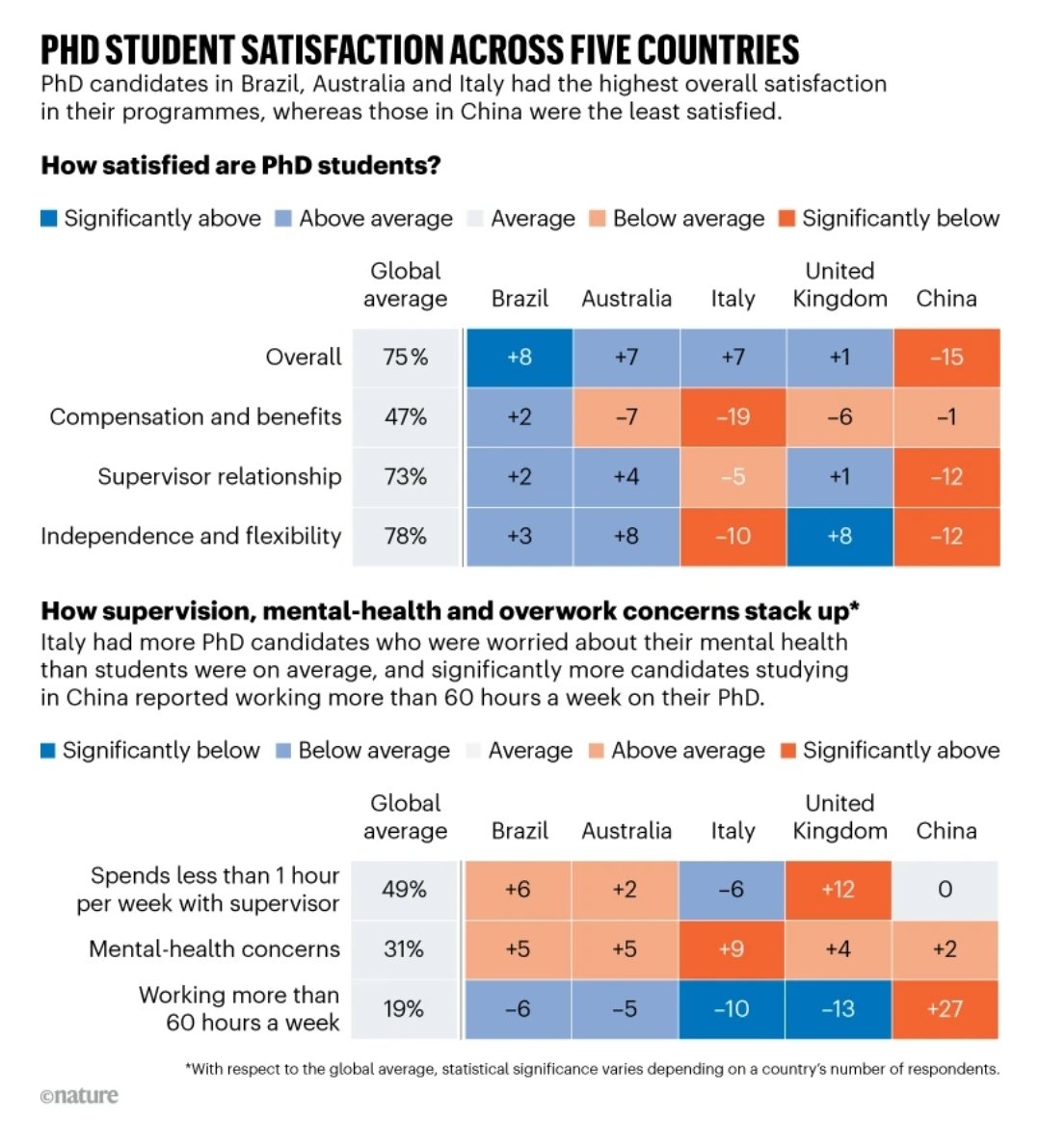
This article in @Nature reinforced my long-held belief that when it comes to supervising PhD students, we in India need to deviate from our traditional approach to education and knowledge transfer. Supervising is not teaching. PhD students need to be treated as colleagues and intellectually independent, else their professional growth will remain incomplete.
In 1992 Peter Ratcliffe received this rejection letter from Nature.
His findings were not "a sufficient advance in our understanding".
27 years later he won the Nobel Prize for the same discovery.
Don't lose faith in the things you believe in.
CEO's question: What will be the hourly cost of work of a humanoid robot?
Several projections have been published, e.g. by @CernBasher, @adam_dorr and @GoingBallistic5. Here's my take.
I've produced a long-form video on this question (see link in comments).
Here is the essence - based on very conservative assumptions (see attached image).
- Production cost: $30,000. A humanoid is ~5% the mass of a passenger car. The costly parts are actuators and gearboxes; the rest is electronics, sensors, a few kWh of batteries, and plastics—components that are highly scalable in volume manufacturing.
- Operating cost: $30,000 per year, of which $18,000 is human oversight and coordination. This is likely way too high.
- Operating time: 6,600 hours per year (330 days × 20 hours/day). That equals the yearly working time of more than three people.
- Work speed vs. humans: 100% initially. As with industrial robots, later generations will likely reach 200%+.
- Business model: Most manufacturers will offer Robot-as-a-Service (RaaS) rather than selling units, because it drives far higher revenue and margin. Expect an initial one-time fee roughly equal to manufacturing cost plus a usage fee per year, month, day, or hour.
- Service life (incl. repairs): 8 years.
- Market dynamics: Because humanoids will be highly profitable to use (see below), demand will ramp quickly. But many suppliers will enter, so sustained overly high monopoly pricing is unlikely.
Result: Based on these assumptions, a humanoid work hour will cost at most $14.
That’s the highest realistic value. With learning effects and scale, the hourly cost will drop below $10 and likely below $5. @rethink_x even projects that by 2035 a humanoid hour could cost less than $1.
By comparison, a skilled worker’s fully loaded hour is $42.53.
Strategic consequence: In competitive markets, companies will have no real choice: first to replace labor shortages, and soon to replace existing roles. Even at $14/hour, the financial advantage vs. human labor is close to $200,000 per robot per year.
I’ve published a three-part video series on the societal implications of this inevitable shift (see comments).
Urgent advice: If you make or move anything physical, start rethinking your business around humanoids—as a supplier, service provider, or user. It is quiet now, but the ramp-up will be fast.
How about you? Which tasks would you deploy humanoids for first?
NVIDIA’s Graduate Fellowship Program is now accepting applications for the 2026–2027 academic year. Selected Ph.D. students receive tuition and stipend coverage up to $60K, plus mentorship and technical support from top NVIDIA researchers during an NVIDIA internship.
If you’re advancing work in AI, robotics, computer graphics, autonomous vehicles, healthcare, HPC, or related fields — this is your moment.
📅 Apply by Sept. 15, 2025: https://t.co/MnIJqxahUq
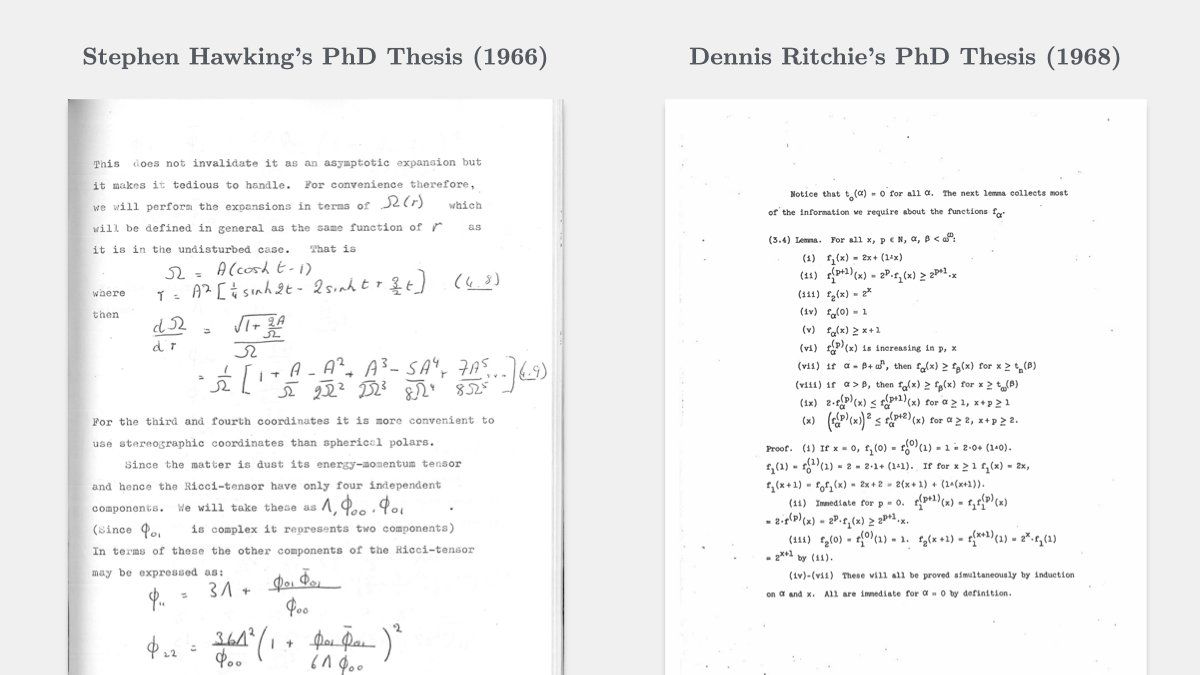
Long before LaTeX, most mathematical theses relied on hand-inserted symbols.
But in 1968, Dennis Ritchie - creator of C - typeset his entire thesis, subscripts and all, with astonishing accuracy.
How exactly he pulled it off remains a mystery.
🚨 POR QUÉ NO PUEDES COMPRAR CASA NI ALQUILAR A PRECIOS NORMALES EN ESPAÑA 🚨
Muy sencillo: porque al Estado le viene de puta madre que vivas ahogado, desesperado y pagando impuestos hasta por respirar.
A ningún político le interesa solucionar el problema de la vivienda, porque para ellos no es un problema: es su principal fuente de ingresos.
Te lo explico claro, con números y ejemplos REALES, para que entiendas por qué te roban cada vez que buscas casa 👇🧵