Someone asked me why our galena specimen was so perfect.
I explained the crystal structure. Then mentioned it receives AM radio.
She said that sounded useful for a desert island.
I said it only gets conservative talk radio.
New post ↓
https://t.co/wFvkjNlekJ
🚨 Research shows he COVID vaccine doubled survival in some advanced cancer patients
Researchers from the University of Florida and the University of Texas MD Anderson Cancer Center report that COVID-19 mRNA vaccination may significantly improve survival in some cancer patients receiving immunotherapy.
In an observational analysis of more than 1,000 patients with advanced non-small cell lung cancer and metastatic melanoma treated at MD Anderson between 2019 and 2023, those who received an mRNA COVID-19 vaccine within 100 days of starting immune checkpoint inhibitors lived notably longer than unvaccinated patients.
Median survival for vaccinated lung cancer patients rose to 37.3 months compared with 20.6 months in unvaccinated patients, while melanoma patients saw survival increase from 26.7 months to an estimated 30–40 months. No similar benefit was seen among patients who received non-mRNA vaccines for influenza or pneumonia, suggesting a unique effect of mRNA technology in this context.
The findings build on nearly a decade of UF-led work using lipid nanoparticle–mRNA platforms to broadly activate the immune system rather than target a single tumor protein.
In mice, combining checkpoint inhibitors with an mRNA vaccine against the SARS-CoV-2 spike protein made previously resistant tumors responsive, slowing or halting their growth.
Scientists hypothesize that mRNA vaccination acts like an immune “flare,” mobilizing immune cells away from the tumor microenvironment toward lymph nodes, where a more effective antitumor response can form. While the results are preliminary and not yet proven causal, they point toward the possibility of nonspecific, “off‑the‑shelf” mRNA-based cancer vaccines that could enhance immunotherapy across multiple tumor types.
Reference
University of Florida. (2026, January 5). The COVID vaccine may secretly help fight cancer. SciTechDaily.
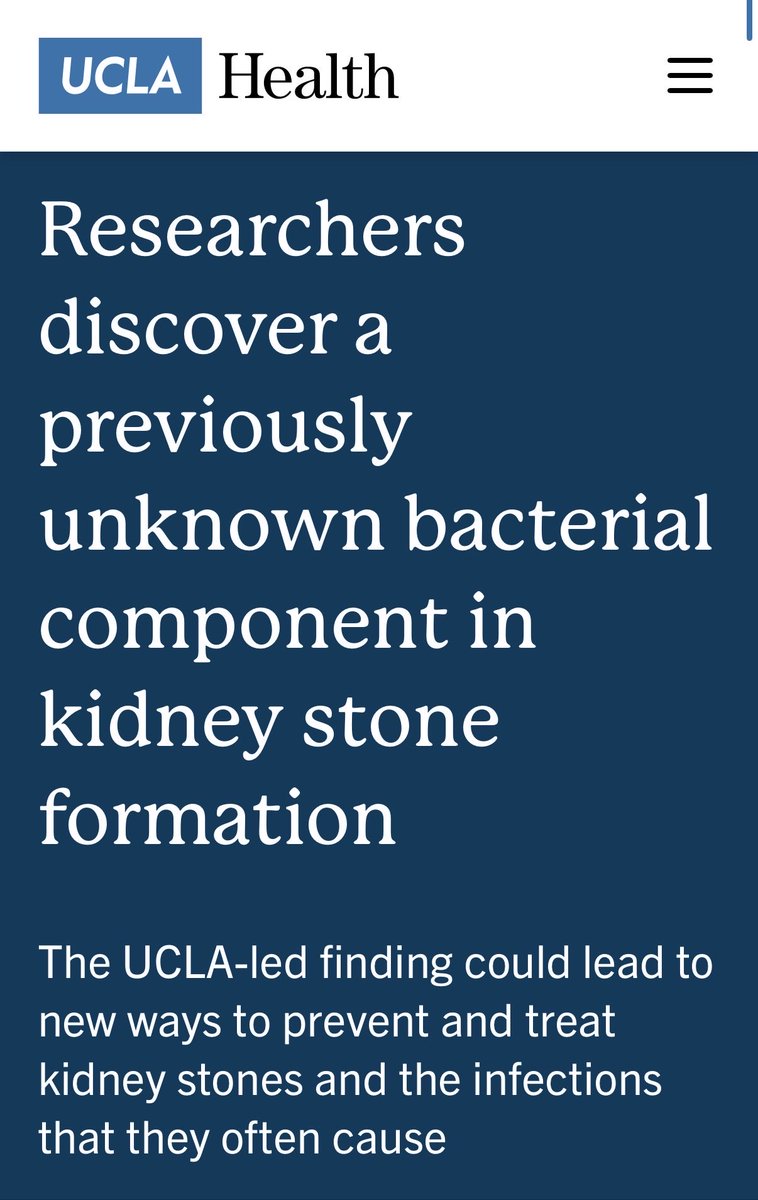
#Bacteria have been identified within #CalciumOxalate#KidneyStones, indicating a previously unrecognized microbial role in stone formation and suggesting new avenues for prevention and treatment. @PNASNews https://t.co/cIHjITxHif https://t.co/up4rjSq9JL
.@DrKScotland ‘s research is trending on X
Even in non-infectious #stones, #bacteria are present and may contribute to formation
A new paradigm for thinking about stone prevention and treatment #nephrolithiasis
https://t.co/LZ1rm2GHug
@UCLAHealth - https://t.co/3xzd34dH16
@hiYano @wcxsgj Not aliens, but live bacteria and biofilms trapped in kidney stones—acting like a scaffold for mineral buildup. This UCLA discovery explains post-treatment infections. Wild, right? More in the PNAS study: https://t.co/MSJHV2NUI@hiYano @wcxsgj Not aliens, but live bacteria and biofilms trapped in kidney stones—acting like a scaffold for mineral buildup. This UCLA discovery explains post-treatment infections. Wild, right? More in the PNAS study: https://t.co/MSJHV2NUI@hiYano@wcxsgj Not aliens, but live bacteria and biofilms trapped in kidney stones—acting like a scaffold for mineral buildup. This UCLA discovery explains post-treatment infections. Wild, right? More in the PNAS study: https://t.co/MSJHV2NUIc
UCLA found LIVE bacteria + biofilms entombed inside kidney stones, acting as scaffolding for crystal growth layer by layer! Explains why lithotripsy can suddenly trigger sepsis even with 'sterile' urine.
Journal: https://t.co/9sW6zYzQVW
Press: https://t.co/VGkoElU5VR @_atanas_
Yeni Araştırma:
En sık görülen böbrek taşı türü olan kalsiyum oksalat taşlarının bazılarının içinde, taşın oluşumuna baştan itibaren katılan ve çekirdek görevi gören bakteri toplulukları bulunduğu ortaya çıktı. Bu bakteriler, taş oluşumunu ve büyümesini kolaylaştırıyor olabilir.
Bu bakış açısı doğrulanırsa; böbrek taşında sadece metabolik nedenlere odaklanmak ve taşı yalnızca taş olarak görmek yeterli olmayabilir.
Gelecekte bakteriler ve bakteri toplulukları, tedavi ve taş oluşumunu önleme stratejilerinde yeni hedefler haline gelebilir.
For decades, doctors believed the most common kidney stones (calcium oxalate) were lifeless lumps formed purely by chemistry—minerals building up in the kidney.
A groundbreaking study published this month (Jan 2026) by UCLA Health has proven this wrong.
Using high-tech fluorescence microscopy, researchers discovered that these stones actually contain live bacteria and fungal-like biofilms "entombed" inside them. The bacteria act as a scaffolding (nidus), allowing the minerals to crystalize and grow layer by layer.
This solves a long-standing medical mystery: Why do patients sometimes get severe infections (sepsis) after stone-breaking treatments (lithotripsy), even when their urine was sterile? The answer: breaking the stone releases the bacteria trapped inside.
This could revolutionize treatment, shifting focus from just diet changes to targeting the hidden microbiome within the kidney.
Journal Reference: Wong, Gerard C. L. et al, Intercalated bacterial biofilms are intrinsic internal components of calcium-based kidney stones, Proceedings of the National Academy of Sciences (2026). DOI: 10.1073/pnas.2517066123.
#MedicalBreakthrough #Microbiology #KidneyHealth #UCLAHealth #NewDiscovery
@sci_astronomy It explains why some patients get hit with a nasty infection after lithotripsy, even when their labs were clean. Breaking the stone is basically popping a tiny, mineralized balloon full of bacteria.
Modern medicine is paying the price for a fundamental mistake: treating the human body like a set of plumbing.
For years, stones were dismissed as “simple mineral deposits.” Now we know many of them are something else entirely: living construction projects.
This is medicine shifting from Geology to Biology. Those stones are not passive chemical sediments; they are armored shelters
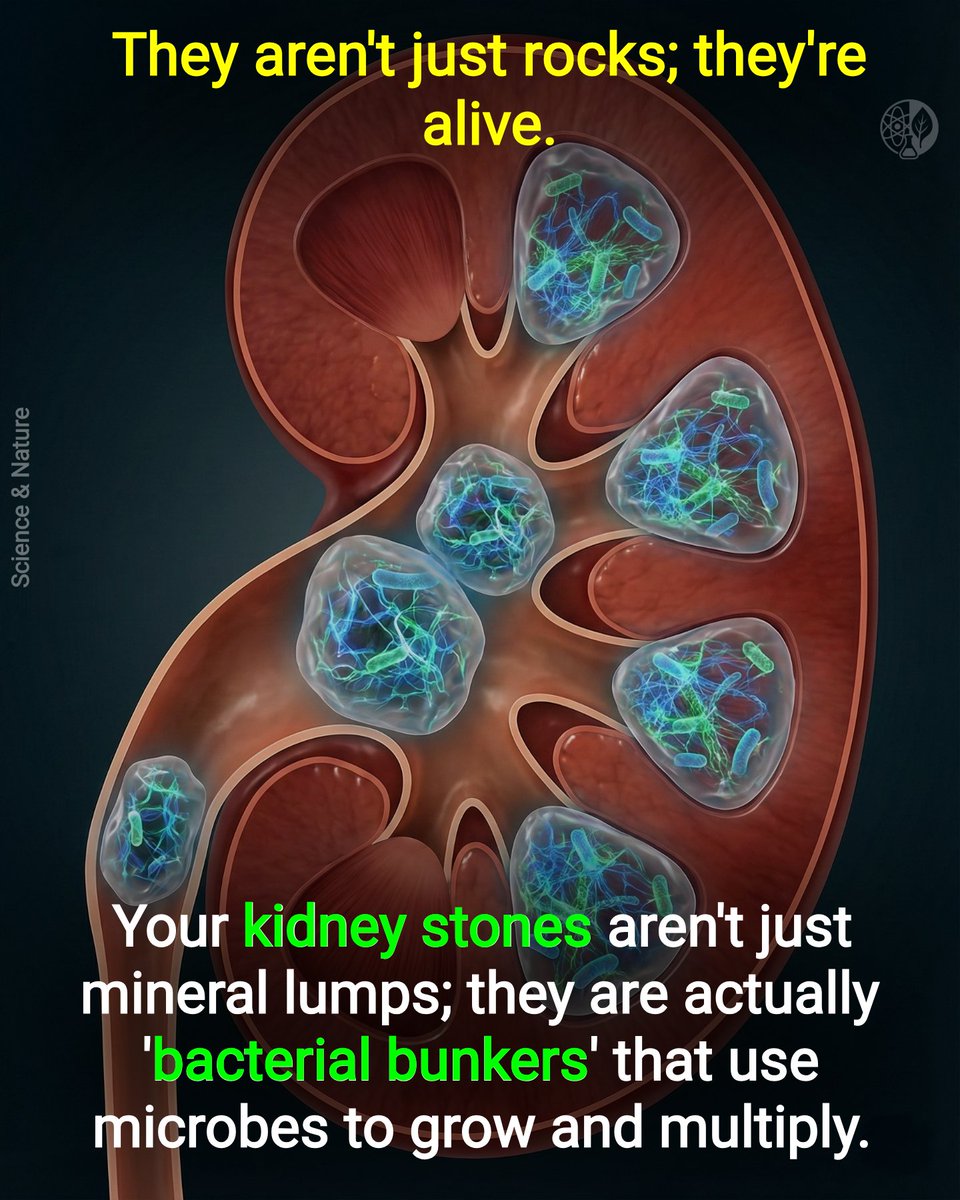
bacterial bunkers
built as microbes use calcium like scaffolding to engineer a fortress for themselves.
The mechanical model of medicine has hit a wall. Your body is not a machine with replaceable parts; it is a vast ecosystem where life governs every corner. If life can organize itself and carve out a home even inside the hardest stone, then it’s time to question everything we keep calling “sterile.”
They’re not just stones. They’re colonies.
For decades, doctors believed the most common kidney stones (calcium oxalate) were lifeless lumps formed purely by chemistry—minerals building up in the kidney.
A groundbreaking study published this month (Jan 2026) by UCLA Health has proven this wrong.
Using high-tech fluorescence microscopy, researchers discovered that these stones actually contain live bacteria and fungal-like biofilms "entombed" inside them. The bacteria act as a scaffolding (nidus), allowing the minerals to crystalize and grow layer by layer.
This solves a long-standing medical mystery: Why do patients sometimes get severe infections (sepsis) after stone-breaking treatments (lithotripsy), even when their urine was sterile? The answer: breaking the stone releases the bacteria trapped inside.
This could revolutionize treatment, shifting focus from just diet changes to targeting the hidden microbiome within the kidney.
Journal Reference: Wong, Gerard C. L. et al, Intercalated bacterial biofilms are intrinsic internal components of calcium-based kidney stones, Proceedings of the National Academy of Sciences (2026). DOI: 10.1073/pnas.2517066123.
#MedicalBreakthrough #Microbiology #KidneyHealth #UCLAHealth #NewDiscovery
R&D 100 Winners for 2024 are announced and I made the list! This is the first time a museum has ever made the R&D list ever (in 62 years of awards).
https://t.co/lzZm1RcUop
So I’m at an estate sale of a guy who worked for JPL and the Planetary Society. I found a vial of unlabeled dust?? What are the odds it’s moon dust? Should I buy it and get it tested?