"You aren't a Christian if you don't accept the Trinity."
The history of that statement is quite shocking, and almost nobody who says it knows that acceptance of the doctrine of the Trinity was once enforced by exile, fire, and death.
Here is what happened.
For the first 300 years after Jesus, Christians did not agree on how He related to God the Father. They argued about it constantly. There was no official rule. That was just normal.
Then a priest named Arius said the Son came from the Father and was beneath Him. Not equal. Not eternal. A lot of Christians agreed with him. A lot. This was not some fringe group. For stretches of the next century, his side was winning.
Other Christians said the opposite. The Son was fully God, equal to the Father, no beginning. Two camps, same Bible, opposite conclusions.
The fighting got bad. Riots. Mobs in the streets. Christians brawling over the nature of God.
So the Roman emperor stepped in. Constantine. He had just won a civil war and he wanted his empire to stop fighting. He was not even baptized. He did not care about the theology. He cared about order.
In the year 325 he called the bishops to a town called Nicaea. He paid for it. He ran the meeting himself. And they voted. They ruled that the Son was equal to the Father, fully God, one substance with Him. That ruling is the core of the Trinity. It got settled in that room, by that vote, on one word that is not even in the Bible.
They wrote the ruling into an official statement of belief. A creed. Every bishop was expected to sign it.
That is the part people think is the story. It isn't. The shocking part is how they made everyone accept it.
Constantine made the bishops sign the creed. The few who refused, he banished.
Then he ordered every book Arius ever wrote to be burned.
Then he made a law. If you were caught hiding one of those books, you were put to death.
Even after all of that, the Trinity did not win for good.
A few years later Constantine changed his mind. He brought Arius back. And he exiled Athanasius, the bishop who had won the argument at Nicaea. That man got banished five separate times in his life for believing the thing the church now says you have to believe.
For the next fifty years it flipped back and forth. One emperor said Trinity. The next said no. Whoever sat on the throne decided what was true. The official belief about God changed every time power changed hands.
It finally got locked in by another emperor named Theodosius. He made the Trinity the law of the empire. Disagree, and you were a heretic. Not in some spiritual sense. By law. Backed by soldiers.
A few years after that, the empire executed a bishop for his beliefs. The first time the state put a Christian to death over doctrine. It would not be the last.
Then came the document that says it out loud. A creed written around the year 500. Almost five centuries after Jesus. They named it after Athanasius, that same bishop. He did not even write it. They put his name on it for the authority.
It opens by declaring that anyone who does not hold the Trinity, whole and complete, will perish forever. Believe it or be damned. Put in writing, and made the test of who gets saved.
So that is where the line comes from. Not from Jesus. Not from the apostles. From emperors and councils who needed a divided empire to fall in line.
The Trinity did not become the rule because the argument was settled. It became the rule because the side that held it had the throne, the law, and the sword.
The next time someone says you aren't a Christian unless you accept the Trinity, remember what it took to make that rule stick. Exile. Fire. And death.
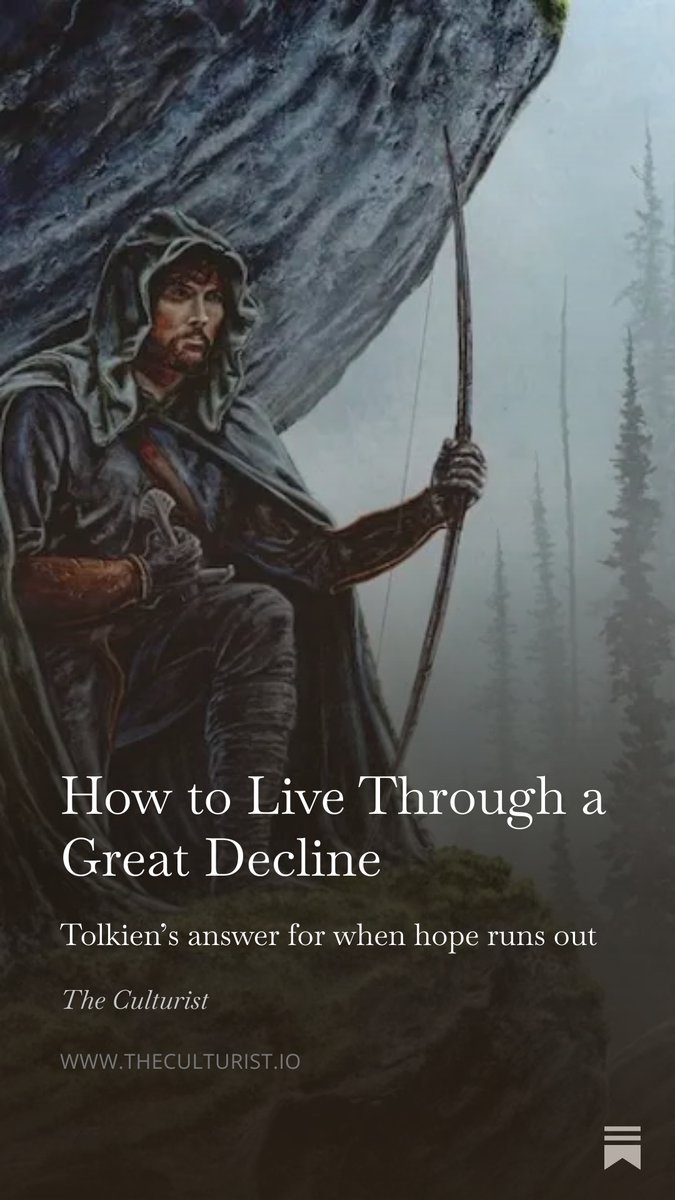
If you're living through a great decline, how should you personally live and act in the midst of it?
This is the question at the heart of "The Lord of the Rings," and it's best answered by the scene following the death of Boromir.
After Boromir gives his life to save the Hobbits from Saruman's Orcs, the Fellowship is in tatters. With time against them, Merry and Pippin swept away by the enemy, and Frodo passing out of their control, Aragorn and company make a decision that seems strange.
They pause to mourn Boromir's passing with a proper ritual.
To many readers, this feels entirely reckless. Their "best" course of action is surely to prioritize what is most urgent: that the fate of their quest hangs in the balance. We recognize that, in any "normal" context, it would be wrong to let Boromir's body lie out in the open, but the nature of their mission surely doesn’t allow for the luxury of a funeral — right?
But the fact that abandoning Boromir's body is wrong in normal times is precisely why it is wrong even now. At the heart of LOTR is the idea that moral decisions lie beyond their immediate context: some things just are wrong and others right, and once context becomes an arbiter of that distinction, you've lost your grip on what it means to be good.
Aragorn's next statement helps us understand this further:
"I would have guided Frodo to Mordor and gone with him to the end; but if I seek him now in the wilderness, I must abandon the captives to torment and death. My heart speaks clearly at last: the fate of the Bearer is in my hands no longer."
Aragorn makes yet another decision to halt progress on the greater mission in favor of that which speaks directly to his heart: he will pursue Merry and Pippin, rather than sacrifice them for the "more important" quest.
Tolkien's heroes recognize that they are not in control of everything. They cannot force the Ring to be unmade through their own will to power, and they're aware that their universe is guided by forces beyond their own and of their enemies. All they do is done in that humility, and they are bound by moral laws beyond themselves.
Indeed, Middle-earth is guided not just by the opposing wills of Good and Evil but by another, providential force beyond the material.
It is precisely because Tolkien's heroes believe in objective good that they can trust that a great, providential turn in fortune — a "eucatastrophe" — is around the corner. To believe in the objective good is to live in accordance with destiny, and to act on what is inherently good at all times, and to die for it if necessary.
To live in submission to divine providence is to recognize that the right actions also lie in the little things, and that you yourself play only a small part in the grand story.
A good world is brought into being by small acts of courage and kindness, even when they seem superfluous in the wider context of your quest...
https://t.co/HyhHZGGYde
Je jouais aux Assassin’s Creed surtout pour l’intrigue du présent liée aux aventures dans le passé, je m’accrochais à ça.
Maintenant que cet aspect a quasiment disparu, je suis beaucoup moins motivé pour faire les nouveaux AC.