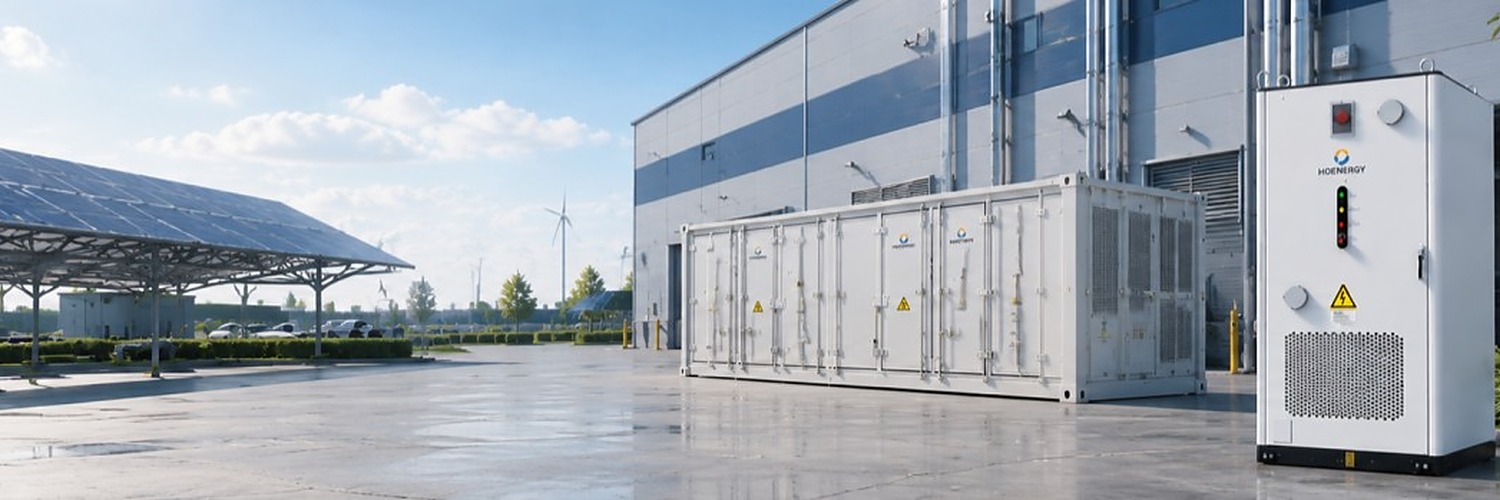
Head of Sales Europe at HOENERGY. C&I battery storage for grid congestion and peak shaving, straight from the manufacturer. BNEF Tier 1. Serving all of Europe.
I lead European sales for HOENERGY, a BNEF Tier 1 manufacturer of C&I battery storage.
Most projects I see start with a full grid connection or an energy bill with expensive peaks.
Here I share what comes up: grid congestion, peak shaving, and the numbers behind them.
Ofgem, 19 Nov: most projects in the reformed GB connection queue are now seeing delays, some moved back materially.
Next step it names: financial commitments for over-subscribed technologies, "notably batteries". No level or date yet.
@edcporter Does the model keep the 2050 fleet mostly at 2 hours, or do 4-hour units hold their de-rating better once the remaining stress events get longer?
October: 9 days in the Netherlands had a quarter-hour below €25/MWh, two went negative.
Since 28 October the cheapest quarter-hour stayed above €140 on 22 of 27 days.
In winter a battery charges on expensive energy, so every point of round-trip loss costs real money.
Dutch energy tax for 2027 still isn't a single number I'd put in a payback model.
Belastingplan 2027 passed the House 76–74 on 12 Nov. The Senate finance committee only discussed procedure on 17 Nov. No vote date yet.
Until the Senate votes, I'd model it as a range.
Unit-level UL 9540A test on our cabinet, by an SGS lab in October. The cabinet's fire suppression was left unpowered. One cell was forced into thermal runaway: 2 of the 52 cells in that module followed, the other four modules did not vent, and no flame came out of the enclosure.
Sunday 15 Nov, Dutch day-ahead: cheapest 2h at 10:45 (€92/MWh), best at 16:15 (€186).
Monday 16 Nov: spread back to €160, but the cheap hours were 03:00–05:00 (€108). Midday never went below €192.
A fixed "charge at noon" schedule paid €192 on Monday, not €108.
@montelnews If intraday splits into regional sub-markets close to delivery, would a battery on the congested side of the line see that local price directly, or only through redispatch payments?
@montelnews How much of a £700 balancing spike actually reaches batteries already signed into floor or toll contracts? Or is that upside mostly for the merchant fleet this winter?
@edcporter If the €8 comes mostly out of the evening hours, does the midday-to-evening spread in your forecast shrink by more than €8? Curious what that does to the case for 4h batteries in Spain
What happens to one of our cabinets before it ships: cell and pack tests, then BMS, PCS and EMS function checks, environmental and safety tests, and a full commissioning run while it is still in the factory.
Some of our 125 kW / 261 kWh cabinets being loaded in August, bound for our European warehouse. With stock already in Europe, a replacement part for a site in Poland or Czechia goes by truck, not by ship.
Inside our production line: robots handle the cells, and finished cabinets come off the line already crated for transport. The point of automating this is that unit 200 is built exactly like unit 1.
SDE++ 2026 closes on 26 November at 17:00.
Phase 3 opened on 9 November, with a cap of €225 per tonne of CO₂. The cap steps up each week, to €400 in the last phase from 23 November.
The round's total budget is €8 billion.
Another batch of our battery cabinets left the factory at the end of October, bound for European projects. Earlier units are already running in Poland, Czechia, Spain and Lithuania.
In an accelerated lab test, a single PEM cell on intermittent solar power degraded about 11 mV/h. With a simulated battery buffer: about 3 mV/h.
Stress-test rates from one cell, not field life. In this test, steadier power meant slower wear.
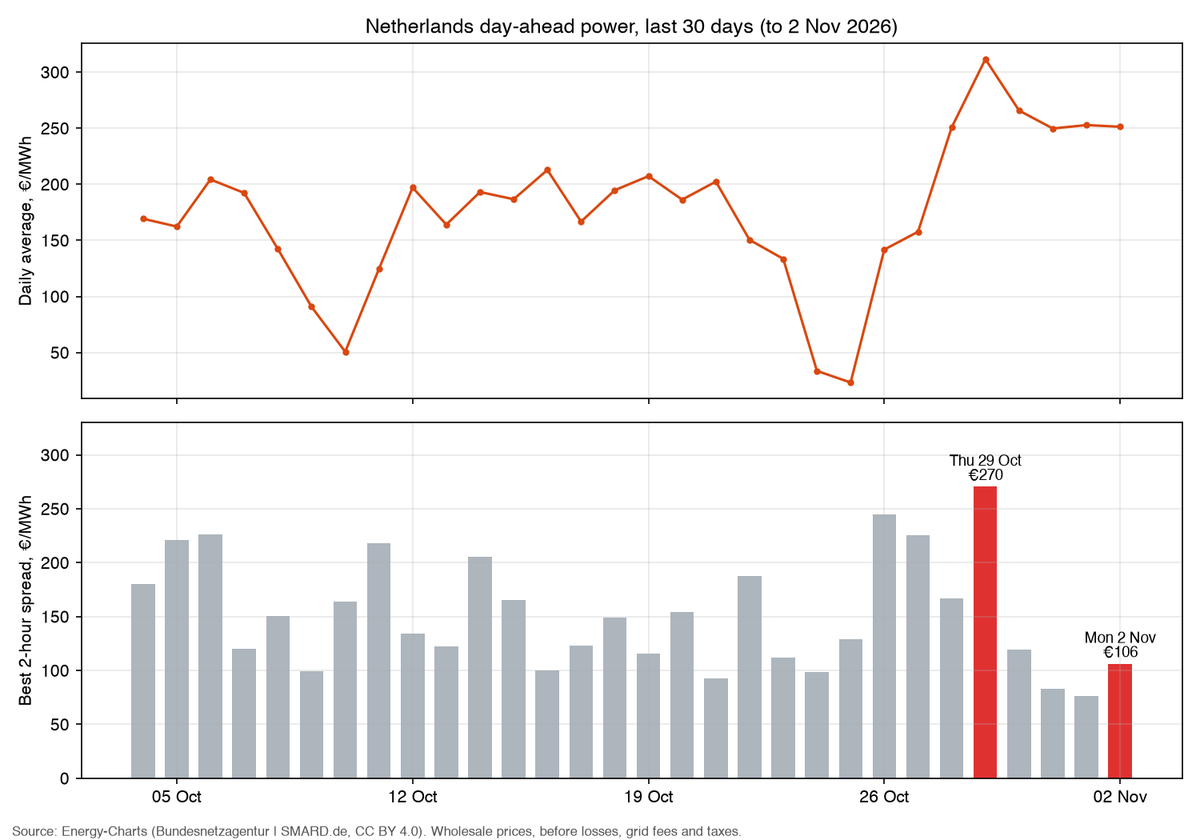
Dutch day-ahead power:
Thu 29 Oct: best 2-hour spread €270/MWh.
Mon 2 Nov: €106/MWh.
Both weekdays, both averaging over €250. A 2-hour battery on spreads alone would have earned about 40% as much on Monday, before losses and fees.
I don't build C&I cases on arbitrage alone.
Virginia, July 2024: six faults on one 230 kV line, each cleared in under 70 ms.
A typical data centre rule: three dips in a minute, go to backup and stay. At the third reclose, ~1,260 MW left together.
The dip was the trigger. The shared setting made it big.