Il est désormais attendu 42 à 45°C de la Bretagne (!!) jusqu'aux Pays de la Loire mercredi, avec des rafales pouvant atteindre 50 km/h et une humidité relative inférieure à 10 %.
Dans ces conditions, il apparaît de plus en plus probable qu'un épisode majeur de Heat Wave Flash Drought (HWFD) (plus connu du grand public sous le nom d'« effet sèche-cheveux » ou de sécheresse éclair) se mette en place sur une superficie immense (carte 1).
L'association d'une chaleur extrême, d'un air exceptionnellement sec et d'un vent soutenu provoque une accélération brutale de l'évapotranspiration et du dessèchement de la végétation. Les conséquences peuvent être très rapides : pertes foliaires massives, mortalité de jeunes plants particulièrement sensibles, stress sévère pour la faune et l'élevage, et risque d'incendie atteignant des niveaux extrêmes à très extrêmes (carte 2).
L'ampleur des valeurs envisagées pour l'ouest de la France est difficile à appréhender. Voir de telles conditions s'étendre jusqu'à la Bretagne est tout simplement stupéfiant. En tant qu'agroclimatologue, je suis profondément sidéré par ce que les modèles continuent de simuler.
A Swiss teenager killed the Lightroom subscription.
It's called RapidRAW. A free open-source RAW photo editor that runs on Windows, Mac, and Linux. Non-destructive, GPU-accelerated, and under 20MB.
He was 18 when he started it.
Lightroom vs RapidRAW:
- Price: $143.88 a year → $0
- Account: Adobe login required → No login, ever
- Storage: 20GB cloud, then you pay more → Your files, your disk
- Install size: Adobe Creative Cloud, multi-GB → Under 20MB
- Updates: Forced when Adobe says → When you want
- Works on: Windows and Mac → Windows, Mac, and Linux
No Adobe ID. No cloud upload. No AI trained on your photos.
What it actually does:
→ Non-destructive editing. Your original RAW stays untouched.
→ GPU-accelerated. Sliders move in real time on a cheap laptop.
→ Masks, parametric curves, manual noise reduction with separate luma and color controls.
→ EXIF editing, batch presets, custom keyboard shortcuts.
→ Built in Rust + Tauri + WGPU. That's why it's tiny and fast.
→ Works on touchscreens. Has an Android build.
6,849 stars in 11 months. 275 forks. 20+ contributors.
One honest note: it's still in active development. The author says it isn't yet as polished as Darktable, RawTherapee, or Lightroom. You report bugs, he fixes them, usually within days.
License is AGPL-3.0. Free forever. No "Pro" tier. No upgrade nags.
Timon Käch built RapidRAW from Switzerland as a personal challenge to learn Rust, React, and WGPU shaders. He's a full-stack developer and photographer. No VC. No team. No fundraise.
This is what Lightroom should have been when the subscription started.
(Link in the comments)
You have an old Android phone in a drawer right now. Collecting dust. Worth nothing.
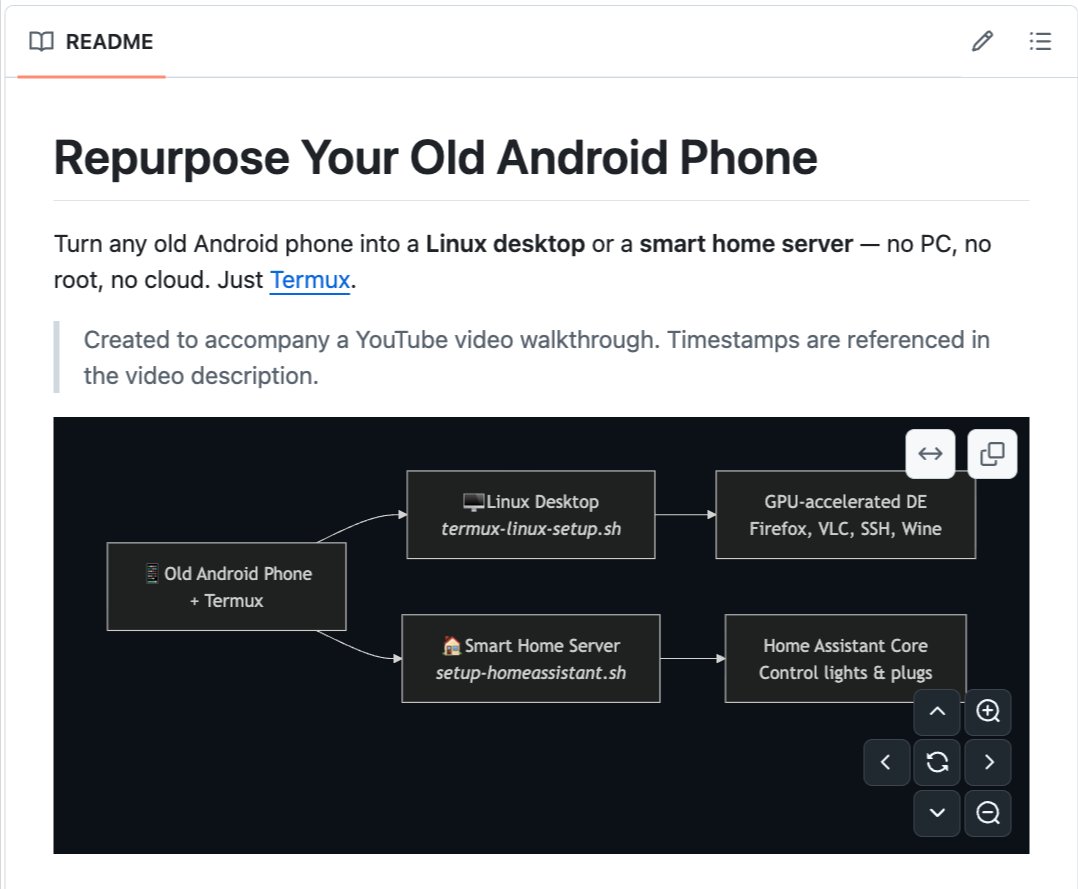
Someone built a script that turns it into a full Linux desktop. Or a smart home server. Or a development machine. For free.
It's called linux-android.
One script. No root required. No flashing. No risk of bricking your device. Run it in Termux and your old phone becomes a Linux computer.
Here's what it installs:
→ Full Linux desktop. XFCE4, LXQt, or MATE. Real windowed desktop on your phone. Connect a monitor and keyboard via USB and it looks like a PC.
→ Smart home server. Home Assistant runs on your phone. Control your WiFi lights, plugs, and smart devices from any browser on your network. No cloud needed.
→ GPU acceleration. Snapdragon phones get near-native GPU performance through Turnip Vulkan drivers. Mali GPUs use software fallback.
→ SSH server. Access your phone from any computer on your WiFi. Full terminal. Transfer files. Write code. All from your laptop keyboard.
→ Wine support. Run basic Windows applications on your Android phone through Box64 translation.
→ Audio support. PulseAudio configured automatically.
→ Works on any Android phone with Termux support.
Here's the wildest part:
A Raspberry Pi 4 costs $35 to $75. A used mini PC costs $100+. A VPS costs $5/month forever.
That old phone in your drawer? It has a faster processor, more RAM, a built-in battery backup, WiFi, and a touchscreen. All for $0. You already own it.
A Snapdragon 855 from a 2019 phone still outperforms most entry-level server chips. You're throwing away a computer every time you upgrade your phone.
Not anymore.
One command. One old phone. A full Linux machine.
100% Open Source. MIT License.