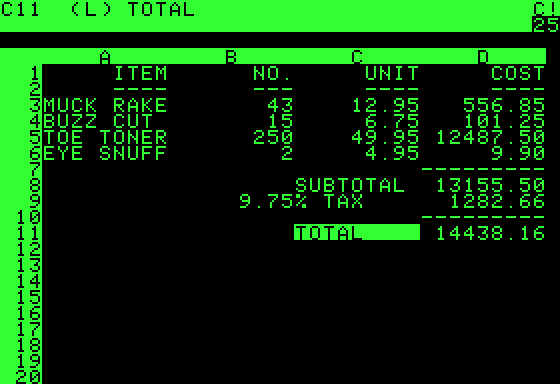
Watch Nadella describe SaaS apps as nothing more than a CRUD database with some business logic, but once the business logic moves to AI agents, SaaS is over:
Not being interested in a fancy lifestyle is a competitive advantage when it comes to mental health and happiness.
You don't need an expensive condo, expensive clothes, or expensive restaurants if your thing is to train your body, eat healthy, read stimulating books, work on your original ideas and stories, have relaxed time for deep conversations with family and friends, feel connected and at peace with who you are.
You won't be able to quiet your mind as long as you remain a slave to the many desires that were deeply transplanted into your mind by the rest of society.
Most people aren't angry, anxious, depressed, they are simply mindlessly chasing a vision that was fed to them, and that isn't aligned to their true core values.
You need to step back, see the bigger picture, do the internal work to unlearn what you don't need, that's when you will get a first experience of true wealth: mental freedom and peace of mind.
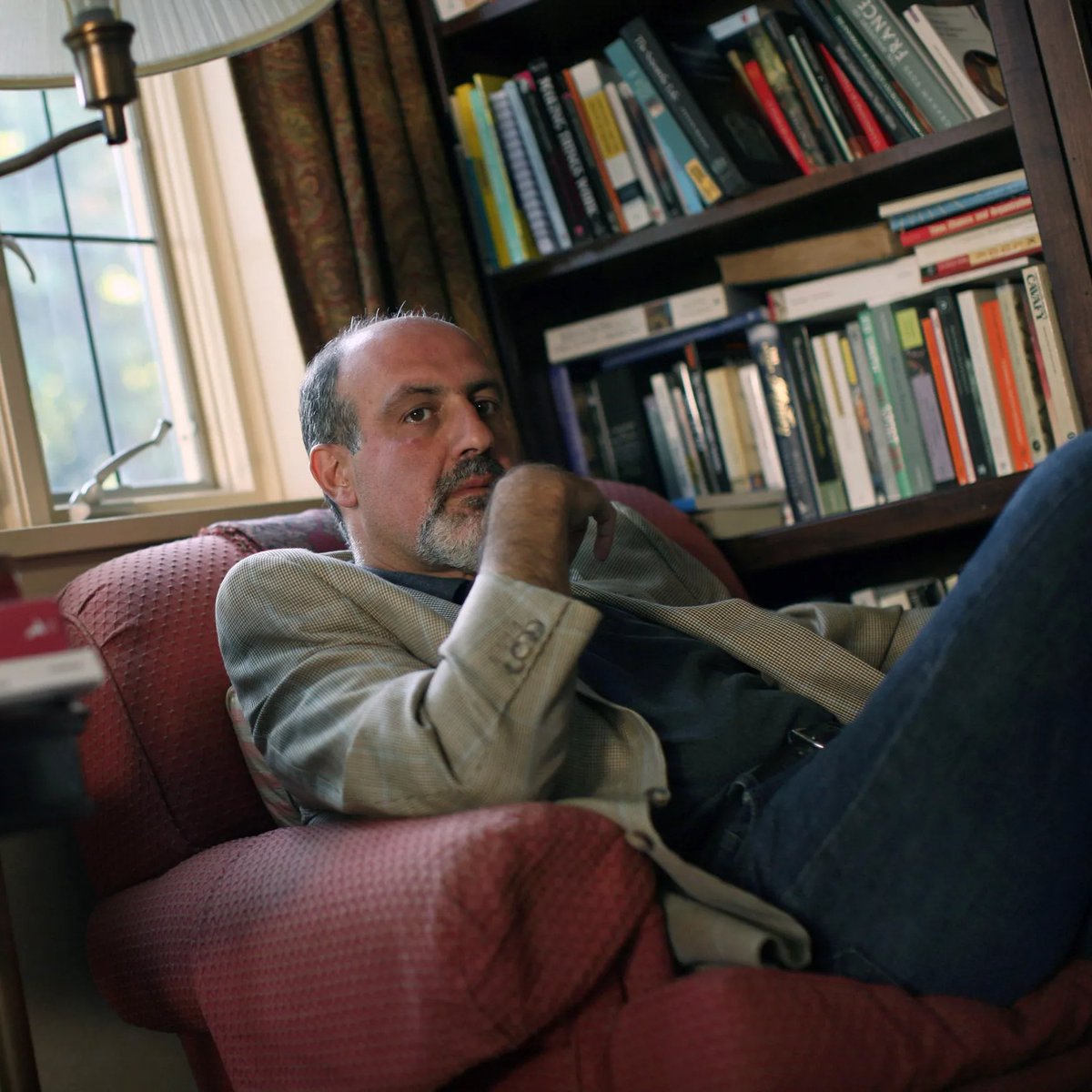
Nassim Taleb spends 30 hours every week reading books.
Here are 27 reading tips from @nntaleb:
1) The minute I was bored with a book or a subject I moved to another one, instead of giving up on reading altogether.
2) The trick is to be bored with a specific book, rather than with the act of reading.
3) A good book gets better at the second reading. A great book at the third. Any book not worth rereading isn’t worth reading.
4) I follow the Lindy effect as a guide in selecting what to read: books that have been around for ten years will be around for ten more; books that have been around for two millennia should be around for quite a bit of time, and so forth.
5) The reading of a single text twice is more profitable than reading two different things once.
6) A private library is not an ego-boosting appendage but a research tool.
7) Read books are far less valuable than unread ones. The library should contain as much of what you do not know as your financial means, mortgage rates, and the currently tight real-estate market allows you to put there.
8) Drink old wine. Read old books. Keep old friends.
9) Read nothing from the past one hundred years.
10) Never read a book that can be adequately summarized.
11) Never read a book you would not reread.
12) No book that can be shortened survives.
13) Books that endure don't look like good books; they are almost always very poorly written, but address fundamental topics.
14) What matters for a book is depth and relevance, which is extremely rare. Plus internal, not external coherence. Books that have them don't need the cosmetic shit.
15) When a risk taker writes a book, read it. In the case of Peter Thiel, read it twice.
16) Keep the book. Easier to remember contents just by looking at it. Often not even necessary to consult notes.
17) I don't remember what I learned in class. I remember much of what I read on my own.
18) To become a scholar, spend decades reading 30-40 h/week.
19) You will accumulate more knowledge and more books as you grow older, and the growing number of unread books on the shelves will look at you menacingly. Indeed, the more you know, the larger the rows of unread books. Let us call this collection of unread books an antilibrary.
20) I don’t read newspapers. I don’t watch television. I’m not on Facebook. I don’t care for the social networks. I’m on Twitter, but I use it only as a means to an end. I read books.
21) Books are not read by the majority because they read the Internet, which is like junk food for the mind.
22) The unread books on your shelf are like a universe of alternate possibilities waiting to be explored.
23) I divide my spirits into two categories: those I read for the pleasure of reading and those I read for the pleasure of rereading.
24) To see if a book is real, ask 10 people of different backgrounds & professions to summarize it. If the summaries are similar, the book will not survive as it can be shortened to a journal article.
The more the summaries diverge, the higher the dimensionality of the book.
25) If you want to study classical values such as courage or learn about stoicism, don’t necessarily look for classicists. One is never a career academic without a reason. Read the texts themselves: Seneca, Caesar, or Marcus Aurelius, when possible. Or read commentators on the classics who were doers themselves, such as Montaigne—people who at some point had some skin in the game, then retired to write books. Avoid the intermediary, when possible.
26) Criticism, for a book, is a truthful, unfaked badge of attention, signaling that it is not boring; and boring is the only very bad thing for a book. Consider the Ayn Rand phenomenon: her books Atlas Shrugged and The Fountainhead have been read for more than half a century by millions of people, in spite of, or most likely thanks to, brutally nasty reviews and attempts to discredit her.
27) A novel you like resembles a friend. You read it and reread it, getting to know it better. Like a friend, you accept it the way it is; you do not judge it.
The countdown is on for all things Cybereason at 2023 RSA Conference! We're excited to meet you at booth N-5457 in the North Expo Hall. Here is what you can expect to see #RSAC2023#RSA https://t.co/xkotKv38l0
BREAKING News: Cybereason has been named a leader in 2022 Gartner® Magic Quadrant™ for Endpoint Protection Platforms! #Defender#Gartner#MagicQuadrant#EPP https://t.co/l4o8TO3Hv8
Gearing up for #RSAC2023! Don't miss Cybereason at booth N-5457 and be sure to catch our speakers covering topics from ransomware, to XDR, to ChatGPT. #RSAConference https://t.co/3SnRvormuf
Banks treat you more nicely when you have a lot of money.
Companies treat you more nicely when you are influential on social media.
People treat you more nicely when they find you good-looking, smart, talented.
The world is mostly self-interested.
Don’t be naïve.
Most people barely move away from their home town, let alone from their country. If you are scared of leaving the familiar behind, you will never reach the next level of who you could be.
Cybereason’s GSOC and Incident Response teams have analyzed a growing C2 framework named Sliver. Here is what you need to know about this attack, described in detail#malwareattack #Sliver https://t.co/VTlc71VcoB
Promise of new concepts and diversity of ideas, see what you can expect from the RSA Conference program with insight from Cybereason VP & Global Field CISO Greg Day #RSAC#cybersecurity https://t.co/6sYWP0ceKk
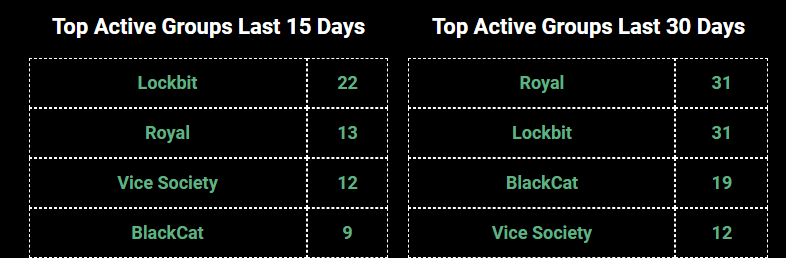
In the first month of the year, there is a battle at the top for first and second place 🧮
➡️Top Active Groups 15 Days:
- Lockbit: 22
- Royal: 13
- Vice: 12
- BlackCat: 9
➡️Top Active Groups 30 Days:
- Royal: 31
- Lockbit: 31
- BlackCat: 19
- Vice: 12
#Ransomware
What is the MITRE ATT&CK framework and how can you validate your security systems against an adversary using it? Cybereason has developed a comprehensive guide to understanding this framework. Check it out and start building better defenses https://t.co/YQNEENq7Nn