@karpathy true but top capability in any scientific domains has always been inaccessible
even before AI how many people can even conceive of Grigori Perelman's Poincarre work?
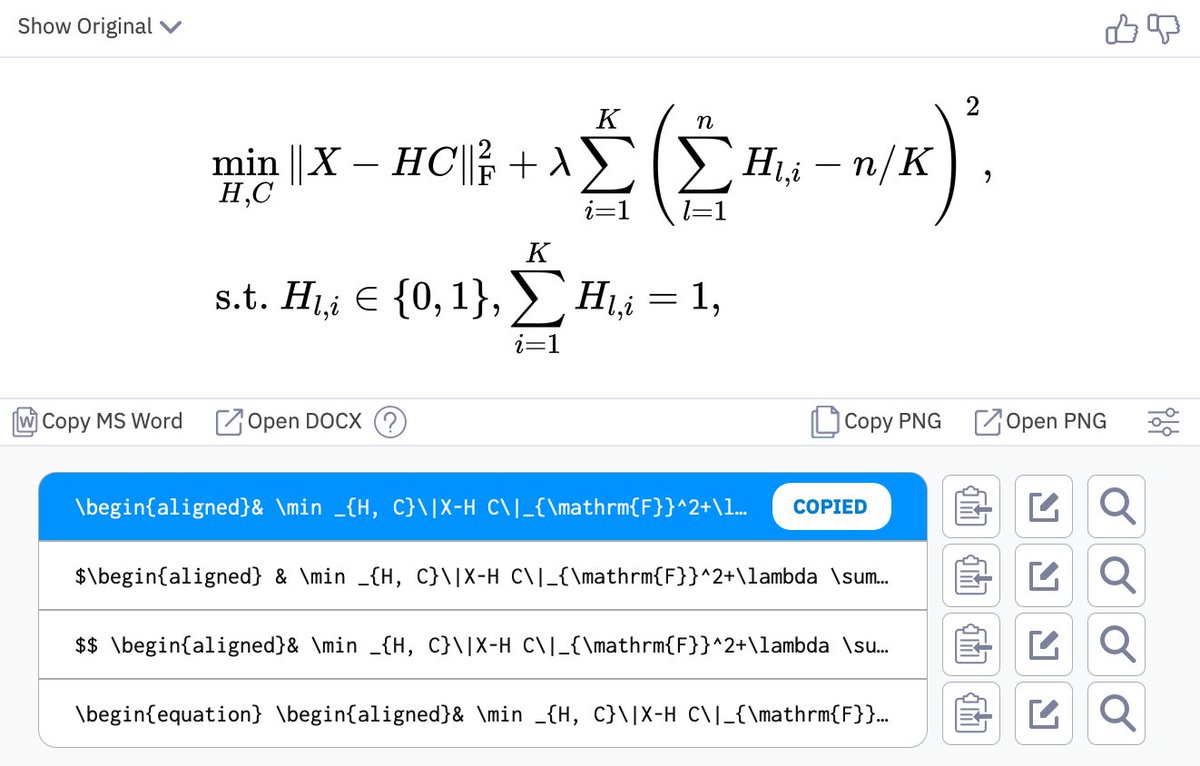
@pmarca@MathpixApp is a cloud app that supports creating large pdf collections and searching through them. Clicking on results will bring you to exact place in pdf so you can easily audit search results.
https://t.co/AEHWxbLRUs
@Cassius75495871 @MathpixApp I am very sorry you had a bad experience. Can you please share the email you used to sign up with? What version of the app are you using? I’d love to give you free Pro subscription for your troubles and hopefully a longer bug report, my email is [email protected]
@DiracDeltaFunk@andy_matuschak@MathpixApp Omg \hat legend! Love this. We need more \hats I love those things I want to make a new version of the hat but software development keeps getting in the way!
Mathpix claims to offer PDF -> LaTeX / Markdown conversion. I was skeptical… but the results are quite amazing! Does anyone know if this implements a published model? Or is it all proprietary?
https://t.co/M4LeyvKWRB
🧮Mathpix PDF Loader
This @danielgross approved PDF loader uses @MathpixApp to convert images and PDFs with math into LaTeX and text instantly!
Daniel's OG tweet which inspired this: https://t.co/3fql0MEEJk
Docs: https://t.co/ofFLPzmhyk
I don't think people realize what a big deal it is that Stanford retrained a LLaMA model, into an instruction-following form, by **cheaply** fine-tuning it on inputs and outputs **from text-davinci-003**.
It means: If you allow any sufficiently wide-ranging access to your AI model, even by paid API, you're giving away your business crown jewels to competitors that can then nearly-clone your model without all the hard work you did to build up your own fine-tuning dataset. If you successfully enforce a restriction against commercializing an imitation trained on your I/O - a legal prospect that's never been tested, at this point - that means the competing checkpoints go up on bittorrent.
I'm not sure I can convey how much this is a brand new idiom of AI as a technology. Let's put it this way:
If you put a lot of work into tweaking the mask of the shoggoth, but then expose your masked shoggoth's API - or possibly just let anyone build up a big-enough database of Qs and As from your shoggoth - then anybody who's brute-forced a *core* *unmasked* shoggoth can gesture to *your* shoggoth and say to *their* shoggoth "look like that one", and poof you no longer have a competitive moat.
It's like the thing where if you let an unscrupulous potential competitor get a glimpse of your factory floor, they'll suddenly start producing a similar good - except that they just need a glimpse of the *inputs and outputs* of your factory. Because the kind of good you're producing is a kind of pseudointelligent gloop that gets sculpted; and it costs money and a simple process to produce the gloop, and separately more money and a complicated process to sculpt the gloop; but the raw gloop has enough pseudointelligence that it can stare at other gloop and imitate it.
In other words: The AI companies that make profits will be ones that either have a competitive moat not based on the capabilities of their model, OR those which don't expose the underlying inputs and outputs of their model to customers, OR can successfully sue any competitor that engages in shoggoth mask cloning.
@mjovanovictech VS Code is an awesome tool that I like and use a lot, but that's the cost of IDEs: they WILL act up on you. VIM has a lot fewer feature, but you know it will always work, and always be fast.