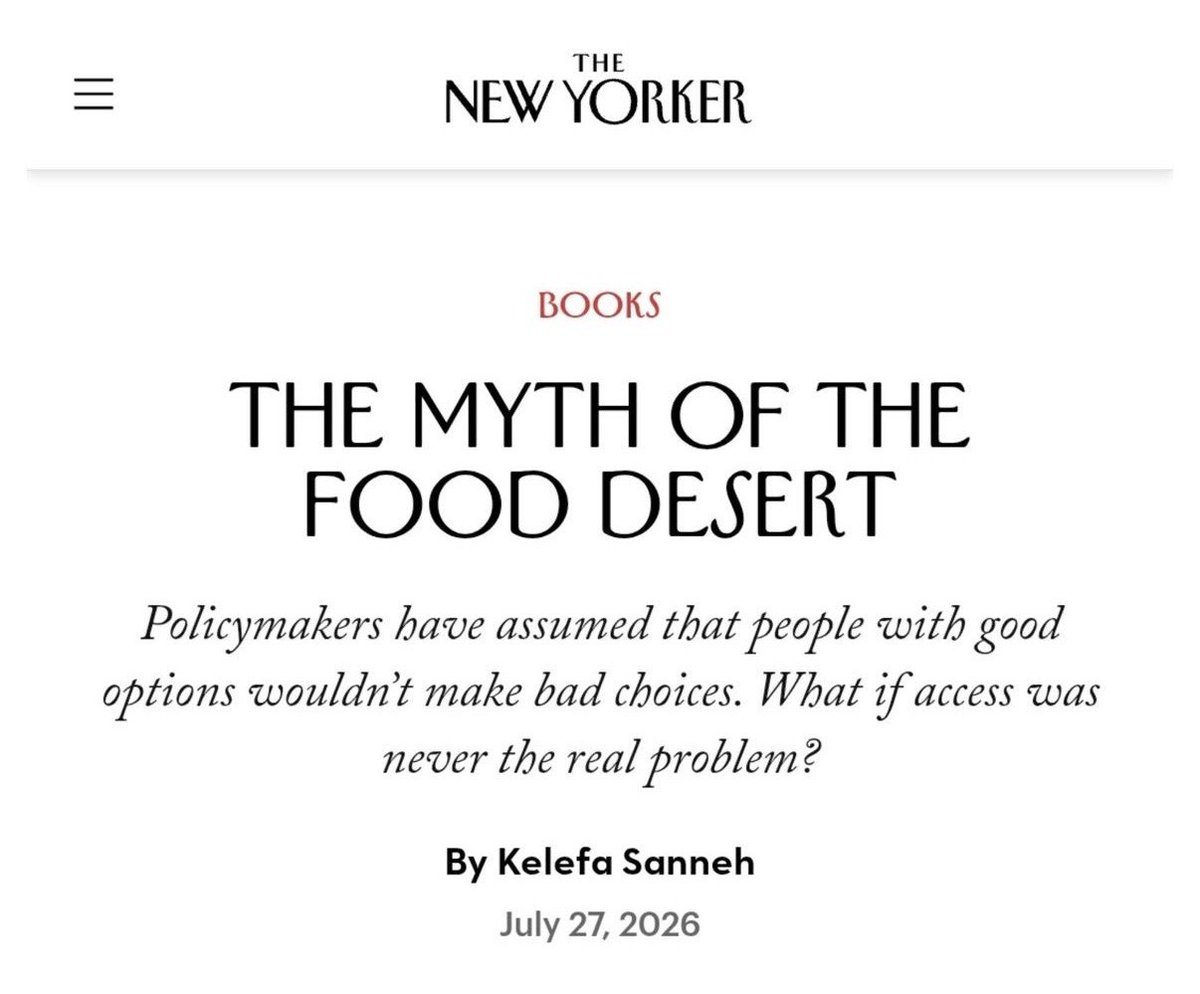
~15 yrs ago my wife had a post-doc in public health. Several of the other post-docs and profs were obsessed with "food deserts." I thought it sounded like a dodgy idea even then. White liberals assume anyone who can't access tempeh or arugula within a couple miles is oppressed.
@DevilsPepper@Grumpy_Nellis@Acyn Nyc dsa co chair gordillo showed true face of collectivism in the recent interview. They don’t care about common people. They only want their envious ideology to win for the sake of it and all hard working successful people to be punished as success for them is the greatest sin.
@DevilsPepper@Grumpy_Nellis@Acyn You could have named beryozka as well. Deficit of goods solved by the deficit of customers. Terrific.
Government creating a competitor to private business operating with minimal margin of three percent on its own money taken by force is completely unfair and evil.
Nearly 60,000 rent-stabilized apartments sit empty because their owners can't afford to renovate them and put them back on the market.
https://t.co/TtRQaWSF55
You don’t hate capitalism, numb nuts; you hate the prerequisites for life. Every living creature on Earth has to work for its survival. It’s not a creation of capitalism.
Free-market reforms are not overnight fixes. New research across 30 countries finds that growth improvements may be weak at first, but gains often appear 3–5 years later as investment, jobs, and resources adjust. Cato’s @jeffreyamiron explains that we should judge reforms by long-term results, not early turbulence.
https://t.co/pI2Oa6HLvg
“A Government is not free to do as it pleases” — a powerful reminder from David Boaz.
Government is established to protect our unalienable rights and to protect us from those—including government and its agents—who would initiate force or coercion against us. Law and government require the consent of the governed and must be limited, constitutionally defined and constrained, transparent, and applied equally and consistently.
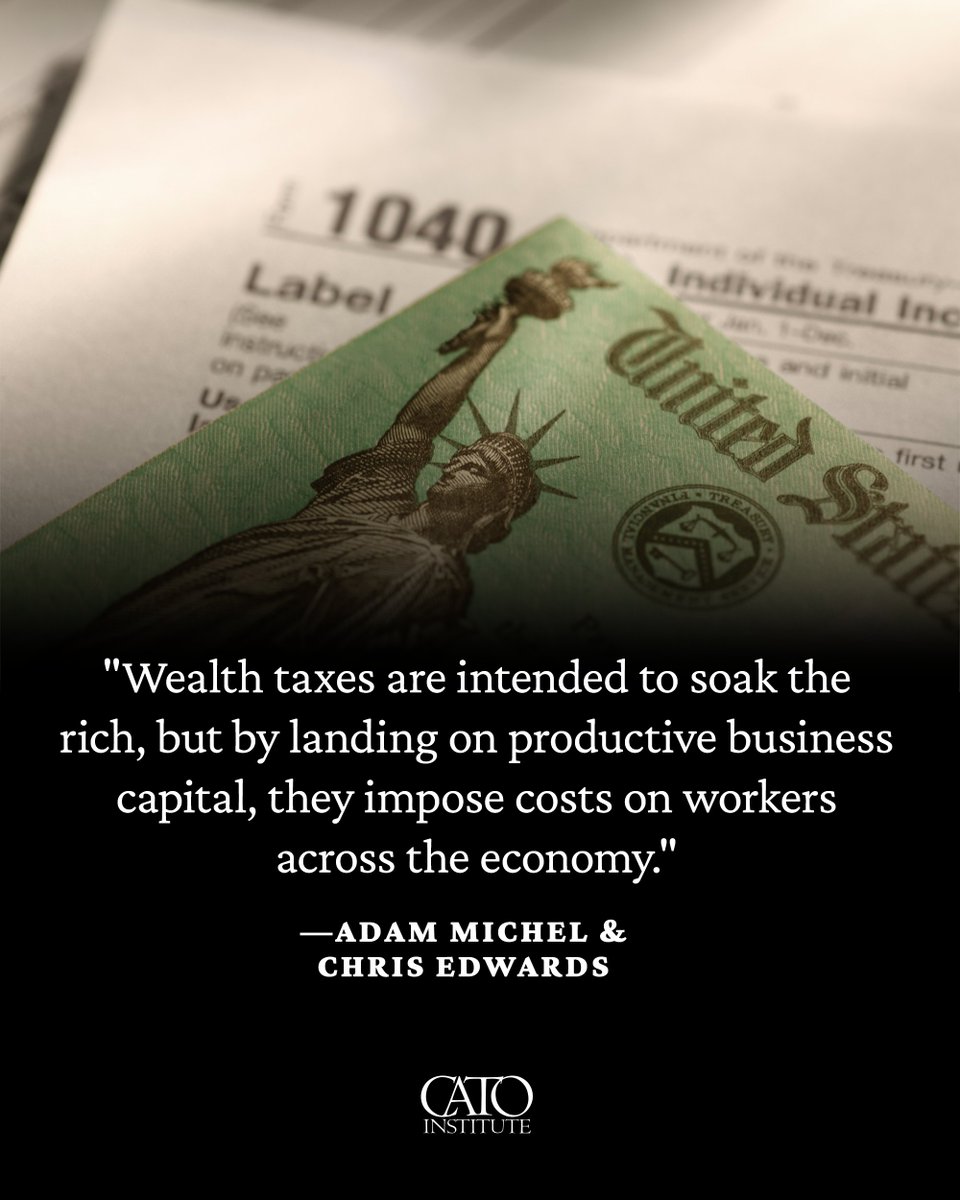
Wealth taxes do not work. They raise little revenue, drive away investment, and ultimately hurt workers through lower wages and slower growth. Shift the federal tax code toward a consumption base is a more effective approach than targeting wealth, report Cato's @adamnmichel and @CatoEdwards. Read Cato’s new Policy Analysis on the Wealth Tax: https://t.co/uqtAyvmk4D
I’m calling BS on these 120 millionaires calling to be taxed more.
Look closely at who signed. A retired footballer whose been paid millions by taxpayers. A retired trader who’s net worth is well under $5M. Retired musicians, film directors and some heirs. People who finished building years ago - half of them aren’t worth the $10M threshold they think needs the wealth tax. Their wealth sits in liquid portfolios. The tax they propose either doesn’t apply to them or they have liquidity to pay it.
Now picture a founder with a £50m biotech firm. Her wealth isn't in a bank account. It's based on a speculative VC round. To pay 2% she has to rip £800k a year out of her business or sell it down piece by piece until someone else owns it.
Or imagine the restauranteur whose chain is finally having a profitable year after a decade of losses. A PE deal to expand gives him a paper worth of £60M and he now has to find £1M a year, every year personally if he wants to grow. Imagine the property developer couple who made a lifetime of delayed gratification and good decisions. Their portfolio makes £4M profit which is barely enough to cover the £2M in wealth taxes per year after they draw it from their company and pay the corporation tax - 100% essentially goes to tax.
The signatories aren't offering to pay a tax. They're volunteering someone else to. Someone who is still building, investing, growing, hiring.
HMRC already accepts voluntary payments. Any of these self-aggrandising millionaires could send extra money tomorrow. ALL of them benefited from lower tax rates and should pay the difference if they want to make a start. None of them will. They don't want to give more. They want a law that forces others to.
The wealth tax they propose won't work. It will backfire.
We don't need to guess. In 1990, twelve OECD countries had a wealth tax. Today it's three.
Sweden scrapped theirs. Germany suspended theirs. France tried it for decades, watched tens of thousands of wealthy families leave, collected a fraction of what was promised, and Macron repealed it because the country was losing more than it raised.
The £24bn projection assumes nobody changes their behaviour. Nobody has ever designed a tax where nobody changes their behaviour. Liquid wealth leaves. Illiquid wealth, the businesses and farms and employers, stays behind and gets squeezed.
The tax doesn't catch the guy with the yacht. It catches the guy with the factory.
It will end up hitting normal people.
Every tax "on the very richest" drifts downwards. Income tax started in 1799 as a temporary 3% levy on the richest 3% to fight Napoleon. Now workers are paying a 45% marginal rate. Inheritance tax was designed for stately homes and now catches three-bed semis in Surrey. VAT launched at 8%. It's now 20%.
When the wealth tax raises a fraction of what was promised, and it will, no Chancellor repeals it. They lower the threshold. £10m becomes £5m becomes £2m becomes your parents' house.
Here's what I'd say to the 120…
If you want your capital serving Britain, I'm with you. The best way is to back founders. Fund the startups and scale-ups on great terms like they do in the USA. Help build companies that scale here instead of selling early to America. Growing businesses already pour money into the Treasury through corporation tax, employer's NI and PAYE on every job they create. Back success and productivity. Stop rewarding fiscal deficits with good money after bad.
That's harder than signing a letter. You don’t get to look like a socialist super-hero. It's also the only version of "proud to pay" that's ever made a country richer.
Don't pretend to ask the government to tax you… or people twice as rich as you.
Invest in real growth and success.
@NYCMayor > out of your homes
These are not theors homes, they belong to landlords as you say and your filthy administration is working on seizing what’s been built by generations of hard working people. You’re disgusting arrogant hypocritical monster and are going to hell.
The rising tax burden on the economy is enslaving in a very literal sense. And the problem isn't just that people are forced to pay for services they'd never buy voluntarily, or would buy elsewhere — state schools, state healthcare. It isn't just how poorly the state handles its actual core functions — police, the army. There's a far more destructive long-term effect, and it's psychological.
First, learned helplessness. People settle into the rut carved out for them and unlearn how to make their own decisions.
Second, "the state" is not an abstraction. It's people. Bureaucrats. Society is growing an ever-wider class of people who have never built anything, created anything, risked anything — yet who acquire, straight out of university, the power to punish others for breaking laws. And the laws themselves grow ever more idealistic, because practitioners write them less and less. Nobody asks whether a law can actually be complied with. Politicians only ask whether it makes them look moral.
That is what's truly frightening. And truly destructive.
Jeff Bezos: "I've created $2.1 trillion of wealth for other people."
"Somebody needs to make a list where they rank people by how much wealth they've created for other people."
While talking about his net worth, he floated an idea that flips the whole concept of a "rich list" on its head.
He did the math live, right there on stage.
"Amazon's market cap is 2.3 trillion today. I own about 200 billion of it."
"So if you take 2.3 trillion and subtract out the piece I kept for myself, then I've created something like $2.1 trillion of wealth for other people."
That's not a typo. Trillion, with a T and it's not even his money.
"That should put me pretty high on some kind of list."
He didn't stop at himself, either. He immediately named who else deserves a spot at the top.
"People like Jensen, Nvidia, he's going to be very high on that list."
"That would be a pretty cool list. Somebody should do that list."
In 1825, a rich Welsh industrialist bought an entire American town to prove that socialism could work.
He had the money, the buildings, the theory, and hundreds of eager followers waiting to move in.
Two years later, it was over. 🧵
The biggest myth about socialised healthcare is that Britain had no healthcare before the NHS was founded in 1948. But Britain had a thriving extensive healthcare system long before the NHS - built on private practice, mutual aid and charity, rather than the state.
The backbone of medical care for ordinary people was the friendly society movement. By the late Victorian period, millions of working men and women paid small weekly subscriptions into these mutual organisations and in return received access to a doctor and medicines, and often sickness benefits as well. These societies often contracted local doctors on a capitation basis, giving working families a degree of security without relying on charity or the Poor Law.
For those who could afford it, there was a thriving private medical market. Doctors competed for patients, and many working-class families paid directly for treatment when needed. At the same time, a large network of voluntary hospitals and dispensaries provided care to the poor, funded through philanthropy, subscriptions from the middle and upper classes and donations. Hospitals such as Guy’s, St Bartholomew’s and the Edinburgh Royal Infirmary treated large numbers of working-class patients, often for free or at very low cost.
While the very poorest sometimes ended up in the often harsh Poor Law infirmaries, the combination of friendly societies, private payment and charitable hospitals meant that organised medical care reached far more people than is commonly acknowledged, long before the state took over.
Britain was also a world leader in medical science during this period. British researchers made major advances in public health, surgery and tropical medicine, with several Nobel Prizes in Physiology or Medicine awarded to British scientists in the early 20th century for work carried out in the Victorian and Edwardian eras. Far from being a healthcare desert, pre-NHS Britain had a dynamic, decentralised system that combined mutual aid, private enterprise and philanthropy to deliver care to millions.
Thomas Sowell: “One of the sad signs of our times is that we have demonized those who produce, subsidized those who refuse to produce, and canonized those who complain.”
KEVIN O’LEARY, WHO’S ESTIMATED TO HAVE A $400,000,000 NET WORTH, GOT MAD AT PODCAST HOSTS GRAHAM & JACK AFTER THEY SUGGESTED THERE SHOULD BE A WEALTH TAX, EXPLAINING THAT PEOPLE LIKE ELON MUSK DESERVE EVERYTHING THEY GET.
“YOU’RE GOING TO HELL FOR SAYING THAT…”
“IT’S UNAMERICAN. IT WILL DESTROY THE FABRIC OF THE ECONOMY.”