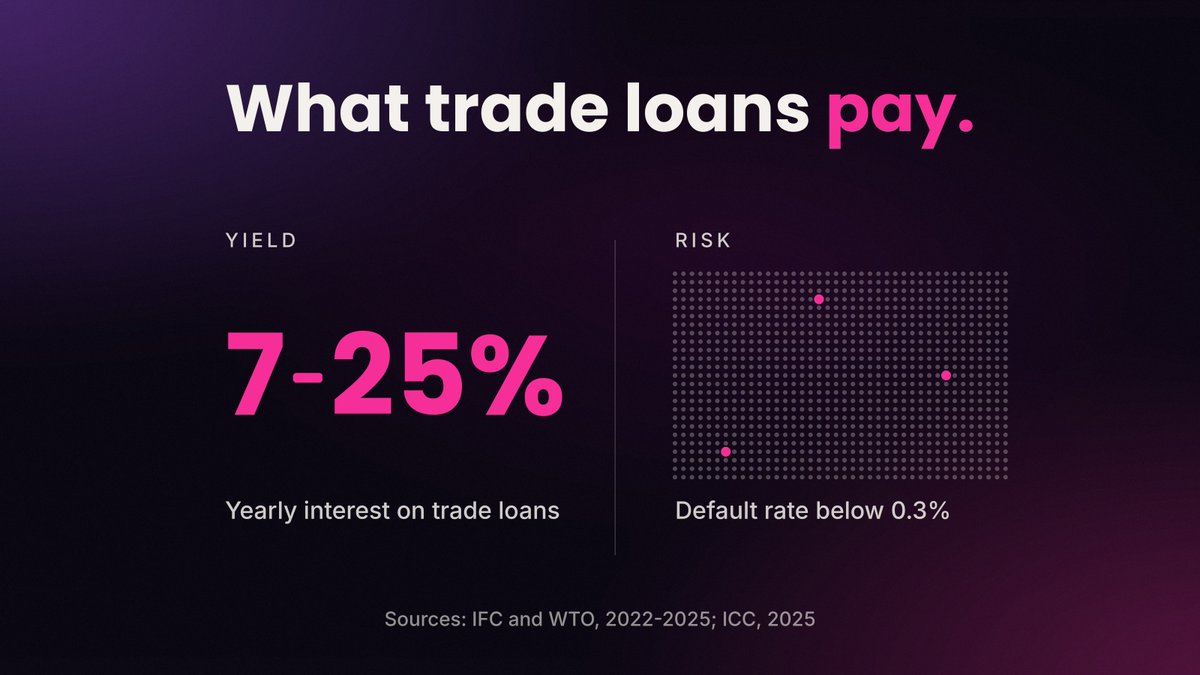
Trade loans in emerging markets charge 7 to 25% a year. Worldwide, fewer than 3 in 1,000 trade finance loans default.
So far, banks have kept most of that interest. On Ceres, you don't need to be a bank to earn yield by financing commodity trades.
Trade loans can cost as much as 13 to 25% a year across the world. Some traders get no loan at all.
Even with a sound cargo and a reliable buyer, the rate is the bank's call, based on the borrower's country, size, and sector.
On Ceres, the price follows the trade.
Every vault page on Ceres lists its terms in the same order, regardless of the curator. You can compare any two vaults line by line.
• Enforced by the contract: currency, access, close cadence, notice to exit, redemption, early exit, seniority, and minimum deposit.
• Stated by the curator: target return, security, documents, its name, and the publication date.
Every term is on the page before anyone deposits.
Every vault on Ceres has a named curator. It does the work a bank's credit team does today.
1. Sourcing. Finds the trade and decides whether it belongs in a vault.
2. Underwriting. Takes the credit decision and sets the terms.
3. Documentation. Lists the contracts, the security, and the documents on the vault page.
4. Monitoring. Values the vault at each close and reports to lenders.
That is why terms differ from vault to vault.
Every vault on Ceres has four parties, and each has a specific role.
• The borrower brings a documented trade that repays the vault.
• The curator underwrites the trade, structures the vault, and publishes the terms.
• The lenders deposit into the vault on the published terms.
• Ceres runs the marketplace and keeps one record of every vault. It never lends, sets the rate, or holds funds.
Gami joins Precept as a launch partner and curator, bringing institutional-grade risk expertise to Stellar.
As a curator on Precept, Gami sets the risk parameters and administers the price oracle of its markets. Each market isolates its own risk and keeps its terms on-chain, providing a high transparency level to participants.
The same commodity trade can be financed in two ways.
One goes through a bank, a credit committee, and a yearly review. The other runs on one page of terms 🧵
People have complained for years about "putting the 'war' back into World of Warcraft."
As it turns out, the smarter move was to put the "world" back into World of Warcraft.
Forever is a triumph.
Talent is rare.
Know what's rarer?
The ability to sit at your desk for 12 hours a day, say no to everything, take risk, work without reward and grind the work regardless of motivation.
Talented people fail all the time. The grinder's destroy and conquer. Be the latter.
Introducing Ceres, a marketplace for commodity trade finance.
Each vault is structured by a named curator, funded by lenders and repaid by the trade it finances.
Priced by the trade, not the postcode.
User funds are safe!
It does look like a hack on Binance. Appreciate the quick freeze from Tether (~$971m) and Circle (~$823m).
I don't manage Binance (.com) anymore, but as a shareholder, I expect all user funds will be fully covered.
1$ is all it takes to pull a Legendary 🔑
Every result is locked on-chain before the box opens.
➤ Pull from $1, bigger pulls scale the prize, not the odds
➤ Every pull pays, nothing returns zero
What would you want to pull first?