Software stocks having a good day.
Semis and ai infrastructure stocks not having a good day.
Seems like another rotation day based on the premise that open source models will be cheaper for software companies to implement/integrate into their workflows, products, development etc which could accelerate productivity gains and margin expansion however as that adoption and usage accelerates so does the demand for compute… so I think the selloff in many of the ai infrastructure names is misguided because companies switching to open source models doesn’t diminish the need for more compute… it actually increases it.
Just my opinion. Feel free to disagree.
Speaking of ai infrastructure stocks, $CLS just crushed it...
Revs of $4.7B vs $4.39B est
Revs up 62.5% YoY
EPS of $2.54 vs $2.31 est
EPS up 82.7% YoY
Guidance...
Revs of $5.25-5.55B vs $5.0B est
Implies 64-74% YoY growth
EPS of $2.88-3.08 vs $2.69 est
Implies 82-95% YoY growth
This means revenue growth and eps growth are both accelerating.
Going off current sell side estimates...with $CLS trading at $348 AH, the stock is only trading at 26x NTM EPS and I'm pretty sure those estimates are going higher by at least 10-15% which means $CLS is probably trading closer to 22x NTM EPS.
$CLS also saying this... "We now expect our revenue growth rate in FY2027 to accelerate, relative to the 65% revenue growth rate anticipated in our latest FY2026 outlook. We also anticipate adjusted EPS to grow at a faster rate than our revenue in FY2027"
This should give ai infrastructure stocks a lift tomorrow.
I'm re-reading this 58-page Morgan Stanley data center report and here's one comment that stands out (copy & pasted)...
Statements from key AI players indicate a growth rate in compute demand higher than
our projections.
In November, a Google exec stated that the company likely needs to double compute every 6 months, with a result of 1,000x in 5 years... doubling every 6 months would in fact result in ~1,000x compute within 5 years.
To put this growth rate in perspective, in 2025-2028, our projected CAGR in compute sold by NVIDIA is ~210% per year; extrapolated over a 5-year period to line up with the Google statement, in 5 years the compute accumulated would be ~300x rather than Google's >1,000x.
$ASTS - SpaceX’s Starship can carry +100,000 kg into space
This means Starship could potentially hold 12 - 18 composite Bluebirds per launch.
1 Falcon 9 launch costs around $74M
1 Starship launch is estimated at $90M
A big boost to launch cadence when Starship becomes commercial sometime in 2027 if testing continues to go well. 🚀
Not a great day for ai stocks including the memory companies… but after the close we have Anthropic announcing a major LTA with Samsung and SK Hynix… then in the past couple hours $NVDA announces a $500B deal with SK Group which includes SK Telecom (2GW data center) and SK Hynix (HBM)… https://t.co/3odBCkpg2E
The weekend just got a little better 🎉
Curious to see how the KOSPI opens on Sunday night… I’m thinking we should see some green 🙏🏼
*We are long $NVDA and $SKHY (in multiple ways) at @FirstWaveFund
⚡️Jensen is declaring NVIDIA’s preferred end state for AI.
Frontier intelligence remains expensive enough to require giant training clusters. Open models then diffuse those capabilities into every company, country, device, factory, hospital, vehicle, and government system.
NVIDIA wins both layers.
Closed frontier models create the arms race.
Open models create the deployment explosion.
The strategic core is simple:
NVIDIA wants models to become abundant while compute remains scarce.
Open weights weaken the power of any single model company. They reduce dependence on OpenAI, Anthropic, Google, or any other API gatekeeper. Enterprises can customize models, nations can keep data inside their borders, developers can deploy locally, and companies can build intelligence directly into their products.
Every one of those choices creates more demand for chips, networking, inference servers, edge hardware, and NVIDIA’s software stack.
The sovereignty argument matters enormously. No serious country wants its military planning, healthcare data, industrial systems, or public administration permanently dependent on a foreign proprietary model. Open models allow nations to own the intelligence layer while NVIDIA supplies the machinery underneath it.
That makes NVIDIA’s position stronger than any individual model lab.
OpenAI needs ChatGPT to win.
Anthropic needs Claude to win.
Google needs Gemini to win.
NVIDIA profits when all of them compete, when open models proliferate, and when every country builds its own stack.
The safety language is partly sincere and partly strategic. Open models improve auditability, redundancy, local control, and defensive research. They also expand access to capabilities that can be misused. Jensen is emphasizing the side that aligns with American diffusion and NVIDIA’s economics.
The deeper pattern is that NVIDIA does not want a single AI sovereign.
It wants millions of sovereign AI systems, all requiring the same industrial substrate.
Jensen is trying to commoditize intelligence while preserving a toll on its physical production.
That is the cleanest position in the entire AI economy.
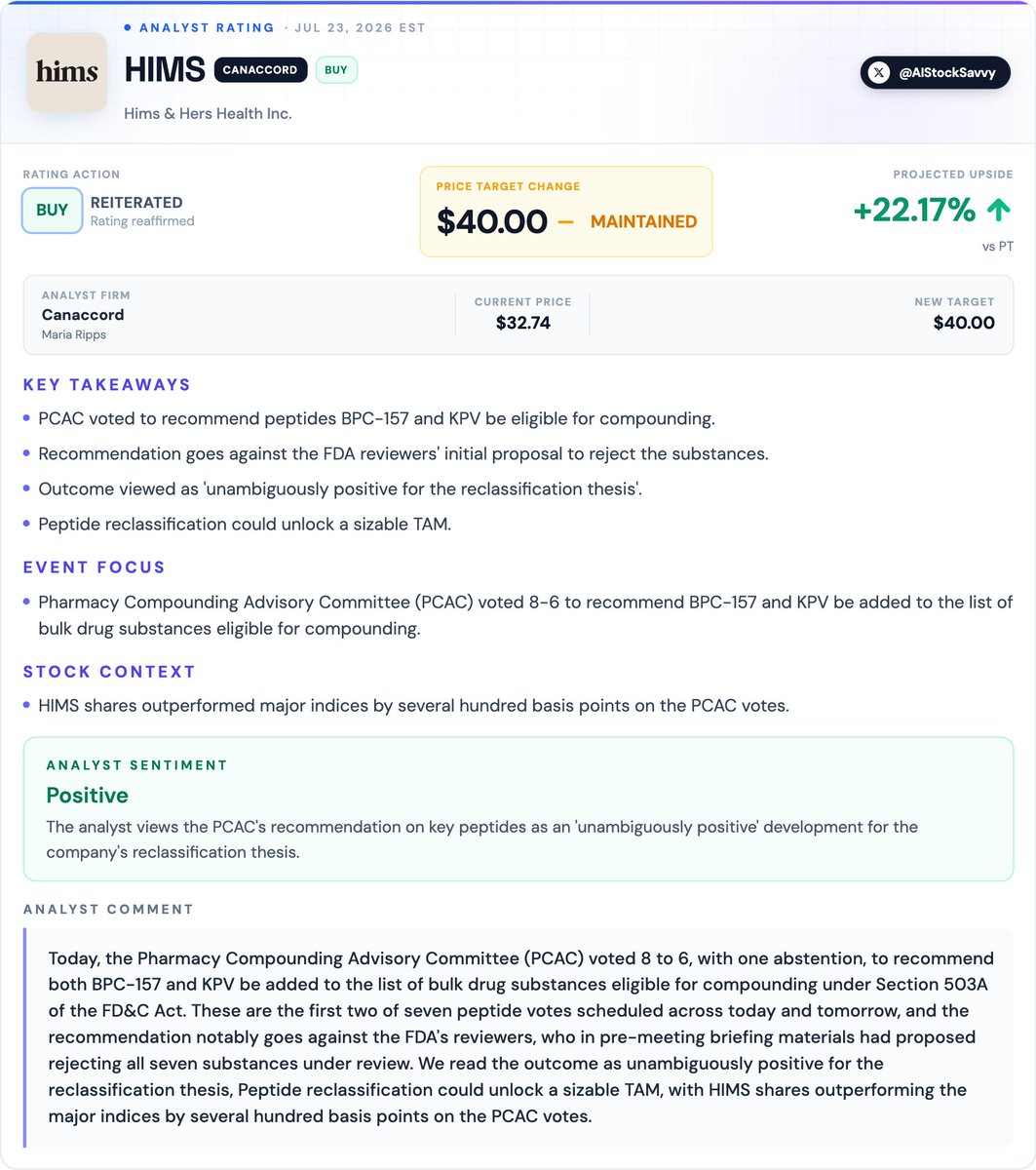
$HIMS | Canaccord reiterates 𝐁𝐮𝐲 on 𝐇𝐢𝐦𝐬 & 𝐇𝐞𝐫𝐬, maintains 𝐏𝐓 𝐚𝐭 $𝟒𝟎
Analyst sees the PCAC vote on peptides as unambiguously positive for Hims & Hers, potentially unlocking a sizable addressable market.
$ASTS - Clear Street Note This Morning:
Update Ahead of 2Q26: Buy the Dip Before the Launch Bottleneck Improves
ASTS has pulled back 50%+ from its $133.86 high on third-party launch- vehicle disruption, not a collapse in D2D demand, technology failure, or lost contracts. June/July gateway milestones demonstrate the MNO pipeline converting to physical infrastructure. As new entrants increasingly threaten incumbent carrier subscriber bases, we believe MNO partners will lean more aggressively into ASTS's direct-to-device coverage solution to protect retention. Key points:
• Into 2Q, the $1B revenue goal for 2027 faces pressure as the 45 Blue Bird target moved to 2027, from year end 2026; we view this risk as already captured in our/consensus at $557M/$779M.
• Key topics to monitor on the 2Q26 call include the launch partnerships and/or acquisitions commentary in the July 15 8-K.
• Dilution protected to $149.20 via a $96.9M capped call on the $1.15B offering, 135% above spot and well above our $115 PT.
Valuation: At current levels, ASTS trades at roughly 10x our 2029E EBITDA of ~$2B and ~6x our 2029E revenue of ~$3.5B. We maintain our Buy rating and $115 PT, implying 20x 2029E EBITDA which translates to ~12x revenue, with our DCF cross-check including spectrum value supporting ~$110/share.
Key Points
Next Catalyst, Launch Progress: BlueBirds 11-13 could set a launch date in the next several weeks. A successful mission, or any grounded medium to heavy lift rocket returning to market, would be a meaningful sentiment inflection where launch capacity remains the critical bottleneck.
Launch Vertical Integration a Key 2Q26 Theme: The July 15 SEC filing cited partnerships and/or acquisitions to reduce third-party launch provider reliance as a potential use of proceeds. Expect this, alongside any new launch partner announcements, to be a central focus on the earnings call. Source: ASTS 8-K, July 15, 2026
Japan's ~$1B J-LEO Initiative: ASTS and Rakuten Mobile (TSE: 4755, NC) are in discussions on the J-LEO sovereign satellite project, with no assurance the joint venture will be finalized. Look for management to potentially add color or size the opportunity on the 2Q26 call.
Well Capitalized With Runway to Execute: With ~$2.7B in cash prior to the raise plus ~$886.7M in net proceeds from the convertible offering, ASTS is well funded to navigate launch delays and pursue vertical integration opportunities. The capped call structure leaves our outlook largely unchanged.
Morgan Stanley put out a really great 58-page report this morning as they began covering $APLD, $HUT and $RIOT.
They started $APLD at equal weight with $36.50 price target, implying 21% upside.
They started $RIOT at overweight with $36 price target, implying +53% upside
They started $HUT at overweight with $263 price target, suggesting 141% upside.
MS says their bull case price target for $HUT is $320 which implies 194% upside from yesterday's close.
Three other names mentioned in the report are $WULF, $CIFR and $GLXY.
$WULF price target implies 262% upside
$CIFR price target implies 105% upside
$GLXY price target implies 46% upside
MS is calling these companies "PSPs" which stands for Powered Shell Providers.
Obviously I can't share the full report but I want to highlight a few paragraphs...
What are the key drivers of our bullish stance with respect to these Powered Shell Providers?
(1) The magnitude of improvement in AI capabilities will continue to increase at a non-linear rate;
(2) the value creation for both AI Adopters and AI Enablers is high (with attractive ROIC for AI-related capex);
(3) the demand for compute is likely to be systematically much higher than the supply, with the result that
(4) the economic incentives (like powered shell leases) to eliminate key bottlenecks to the growth of compute will grow;
(5) in the US and Europe, data center (DC) developers face a significant power access bottleneck—especially with recent state-level moratoriums;
(6) Bitcoin-to-DC conversions represent the most attractive "time to power" option for DC developers; and
(7) even if data center developers secure all large US and European Bitcoin company power access, they would still be, in our view, short access to power.
We are seeing signs of increasing willingness among key AI players to pay higher "time to power" in the form of increasingly rich economics to powered shell providers for using their power access to serve DC developers.
In March, we introduced our 15/15/15 framework; the conviction that future powered shell deals would appear with terms of 15 year leases, 15% yields on capex, and $15/watt of equity value creation. Recent deals—like those by $HUT this week and $WULF earlier this month—exceeded our expectations, with terms of 15 years, 17% yield, and $17/watt for the former and 20 years, 18% yield and $19/watt of equity value creation for the latter.
Importantly, we expect future terms for $HUT and $RIOT close to those in the $WULF and $HUT deals, reflecting the strong past precedent and consistency of the former and the strength of sites for $RIOT. In our evaluation of $APLD, we lower our expectations on terms to approximately $10/watt, significantly below our 15/15/15 framework but aligned with $APLD's existing deal terms. If we see evidence that $APLD can replicate terms closer to recent $HUT, $CIFR, or $WULF deals, we would expect to increase our valuations of these stocks accordingly.
That's all I can share for now.
If you can get your hands on this report, I would highly suggest doing so. It's one of the better sell side reports I've seen this year on the DCs/HPCs/PSPs.
NFA.
DYOR.
*We are long $RIOT $CIFR $HUT $WULF at @FirstWaveFund
**Our favorite DC/NC name is still $NBIS
Going into this earnings season... the expected capex from hyperscalers ($GOOG, $MSFT, $AMZN, $META, $ORCL, $SPCX) for CY2026 was $760+ billion (it's a little tricky since they're not all on the same fiscal year... but with that said... I'm guessing we exit Q2 earnings at $820B+ ... and I think CY2027 capex will at least $1.1 trillion with a shot at $1.25 trillion depending on backlogs and bottlenecks for power, memory, chips, labor, optics, permits, etc.
Feel free to share your thoughts below :)
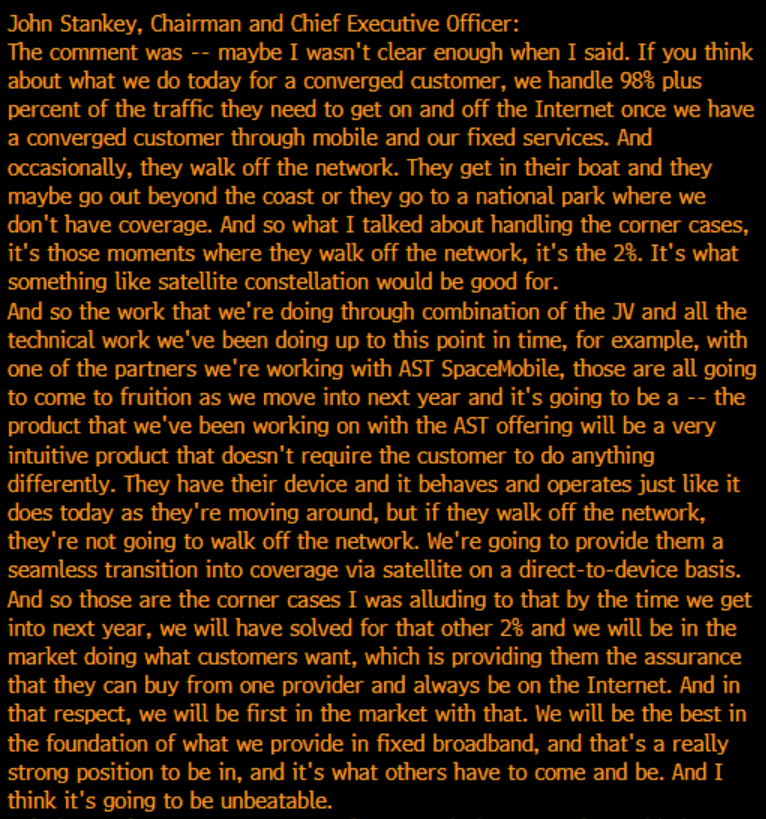
$ASTS:Gartner Forecasts LEO Satellite D2D Connections in Australia & New Zealand to Reach 1.5M in 2027
“Gartner predicts 100% geographic outdoor mobile coverage will become a baseline customer expectation within 5 years”
“CSPs are highly motivated to deploy D2D to reduce churn”
*AMD AND ANTHROPIC SIGN A MULTI-BILLION DOLLAR CHIPS AND INVESTMENT AGREEMENT PER WSJ
*AMD WILL INVEST $5 BILLION INTO ANTHROPIC AS PART OF THE DEAL
*ANTHROPIC WILL BUY UP TO 2 GIGAWATTS OF AMD CHIPS
AMD INVESTS IN ANTHROPIC, ANTHROPIC USES THE MONEY TO BUY AMD CHIPS
PROFIT ?
I’m on a call right now with an ai expert based in china, mostly talking about Kimi however she just said GPU rental rates in China are now 3x higher than GPU rental rates in the US.