@nikitabier I am sure you will be missed in your team.
Fwiw, I became a super engaged user of X during your run.
Watching you shape this product from the side was a master class.
Another great hire by @elonmusk
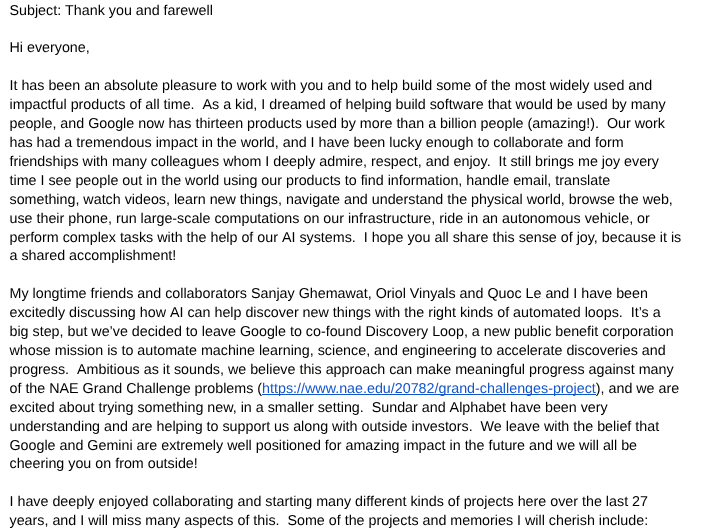
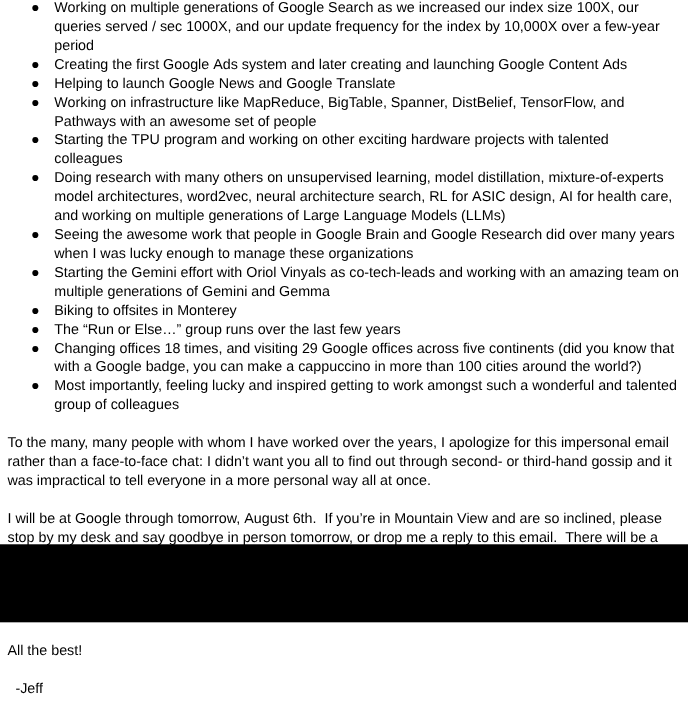
Tomorrow will be my last day at Google after 27 years, and watching it grow from 25 people to 190,000+ has been an amazing journey. Below is a note I shared with many people internally at Google today. An excerpt is:
It has been an absolute pleasure to work with you and to help build some of the most widely used and impactful products of all time. As a kid, I dreamed of helping build software that would be used by many people, and Google now has thirteen products used by more than a billion people (amazing!). Our work has had a tremendous impact in the world, and I have been lucky enough to collaborate and form friendships with many colleagues that I deeply admire, respect, and enjoy. It still brings me joy every time I see people out in the world using our products to find information, handle email, translate documents, watch videos, learn new things, navigate and understand the physical world, browse the web, use their phone, run large-scale computations on our infrastructure, ride in an autonomous vehicle, or perform complex tasks with the help of our AI systems. I hope you all share this sense of joy, because it is a shared accomplishment! Thank you to all of my colleagues at Google over many years!
Now I'm excited to go start @DiscoLoopAI with my longtime friends and colleagues @Sanjay_Ghemawat, @OriolVinyalsML, and @quocleix.
(Updated post: slightly redacted to not have some personal info)
@a16z Uber is still way lower than 0.5 trillion. I had setout to take over the transportation world across form factors but it never happend. Why does @a16z worship Travis so much?
I am particularly worries about pt 3. In the past I used to just make cold outreaches to get in touch with an expert and pick their brain. It did help me grow my network too.
However, now my network is limited to Claude
AI has been great for my productivity, but I’m starting to recognize three dark patterns:
1. Becoming too lazy to read anything
It's too easy to just read AI summaries over the original piece or let agents go wild changing my files without reviewing what they did.
2. Getting distracted by agents while I’m out
It’s too easy to open ChatGPT or Claude on my phone while I’m out to give feedback my agents and feel “productive,” even when I’m supposed to be watching my kids or doing literally anything else.
3. Preferring to talk to the agent vs. a human
This is a new pattern with ChatGPT Voice, I sometimes find myself preferring to brainstorm with the agent instead of the actual human in the room.
@AnikaSomaia@SemiAnalysis_ I had started to believe that the chance for smaller companies with low capital is over in this space. @Kimi_Moonshot proved otherwise
Our immigration policies need to be reformed to allow the best and brightest to be educated in the USA and stay here to create value for our country. As long as their values are aligned with the long-term interests of our country, their visas should be fast tracked.
Can someone in immigration help this young woman?
I wonder how come model routing is such a big deal. We need a high capability model just classifying the kind of work on a few dimensions and allocating. Do it enough times, measure the outputs and iterate to make the classifier better. Am I missing something?
Open-weight models like Kimi and GLM will cause a complete rethink of the enterprise AI stack.
If you are running an enterprise, you need to maximimize model optionality.
Here are 3 things you should be doing:
1. Evals - build rigorous evals representative of your use case
(a) Regression evals - tablestakes features that should always work with high reliability
(b) Aspirational / hill-climbing evals - harder use cases that the best model for your price point struggles to solve. So you scaffold it with prompting, context management and other techniques to overcome weaknesses or wait for a better model
These evals should be easy and quick to run. Eval velocity is a competitive advantage.
2. Model routing - Model selection is about tradiing off quality/cost/latency for your use case. If you have good evals, you know which models to route traffic to for different use cases.
This is something you ideally build yourself cos nobody understands your business and users like you do.
There are off the shelf routers, but I haven't seen one I would recommend yet.
3. Model-agnostic harness - your system should never know which model is behind the API call.
This means your harness normalizes prompt structure, context management, tool definitions, and output parsing across models, making it easy to switch... once your evals pass.
@signulll This is how tools should be. It should bend to the will of creator. Imagine if your pen stops writing just because your ideas are contrary to the general belief. Or your IDE stops letting you write an app just because the app breaks the norm.