Tolstói entendeu uma coisa sobre o amor moderno antes mesmo de existir Instagram, Tinder ou aplicativos de relacionamento.
Em Ana Karenina, o adultério não nasce simplesmente do desejo, nasce do tédio. Ana tem marido, filho, estabilidade, posição social, porém, tudo isso começa a parecer pequeno diante da promessa de uma vida “mais intensa”. Basta um baile, um olhar, um homem bonito chamado Vronski, e ela passa a acreditar que a felicidade está escondida em outro lugar.
É curioso porque o romance inteiro gira em torno dessa sensação muito contemporânea: a ideia de que paz virou sinônimo de monotonia. A vida comum parece insuficiente. Amar alguém por muitos anos parece pouco. Construir uma família parece menos emocionante do que perseguir uma paixão avassaladora.
Tolstói coloca isso diante de outro casal: Levin e Kitty. Enquanto Ana vive consumida pela necessidade de sentir algo novo o tempo inteiro, Levin aprende uma coisa muito menos cinematográfica: amar é cultivar. Tem rotina. Tem desgaste. Tem silêncio. Tem reconstrução.
E talvez seja justamente isso que o nosso imaginário desaprendeu.
A cultura moderna nos treinou para buscar intensidade emocional contínua, como se o amor verdadeiro precisasse parecer um baile eterno. Só que relações humanas não sobrevivem de dopamina. Elas sobrevivem de permanência.
Por isso Levin acaba entendendo algo que Ana nunca consegue aceitar: amar é arar a própria terra.
Você planta, cuida, perde colheitas, começa de novo. E, aos poucos, aquilo cria raízes.
Tolstói escreveu isso no século XIX. Continua parecendo um retrato do amor em 2026.
Major life hack: Don't complain, ever. Nobody likes a complainer. They drain the energy of everyone around them. It's exhausting spending time around someone who constantly complains about things outside their control. If it’s within your control, go do something about it. If it’s not, you’re just wasting energy thinking about it. Complaining gives too much power to the thing. Take back that power.
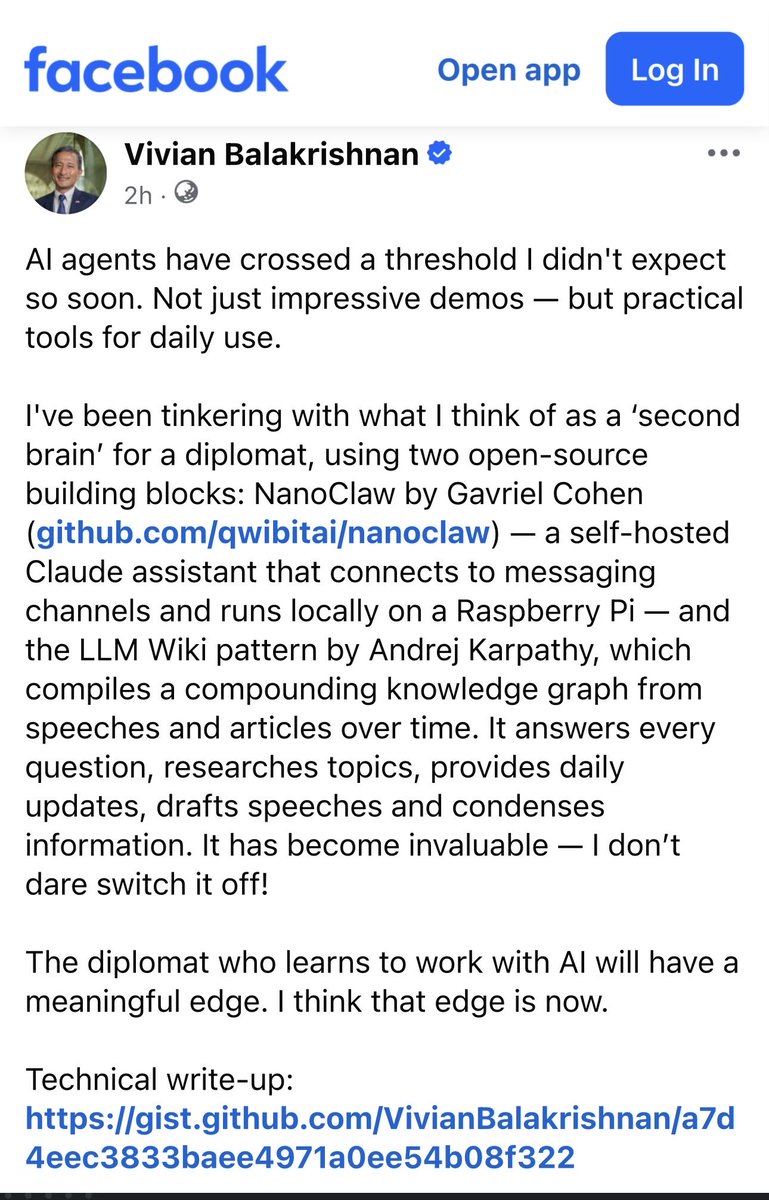
Singapore’s AI obsession just hit Everest peak.
The Foreign Minister is self-hosting Claude on a Raspberry Pi and building a diplomatic knowledge graph using Karpathy’s LLM Wiki pattern. Wahlao!
SG devs, the minister is coming for your job. And he’s not even using Cursor — he’s on NanoClaw running locally. Can someone git pull his code and give it a test.
Only bad thing? He dropped this on Facebook instead of X. Minister, we need to talk.
https://t.co/JzU3ZeBdPz
Stuff I wish I knew when I was younger:
1. Doing something poorly and consistently is better than doing it in a world class manner occasionally
2. Other people tell you to take risks bc they want to see what happens or have a free option if you win not bc they think it’s a good idea
3. Most people don’t think about you at all. But some people think about you a lot. If someone who is a baller takes an interest in you for no particular reason just run with it. One trick to vastly improve your relationship outcomes is spend time w people who like you (not ppl who ignore you or treat you poorly).
4. Everything in your life you can categorize as 1) addictive 2) enjoyable. And if you do a bunch of non addictive enjoyable things it’s quite likely you’ll be happier. If you stop doing that basket you’ll burn out, predictably
5. It’s a lot easier to deal directly with negative thoughts than it is to deal with the life circumstances generating them and most of the time you can actually deal w the circumstances more effectively if you’re not tilted
6. Most of the economy is a cartel defined by proximity to central banks, the government, and a small elite. The reason “contrarian” ideas work isn’t because they’re good. It’s bc they’re “king made”. It’s decided in advance who is going to win. You need to decide if you’re going to play or not. There is no halfway
7. Being mad about the system being rigged is a waste of time it’s a lot better to just bet on it, or invest with that as an edge bc most people aren’t blackpilled enough.
8. Most studies - especially social science studies have criminally low r sq or poor methodology. Such that most things you read online don’t actually work. At the same time - your own response to things is fairly predictable. So if you find something that works - you can just go back to that - a lot more easily than optimizing something new
9. Life getting worse after 30 is a scam. Actually - it might genuinely get worse for most people. But it doesn’t have to. The people who most loudly tell you what you need to be happy are the least happy people
10. Over time your outcomes are mostly determined by the quality of your network, your investment rate of return and your tax rate. But every once in a while you can do something non linear that can be a home run. It’s best to do non linear things during asset bubbles or when you have a hot hand. It’s not a good idea to do non linear things when there isn’t strong investor appetite for risk taking
11. Your behaviors will tell you stuff you’re not dealing with. If you’re overeating or sleeping poorly it’s probably bc there’s something you haven’t acknowledged or faced or are putting off
12. As you move towards a singularity , accelerating progress or a purported societal shift the predictability decreases - rather than increasing. People are the most certain at maximum acceleration when the very nature of acceleration or complexity suggests they should do the opposite. If AGI is coming start thinking 1 week out not 3 years out
Your moat isn’t the model.
It’s the memory architecture + decision harness around it.
Same model, different memory loops = completely different outcomes.
Build the harness first. Swap models later.
https://t.co/t85e6t7lhb
my experience with gpt 5.4 in openclaw
- pls continue
- yes pls do that
- yes do what i told you to do
- yes continue
- please do what you said you're gonna do
- did you do that? no. then pls do it.
just pure pain
I actually wrote this back on March 18th to explain things to my Korean friends, but I'm posting it here on X as well since so many ppl still seem to get it wrong.
Global Total Crude Inventory = Commercial MOI + Commercial Available Inventory + Surplus crude + SPR
The world looks like it’s overflowing with oil, but prices don’t wait for all 2 billion barrels of global inventory to vanish before they spike. Every single time oil crossed $100/bbl, it was the same story.
Take the US as the prime example. Right now, US commercial crude inventory is sitting around 440 million barrels, but that number physically cannot drop below 280–300 million.
You might say, "What the hell are you talking about? Just draw it down, you idiot lol." But let’s look a bit closer.
That "Commercial MOI" I mentioned stands for Minimum Operating Inventory. This isn't oil sitting in a refinery tank or a hub ready to be used instantly.
MOI is the volume physically locked in the system you cannot pull out. It’s the baseline required just to keep the entire US oil system running.
Here are the main components:
1) Linefill: This is the oil filling the entire pipeline network across the US. bc of the "push from one end to get out the other" structure, about 110–120 million barrels must stay in the pipes at all times.
2) Tank Bottoms: This is the volume at the very bottom of storage tanks that pumps literally can’t reach. Estimated at around 80–90 million barrels.
3) In-transit & Working Stock: The minimum volume sitting on tankers, barges, or waiting at refineries to be blended and fed into the units. Without this base feed, the refinery simply stops.
Just combining Linefill and Tank Bottoms (Unavailable Stocks) gives you ~200 million barrels. Add the Working Stock needed for operational flexibility, and ~300 million barrels becomes the actual hard floor.
I used the US as an example, but you probably get the point by now. The "Global Total Onshore Inventory" figure includes all that MOI—Linefill, Tank Bottoms, etc.
Since it’s global, we don't have the exact numbers, but this MOI accounts for 60-70% of the total figure. Minimum Working Stock is another 20-25%.
Most of those 2.3 billion barrels are scattered across tens of thousands of kilometers of pipelines and the bottoms of thousands of storage tanks.
The vast majority is essential just to keep the system alive; it’s physically impossible to gather it all in one place and dump it onto the market.
Therefore the actual available crude—the delta actually moves prices and balances—is much smaller than ppl think. That’s why the oil market sees massive price swings even over a quarterly shift of just 1mb/d.
Think of the "buffer" I mentioned as cash on hand for immediate liquidity. The rest of those 2.3 billion barrels? That’s like your factory equipment.
No matter how much equipment you have, if you run out of cash, you go bankrupt. The oil market is the same; once that tiny sliver of available crude vanishes, the system hits a crisis and faces desperate bidding.
Right now, we are in the phase of burning through the "excess cash" in the corporate account. And we're doing it very fast. Next we'll start dipping into personal savings.
But like most business owners, there isn't actually much cash in the personal account. It’ll run dry in no time.
Now imagine if you knew as long as you kept the factory running, you could eventually pay off the debt and fix the cash flow—but right now you don’t have a single cent of available cash. What happens?
To keep the factory from going under, you’d do anything to scrape together cash for the electric bill and payroll. You’d sell your kid’s iPhone or even put your wife on the street—you’d do anything desperate to get that cash.
Once we hit that stage, prices go absolutely vertical. Bottom line: when the buffer is gone, you have to start withdrawing all available commercial inventory. The pace will be lightning fast.
Even the ppl who were sitting on the sidelines hoping for the war to end will start bidding desperately bc they need oil 'right now'. I’m not just acting calm or pretending I’m okay with this taking a long time.
Even if you believe a long position is the way to go, there’s a specific process and setup must be cleared for the environment to force prices up. And it won't take that long.
Until then I expect vol to be absolutely violent in both directions.
#oott #com
Robert Mueller died last night.
He was 81 years old. He had a wife who loved him for sixty years. He had two daughters, one of whom he met for the first time in Hawaii, in 1969, on a few hours of military leave, before he got back on the plane and returned to Vietnam. He had grandchildren. He had a faith he practiced quietly, without performance. He had, in the way of men who have seen real things and survived them, a quality that is increasingly rare and increasingly mocked in the country he spent his life serving.
He had integrity.
And tonight the President of the United States said good!
I have been sitting with that word for hours now. Good. One syllable. The thing you say when the coffee is hot or the traffic is moving. The thing a man who has never had to bury anyone, never had to sit in the specific silence of a room where someone is newly absent, reaches for when he wants the world to know he is satisfied. Good. The daughters are crying and the wife is alone in the house and good.
I want to speak directly to the Americans reading this. Not the political Americans. Just the human ones. The ones who have lost a father. The ones who know what it is to be in that first hour, when you keep forgetting and then remembering again, when ordinary objects become unbearable, when the world outside the window seems obscene in its indifference. I want to ask you, simply, to hold that feeling for a moment, and then to understand that the man you elected looked at it and typed a single word.
Good.
This is not a country having a bad day. I need you to understand that. Countries have bad days. Elections go wrong. Leaders disappoint. Institutions bend. But there is a different thing, a rarer and more terrible thing, that happens when the moral center of a place simply gives way. Not dramatically. Not with a single catastrophic event. But quietly, in increments, until one evening a president celebrates the death of an old man whose family is still warm with grief, and enough people find it acceptable that it becomes the weather. Just the weather.
That is what is happening. That is what has happened.
The world knows. From Tokyo to Oslo, from London to Buenos Aires, people are not angry at America tonight. Anger would mean there was still something to fight for, some remaining faith to be betrayed. What I see, in the reactions from everywhere that is not here, is something older and sadder than anger. It is the look people get when they have waited a long time for someone they love to find their way back, and have finally understood that they are not coming.
America is being grieved. Past tense, almost. The idea of it. The thing it represented to people who had nothing else to believe in, who came here with everything they owned in a single bag because they had heard, somehow, across an ocean, that this was the place where decency was written into the walls. That idea is not resting. It is not suspended. It is being buried, in real time, with 7,450 likes before dinner.
And the church said nothing.
Seventy million people have decided that this man, this specific man who has cheated everyone he has ever made a promise to, who has mocked the disabled and the dead and the grieving, who celebrated tonight while a family wept, is an instrument of God. The pastors who made that bargain did not just trade away their credibility. They traded away the thing that made them worth listening to in the first place. The cross they carry now is a costume. The faith they preach is a loyalty oath with scripture attached. When the history of American Christianity is written, this will be the chapter they skip at seminary.
Now I want to talk about the men who stand next to him.
Because this is the part that actually breaks my heart.
JD Vance is not a bad man. I have to say that, because it is true, and because the truth matters even now, especially now. Marco Rubio is not a bad man. Lindsey Graham is not a bad man. They are idiots, but not bad, as in BAD! These are men with mothers who raised them and children who love them and friends who remember who they were before all of this. They are not monsters. Monsters are simple. Monsters do not cost you anything emotionally because there is nothing in them to mourn.
These men are something more painful than monsters.
They are men who knew better, and know better still, and will get up tomorrow and do it again.
Every small compromise they made had a reason. Every moment they looked the other way had a justification that sounded, at the time, almost reasonable. And now they have arrived here, at a place where a president celebrates the death of an old man and they will find a way, on television, to say nothing that means anything, and they will go home to houses where children who carry their name are waiting, and they will say goodnight, and they will say nothing.
Their oldest friends are watching. The ones who knew Rubio when he still believed in something. Who knew Graham when he said, out loud, on the record, that this exact man would destroy the Republican Party and deserve it. Who sat next to Vance and thought here is someone worth knowing. Those friends are not angry tonight. They moved through anger a long time ago. What they feel now is the quiet, irrecoverable sadness of watching someone disappear while still being present. Of watching a person they loved choose, again and again, to become less.
That is what cowardice costs. Not the coward. The people who loved him.
And in the comments tonight, the followers celebrate. People who ten years ago brought casseroles to grieving neighbours. Who stood in the rain at gravesides and meant the words they said. Who told their children that we do not speak ill of the dead because the dead were someone's beloved. Those people are tonight typing gleeful things about a man whose daughters are not yet done crying. And they feel clean doing it. Righteous. Because somewhere along the way the thing they were given in exchange for their decency was the feeling of belonging to something, and that feeling is very hard to give up even when you can no longer remember what you gave for it.
When Trump is gone, they will still be here.
Standing in the silence where the noise used to be. Without the permission the crowd gave them. Without the pastor who told them their cruelty was holy. They will be alone with what they said and what they cheered and what they chose to become, and there will be no one left to tell them it was righteous.
That morning is coming.
Robert Mueller flew across the Pacific on military leave to hold his newborn daughter for a few hours before returning to the war. He came home. He buried his dead with honour. He served presidents of both parties because he understood that the institution was larger than any one man. He told his grandchildren that a lie is the worst thing a person can do, that a reputation once lost cannot be recovered, and he lived that, every day, in the quiet and unglamorous way of people who actually believe what they say.
He was the kind of American the world used to point to when it needed to believe the story was true.
He died last night. His wife is alone in their house in Georgetown. His daughters are learning what the world is without him in it. And somewhere in the particular hush that falls over a family in the first hours of loss, the most powerful man and the biggest loser on earth sent a message to say he was glad.
The world that loved what America was supposed to be is grieving tonight. Not for Robert Mueller only. For the country that produced him and then became this. For the distance between what was promised and what was delivered. For the suspicion, growing quieter and more certain with each passing month, that the America people believed in was always partly a story, and the story is over now, and there is nothing yet to replace it.
That is all it needed to be.
A man died. His family is broken open with grief.
That is all it needed to be.
Instead the President said good.
And the country that once stood for something looked away 🇺🇸
Gandalv / @Microinteracti1
Millennials are the elite generation because they cranked out 12-page essays the night before they were due. No ChatGPT. No Claude. Just lo-fi beats playing in the background, Black coffee at midnight, footnotes that were somehow correct, and pure delusion. Grade was an A minus. Period.
vibecoder asks claude code to build a chat app, gets a working prototype in 20 minutes, immediately tweets "just killed slack and discord"…
brother you don't even know what a distributed system is. you don't know what database replication means. you have no idea how websocket connections behave at scale or what happens when 50k people are online at once and someone's message needs to show up in 200ms across 3 continents
slack has engineers making $300k+ who have spent a decade solving problems you don't even know exist yet. race conditions, eventual consistency, message ordering, presence systems, file storage at scale, search indexing across billions of messages
your app works on localhost with 2 connections. that's not the same thing as "killing slack" that's a college homework assignment
the prototype is maybe 0.5% of what makes these products actually work in production. the remaining 99.5% is infrastructure, reliability, edge cases, and years of iteration on problems that only surface when real humans use your thing at scale
and the worst part is the confidence. "yeah its not perfect but ai one-shotted it, just need to adjust a few things and deploy" - the few things you need to adjust IS the entire product. thats like pouring a foundation and saying you basically built a skyscraper, just need to adjust a few things
ai is genuinely incredible for building tools and prototypes. i use it every day. but there's this weird thing happening where people who have never shipped anything to real users at scale now think the hard part of software is writing the first 200 lines of code
it never was bro