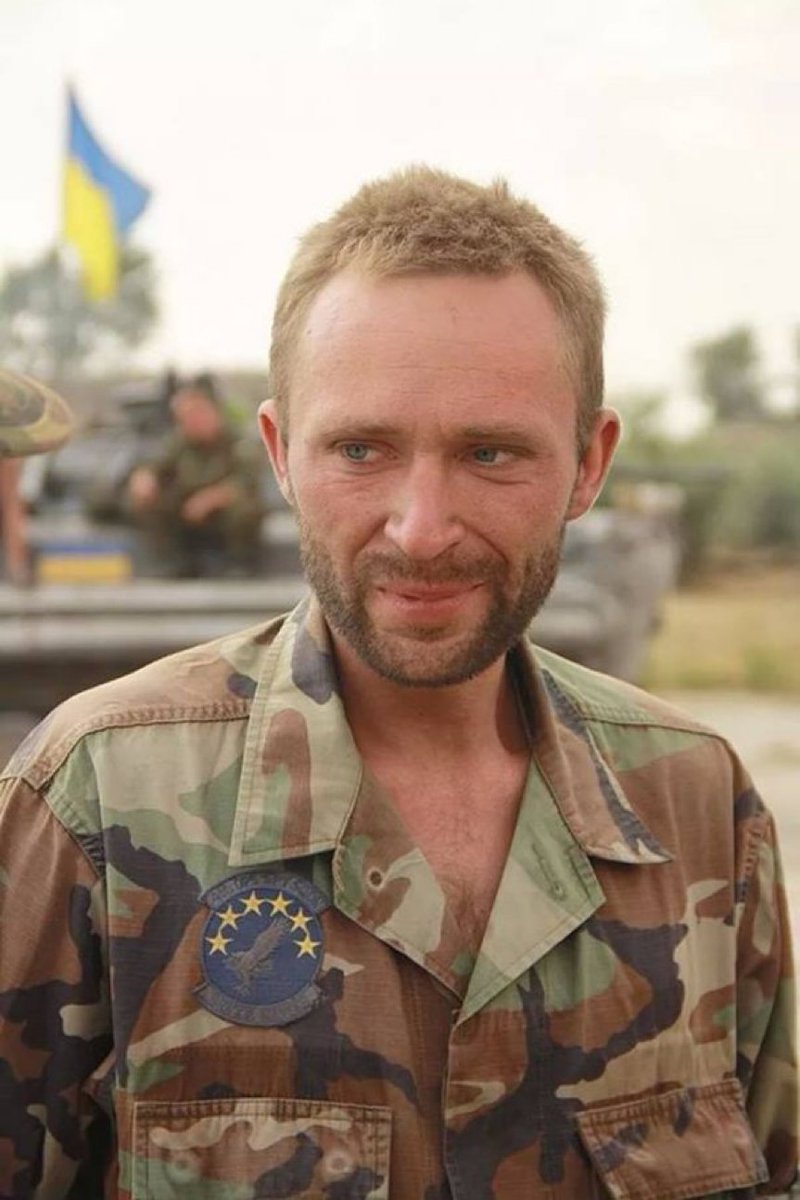
If memory serves me correctly, the new top commander of Ukraine’s Armed Forces began this war in the Donbas in 2014 as a battalion leader, serving in the rank of major with the valiant 72nd Mechanized and leading troops in BMPs.
Those who were mid-ranking officers back then and grew through that war into a new generation of combat leaders are now, at last, gradually taking full command of the Armed Forces, alongside those who, like the leaders of the heroic defense of Mariupol, rose to senior ranks during the full-scale war that began in 2022.
And this should have happened much, much earlier.
Welcome Mykhailo Drapatyi as new Ukraine’s Commander In Chief.
Very solid choice.
As a Ukrainian soldier, I fully support and trust General Drapatyi! Godspeed! 🫡
Syrskyi is out. Drapatyi is in. The General Staff faces an overhaul.
Tonight you will hear that Zelensky ‘caved.’ That the street now runs the war. That changing commanders mid-war is chaos.
I see the opposite — and I wrote it this morning: a leader who can be argued back into the right position by his own citizens is not weak. He is governed.
But don’t miss the deeper event. This was never about two men. It was a referendum on military doctrine — the Soviet inheritance of centralized command versus the war Ukraine actually proved it could win: software, iteration, initiative at the edge.
The old doctrine just lost its chief defender.
And look at who won. Drapatyi is the general who once offered his resignation because a Russian strike killed his recruits — he claimed responsibility for deaths he did not cause. In Moscow, generals collect medals for deaths they did cause.
That is the difference between the two armies. Tonight it became the difference between the two futures.
Fedorov’s return is still unresolved. The doctrine question no longer is.
Six days of protest. Zero broken windows. One corrected government.
Democracies argue. That is not their weakness. It is their weapons system.
People keep asking what the Soviet occupation actually cost the Baltic states. You don't have to imagine it. There's a control group, and it's sitting right across the gulf.
In 1938 — the last full year before the war — Estonia and Finland had essentially the same GDP per capita. Two small nations, same sea, neighboring languages, the same starting line. By some rankings Estonia was even slightly ahead. Heritage FoundationX
Then history split in two.
Finland fought the Winter War and kept its independence. Estonia was occupied, annexed, and folded into a planned economy. Same decade, opposite roads.
Fifty years later:
🇫🇮 Finland — ~$24,000 per person (1992)
🇪🇪 Estonia — ~$2,800
An eightfold gap — from an identical starting point. Not because Finns worked harder. Not because Estonians were less capable. One country was free to build. The other was told what to build, for whom, and at what loss.
The wages say it even more cleanly: in 1938 Estonian purchasing power was just 4% below Finland's; by 1988 it was 42% below. That cliff is the occupation, drawn in numbers.
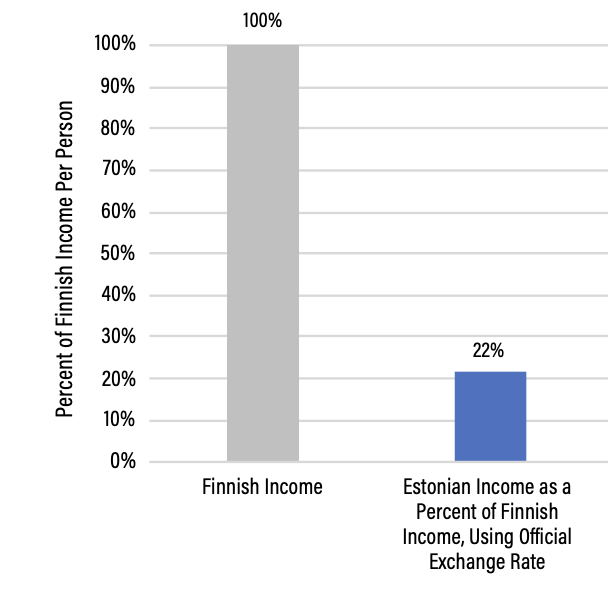
And here's the part that ends the argument. Set free for a single generation, Estonia has already clawed back to roughly four-fifths of Finnish income. A gap that took 50 years to open is closing in 30. That's the proof it was never about us — it was the system imposed on us.
There's a cost that never shows up in GDP, either. No occupation means no cattle cars to Siberia. No murdered and exiled intelligentsia. No decades of settlers moved in to outnumber the natives — which means the very "Russian-speaking minority" Moscow is now parading before the ICJ wouldn't exist at anything like that scale. The grievance Russia is litigating is one it manufactured itself.
So no — we don't wonder what we lost. We can see it from the ferry.
And free at last, it's what we're finally becoming again. 🇪🇪🇱🇻🇱🇹
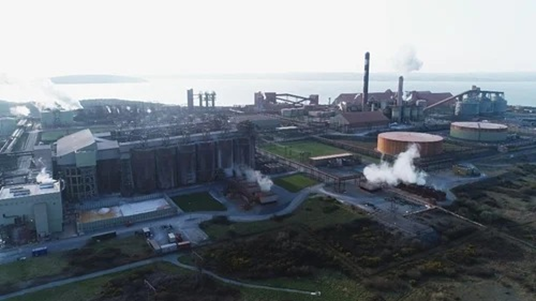
⚡⚡⚡BREAKING: Ireland’s dirty secret exposed: Data reveals Ireland’s Aughinish Alumina factory — owned by Russian giant Rusal — shipped a staggering 83% of its exports (200,619 tons) to Russia in Q1 2026 alone. While PM Micheál Martin claims sanctioning it would “hurt the EU more than Russia,” the truth is this Irish plant is fueling Putin’s war machine: alumina → Russian aluminum → weapons killing Ukrainians. Official statistics crush the factory’s own lies (they claimed only 45% to Russia). As Ireland prepares to lead the EU Council, will Dublin keep blocking sanctions on its Russian-owned cash cow? Share if you want real sanctions.
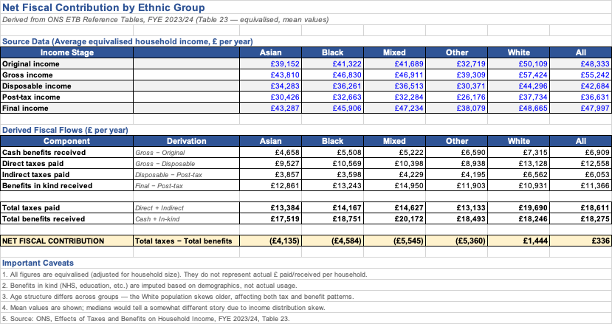
A chart was circulating on X recently showing net fiscal contribution by ethnic group in the UK. White positive, everyone else negative. It looked like the kind of thing someone fabricates for grift.
So I downloaded the original dataset - the ONS Effects of Taxes and Benefits reference tables for FYE 2023/24 - and ran the numbers myself from Table 23. The table gives average equivalised household income at each stage of the tax-benefit system, broken down by ethnicity: Asian, Black, Mixed, Other, and White.
The arithmetic is not complicated. The difference between income stages tells you what was added or subtracted at each step. Gross minus original income gives you cash benefits received. Gross minus disposable gives you direct taxes paid. Disposable minus post-tax gives you indirect taxes. Final minus post-tax gives you benefits in kind.
The results: White is the only group with a net positive fiscal contribution, at +£1,444 per year. Asian sits at -£4,135, Black at -£4,584, Other at -£5,360, and Mixed at -£5,545. The chart was not fabricated. The data is real, it's official, and it's current.
But the number alone is meaningless without understanding what drives it. And the answer is not what most people assume.
The gap is overwhelmingly a tax-side story - not a benefits story. Between 72% and 96% of each group's gap versus White is explained by lower taxes paid. On the benefit side, the White group actually receives the most cash benefits of any group at £7,315 per year, primarily because of state pension receipts from its older population. Asian households receive the least at £4,658. So the question is: why are taxes lower?
The first and most important factor is age structure. Census 2021 data shows the White population has a median age of 43. Asian and Black sit at 32. The Mixed group has a median age of just 19. A younger population means fewer people at peak earning years, more children and students not generating taxable income, and less accumulated private pension and investment income. This single variable probably explains more of the gap than anything else.
The second factor is employment. ONS labour market data shows White British employment at 76-77%, Indian at 77%, Black at 69%, and Pakistani/Bangladeshi at 61%.
But the employment numbers mask a specific structural issue: 48% of Pakistani and Bangladeshi women are economically inactive, with the gender gap in economic activity at 29 percentage points - the largest of any ethnic group. If one adult in a two-adult household is not in the labour market, household taxable income drops substantially.
This is a pattern largely driven by cultural expectations around family care and early family formation - Pakistani and Bangladeshi communities show marriage rates above 60%, higher fertility, and earlier childbearing than other groups.
The third factor is occupational entry. Even among those employed, ethnic minorities are disproportionately concentrated in lower-paying firms and lower-paying roles within those firms at the point of labour market entry. This initial gap then persists through careers.
Part of this traces back to migration policy. The post-war Commonwealth migration from 1948 to 1962 had zero skills filtering. Workers were recruited into textiles, transport, and steel. After 1962, family reunification became the dominant channel, bringing spouses, dependents, and elderly parents with no labour market selection at all. Even the Points-Based System from 2008 covers only about a quarter of total net migration - study, family, asylum, and irregular channels make up the rest.
A crucial caveat: the five broad ethnic categories in the ONS data obscure enormous variation. Indian households have employment rates matching White British, median hourly pay exceeding White British, and Attainment 8 scores of 59.4 versus 50.0 for White British pupils. Chinese pupils score 65.5. Meanwhile Pakistani/Bangladeshi employment sits at 61% with nearly half of women economically inactive. Lumping these together as "Asian" is statistically convenient but analytically misleading.
There is also a question of whether this is a permanent pattern or a transitional one. The educational data suggests the latter. Progress 8 scores - which measure value-added school progress - show Asian pupils at +0.51 and Black pupils at +0.26, both outperforming White pupils at -0.15.
University entry rates by age 19 run: Chinese 83.8%, Asian 67.8%, Black 63.5%, White 41.8%. Second-generation Bangladeshi and Indian men are 30 percentage points more likely to obtain degrees than White British peers. The employment rate gap has halved from 16 percentage points in 2004 to 8 in 2022. The cross-sectional fiscal snapshot captures populations at different lifecycle stages, not a permanent condition.
A few methodological points worth noting. The figures are equivalised - adjusted for household size - which compresses larger households downward, likely understating actual tax paid by larger Asian and Other households. Benefits in kind (NHS, education) are imputed based on demographics, not actual usage, so groups with more children mechanically receive higher allocations. And the framework captures only household-level taxes - employer NICs, corporate tax, and business rates are not attributed by ethnicity.
None of this is politically comfortable. But the data is from the ONS, the methodology is published, and the arithmetic is elementary. The net fiscal gap exists. Its principal driver is lower tax payments, not higher benefit receipt. Those lower tax payments reflect age structure, female economic inactivity in specific communities, and the legacy of migration policy that selected for labour needs rather than fiscal contribution. The educational trajectory suggests the gap is closing, but the cross-sectional snapshot does not yet reflect that.
If we want an immigration system that produces net fiscal contributors from day one - which, I think, we do - it needs to select on skills, earnings potential, and economic participation - not on family ties, asylum geography, etc.
🇱🇻 Kopš kura laika cilvēktiesības ir kļuvušas par diskusiju jautājumu?
📢 Pievienojies arī mums 6. novembrī plkst. 19:00 Doma laukumā!
Kopā esam stiprāki, lielāki un skaļāki!💪
📍Ja vēlies pievienoties protesta laikā, meklē mūsu balto karogu ar sarkano uzrakstu un nāc pie mums.
Magyar on the line.
Enough running from the army – it’s time to fly!
I’m announcing recruitment to the ranks of the Unmanned Systems Forces (USF).
15,000+ vacancies, half of which are roles from civilian life.
‼️ You will serve where you choose and as who you personally choose – that’s a commander’s word.
Just type three letters online: U S F or use the link:
👉 https://t.co/5EGEEhuhvE
Twelve “Bird” units are waiting for you!
Drone, munition, and all gear are waiting for the pilot – not the other way around. Leave that hassle to me. We’ll train you, get you airborne, and keep you safe.
In just 5 months, the USF group has delivered results:
30,000 sent off and permanently removed from the enemy’s “special military operation”, over 100,000 enemy targets destroyed or neutralized in 150 days.
That’s the equivalent of two full russian army assault corps down. Or, for those who prefer simpler math – 50 fully manned battalions.
We aim to become 5% of the total manpower of Ukraine’s Defense Forces.
Without a doubt, we’ll achieve our mission: a continuous Drone Line from flag to flag along the entire current front line – at tactical, operational, and strategic depth.
Join us – the war is in full swing.
(c) Commander of the USF Robert MAGYAR Brovdi
30.10.25
🧵1/25 Čau, mani sauc Inese un es pēdējo pusgadu pavadīju laiku kopā ar telefonkrāpniekiem Gruzijā. Lasīju viņu iekšējās sarakstes, skatījos, ko glabā datoros, klausījos, kam viņi zvana, redzēju, cik nopelna un kur sazagtos miljonus iztērē.
Pavedienā izstāstīšu, kā tā sanāca.
🇱🇻🫡 "Ja man tagad būtu 18 gadi, es domāju, ka es būtu izveidojis ļoti labu militāro karjeru, " tā @LatvijasTV redaktors un raidījumu vadītājs Uģis Joksts par savu pieredzi rezervistu militārās pamatapmācības kursā. Līdz 29.04. piesakies vasaras kursam - https://t.co/b1yce34Fzj
I can not imagine better news to wake up with here in Latvia! 🇱🇻🥳 #Flow has won the best animated film at the #Oscars2025 So proud of our guys and director @gintszilbalodis . First Oscar for a movie from Latvia EVER. Such a historical and beautiful moment! And UNBELIEVABLE.
Pirms 10 gadiem es iestājos @zemessardze_LV. Toreiz uzrakstīju rakstu par to kāpēc. Katrs vārds ir tikpat atkuāls šodien. Aicinu visus nevis tikai klaigāt, ka valdība nedara un viss slikti, bet pajautāt sev, "ko es var darīt valsts aizsardzībā?".
Raksta teksts šeit:
Es izlēmu un iestājos zemessardzē
Radio skan prezidenta balss. Izsludināts kara stāvoklis, militārie spēki ir mobilizēti, un NATO 5. pants ir iedarbināts. TVNet redzamas bildes, kurās zaļie vīriņi ieņēmuši galvenās Daugavpils ēkas. Krievijas karaspēks veic masīvus manevrus pie valsts robežas. Latvijai ir jāiztur 72 stundas, kamēr ierodas nopietni NATO spēki.
Lai arī šķiet, ka šis scenārijs ir maz ticams, iespējamība noteikti ir lielāka par nulli. Un, kamēr mūsu augstākās amatpersonas tautu mierina, stāstot, ka viss būs labi, es zinu, ka daudzās ģimenēs ir runāts par to, ko darīt, ja X stunda pienāks. Mēs ar sievu arī apspriedām. Es sievai paziņoju, ka cīnīšos par savu Tēvzemi.
Taču nesen sapratu, ka tomēr nebiju nopietni izlēmis. Padomāju, ko reāli darītu, ja ļaunais scenārijs piepildītos. Stāvētu bez ieroča barikādēs Vecrīgā? Brauktu uz veikalu pēc gaisenes? Aizsoļotu uz Aizsardzības ministriju un pirmajam ierēdnim pateiktu, ka man ir maģistra grāds no Stenforda universitātes biznesa skolas, gribu palīdzēt?!! Nē, pašam kļuva skaidrs, ka īstenībā rīcības plāna man nav un tie ir tukši vārdi.
Ja iestāsies X stunda, Latvijas iedzīvotāji dalītos trīs grupās: militārie un drošības spēki, bēgļi un pārējie civiliedzīvotāji. Pēdējā grupa cerētu, ka viņiem laimēsies un karš viņus nepamanīs. Sapratu, ka īstenībā neesmu starp cīnītājiem, tikai izliekos. Tāpēc pirms dažām dienām nodevu zvērestu zemessardzē, jo tā ir vienīgā organizācija, kas iesaista civiliedzīvotājus valsts aizsardzībā.
Lai arī mēs ceram, ka tā stunda nepienāks, taču, ja tāds brīdis notiks, tad civilās pasaules zināšanas un iemaņas kļūs otršķirīgas. Tajā brīdī NATO un mūsu militārais (un diplomātiskais) spēks būs vienīgie rīki, ar kuriem nodrošināt, lai neatkārtojas 1949.gada deportācijas un netiek iznīcināta mūsu mazā tauta.
Protams, ir vietā pārmetumi, ka mana rīcība ir jau gadu (vai pat daudzus gadus) nokavēta. Bet labāk vēlu nekā nekad. Līdz šīs vasaras beigām būšu izgājis pamata apmācības, līdz ar to būšu noderīgs valsts aizsardzībai. Pievienojoties daudziem brīvprātīgajiem, kas jau darbojas zemessardzē, arī skaitliski palielinām varbūtību, ka ļaunākais scenārijs varētu nesākties.
Iestāšanās neapšaubami bija pareizs lēmums. Pirms tam par zemessardzi zināju maz un sevi par militāru cilvēku noteikti neuzskatīju. Izrādās, zemessardzē ir vieta arī biroja žurkām un mazu bērnu tēviem kā es. Apmācībās jutos negaidīti pacilāts, redzot, ka arī pārējie zemessargu kandidāti uzklausījuši aicinājumu palīdzēt Latvijai. Nedzirdēju ikdienišķo vaimanāšanu par to, cik šī valsts ir slikta. Vēl viens pluss ir stimuls uzturēt sevi formā, lai spētu tikt līdzi tādiem (un tādām), kuri ir divdesmit gadus par mani jaunāki.
Nevienam nevar pārmest lēmumu palikt civiliedzīvotāja statusā. Bet tiem, kā es, kas sasapņoju��ies nereālas atbildes uz jautājumu, kā rīkoties X stundā, pastāv iespēja to mainīt.
Vēl nav pienācis 2024.gada 24.februāris.
Ir 2019.gada vasara. @AizsardzibasMin organizē pirmo "grantu projektu konkursu inovatīvu militāra vai divējāda lietojuma produktu attīstībai".
Piesakamies arī mēs ar @Baltic3D. Projekta tēma - izveidot rezerves detaļu digitālo bibliotēku, lai X.stundā ir gatavi dizaini, kurus var drukāt ar 3D printeriem vai CNC frēzēm, kas ir LV uzņēmumu rīcībā. Projektu noraida.
2020.gadā 2.konkurss. Piesakāmies. Esam viens no uzņēmumiem, kam piešķir grantu - https://t.co/tBapC7RTeR
Grants - 10k EUR, uzņēmumam jāinvestē arī savi 10k.
Tiekamies ar desmitiem NBS un Zemessardzes pārstāvjiem, redzam simtiem problemātisku detaļu. Kopā izvēlamies 5-10, kurām uztaisām 3D modeļus, izdrukājam detaļas, iedodam testēt. Projekts pabeigts.
Mēnešiem pēc tam mums zvana NBS un Zemessardzes pārstāvji ar 2 jautājumiem:
1) atradām nākamās vajadzības, kad varēsiet uzprotipēt? Atbildam, ka projekts beidzies, viss @AizsardzibasMin rokās.
2) mums ir priekšlikums prototipa pilnveidošanai, kad varam runāt par iterāciju nr.2? Atbildam, ka projekts beidzies, viss @AizsardzibasMin rokās.
Vairākkārrīgi mēğinam runāt ar @AizsardzibasMin - 0 rezultātu.
Pienāk 2022.gada 24.februāris.
Pirmā saziņa ar @AizsardzibasMin 2022.gada 18.martā. Saku "šis ir tas brīdis, kas tā 3D modeļu bibliotēka noderētu. Visi krata ar galvu - jā, noderētu".
Jautāju, ko daram? Klusums.
2022.gada maijā ar LV uzņēmēju aizejam uz @AizsardzibasMin un pārādam prototipu dronam, kas var nest 4 lādiņus. Ideja no šī raksta.
2022.gada galvenais iebildums - nevar veidot rezerves detaļu 3D modeļus un prototipēt, jo Latvijai ir saistoši noslēgtie 20-40 gadus veco iekārtu ekskluzīvie rezerves daļu piegādes līgumi.
2023.gada septembrī pārsūtu šo ziņu - https://t.co/prgEybJq1S
Pēdējo reizi ar @AizsardzibasMin runāju 2024.gadā. Pieeja nebija mainījusies.
Turam īkšķus, ka kara gadījumā piegādes notiks saskaņā ar miera laika piegāžu līgumu termiņiem no citām valstīm.
2020.gadā tas notiktu lēnāk nekā šodien, kad ir desmitiem AI rīku, kas spēj analizēt 3D modeļus. Bet 3D modeļi ir pirmais solis.
Ministr, @AndrisSpruds jums ir plāns, kā ražot rezerves detaļas Latvijā?
Cik detaļu 3D modeļi varētu būt izstrādāti 4 gadu laikā?
ASV analizē desmitiem tūkstošu detaļu, te viens no linkiem, 2024.gada jūnijs - https://t.co/DFHNkihUl6.
@EvikaSilina 4 x4 plāns.
@edgarsrinkevics & @Rajevskis
In 732 AD, a Muslim army swept into France.
Nothing had stopped them before. Kingdoms had fallen. Cities had burned.
Then, at Tours, one man stood in their way—Charles Martel.
What happened next decided the fate of Europe:
‼️ BREAKING NEWS ‼️
The European Parliament has approved a €35 billion loan to Ukraine.
Who will pay for it?
Russia!
How?
The loan will be paid using profits from Russia's frozen assets.