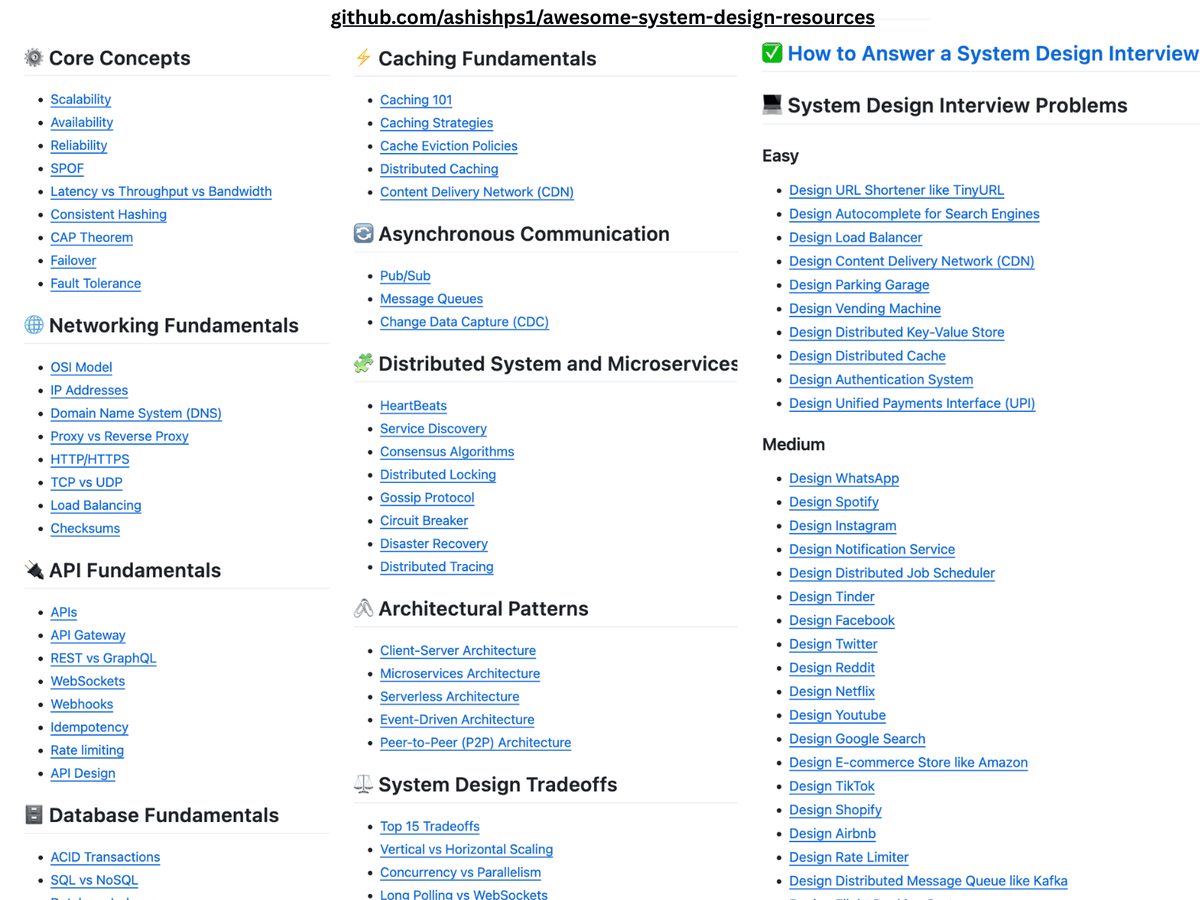
4 GitHub Repositories to Prepare for 4 Different Types of Software Engineering Interviews:
1. System Design Interviews: https://t.co/pkVpi6LxSV
2. Low Level Design Interviews: https://t.co/ewnEgFdlfF
3. Coding Interviews: https://t.co/oTez9H4sGh
4. Behavioral Interviews: https://t.co/NsN4Ki0wlz
♻️ Repost to help others in you network
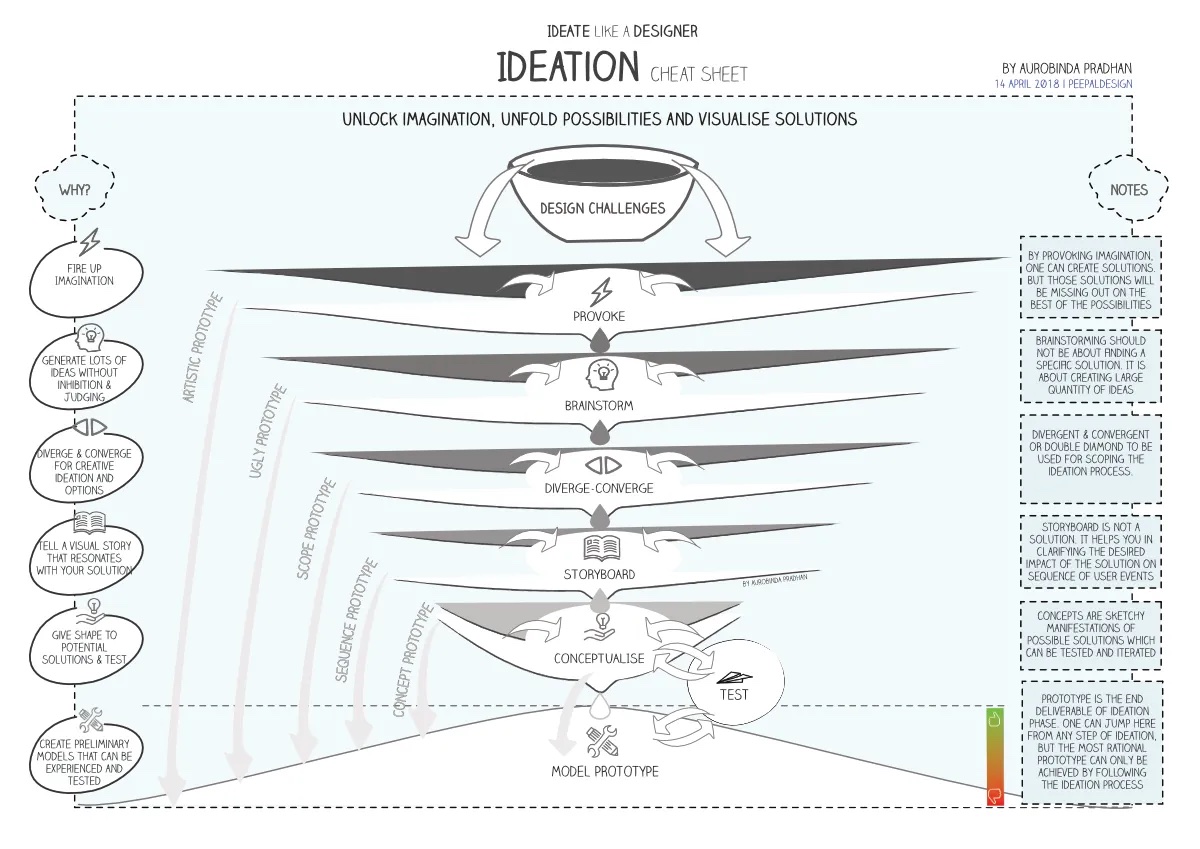
Learn about Design Thinking with these Four Excellent Sketch Cheatsheets 🔥🔖
Four FREE Design Thinking Cheatsheets attached 🙌
Overview:
1. DESIGN THINKING OVERVIEW
UNDERSTAND & EMPATHISE
DISCOVER WHAT PEOPLE REALLY NEED. SENSE & SHARE THE SAME FEELINGS THAT OTHERS FEEL
2. SYNTHESIS
COLLATE YOUR UNDERSTANDING IN ORGANISED MANNER FOR SENSE MAKING AND CREATIVE INTERPRETATION
3. EMPATHY
COLLATE YOUR UNDERSTANDING IN ORGANISED MANNER FOR SENSE MAKING, DESIGN CHALLENGE DEANITION AND CREATIVE INTERPRETATION
4. IDEATION
UNLOCK IMAGINATION, UNFOLD POSSIBILITIES AND VISUALISE SOLUTIONS
by @auropradhan
#ux #uxdesign #ui #uidesign #productdesign #uxprocess #uxstrategy #design #designthinking #research #userresearch #uxresearch #usertesting #usability #usabilitytesting #prototyping #agile #mvp #startup #digital #ideation #userexperience #business #startup
This repository contains everything you need to become proficient in #DataAnalytics with 45 end-to-end implemented projects — compiled by @NainaChaturved8
https://t.co/4iaUN4PfTC
Here is the process to design the perfect database:
1- Design your database following the rules you learned at school.
2- Make sure you normalize every table.
3- Write a simple script that generates millions of fake rows.
4- Identify the most important queries that your application will execute on your data.
5- Measure how long each query takes. Any database system will let you measure this.
5- Start denormalizing your data. Break expensive relationships and bring the data together. Measure after every change.
Start following the rules. Measure. Then break the rules.
Frontend Unit Tests.
🟡 The Gold Standard 🟡
Everyone racing for top coverage.
But reality looks much much different.
When NOT to Write Frontend Unit Tests:
• PoCs/MVPs: Here today, irrelevant tomorrow.
• UI part that is changed a lot: Don't waste your time.
• Experimental features: Can change any minute.
• Basic static components: Not worth it.
• Overwhelming mocking: Value > Effort.
• Deadlines: Especially in startups.
• Limited resources: Business value first/early phase.
• Redundant scenarios: 100% coverage is not the goal.
• Backend is more important: Frontend is changing much more often.
When TO Write Frontend Unit Tests:
• Critical features: Some things just can't fail.
• Complex logic: Once stable of course.
• Reusable components: The Foundation.
• Regression prevention: When it breaks often.
• Set in stone features: Worth the effort.
• Documentation: Tests can be great for that.
• Pre-refactoring: Before embarking on refactoring.
• Integration points: Vulnerable places.
Business Perspective:
• User Focus: E2E reflecting customer experience.
• Cost Efficiency: E2E tests can catch critical bugs.
• Time Savings: Reducing emphasis on unit tests can speed up development cycles.
• Real-world Relevance: E2E tests in near-production environments offer tangible insights.
• Simplified Reporting: E2E results are often more digestible for non-technical stakeholders.
• Coverage Overkill: Extensive unit tests can be redundant with a strong E2E suite.
• Maintenance Overhead: Frontend changes might require frequent unit test updates.
Businesses often lean towards ROI.
E2E tests often provide clearer value.
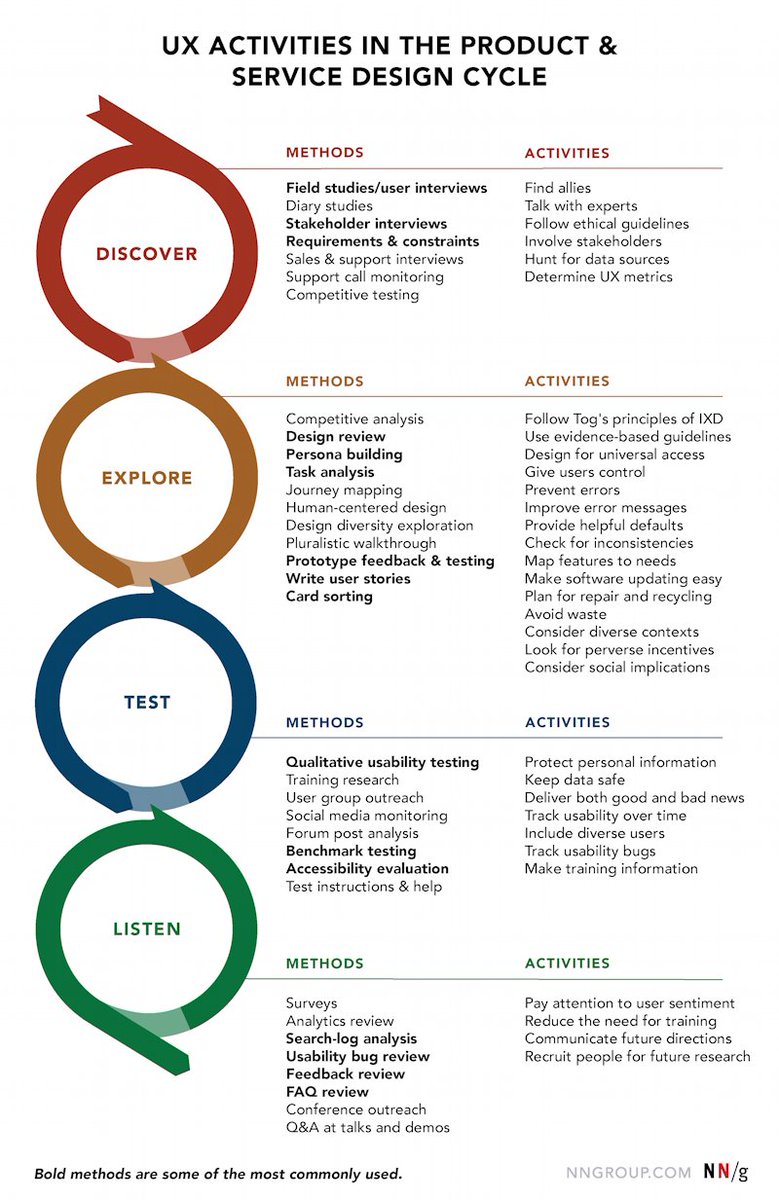
Excellent UX Research Cheat Sheet! 🚀🔖
User research can be done at any point in the design cycle. This list of methods and activities can help you decide which to use when.
Overview:
User-experience research methods are great at producing data and insights, while ongoing activities help get the right things done.
Alongside R&D, ongoing UX activities can make everyone’s efforts more effective and valuable. At every stage in the design process, different UX methods can keep product-development efforts on the right track, in agreement with true user needs and not imaginary ones.
The chart below describes UX methods and activities available in various project stages.
UX ACTIVITIES IN THE PRODUCT & SERVICE DESIGN CYCLE
DISCOVER
METHODS:
- Field studies/user interviews
- Diary studies
- Stakeholder interviews
- Requirements & constraints
- Sales & support interviews
- Support call monitoring
- Competitive testing
ACTIVITIES:
- Find allies
- Talk with experts
- Follow ethical guidelines
- Involve stakeholders
- Hunt for data sources
- Determine UX metrics
EXPLORE
METHODS:
- Competitive analysis
- Design review
- Persona building
- Task analysis
- Journey mapping
- Human-centered design
- Design diversity exploration
- Pluralistic walkthrough
- Prototype feedback & testing
- Write user stories
- Card sorting
ACTIVITIES:
- Follow Tog's principles of IXD
- Use evidence-based guidelines
- Design for universal access
- Give users control
- Prevent errors
- Improve error messages
- Provide helpful defaults
- Check for inconsistencies
- Map features to needs
- Make software updating easy
- Plan for repair and recycling
- Avoid waste
- Consider diverse contexts
- Look for perverse incentives
- Consider social implications
TEST
METHODS:
- Qualitative usability testing
- Training research
- User group outreach
- Social media monitoring
- Forum post analysis
- Benchmark testing
- Accessibility evaluation
- Test instructions & help
ACTIVITIES:
- Protect personal information
- Keep data safe
- Deliver both good and bad news
- Track usability over time
- Include diverse users
- Track usability bugs
- Make training information
LISTEN
METHODS:
- Surveys
- Analytics review
- Search-log analysis
- Usability bug review
- Feedback review
- FAQ review
- Conference outreach
- Q&A at talks and demos
ACTIVITIES
- Pay attention to user sentiment
- Reduce the need for training
- Communicate future directions
- Recruit people for future research
View the full details: https://t.co/sAAmK0HxnJ
By @NNgroup
#ux #uxdesign #ui #uidesign #productdesign #userexperience #webdesign #psychology #research #uxresearch #usertesting #usability #uxmethods #prototype #designresearch #webdesign #mobile #users #uxstrategy #productmanagement #business #startup #agile #mvp
The trouble with working on open source is that as you add new features, you’re adding indefinite maintenance burden and increasing the surface area for bugs.
The trick is to say no to new features, or even better, say no to everything and go live in a van down by the river.