One new feature in Tesla FSD V14.3.5 is you can now open Camera Preview at any time, even if your Tesla is driving.
This includes the interior cabin camera, so if you want to keep a better eye on your kids while you drive, you now can.
New in Claude Code: /checkup
Run /checkup to:
1. Clean up unused skills/MCPs/plugins and save context
2. Dedup your local CLAUDE.md against the checked in CLAUDE.md
3. Break up root CLAUDE.md into nested CLAUDE.md's + skills
4. Turn off slow hooks
5. Update your Claude Code to the latest version
6. Enable auto mode by default
7. Pre-approve frequently denied read-only commands
.. And a few other goodies.
/checkup confirms with you before making any changes. Enjoy!
As engineering, product, design, DS, etc. melt into a new kind of role, I was reflecting on what roles might look like in the future. For example, when I look at the Claude Code team I see what I think is five archetypes:
1. Prototyper: comes up with brand new ideas; churns out many ideas, most of which don't ship
2. Builder: quickly turns a prototype/idea into production-grade product/infra
3. Sweeper: cleans up the UI, simplifies the code and system, unships, optimizes performance
4. Grower: takes a product that has been built and iterates on it to improve Product-Market Fit
5. Maintainer: owns a mature system to make it secure, reliable, fast, and efficient as it scales
Many people span across 2 roles, and sometimes 3 roles. I also notice that these roles are not really tied to job function -- eg. across Anthropic, some designers match category 1, some 2, some 3; same for engineers, PM, DS.
A healthy team needs a mix of these, depending on the product:
- A product that is new and pre-PMF needs people that are strong at 1+2+3
- A product that is growing and has found PMF needs 2+3+4 and some 5
- A product that has strong PMF needs 3+4+5 and some 2
Maybe product roles of the future will look more like this, and less like the domain-specific roles of today?
Vector databases are no longer a cloud product. They're becoming a pip install.
A new open-source project called turbovec just crossed 10K stars on GitHub. And once you understand what it does, you understand why.
It's a Rust vector index with Python bindings, built on Google Research's TurboQuant algorithm, a quantizer accepted at ICLR 2026 that compresses embeddings to within a hair of the theoretical Shannon limit.
No codebook training. No train phase. No rebuilds as your corpus grows. You add vectors, they're indexed. Done.
The headline number: A 10 million document corpus takes 31 GB of RAM as float32. turbovec fits it in 4 GB and searches it faster than FAISS.
Read that again. Faster than FAISS. The library Meta has tuned for a decade. Hand-written NEON and AVX-512 kernels beat FAISS FastScan by 12–20% on ARM and match-or-beat it on x86.
(And the recall benchmarks are published openly against FAISS as the baseline including the configs where it loses. That honesty alone is rare in this space.)
But the speed isn't even the strategic part. The strategic part is what this enables:
Fully local, air-gapped RAG.
10M documents in 4 GB means your entire company knowledge base fits in the RAM of a MacBook. Pair it with an open-source embedding model and nothing not a query, not a vector, not a document ever leaves your machine.
It also ships drop-in replacements for the vector stores inside LangChain, LlamaIndex, and Haystack. Swap one import, keep your pipeline. The switching cost is approximately zero.
The obvious comparison is SQLite.
Databases used to be servers you provisioned and paid for. Then SQLite made the database a file inside your app, and an entire category of managed infrastructure became optional for most use cases. The same compression-driven collapse is now coming for vector search.
Every startup selling "managed vector search" as a line item should be paying attention. When the index fits in laptop RAM, runs faster than the industry standard, and installs in one line the moat was never the database.
The vector database is becoming an embedded library, not a cloud service. And the frontier of RAG just moved on-device.
Really cool to see.
Super excited to finally share Dynamic Workflows in Claude Code!!
We built this a couple months ago, and it has slowly become a daily driver for a bunch of people at Anthropic. A few tips for getting the most out of it 🧵
https://t.co/WtwkSd3JPp
Effective today, we are:
1) Doubling Claude Code’s 5-hour rate limits for Pro, Max, and Team plans;
2) Removing the peak hours limit reduction on Claude Code for Pro and Max plans; and
3) Substantially raising our API rate limits for Opus models.
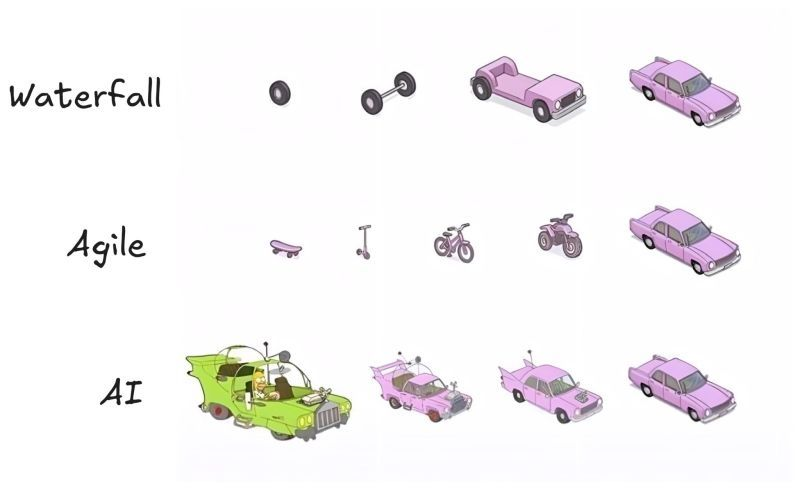
Honestly, this is the most accurate diagram I've seen.
Waterfall: You plan for 18 months and deliver exactly what nobody needs anymore.
Agile: You deliver something usable at every step, but the CEO keeps asking, "Where's the car?"
AI: You get the car on day one. It has six wheels, the doors are on backwards, and it has a rocket launcher. You spend more time making it yours than actually "building"; it's shaping. owning. verifying. That's what the best AI developers do now. They don't build. They shape and own.
Thrilled to announce the Monitor tool which lets Claude create background scripts that wake the agent up when needed.
Big token saver and great way to move away from polling in the agent loop
Claude can now:
* Follow logs for errors
* Poll PRs via script
* and more!
Computer use is now in Claude Code.
Claude can open your apps, click through your UI, and test what it built, right from the CLI.
Now in research preview on Pro and Max plans.
New in Claude Code: auto mode.
Instead of approving every file write and bash command, or skipping permissions entirely, auto mode lets Claude make permission decisions on your behalf.
Safeguards check each action before it runs.
We just released Claude Code channels, which allows you to control your Claude Code session through select MCPs, starting with Telegram and Discord.
Use this to message Claude Code directly from your phone.
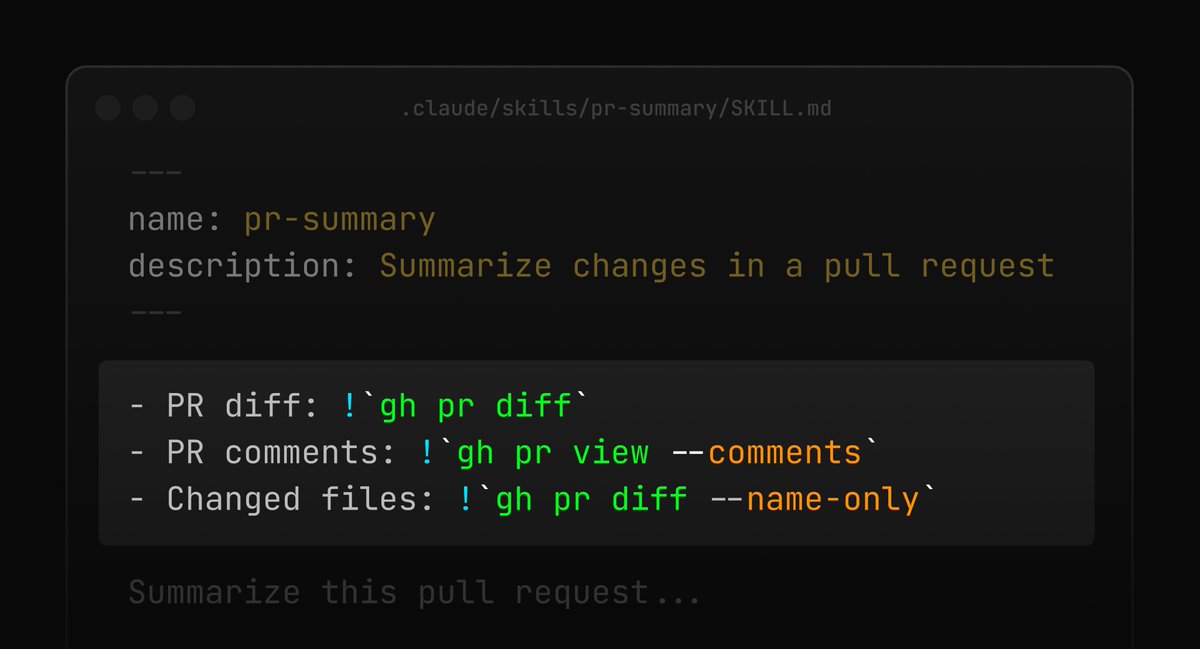
if your skill depends on dynamic content, you can embed !`command` in your SKILL.md to inject shell output directly into the prompt
Claude Code runs it when the skill is invoked and swaps the placeholder inline, the model only sees the result!