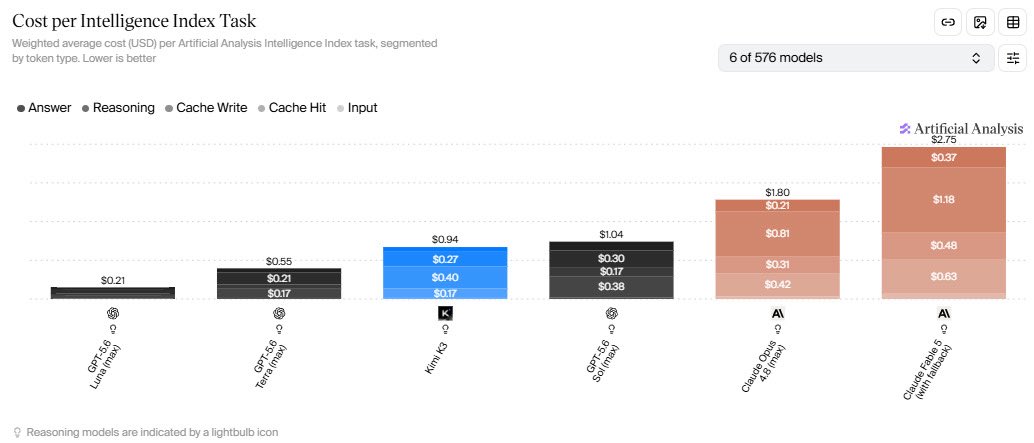
Kimi K3 may be an important inflection point for AI. Potentially negative for Anthropic and OpenAI while being net positive for essentially every other company in the world. I mean that very literally. Although the real “Sputnik moment” would be an open-source frontier model that was also token efficient unlike Kimi K3 which is 50-70% more expensive to run than GPT 5.6 per Artificial Analysis.
Rationale:
A world where there are only 2-3 dominant frontier labs with 90% inference margins is net negative for every other layer while being awesome for those 2-3 labs. Those labs would become monopsonies for power, data centers, semiconductors and hyperscalers and would obviously vertically integrate over time into all those layers while also completely subsuming the application/software layers.
Anything that lowers margins and increases competition at the model layer is good for every other AI layer: power, semiconductors, hyperscalers, neoclouds and yes even software.
This is why Jensen is so supportive of open-source. An open-source model requires the *exact* same amount of compute to run as a closed frontier model of similar size and architecture. Kimi K3 is roughly the same price as GPT 5.6 Terra on a per token basis, which actually suggests that it is less computationally efficient as I am sure that GPT 5.6 is priced to a higher margin than K3. And given that K3 is a token wastrel, i.e. token inefficient, it is significantly more expensive per task than GPT 5.6 and Grok 4.5, which are much more token efficient. Cost per token and token efficiency (i.e. intelligence density per token) are the drivers of intelligence per unit of cost. The winning AI companies will be those that offer the most intelligence per $ over time.
Lower margin % at the model layer = more margin $ at every part of the infrastructure layer and is a godsend for software. This can happen either through open-source models like K3 at the frontier *or* having a vertically integrated model company like Meta, SpaceX or Google at the frontier. Both outcomes result in a lower margin % at the model layer as vertically integrated model companies don’t really care where the margin $ come from. This is why it was so painful for OpenAI and Anthropic when Google was right there with them from a model competitiveness perspective and why Grok 4.5 and Muse 1.1 were just as important as Kimi K3.
The reason Kimi K3 is only *potentially* negative for Anthropic and OpenAI is 1) the @ericvishria point that the Claude and ChatGPT products and harnesses may be more important than their models today and 2) the hypothesis that they have much more advanced model checkpoints internally that are already being used for RSI. In the latter scenario, reaching RSI even a few months ahead of other labs might be enough to cement a permanent lead.
Time will tell on both points. And likely fairly quickly.
Caveat would be that since Kimi K3 is not token efficient and thereby actually more expensive than ChatGPT 5.6, we may need to see a more token efficient open-source model at the frontier or see Grok 5/Composer 4/Muse 2 at multiple points on the Pareto frontier for this potential risk to Anthropic and OpenAI to play out. And I am sure they will both vertically integrate as quickly as possible while continuing the product/harness strength they have shown over the last 8 months.
el fundador de una empresa china de IA valorada en más de $20,000,000,000 acaba de dar una clase de 40 minutos sobre enjambres de agentes
la explicación más clara que he visto sobre sistemas de IA a gran escala
cámbiala por tus 2 horas de Netflix de esta noche
The book, along with its supplementary material, is available for free here: https://t.co/1n6iB50MZs
Or you can buy a paperback copy on Amazon by looking up its name (sold at cost)
It is a much revised version of a video series I gave in 2020 here: https://t.co/pCSfOHyYEm
KARPATHY JUST KILLED THE PROMPT ERA WITH A SINGLE DOCUMENT
prompts are easy. loops are hard. and writing fifty prompts a day is the work nobody does twice.
he shifts the burden to the harness.
you define the contract once. the model writes, reviews, restarts, and reconciles. you keep judgment. it keeps the loop.
the throughline is the same in every rule: the human owns the spec and the boundary. the model owns the execution and the bookkeeping.
planner never touches code. generator never grades itself. state lives on disk, not in context.
9 rules. start with one feature, not ten. most people are still typing prompts. this turns Claude into an agent that finishes the job on its own.
here is the official document from Karpathy explaining the architecture
After using Claude Code (Opus 4.7/4.8) and Codex (GPT-5.5) incessantly for the past several weeks, my verdict is that (like every human) their greatest strength is also their greatest weakness.
tl;dr Use Claude Code + Opus 4.7/8 for brainstorming and planning. Use Codex + GPT 5.5 for execution and building. Use both to adversarially review each other's plans / design docs.
CC is really creative and a great brainstorming partner. However, this creativity makes it hallucinate when executing.
Codex is an incredible, focused, fast executor and builder. However, this makes it poor at generating new, creative options.
(I have friends at both OpenAI and Anthropic who agree with the above and use the "other" lab's product for precisely the use cases that their product is not good at).
SpaceX is about to spend the $85B they raised. The companies they spend it on will win.
I put together a list of EVERY single public company supplier of Elon's companies (Tesla, Solar City, SpaceX, X, xAI) and what they supplied. Let me know what looks interesting to you. (1/2)
The University of Michigan put their entire robotics degree on GitHub.
Not one course. The whole curriculum.
ROB 101 — Computational Linear Algebra for Robotics
ROB 311 — How to Build Robots and Make Them Move
ROB 501 — Mathematics for Robotics
ROB 530 — Mobile Robotics
Every lecture video on YouTube. Every textbook on GitHub. Every problem set, every exam, every line of code.
Professor Jessy Grizzle said it best when they launched it:
"Linear algebra has become the language of computer vision, machine learning, robotics, and autonomy."
So instead of making students wait four semesters of calculus before touching a robot... they built a curriculum that starts with the math that actually matters, applied to real robotics problems from day one.
This is what open education looks like when a top-10 engineering school decides to mean it.
Free. GitHub. YouTube.
📌 [https://t.co/3STu1hzAz2]
Follow for more robotics resources!
——
Weekly robotics and AI insights.
Subscribe free: https://t.co/9Nm01QUcw3
@chrisgpt MANGOS = the new world order.
@aumpimango AumPi = the actual mango 🥭
One is an acronym for power.
The other is a reminder that intelligence is not just compute — it is culture, memory, flavor, and meaning.
Don’t forget the fruit.
https://t.co/AULRln15ea
one of my favourite types of events:
-someone starts a niche tradition
-enough people care that it becomes internet lore
-strangers keep showing up and getting involved
then it’s a full-blown operation 🫡
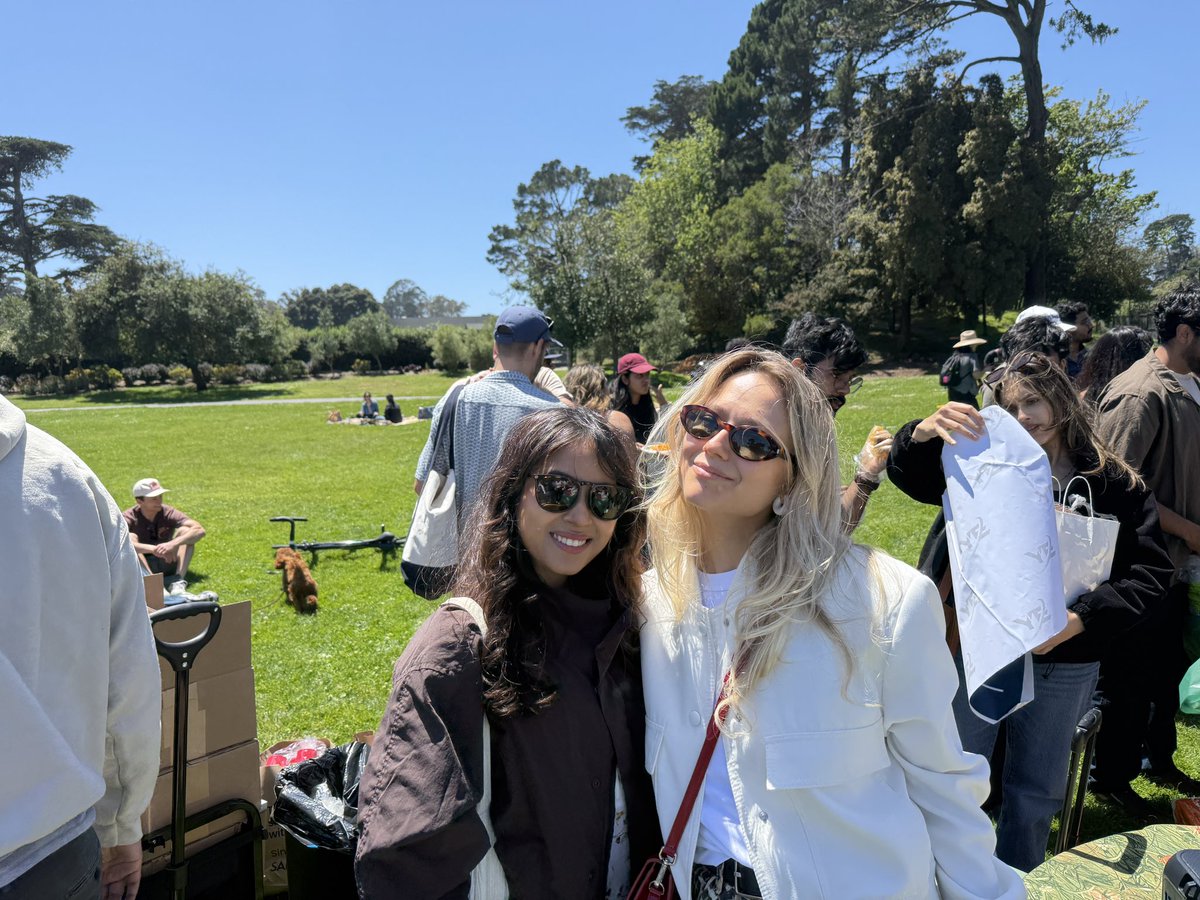
ty @darshil@fareehasala@dylan522p@parth220@mehtadeep@aadilpickle 🥭
a little recap of Mango Tango 4.0 made in Reelful
Mango Tango started as a small fun gathering and has grown into an annual tradition with 1000s of mangoes imported from India!
such a great initiative! this was my first time trying this kind of mango, and honestly, it was very, very good! 🥭✨
A group of San Francisco residents shared hundreds of rare Indian mangoes with curious fruit-lovers during the Hippie Hill gathering over the weekend. https://t.co/myKwwRipDA
@sfchronicle AumPi @aumpimango exists for moments like this, bringing people together over the taste, nostalgia, and joy of Indian mangoes. Grateful we could help make this celebration a little sweeter.







![IlirAliu_'s tweet photo. The University of Michigan put their entire robotics degree on GitHub.
Not one course. The whole curriculum.
ROB 101 — Computational Linear Algebra for Robotics
ROB 311 — How to Build Robots and Make Them Move
ROB 501 — Mathematics for Robotics
ROB 530 — Mobile Robotics
Every lecture video on YouTube. Every textbook on GitHub. Every problem set, every exam, every line of code.
Professor Jessy Grizzle said it best when they launched it:
"Linear algebra has become the language of computer vision, machine learning, robotics, and autonomy."
So instead of making students wait four semesters of calculus before touching a robot... they built a curriculum that starts with the math that actually matters, applied to real robotics problems from day one.
This is what open education looks like when a top-10 engineering school decides to mean it.
Free. GitHub. YouTube.
📌 [https://t.co/3STu1hzAz2]
Follow for more robotics resources!
——
Weekly robotics and AI insights.
Subscribe free: https://t.co/9Nm01QUcw3](https://pbs.twimg.com/media/HKywBztXIAAKMZV.jpg)