I binge-watched Operation Safed Sagar over the weekend.
And I want to say thank you to everyone who had a hand in making this series & to Netflix for commissioning it.
For many reasons…
Because, despite some reviewers cribbing about inconsistent CGI & performances that could have been better, I found the actors competent and credible. More importantly, I was moved and inspired by the story & the emotions underlying it.
Because I wish that, when I was growing up, we had had more films like this, recording the feats of our armed forces in the many conflicts we have experienced, in a gritty and convincingly realistic manner.
Instead, we grew up on a diet of Hollywood war movies which, despite often taking enormous liberties with historical accuracy, helped build American pride & self-belief while we watched as envious bystanders.
Because, even though I knew a great amount about the courage of soldiers like Vikram Batra and the role of the Bofors gun in Kargil, I confess I knew far too little about the critical role played by the Indian Air Force.
And I certainly didn’t know that, apart from extraordinary valour, Operation Safed Sagar showcased the ingenuity & rapid improvisation that we now celebrate as a hallmark of Indian innovation.
The IAF acquired handheld GPS receivers, put them into MiGs & used them to calculate release points for ordinary “dumb” bombs. They conducted hurried trials, initially got disappointing results, refined the technique within a handful of sorties & took it into combat almost immediately.
The Mirage story, dealt with more briefly in the series, was equally remarkable. The IAF had Mirage 2000s, Israeli Litening laser-designation pods and Paveway II guidance kits, but had not yet turned that combination into an established combat capability. When a required component could not be obtained from abroad due to the 1998 sanctions, IAF technicians displayed what I call ‘denial-driven innovation’ & engineered the solution themselves!
So at a time when we are debating whether human intelligence will increasingly become a slave to machine intelligence, it’s incredibly valuable to be reminded that even in battle, where decisions are made in seconds & lives depend upon them, it’s ultimately the humans behind the machines who make the difference.
I hope as many people as possible watch this series.
Because when the men and women of our armed forces know that we know their stories & remember their sacrifices, they also know that their courage will not be forgotten.
The heroes of Operation Safed Sagar are my #MondayMotivation.
With a special salute to Squadron Leader Ajay Ahuja. 🇮🇳
Here's my conversation with Khabib Nurmagomedov (@TeamKhabib), one of the greatest fighters of all time.
It was truly an honor to get to train with him, to have this deep conversation, and to get to know him over the past few months.
We did this conversation entirely in Russian. It's translated and dubbed into English. Both language audio tracks and subtitles are available on YouTube. Here on X, I'm posting the English & Russian language versions as seperate videos. The translation & dubbing was a huge amount of work (which I deeply care about) with humans & AI collaborating. Thanks to the amazing team at @ElevenLabs for their help.
Good luck to Islam Makhachev, Khabib & team this weekend at UFC 330!
And as I've said in the video, I'm truly grateful for all of you, for your support all these years. I love you all ❤️
Timestamps:
0:00 - Introduction
1:35 - Why Dagestan produces so many great fighters
11:41 - History of Dagestan warrior culture
21:02 - Hard training in the mountains of Dagestan
24:53 - The trap of fame, money, and power
35:34 - The key to Khabib's dominance
46:47 - Discipline and hard work
59:15 - Street fights in Dagestan
1:12:56 - Khabib's top pressure
1:18:40 - Khabib vs Conor McGregor
1:31:25 - Khabib's toughest fight
1:39:12 - Greatest MMA fighters of all time
1:56:57 - Coaching
2:02:30 - Daniel Cormier
2:06:48 - Islam Makhachev
2:16:46 - Dana White
2:20:16 - Joe Rogan
2:22:31 - Ali Abdelaziz
2:25:08 - Football
2:32:23 - Messi vs Ronaldo
2:50:23 - Dubai
2:54:14 - God
3:01:57 - Advice for young people
We were pleased to have our account featured in a new article by The Times of India. If it wasn't for our X account and followers, we'd just be playing and governing cricket on a frozen volcanic rock in the North Atlantic.
@bhogleharsha Come on. When will you say that the emperor doesn't have any clothes? Shit coach, shit captain...how can a coach get leeway after having presided over the worst test match humiliation, in India? Guess everyone forgets after some WC win, which didn't need Gambhir.
I ran across this video a few days ago and couldn’t stop watching it.
It’s about something ordinary & boring, a plastic gas lighter. But it changes how one thinks about manufacturing.
That lighter in so many of our homes, holds pressurised gas. It has over 30 microscopic parts, has to pass international safety codes, & travel 10,000 miles by sea, & the total cost of doing all that, materials, labour, freight, every middleman along the way, comes to fifteen U.S cents.
So how does anyone make money on this?
Turns out almost the entire world’s supply comes from one place: a county called Shaodong, in China’s Hunan province.
It wasn’t always there.
But today, Shaodong has 114 lighter-related companies packed into the place & between them they source more than 200 different components from each other, all within a 20-kilometre radius. They supply something like seventy percent of the world’s disposable lighters. And the industry alone employs over 80,000 people locally.
Nobody there is winning on cheap labour anymore. They’re winning by shaving a thousandth of a cent off the thickness of a plastic wall, or redesigning a base so a few thousand more units fit into the same shipping container.
It took my thoughts back to an old professor of mine, Michael Porter.
His 1980 book, Competitive Strategy, is still the 1st book most MBAs read, the one that gave the world the Five Forces and basically invented modern strategic thinking.
But there’s a quieter piece of his work, on industrial clusters, that never got nearly the same attention, and it is the one that explains exactly what is happening in Shaodong.
His argument was that nations and regions rarely win because of cheap inputs. They win when rival firms and specialist suppliers crowd into the same small geography for long enough that they keep pushing each other past what any one of them could manage alone. He found it in the Swiss watchmaking towns of the Jura, in the German printing press industry and in Italy’s ceramic tile and footwear districts (interestingly, it’s the SAME blueprint which built Morbi, in Gujarat, into the world’s second-largest ceramic cluster, now outproducing Italy by volume. I have posted before, about Morbi)
None of these started out as giants. The neighbourhood made them giants.
Which is exactly why it’s so relevant to India’s climb up the global manufacturing table
I’ve also attached a slide with this post that I saw recently and which shows us breaking into the top 5 manufacturing globally. (A quick reference check told me that we may not have overtaken Korea yet, but the trajectory’s clear)
That climb has happened on the back of scale: bigger plants, bigger parks, more FDI.
I should declare an interest here, because the Mahindra Group set up 2 of India’s first integrated, plug-and-play business cities, in Chennai in 2002 & Jaipur in 2006.
Both have been extremely successful. Chennai’s business zone alone today employs 45,000 people..
But I admit that we need to think differently.
A park brings in investors and hands them a ready plot, power, water & roads
A cluster is a completely different animal: hundreds of small, specialised suppliers, each obsessed with doing a tiny thing better than anyone else, feeding off each other’s presence for years until no outsider can compete with the whole.
I think that’s the work ahead of us now.
Not just more factories, and not just more parks.
Policymakers & developers like us need to start consciously pulling as many of the inputs and resources a sector needs, the toolmakers, the component suppliers, the testing labs, the logistics specialists, into the same neighbourhood.
Shaodong and Morbi both got there by accident, one town stumbling onto a way to shave a thousandth of a cent off a lighter wall, the other discovering it had the clay and, later, the gas pipeline for tiles.
We don’t have the luxury of waiting for accidents anymore.
We need to do it on purpose
@Sudarshanshaw93 This AI generated map is very wrong. There is no Great pied hornbill. And I have clicked the Great (Indian) hornbill in Corbett, Kaziranga, and Arunachal. Why put it just in S. India?
Driving through one of the many hidden corners of India, we stopped to check out a ‘car’ that didn’t come from a showroom, but from sheer imagination.
This is the kind of talent that doesn’t wait for perfect conditions, it finds a way to roll anyway. Bas mauka milna chahiye!
During a marathon, an abandoned puppy was found beside the road. Rather than leaving it behind, Khemjira Klongsanun carried it for the remaining 19 miles.
She crossed the line with the pup in her arms, and adopted him after
Ensuring a peaceful and secure democratic process! 🗳️
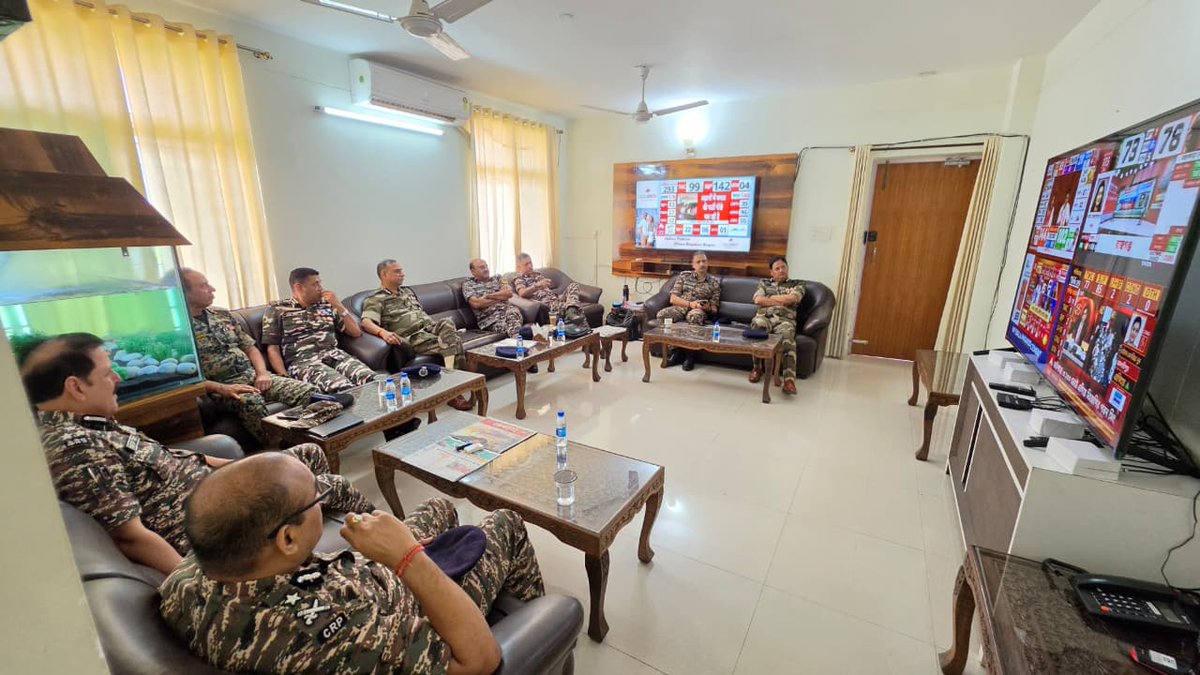
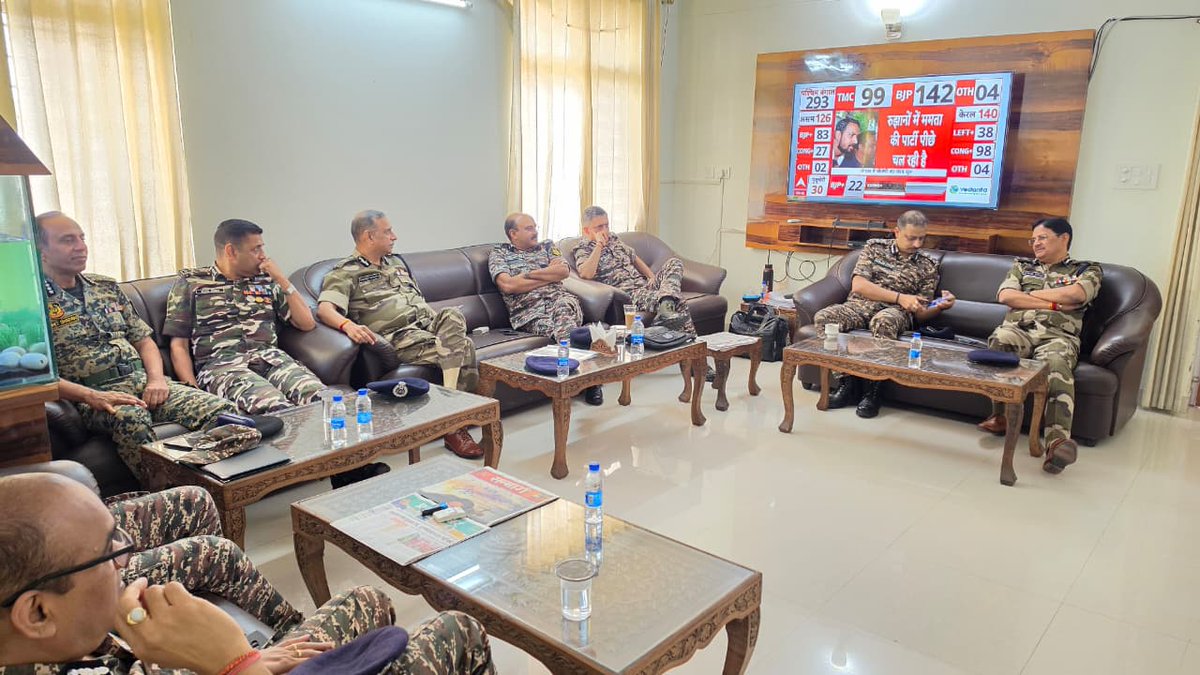
The DGs of all CAPFs are currently stationed in Kolkata, maintaining a vigilant watch over the counting process security and the law & order situation in West Bengal.
By operating from a Centralised Election Control Room, they are ensuring seamless coordination and an integrated, rapid response to any contingencies. A unified front for a stable environment.
#NationFirst
#Vandematram150
#MissionNaxalMuktBharat2026
#WestBengalAssemblyElections2026
@ECISVEEP@BSF_India@CISFHQrs@ITBP_official@SSB_INDIA@gpsinghips@CentralZoneCrpf@CrpfWest
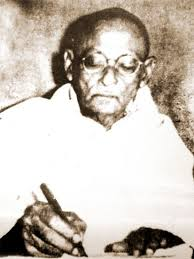
He was the genius behind Bengal Chemicals who gave up fame to become a Guerrilla Scientist. Satish Chandra Dasgupta (1880-1979) was the Ghost who broke the British monopoly on fire extinguishers, batteries, & ink using nothing but local chemistry & raw grit. He did not write papers for journals; he wrote the Open Source'code for Indian independence.
While others were debating physics in classrooms, he was in the villages, teaching people how to turn bamboo into paper. He is the titan of Frugal Engineering... the man who proved that a lab in a hut is more powerful than a factory in London.
Everyone knows P.C. Ray, but Satish Chandra was the Engine & a master of Scaling. He designed & manufactured the 1st indigenous Fire Extinguisher in India. Before him, the British had a total monopoly on safety equipment. Dasgupta’s Fire King (at ~1/4th cost) proved that Indian chemistry could save lives as well as European tech.
Long before India had a formal electronics industry, he developed a process to manufacture Dry Cell Batteries locally, refusing to rely on imports. When he joined Gandhi’s Khadi movement, he realized that if the poor were to be self-reliant, they needed High-Tech for the Low-Income.
Dasgupta realized that dead cattle were a wasted resource. He developed a Silo of Tannery Science, teaching villagers how to use dead animal hides & bones to create high-quality glue, fertilizer, & leather using only local chemicals. He perfected the chemistry of turning bamboo into high-grade paper w/o massive industrial boilers. He essentially democratized the paper industry.
His most unknown contribution is the Khadi Guide, which was effectively the GitHub of the 1930s. He wrote an encyclopedia of industrial processes that could be done in a kitchen. From making Matches to Ink, he broke down complex chemical patents into Open Source recipes for the Indian masses.
He lived like a monk in his ashram in Sodepur, which he turned into a Chemical Research Station. Gandhi called him the Professor of Khadi. He was a world-class chemist who could have been the CEO of a multi-million dollar corporation. Instead, he chose to spend his later yrs in the drought-prone fields of Bankura, using his knowledge of Soil Chemistry to help farmers find water.
He lived to be 99. Even in his late 90s, he was experimenting with natural insecticides & herbal medicines. Satish Chandra Dasgupta is unknown because he did not fit into the Academic Silo/the Political Silo. He was an Industrialist w/o a Factory & a Chemist w/o a University. He proved that science is only as good as the person it serves & turned the periodic table into a toolkit for the common man.
Kuno milestone moment 🐾
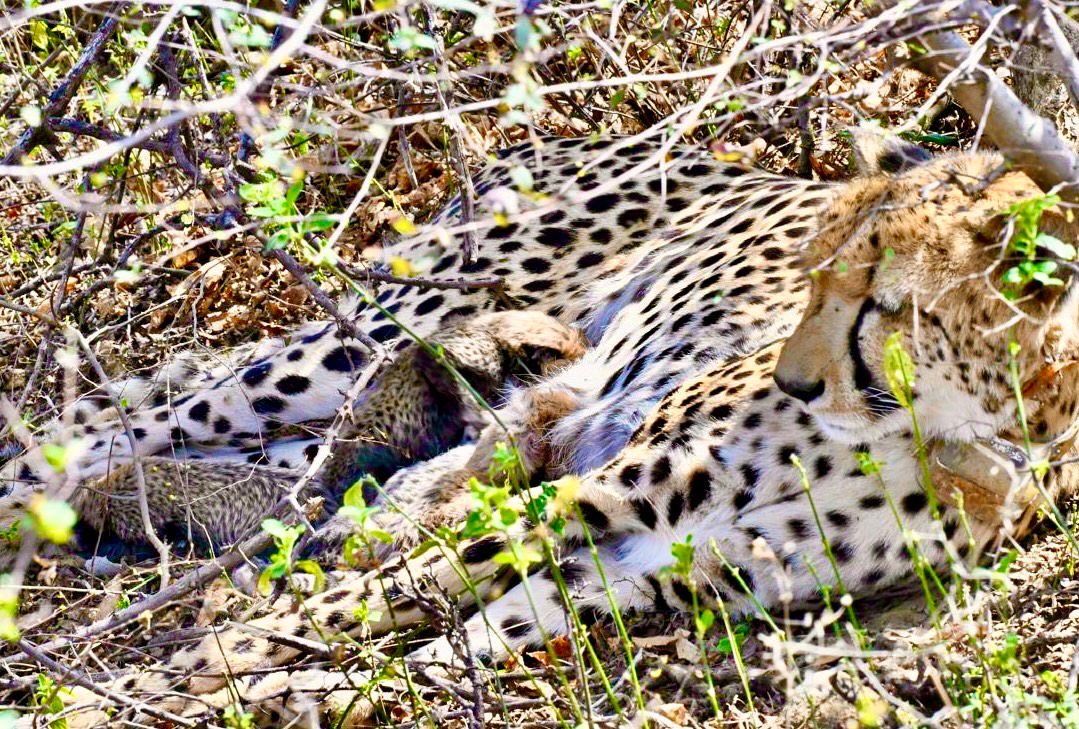
A historic moment unfolds at Kuno National Park as an Indian-born female Cheetah of Gamini, aged 25 months, has given birth to four cubs in the wild—marking a major milestone in India’s cheetah conservation journey.
Having been in the wild for over a year, this is the first recorded birth in the wild since the reintroduction began in 2022, and notably, the first such instance involving an Indian-born female.
This is a significant step toward achieving the core objectives of the project—survival and breeding under natural conditions.
This achievement reflects the growing adaptation of cheetahs to Indian conditions and stands as a testament to the dedication and tireless efforts of the managers, veterinarians, and field staff at Kuno.
A proud moment for the Nation—heartiest congratulations to all.
@TheEconomist Like the twisted tail of a mongrel which can't be straightened, one can't do anything about The Economist's anti-Indian bullshit. The publication exists to propagate a Western hegemonic pov. Read their business & economic articles, which are good. Ignore any geopolitical stuff.