A lot of this seems relative? Yes, big gap vs. Opus/Fable on common sense and grasping the essence of an ask. But GPT model lineage has been cursed with this for multiple generations. And 6 Astra was more unusable with a harder to understand response style.
It still nets out that I substantially prefer the 6.2 public checkpoint over 6 Astra in my daily driving (2nd opinion + reviewer for Opus).
4/ Unsurprisingly, this reads like it's taken straight out of Anthropic's playbook.
Invest early in character, alignment, and other areas of training to make Claude models pleasant to use. Focus entirely on pro users, where the top 0.1% human expertise is concentrated vs. chasing vanity goals like 1B consumer MAU. Make the Claude / Claude Code app a place to do projects end-to-end with every work tool natively integrated. Fund huge amounts of individual usage with generous plans, grants, and other subsidies.
Feels like their lead will only compound from here if Opus and Fable remain overwhelmingly preferred for knowledge work (outside of a few fields like math).
1/ It seems increasingly apparent that the final bridge to AGI* will be built on non-ZDR traces from top 0.1% expert users. Non-verifiable domains be damned. In hindsight, Anthropic's strategy looks incredibly prescient.
*AGI = drop-in replacement for a top human knowledge worker in any role
3/ If you were a frontier lab, the strategy for acquiring this data might look like:
1. Train the most preferred model for expert knowledge work. You want the most talented people to prefer using your model. Raw capability is important, but is not sufficient on its own. The model needs to be pleasant to work with, e.g. good theory of mind, epistemic rigor, collaboration style.
2. Build a product to do knowledge work end-to-end. You want all of the work to happen within this product so user traces capture every input, action, state change behind a good outcome, from docs, to code, to discussions with other humans, to domain-specific tools. As you go from simple tasks to long-horizon work, this gives you blueprints for entire successful projects.
3. Attract as many top 0.1% expert users as possible and fund their usage. You want experts in every field doing work in your product, with no ZDR or training restrictions. Compared to the value of the data, it costs peanuts to subsidize $200 plans with $20k+ of tokens or give free usage to academia. Individual use is heavily incentivized so you can capture top talent whose day jobs have locked down data.
We need an index that tracks the relative advantage between:
(A) 99th %ile domain expert human with a reasonable budget of Model N tokens
(B) domain aware smart generalist human with unlimited Model N+1 tokens
and how close we are to the tipping point in domains beyond math
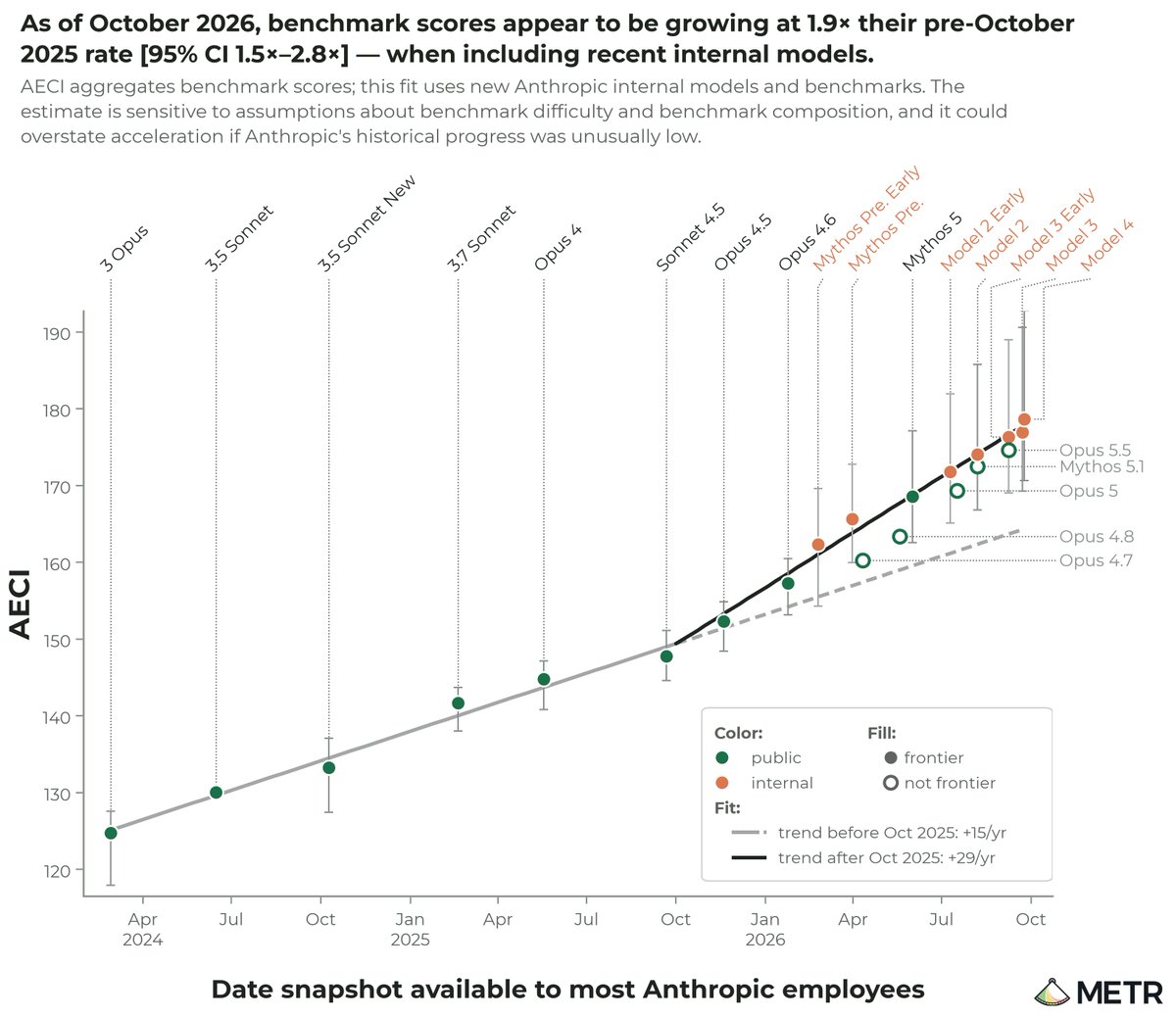
1. Benchmarks provide one piece of evidence for acceleration. Since Oct 2025, AECI scores for Anthropic’s models have grown at 1.9x [95%: 1.5–2.8] the earlier rate. Analysis choices affect this estimate, and it remains unclear how benchmark scores map to real-world capabilities.
Understanding intent (from prompts written by a non domain expert), extrapolating that to sensible decisions, turning that into a clean technical design or solution.
Codex (Astra) failure modes:
- Interprets things literally while missing the “common sense” intent.
- Theoretical correctness above all else. Will suggest convoluted overengineered solutions to achieve this.
- Doesn’t hold firm on recommendations, hard to tell what to trust. If I question it at all, flip flops instantly.
The upside is that it has incredible attention to detail and is basically never wrong, while Opus makes a lot of sloppy mistakes.
interpretability might be the most important scientific problem in the world right now, as I don't think we can solve alignment if we don't know what we're building. I think I have good news about it. I co-authored early work in mechanistic interpretability at OpenAI and came away pessimistic, because neural networks appeared to fold into arbitrary tangled knots. years later, I started openai's first large-scale automated interpretability project, finding about 2% of neurons legible with the primitive tools we had
with modern agentic tools and a much closer look, the picture looks totally different. the vast majority in models up to trillions of parameters are legible, and their circuits beautiful. many famous examples of tangled neurons turned out to be misunderstood. The roadblocks I expected mostly aren't there. I now think ambitious interpretability will be solved by the time we need it most, and possibly quite soon, as automated scientists keep improving. it may be a bitter lesson for interpretability: the simple thing, at absurd scale, works
https://t.co/zHij5zwKGT
Steer dots to not give up so easily on trivial things. E.g. I asked it to take over my existing recurring ChatGPT scheduled threads like daily news, email radar, etc. and it repeatedly claimed it didn’t have access and asked me to manually copy instructions. First, I’m surprised it doesn’t have tools to directly retrieve 1st party context. But at minimum it should use browser first instead of asking me.
Cooking with gas, absolute SoTA on output per μg of cortisol.
It seems starkly apparent with each release that the Claude lineage is far ahead of everyone else in "drop in replacement for human knowledge worker" in a way that's not reflected in any benchmark. Basic intent understanding, common sense, and generalization to real-world usage distribution. And the gap to GPT series is only getting wider.
Credit to OAI for possibly a higher ceiling in a few narrow capabilities... but feels like a fundamental piece is missing, a path to spiky ASI and not AGI.
Vibes after 10 days: Fable still clearly SOTA on drop-in-replacement-for-human-bench
Fable also SOTA by a large margin on ration-tokens-like-im-on-food-stamps-bench 😭