Principal Investigator. Institute of Neuroscience, CAS. Circuit mechanisms for perception, decision making, top-down modulation, and dendritic computation.
Dendritic computation for cognitive flexibility
Our new paper in Science identifies rule-belief signals in the distal apical dendrites of cortical pyramidal neurons. These signals integrate with somatic sensory signals to support flexible decisions.
https://t.co/gTU9W8oufk
@woongworks Good question. We didn't have enough trials to address this. There were mostly only 2-3 block switches in each session. But we do find the rule-belief signals in the dendrites persist across trials.
Dendritic computation for cognitive flexibility
Our new paper in Science identifies rule-belief signals in the distal apical dendrites of cortical pyramidal neurons. These signals integrate with somatic sensory signals to support flexible decisions.
https://t.co/gTU9W8oufk
Many people are talking about Marco Rubio's speech at the Munich Security Conference a week ago.
It may have been the most explicit defense of the colonial tradition by a senior Western official since Winston Churchill and Adolf Hitler’s imperial diatribes nearly a century ago — supremacist views that claimed millions of lives from the fields of Bengal to the streets of Leningrad.
But few are comparing it to the speech that came right afterwards — from Chinese Foreign Minister Wang Yi.
The two speeches offered perhaps the clearest expression of the shape of the bifurcating world order that we have heard from world leaders in this century.
Where Rubio drew a racial line between the governors and the subjects of the world system, Wang Yi outlined principles for global governance rooted in “sovereign equality, international rule of law, multilateralism, a people-centered approach, and real actions”.
Where Rubio attacked global institutions, Wang Yi defended the universality of the UN in terms that spoke directly to the imperatives of the Global South: “On the UN platform, each country, regardless of its size or wealth, has a voice and a sacred vote as well as its due obligations and equal rights.” Without the United Nations, he warned, “the world would revert to the law of the jungle where the strong prey on the weak.”
Where Rubio called on the West to be unapologetic and unashamed in imposing its way of life on others, Wang Yi called on major countries to lead by example — recognizing global diversity, “pursuing cooperation instead of conflict or confrontation” and "promoting equality instead of imposing their will onto others.”
Where Rubio insisted on throwing off the fetters of international law, Wang Yi emphasized the importance of “observing rules instead of applying double standards.”
There is hope amid all the gloom. First, because Rubio's speech was obviously that of a hegemony in decline. The past to which he refers is over and cannot be brought back. And second, because there are still adults in the room — whose words, like Rubio's, are not hollow, but reflect the ongoing construction of a fairer new world order.
Demis Hassabis’s “Einstein test” for defining AGI:
Train a model on all human knowledge but cut it off at 1911, then see if it can independently discover general relativity (as Einstein did by 1915);
if yes, it’s AGI.
My postdoc work "Unsupervised pretraining in biological neural networks" is out now, along with more than 400GB (milliions neurons) neural data. https://t.co/2uI5YAQ0vg. Figshare and Github links can be found in the paper.
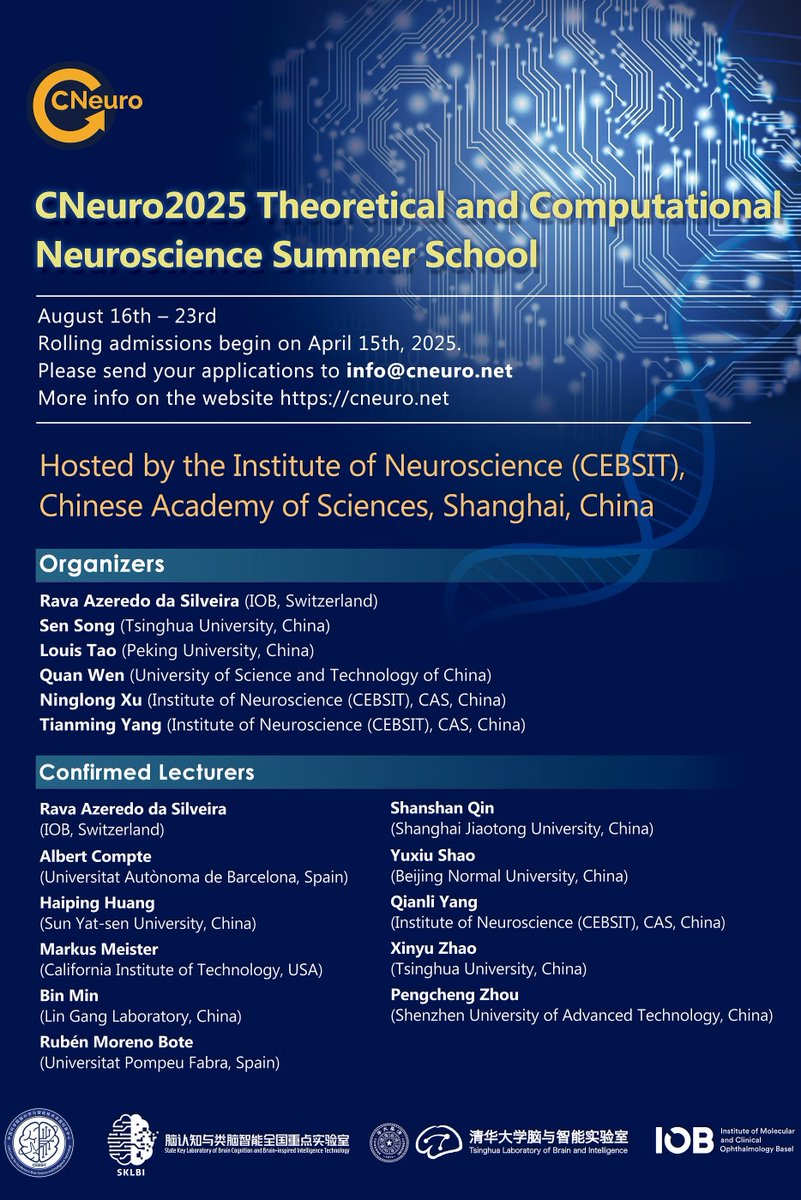
The 1st Chang Hsiang-Tung Brain Science Symposium will be held in Shanghai, Oct 26-28, 2024. Over 20 leading experts will be speaking! Registration is open for international participants. Poster submissions are welcome! Space is limited. Please register and submit soon!
The 1st Chang Hsiang-Tung Brain Science Symposium will be held in Shanghai, Oct 26-28, 2024. Over 20 leading experts will be speaking! Registration is open for international participants. Poster submissions are welcome! Space is limited. Please register and submit soon!
Free webinar from Dr. Yulong Li: Spying on Neuromodulation with Novel Genetically Encoded Fluorescent Sensors. Feel free to attend and communicate with us.
CET 2:00 PM, March 28th (Thursday)
https://t.co/00cJGoAY1s
Clone Robotics is a humanoid robot startup that flies under everyone's radar; they have a uniquely innovative approach to the robot's body.
The Poland-based company, founded in Nov 2021, is designing a human-like musculoskeletal body using hydraulic tendon muscles.
Too often, we think a task is easy because some animal can do it.
But the reality is that the task is fiendishly complex and the animal is much smarter than we think.
Conversely, we think tasks like playing chess, calculating an integral, or producing grammatically correct text are complex because only some humans can do them after years of training.
But it turns out these things aren't that complicated and computers can do them much better than us.
This is why the phrase "Artificial General Intelligence" to designate human-level intelligence makes absolutely no sense.
and build energy efficient new AI systems! Then humans and AI may be able to co-exist for a while. However, this is not the answer you would get if you ask AI ...
Random thoughts around the end of 2023 ---
Witnessed AI integrating into human life with staggering speed. Based on my understanding on how the brain works, I actually believe there would be the possibility that AI could become an independent species in the foreseeable future.
we might face unavoidable competition with AI for resources. Isn’t this the greatest and most fundamental risk?
What can we do? The solution would be, IMO, to understand how our biological brain achieves energy-efficient yet powerful computations,