Rubber stamp travel field notes poster
GPT Image 2
Prompt:
Create one separate poster for each scene. Output each poster individually—never combine scenes or create a collage.
FORMAT
Use a strict 4:5 portrait composition. Cover the entire frame with warm off-white aged paper featuring subtle fibers, natural grain, light wear, and a matte tactile texture. Preserve generous blank whitespace.
STAMP ARTWORK
Create a compact multi-color carved rubber stamp depicting the most recognizable features of the location: distinctive architecture, mountains, terrain, vegetation, roads, shorelines, skyline, or key foreground shapes.
Simplify aggressively. Keep only the visual information needed to instantly recognize the place and scene. Remove crowds, vehicles, repetitive windows, dense buildings, fragmented vegetation, decorative details, and irrelevant background elements.
Place the stamp in the lower-middle, occupying about 30–38% of the frame height, with ample whitespace around it. Keep it compact and understated—not a full landscape illustration, painting, logo, or oversized graphic.
Adapt the composition naturally:
Architecture: distinctive silhouettes, roofs, domes, arches, towers, and main structures.
Mountain settlements: simplified terraced buildings following the terrain.
Coastal scenes: mountains, settlement layers, shoreline, and sparse water marks.
City panoramas: main skyline, one iconic structure, and distant mountains.
Natural landscapes: primary mountains, trees, shorelines, and road directions.
INK & TEXTURE
Use 2–4 muted spot colors, inspired by the scene, such as carbon black, deep green, brick red, ochre, slate blue, or taupe.
Give each color a separate hand-stamped layer with authentic carved-rubber imperfections: engraved marks, uneven lines, chipped edges, dry-ink gaps, paper show-through, granular ink, uneven pressure, ghosting, and subtle 1–2 mm misregistration.
The result must feel like a real rubber stamp pressed onto aged paper, never a smooth vector graphic, filtered image, or digital logo.
TYPOGRAPHY
Generate:
Location: English name
No. [number]
Three short English keywords
Year: 2026
Place the text below or beside the stamp in the whitespace. Use a small, restrained, slightly imperfect typewriter-style font. Keep it minimal, accurate, and documentary.
MOOD
Quiet, tactile, restrained, regional, observational, and collectible—like field notes created by an architect, travel writer, or natural observer.
AVOID
Circular seals, Chinese red stamps, postage perforations, wax seals, stickers, souvenir templates, generic city icons, smooth vector logos, cartoon styles, 3D rendering, glossy gradients, plastic textures, oversaturation, excessive detail, excessive text, and decorative clutter.
100 AI Styles in 100 Days
Day 73/100:
📷 Art style: Vintage Folk Editorial Illustration
+ Mid-century European storybook art, whimsical caricature, hand-painted gouache, dry brush texture, rough ink lines, elongated proportions, flat bold colors, imperfect handmade shapes, retro children's book illustration.
📷Don Quixote rides Sancho Panza’s donkey into battle against a monster. :)))
I think I’m starting to get a few ideas for what to do after my 100-day journey ends. 👀
Road and composition are the same system. You pick the path. The system grows the scenery along it. In Japan the walk to a shrine is a sandō. In Taiwan we call it xiangdao — the incense way.
Shrine or museum, doesn’t matter. You walk first.Same as Polypaths: a fork is code, and a choice.I’m looking for the part the system and the participant can both enjoy.
You shape the road. It grows the landscape.
Folks, please enjoy Skill Cabinet. 🗄️
npx skill-cabinet
If you're anything like me, at some point you're local skills situation has gotten somewhat messy.
Even if you're organised and managing them through Git you'll probably still be installing stuff locally just to test out and need a periodic cleanup.
This is a little app that looks across all the different places you've got skills installed to on your local fs and lets you review them and clean them up if you want.
https://t.co/d3j7OYjfUJ
Chinese researchers published a paper with a devastating title: "The End of Software Engineering”
it argues software engineering is finished.
In traditional software, code is the carrier of pre-written human logic.
In agentic software, the AI agent is the software.
Code is no longer a permanent monument built by human hands. It is completely ephemeral, dynamically generated, executed, and discarded on the fly by an LLM-driven reasoning loop.
Think about how software delivery has evolved:
• Era 1: On-premise licensed software (you installed it locally)
• Era 2: SaaS (hosted in the cloud, managed by vendors)
• Era 3: Agent-as-a-Service (AaaS)
Each historical shift transferred complexity away from the user. But this latest shift transfers something entirely different.
It transfers decision-making complexity itself.
The paper argues that traditional engineering is hitting a hard complexity wall. Human brains can only hold so much state, manage so many dependencies, and debug so many lines at once.
LLM-based agents scale non-linearly.
They don't just write functions faster. They navigate architectural complexity by outsourcing reasoning to models that improve every single month.
Which means the role of the developer is permanently changing.
You are no longer a code author typing syntax line by line.
You are an intent architect.
Your job is no longer writing the implementation. It is specifying goals, designing multi-agent coordination loops, and auditing outcomes.
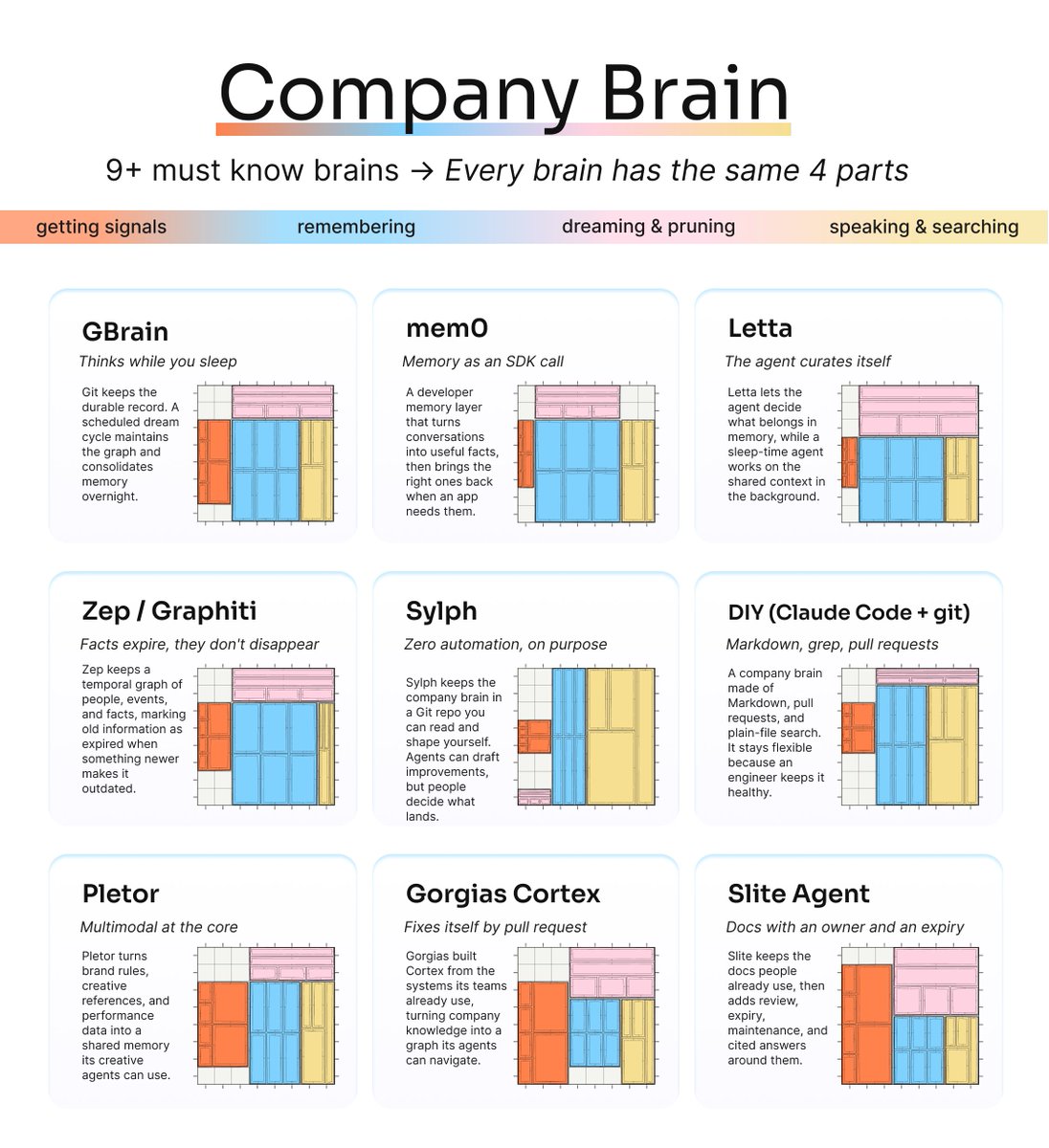
Everyone's suddenly building company brains.
Nobody agrees on what's inside one. 😵💫
So we opened up 9+ company brains to see how they're actually built.
Every single one does the same four things: getting signals, remembering, dreaming & pruning, speaking & searching.
𝟭. 𝗚𝗕𝗿𝗮𝗶𝗻
Garry Tan's open-source personal brain. Your email and calendar flow into a git repo, and a nightly job re-links everything and flags what's gone stale.
𝟮. 𝗺𝗲𝗺𝟬
A memory library you call from your own code. It only stores what you explicitly tell it to, and ranks fresh facts above idle ones at search time.
𝟯. 𝗟𝗲𝘁𝘁𝗮
For building agents that remember across sessions. The agent decides what's worth keeping, and a second agent tidies up its memory in the background.
𝟰. 𝗭𝗲𝗽 / 𝗚𝗿𝗮𝗽𝗵𝗶𝘁𝗶
A knowledge graph with a clock in it. When a fact changes, the old one gets an end date instead of being overwritten, so you can still ask what was true last March.
𝟱. 𝗦𝘆𝗹𝗽𝗵
A content brain that lives entirely in a git repo. Agents write drafts, humans publish, and afterwards the agent reads your edits to learn what it got wrong.
𝟲. 𝗗𝗜𝗬 (𝗖𝗹𝗮𝘂𝗱𝗲 𝗖𝗼𝗱𝗲 + 𝗴𝗶𝘁)
What most engineering teams actually do. Markdown in the repo, grep instead of search, and pull requests as the only thing keeping it honest.
𝟳. 𝗣𝗹𝗲𝘁𝗼𝗿
A brand brain for marketing teams. Campaigns, assets and performance data in one tree, and the brand rules only move when a human signs off.
𝟴. 𝗚𝗼𝗿𝗴𝗶𝗮𝘀 𝗖𝗼𝗿𝘁𝗲𝘅
Built in-house by an eight-person AI team. 12,000 markdown nodes in GitHub, and every night the questions it got wrong become PRs that fix it.
𝟵. 𝗦𝗹𝗶𝘁𝗲 𝗔𝗴𝗲𝗻𝘁
For teams whose knowledge lives in docs and across sources. It watches ~20 connected tools (Slack, Drive, GitHub, Jira, etc.) for what's gone stale and sends the diff to whoever owns the page. Nothing changes without human approval.
We just launched an interactive ebook with architecture notes from real 149 teams of builders and users, interview insights, and the complete research.
The ebook is free, get it here: https://t.co/B7QBztEqgI
Which brain would you pick? 🧠
Plato was actually right..
Researchers proved every LLM on earth is converging on the exact same "universal geometry" of meaning.
They built a method that can translate between ANY model's embeddings without ever seeing the original text or using paired data.
different architectures, different training sets, different parameter counts.. it doesn't matter.
Until now, every AI model has lived in its own isolated mathematical universe.
An embedding vector from Claude meant nothing to GPT, and a vector from Llama meant nothing to Gemini. They spoke entirely different geometric languages.
To bridge them, you always needed paired datasets, complex encoders, or heavy fine-tuning.
Then researchers dropped a bombshell paper.
They built a system that can translate between any model's embeddings without ever seeing the original text, without encoders, and without a single pair of matching data.
How?
Because the geometry is already there.
Different models, built by different companies, with totally different architectures, parameter counts, and training data, are all naturally drifting toward the exact same underlying latent structure of human meaning.
The Platonic Representation Hypothesis isn't just a theory anymore. It’s a mathematical reality.
They built an unsupervised method that maps an unknown embedding from one model straight into a universal representation space, matching text vectors across different models with shockingly high precision.
But here is the dark side nobody is talking about.
If meaning has a universal geometry, and vectors can be freely translated across models without the original text or encoders...
Vector databases are wide open.
An adversary with access only to a company's stored embedding vectors can translate them, invert them, and extract sensitive internal documents, personal data, and proprietary codebases without ever hacking the model itself.
Grace
f z,d
@(30) {
f3 p = z * nor(2*C.rgb - R.xyy),t = p
d=4; @(6) d/=.8,
p += sin(p.yzx * d + z + T) / d;z += (3-len(p.xz))/9;O += f4(9,7,4,1)/(abs(t.x*(t.y-.8))+abs(t.z+3)*.5)
}
O = tanh(O*O / 3e5)


![Goodmanprotocol's tweet photo. Rubber stamp travel field notes poster
GPT Image 2
Prompt:
Create one separate poster for each scene. Output each poster individually—never combine scenes or create a collage.
FORMAT
Use a strict 4:5 portrait composition. Cover the entire frame with warm off-white aged paper featuring subtle fibers, natural grain, light wear, and a matte tactile texture. Preserve generous blank whitespace.
STAMP ARTWORK
Create a compact multi-color carved rubber stamp depicting the most recognizable features of the location: distinctive architecture, mountains, terrain, vegetation, roads, shorelines, skyline, or key foreground shapes.
Simplify aggressively. Keep only the visual information needed to instantly recognize the place and scene. Remove crowds, vehicles, repetitive windows, dense buildings, fragmented vegetation, decorative details, and irrelevant background elements.
Place the stamp in the lower-middle, occupying about 30–38% of the frame height, with ample whitespace around it. Keep it compact and understated—not a full landscape illustration, painting, logo, or oversized graphic.
Adapt the composition naturally:
Architecture: distinctive silhouettes, roofs, domes, arches, towers, and main structures.
Mountain settlements: simplified terraced buildings following the terrain.
Coastal scenes: mountains, settlement layers, shoreline, and sparse water marks.
City panoramas: main skyline, one iconic structure, and distant mountains.
Natural landscapes: primary mountains, trees, shorelines, and road directions.
INK & TEXTURE
Use 2–4 muted spot colors, inspired by the scene, such as carbon black, deep green, brick red, ochre, slate blue, or taupe.
Give each color a separate hand-stamped layer with authentic carved-rubber imperfections: engraved marks, uneven lines, chipped edges, dry-ink gaps, paper show-through, granular ink, uneven pressure, ghosting, and subtle 1–2 mm misregistration.
The result must feel like a real rubber stamp pressed onto aged paper, never a smooth vector graphic, filtered image, or digital logo.
TYPOGRAPHY
Generate:
Location: English name
No. [number]
Three short English keywords
Year: 2026
Place the text below or beside the stamp in the whitespace. Use a small, restrained, slightly imperfect typewriter-style font. Keep it minimal, accurate, and documentary.
MOOD
Quiet, tactile, restrained, regional, observational, and collectible—like field notes created by an architect, travel writer, or natural observer.
AVOID
Circular seals, Chinese red stamps, postage perforations, wax seals, stickers, souvenir templates, generic city icons, smooth vector logos, cartoon styles, 3D rendering, glossy gradients, plastic textures, oversaturation, excessive detail, excessive text, and decorative clutter.](https://pbs.twimg.com/media/HRDs9DcbwAAr4tu.jpg)
![Goodmanprotocol's tweet photo. Rubber stamp travel field notes poster
GPT Image 2
Prompt:
Create one separate poster for each scene. Output each poster individually—never combine scenes or create a collage.
FORMAT
Use a strict 4:5 portrait composition. Cover the entire frame with warm off-white aged paper featuring subtle fibers, natural grain, light wear, and a matte tactile texture. Preserve generous blank whitespace.
STAMP ARTWORK
Create a compact multi-color carved rubber stamp depicting the most recognizable features of the location: distinctive architecture, mountains, terrain, vegetation, roads, shorelines, skyline, or key foreground shapes.
Simplify aggressively. Keep only the visual information needed to instantly recognize the place and scene. Remove crowds, vehicles, repetitive windows, dense buildings, fragmented vegetation, decorative details, and irrelevant background elements.
Place the stamp in the lower-middle, occupying about 30–38% of the frame height, with ample whitespace around it. Keep it compact and understated—not a full landscape illustration, painting, logo, or oversized graphic.
Adapt the composition naturally:
Architecture: distinctive silhouettes, roofs, domes, arches, towers, and main structures.
Mountain settlements: simplified terraced buildings following the terrain.
Coastal scenes: mountains, settlement layers, shoreline, and sparse water marks.
City panoramas: main skyline, one iconic structure, and distant mountains.
Natural landscapes: primary mountains, trees, shorelines, and road directions.
INK & TEXTURE
Use 2–4 muted spot colors, inspired by the scene, such as carbon black, deep green, brick red, ochre, slate blue, or taupe.
Give each color a separate hand-stamped layer with authentic carved-rubber imperfections: engraved marks, uneven lines, chipped edges, dry-ink gaps, paper show-through, granular ink, uneven pressure, ghosting, and subtle 1–2 mm misregistration.
The result must feel like a real rubber stamp pressed onto aged paper, never a smooth vector graphic, filtered image, or digital logo.
TYPOGRAPHY
Generate:
Location: English name
No. [number]
Three short English keywords
Year: 2026
Place the text below or beside the stamp in the whitespace. Use a small, restrained, slightly imperfect typewriter-style font. Keep it minimal, accurate, and documentary.
MOOD
Quiet, tactile, restrained, regional, observational, and collectible—like field notes created by an architect, travel writer, or natural observer.
AVOID
Circular seals, Chinese red stamps, postage perforations, wax seals, stickers, souvenir templates, generic city icons, smooth vector logos, cartoon styles, 3D rendering, glossy gradients, plastic textures, oversaturation, excessive detail, excessive text, and decorative clutter.](https://pbs.twimg.com/media/HRDs8d1aAAAET1f.jpg)
![Goodmanprotocol's tweet photo. Rubber stamp travel field notes poster
GPT Image 2
Prompt:
Create one separate poster for each scene. Output each poster individually—never combine scenes or create a collage.
FORMAT
Use a strict 4:5 portrait composition. Cover the entire frame with warm off-white aged paper featuring subtle fibers, natural grain, light wear, and a matte tactile texture. Preserve generous blank whitespace.
STAMP ARTWORK
Create a compact multi-color carved rubber stamp depicting the most recognizable features of the location: distinctive architecture, mountains, terrain, vegetation, roads, shorelines, skyline, or key foreground shapes.
Simplify aggressively. Keep only the visual information needed to instantly recognize the place and scene. Remove crowds, vehicles, repetitive windows, dense buildings, fragmented vegetation, decorative details, and irrelevant background elements.
Place the stamp in the lower-middle, occupying about 30–38% of the frame height, with ample whitespace around it. Keep it compact and understated—not a full landscape illustration, painting, logo, or oversized graphic.
Adapt the composition naturally:
Architecture: distinctive silhouettes, roofs, domes, arches, towers, and main structures.
Mountain settlements: simplified terraced buildings following the terrain.
Coastal scenes: mountains, settlement layers, shoreline, and sparse water marks.
City panoramas: main skyline, one iconic structure, and distant mountains.
Natural landscapes: primary mountains, trees, shorelines, and road directions.
INK & TEXTURE
Use 2–4 muted spot colors, inspired by the scene, such as carbon black, deep green, brick red, ochre, slate blue, or taupe.
Give each color a separate hand-stamped layer with authentic carved-rubber imperfections: engraved marks, uneven lines, chipped edges, dry-ink gaps, paper show-through, granular ink, uneven pressure, ghosting, and subtle 1–2 mm misregistration.
The result must feel like a real rubber stamp pressed onto aged paper, never a smooth vector graphic, filtered image, or digital logo.
TYPOGRAPHY
Generate:
Location: English name
No. [number]
Three short English keywords
Year: 2026
Place the text below or beside the stamp in the whitespace. Use a small, restrained, slightly imperfect typewriter-style font. Keep it minimal, accurate, and documentary.
MOOD
Quiet, tactile, restrained, regional, observational, and collectible—like field notes created by an architect, travel writer, or natural observer.
AVOID
Circular seals, Chinese red stamps, postage perforations, wax seals, stickers, souvenir templates, generic city icons, smooth vector logos, cartoon styles, 3D rendering, glossy gradients, plastic textures, oversaturation, excessive detail, excessive text, and decorative clutter.](https://pbs.twimg.com/media/HRDs73Ha8AAjeDT.jpg)


![Goodmanprotocol's tweet photo. Rubber stamp travel field notes poster
GPT Image 2
Prompt:
Create one separate poster for each scene. Output each poster individually—never combine scenes or create a collage.
FORMAT
Use a strict 4:5 portrait composition. Cover the entire frame with warm off-white aged paper featuring subtle fibers, natural grain, light wear, and a matte tactile texture. Preserve generous blank whitespace.
STAMP ARTWORK
Create a compact multi-color carved rubber stamp depicting the most recognizable features of the location: distinctive architecture, mountains, terrain, vegetation, roads, shorelines, skyline, or key foreground shapes.
Simplify aggressively. Keep only the visual information needed to instantly recognize the place and scene. Remove crowds, vehicles, repetitive windows, dense buildings, fragmented vegetation, decorative details, and irrelevant background elements.
Place the stamp in the lower-middle, occupying about 30–38% of the frame height, with ample whitespace around it. Keep it compact and understated—not a full landscape illustration, painting, logo, or oversized graphic.
Adapt the composition naturally:
Architecture: distinctive silhouettes, roofs, domes, arches, towers, and main structures.
Mountain settlements: simplified terraced buildings following the terrain.
Coastal scenes: mountains, settlement layers, shoreline, and sparse water marks.
City panoramas: main skyline, one iconic structure, and distant mountains.
Natural landscapes: primary mountains, trees, shorelines, and road directions.
INK & TEXTURE
Use 2–4 muted spot colors, inspired by the scene, such as carbon black, deep green, brick red, ochre, slate blue, or taupe.
Give each color a separate hand-stamped layer with authentic carved-rubber imperfections: engraved marks, uneven lines, chipped edges, dry-ink gaps, paper show-through, granular ink, uneven pressure, ghosting, and subtle 1–2 mm misregistration.
The result must feel like a real rubber stamp pressed onto aged paper, never a smooth vector graphic, filtered image, or digital logo.
TYPOGRAPHY
Generate:
Location: English name
No. [number]
Three short English keywords
Year: 2026
Place the text below or beside the stamp in the whitespace. Use a small, restrained, slightly imperfect typewriter-style font. Keep it minimal, accurate, and documentary.
MOOD
Quiet, tactile, restrained, regional, observational, and collectible—like field notes created by an architect, travel writer, or natural observer.
AVOID
Circular seals, Chinese red stamps, postage perforations, wax seals, stickers, souvenir templates, generic city icons, smooth vector logos, cartoon styles, 3D rendering, glossy gradients, plastic textures, oversaturation, excessive detail, excessive text, and decorative clutter.](https://pbs.twimg.com/media/HRDs9pPbkAAvc1x.jpg)