حياكم الله بمنصة نينجا على تويتر، راح تلقوا عندنا كل شيء تحتاجونه للتجهيز و الاستعداد لاختبار الهيئة السعودية THE #SMLE 🩺✨
مناقشات لاسئلة طبية شيقة✍️، معلومات مهمة بشكل مبسط و مختصر📃
كورسات قوية منافسة، مع عروض حصرية متجددة، و اكثر 😍
و فالكم التوفيق و النجاح باذن الله
Treatments are based on each person's physical and intellectual needs, strengths, and limitations. Services early in life focus on helping children with Down syndrome develop to their full potential. These services include speech, occupational, and physical therapies.
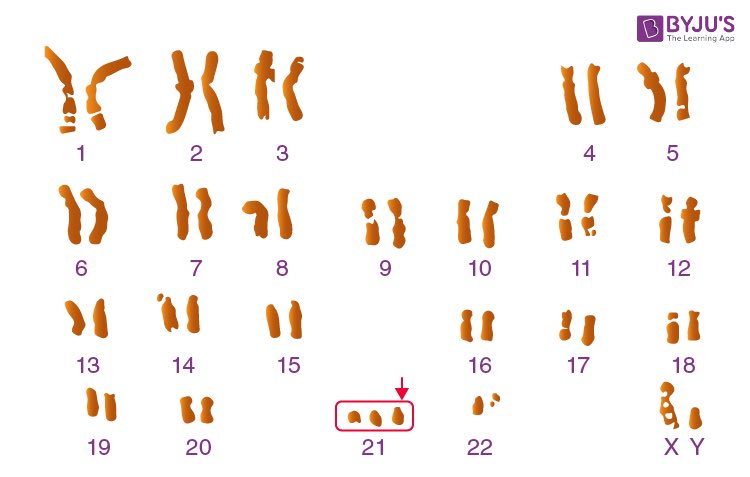
Down's syndrome, also known as trisomy 21, is a genetic disorder caused by the presence of all or part of a third copy of chromosome 21. It is usually associated with developmental delays, mild to moderate intellectual disability, and characteristic physical features.
Risk factors include
Older age. Chances of giving birth to a child with Down syndrome goes up with age because older eggs have a greater risk of unusual chromosome division.
Being carriers of the genetic translocation for Down syndrome. ...
Having had one child with Down syndrome
The early signs during pregnancy can include: Abnormal Ultrasound Findings: Increased nuchal translucency (fluid at the back of the fetus's neck). Abnormal Blood Test Results: Unusual levels of certain proteins and hormones
People with Down syndrome often have a characteristic facial appearance that includes a flattened appearance to the face, outside corners of the eyes that point upward (upslanting palpebral fissures ), small ears, a short neck , and a tongue that tends to stick out of the mouth.
In Down syndrome, there is an additional copy of chromosome 21, resulting in three copies instead of the usual two copies. Down syndrome is a genetic condition caused when an unusual cell division results in an extra full or partial copy of chromosome 21
Treatment
removing and replacing the jelly inside your eye vitrectom attaching a small band around your eye to push the wall of your eye and retina closer together scleral bucklinginjecting a bubble of gas into your eye to push the retina against the back of the eye.
Retinal detachment is a condition where the retina pulls away from the tissue underneath it. It may start in a small area, but without quick treatment, it can spread across the entire retina, leading to serious vision loss and possibly blindness. Is a medical emergency .
The vitreous in your eye may change in texture and may shrink. Sometimes, as it shrinks, the vitreous can pull on your retina and tear it. Other things that can increase your risk of rhegmatogenous retinal detachment are eye injuries, eye surgery, and nearsightedness.
A lot of new floaters (small dark spots or squiggly lines that float across your vision)
Flashes of light in one eye or both eyes.
A dark shadow or “curtain” on the sides or in the middle of your field of vision.
Most people with spina bifida occulta don't need medical treatment. Those with a tethered cord might have surgery to let the spinal cord move more freely.
Spina bifida occulta is when a baby's backbone (spine) does not fully form during pregnancy. The baby is born with a small gap in the bones of the spine. Usually, it causes no health problems.
mild form of spina bifida and rarely causes symptoms. Children diagnosed with spina bifida occulta might have a visible mark on their skin at the lower part of the back when they're born that appears as a lump, a red or purple patch (hemangioma), a dark spot birthmarkor a dimple.
Treatment of localized osteosarcoma may include the following:
Surgery to remove the primary tumor.
Chemotherapy may be given before or after surgery to remove the primary tumor.
Radiation therapy if surgery cannot be done or if the tumor was not completely removed by surgery.
An osteosarcoma or osteogenic sarcoma is a cancerous tumor in a bone. Specifically, it is an aggressive malignant neoplasm that arises from primitive transformed cells of mesenchymal origin and that exhibits osteoblastic differentiation and produces malignant osteoid
The first signs of osteosarcoma are pain and swelling in the affected bone, with symptoms often becoming more severe at night. Additionally, if the tumor is in the leg, a limp or other walking difficulties may occur.
A 39-year-old woman presents with menorrhagia. A pelvic ultrasound confirms the presence of a uterine fibroid. What is the most likely location of this fibroid?