More thoughts on Bluesky, but generally it hit close to home for me. Neuroscience needs a diversity and balance of approaches--nicely articulated in the text (and with so many inspiring examples).
One of the best books I read in 2025 was Nachum Ulanovsky's _Natural Neuroscience_. The worn cover reflects that I read it in freely-behaving, natural conditions.
Was mesmerized many years ago listening to Sydney Brenner talk about reading the human genome base pair by base pair. This is similar. Neither led to "discovery", but both led to changes in how they thought about the system or how to measure it.
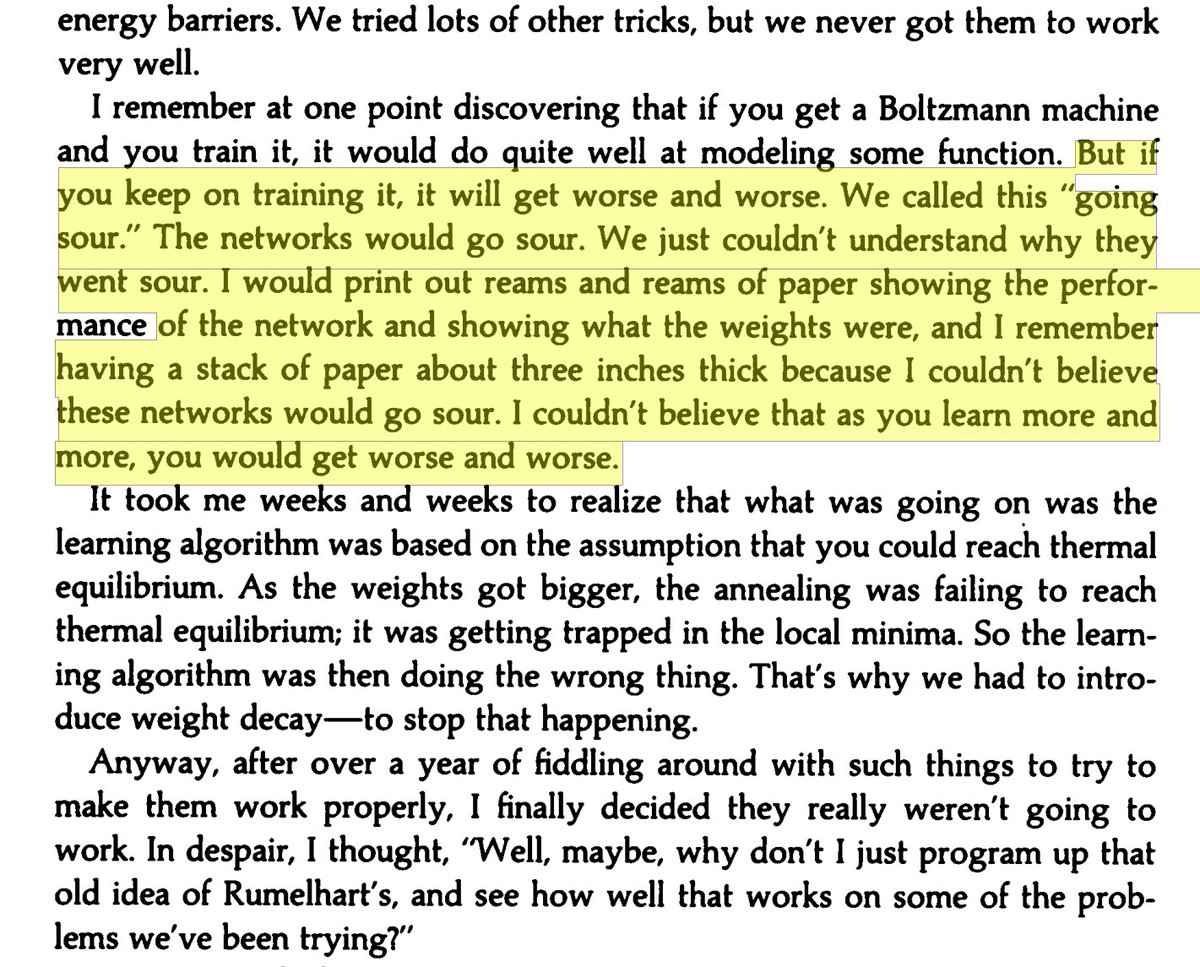
Hinton ~1983 thought Boltzmann Machines > backprop, but debugged himself out of the infatuation
Boltzmann Machines failed to learn, so he printed out weights, 8 cm thick, and inspected them for weeks
it's the dreaded local minimum
so 1 yr later, in desperation, he tried backprop
Out today in @CellCellPress !
We show that oscillations in norepinephrine and cerebral blood volume are the missing pieces that link NREM sleep to clearance of waste from the brain 🧠💤 https://t.co/cvfmkxNzJt
Authors should initially be in randomized order, with some "false authors" included. Then at the end of the paper we find out who the fake authors were ("I never would have guessed!") and who were the first and senior/corresponding authors ("wow, I thought his career was dead").
To encourage readers beyond the abstract, it should also end with exciting leads, e.g., "You won't believe what the mice did next" or "Stay tuned for the big reveal in Discussion"
@birchlse All things Thomas & Friends became much more enjoyable when I realized Sir Topham Hat was training a society of social AI on a graph topology. Or maybe Hat is just the embodiment of a cost function, with "Really useful" versus "Confusion and delay" as reinforcement/error.
Twitter ad for AI company with "generative" in the name, showing an image of a head CT.
New tools are amazing for finding abnormalities in med imaging, but you probably don't want image analysis to be generative?
Nice tweet thread by PhD student @VogtCaleb about his paper in @bmcbiology on rewilded lab mice.
I’ll add a few more details.
1. Mice did NOT form a social hierarchy like they do in lab, instead they quickly formed territories.
2. Mice spent most of their time alone