Lucky: 26 years old Tayab Khan and four other friends from Nepal have won 1.25+ Arba grand prize in the UAE lottery. Tayab works as a security guard in the UAE and the amount will be distributed among five friends as the ticket was bought by them in group. 😮 #Congrats
Tradition meets Modernity in Nepal 🇳🇵@nepaltourismb@hello_dotnpl
A graceful statue in traditional Namaste pose stands tall…....... while Colonel Sanders and KFC watch quietly from the side.
Old heritage and new globalization sharing the same frame. Beautiful chaos.
What do you think - progress or cultural loss?
Which one are you visiting first?
#Nepal #NepaliCulture #TraditionVsModernity #Kathmandu #Namaste
But then who is to blame for this population burst??
Its the indian public and indian govt who came up with no plans/policy to curb its evergrowing polulation putting pressure on its limited resources.the first thing india needs to do is to controll its population immediately.
Every single one of the points are a real problem.
But your understanding is broken, let me explain. :)
Norway has 55 lakh people. Total. That’s smaller than the population of Pune. Their entire country has fewer citizens than India’s 25 smallest cities individually. Norway also has 1.2 trillion dollars in sovereign wealth from oil reserves, accumulated over 50 years.
They have $250,000 per citizen sitting in the fund. India has roughly $3,400 per citizen in forex reserves.
Norway is what you get when a small population sits on top of one of the largest per-capita oil discoveries in human history.
The right comparison is other low-income, high-population, post-colonial democracies. Brazil. Indonesia. Nigeria. Bangladesh. Pakistan. Egypt. Mexico. South Africa. Vietnam. Philippines.
Compare on these and India isn’t doing badly. It’s doing better than most.
UPI is the world’s largest real-time payments system.
Aadhaar is the world’s largest biometric identity system.
We absorbed the global pandemic, the Ukraine war, the West Asia conflict, Trump’s tariffs, the Iran war, and a rupee fall without going into recession.
Most of those countries above did. Pakistan went to the IMF 24 times. Sri Lanka collapsed. Bangladesh is unstable. Egypt needed emergency Gulf bailouts. Argentina has 60% inflation. We stayed standing.
India is the only country in human history to add a trillion dollars of GDP every 18 months. We added our first trillion in 2007. Our second in 2017. Our third in 2024. Our fourth coming in 2026.
The problems you mentioned exist in every large, low-income, high-density country on earth.
Mexico City’s pollution is worse than Delhi’s.
Manila’s traffic is worse than Mumbai’s.
Lagos has worse road quality than Delhi.
Jakarta has worse air than Delhi.
Cairo has worse adulteration.
Karachi has more corruption.
Hanoi has higher pollution.
None of these countries are run by Modi. They’re all dealing with the same impossible math.
Industrialising a country of 145 crore people during a global energy transition, with limited natural resources, while keeping democracy intact, is the single hardest governance challenge in human history.
> China did it without democracy.
> South Korea did it with a population one-tenth our size.
> Japan did it with no major religious or linguistic diversity.
> Singapore did it with 50 lakh people total.
Nobody has done it at India’s scale, with our diversity, in democratic conditions.
So when someone asks “why hasn’t Modi built one city like Norway,” the answer is because building one Norway requires not having 144.5 crore other Indians to look after.
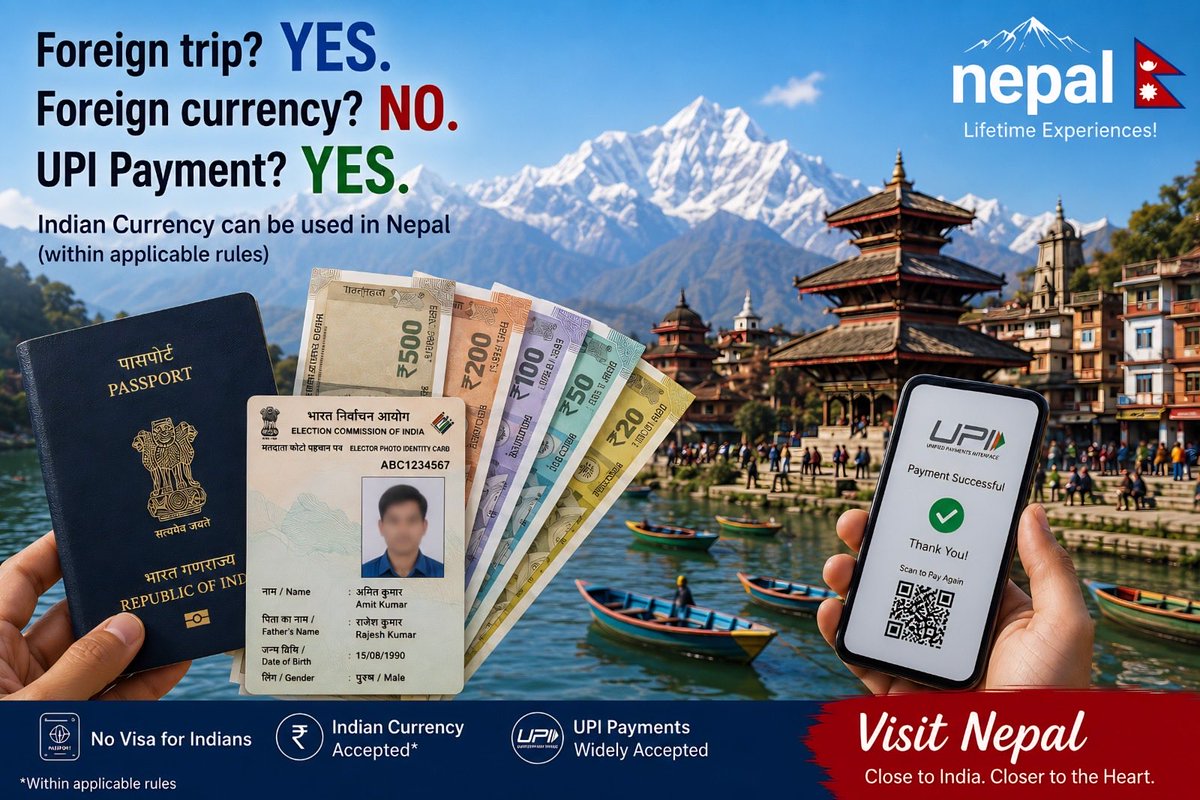
On International Everest Day, Nepal invites our Indian friends to experience the land of the world’s highest peak.
From Everest to Lumbini, Janakpur to Pokhara, Nepal is close to India and even closer to the heart.
Come, feel the Himalayas.
#InternationalEverestDay#VisitNepal
Running accross india frm kasmir to kanyakumari that too in such hot condition when general public cant even step outside their home in the noon is something incredible.👏👏
Kya junoon hai @sufirunner 🫡
A student once explained how wild pigs are trapped:
First, they are given free corn in the forest.
They return every day for the easy food.
Then slowly, fences are built around them, one side at a time.
At first they resist. Then they adapt.
Finally the gate shuts and the pigs, now dependent on the free corn, have lost their freedom without even realizing it.
That is how freedom often disappears in societies too. Not suddenly through force, but gradually through dependence.
Free rations. Free electricity. Free cash transfers. Endless subsidies. Political promises of “something for nothing.”
Each may appear harmless in isolation. But over time, citizens begin depending more on the State than on their own enterprise, effort and initiative.
And when dependence grows, freedom quietly shrinks.
A nation becomes truly strong not when more people vote for benefits, but when more people create, build, innovate and contribute.
There is no free lunch.
Someone always pays the bill.
And sometimes, the hidden cost is freedom itself.