We surely need more youngsters to take up ITI courses but the quality of courses, trainers and apprenticeship opportunities are critical to ensure quality of manufacturing output in India.
#WATCH | I am determined to change the mindset that makes families feel ashamed of their children pursuing ITI courses. ITI students deserve the same respect as IIT graduates. Industries rely on their skills and hard work to function. I take immense pride in honouring these young achievers and recognising the dignity of skilled work: PM @narendramodi at the 5th Kaushal Deekshant Samaroh in Lucknow, Uttar Pradesh.
#KaushalDeekshantSamaroh #SkillIndia #SkillDevelopment #ViksitBharat
Anthropic’s filing cites 5,300 PhDs on roll, each with 10–15 years of prior research in universities that sit on billions in cash, yet India struggles to finance even a ₹30–40 lakh unsecured loan at below 16–18%.
And Uday Kotak wonders why India can’t build an Anthropic?
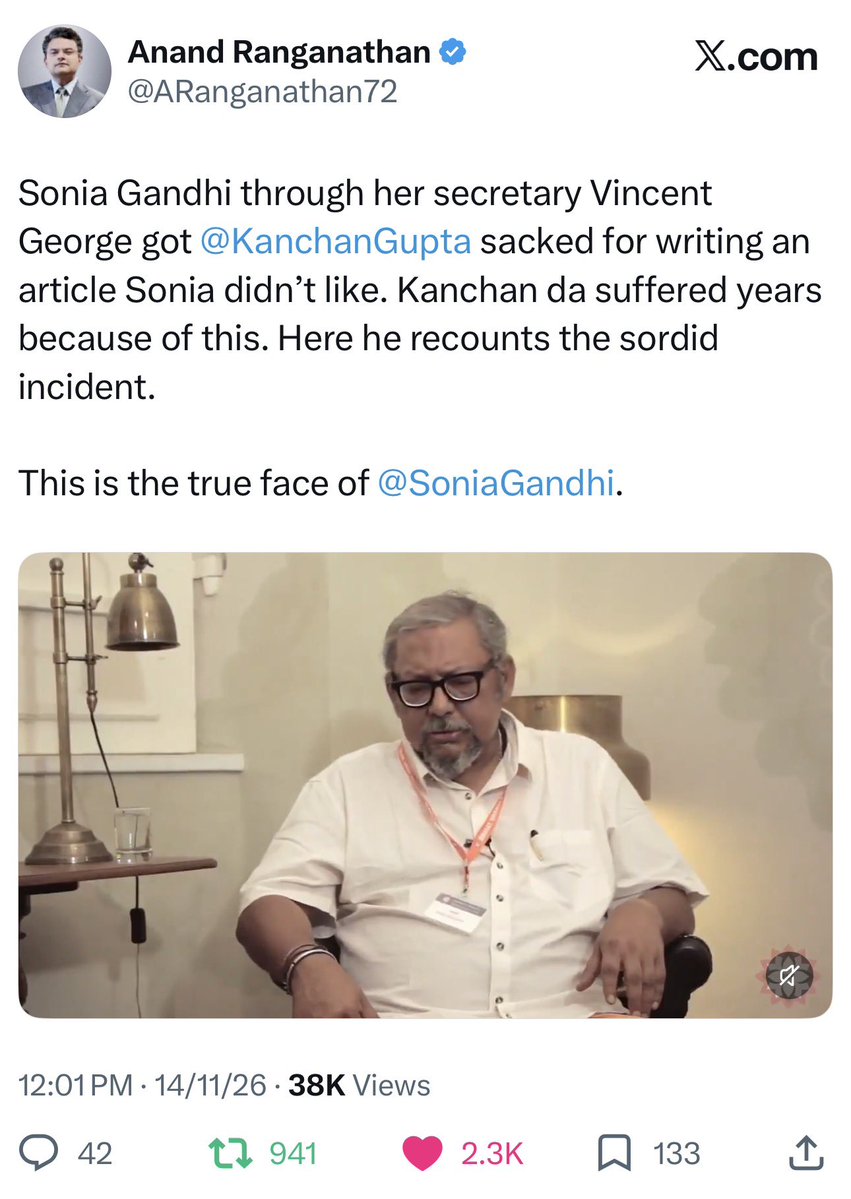
I must thank @ARanganathan72 for flagging my sacking at the behest of a Lutyens clerk merely because I was not deferential to his boss. So this is how this and other near-sackings happened in my otherwise vanilla life.
It was an extremely distressing experience to get sacked in 1995 from The Pioneer where I was Associate Editor because the then Editor (economist Ashok Mitra famously described him as a ‘handout Editor’) needed to suck up to Sonia Gandhi. No less distressing was the reality of being left without a roof and phone (rented / owned by The Pioneer’s then owners, the Thapars) with a family in tow — we were literally out in streets with nowhere to go. All this happened after Vinod Mehta resigned in protest against pressure from Thapar House to be ‘nice’ to Sharad Pawar to whom the ‘Bombay Club’ was beholden.
That was not my first or last experience of running into trouble with Sonia Gandhi and her factotums. I had published a photograph of Rajiv and Sonia in The Statesman’s popular weekend section (The Saturday Statesman) which I edited, shot during their visit to Mizoram in 1986. Sonia was in a Lacoste tee and the couple looked remarkably striking. Those were still Camelot days of Prince Charming.
It was a measure of the then Government’s illicit and undeclared reach that they had access to The Saturday Statesman, which was printed in Kolkata and shipped to Delhi on Thursday-Friday, before its distribution on Saturday. HY Sharada Prasad, Press Advisor to Rajiv Gandhi, called CR Irani, MD of The Statesman, and rained fire and brimstone on him for daring to publish a ‘private photo of Madam.’
Sharada Prasad demanded that The Saturday Statesman with the Rajiv-Sonia photo should not be distributed and all copies must be destroyed. Irani, who was then struggling to get the rebuilding plans for The Statesman’s Delhi office at CP approved, worked out a deal that there would be an ‘apology’ in the main paper and The Saturday Statesman would be distributed. Irani asked me to draft the apology and run it in Saturday morning’s paper.
On that occasion Swapan, also at The Statesman, stood like a rock by me — I remain grateful to him. He also drafted the ‘apology’ for me — Swapan’s nib-breaking, tongue-twisting, brain-wracking English impressed Sharada Prasad but little did he realise it was actually a non-apology.
The story of my encounters with the Nehru Dynasty is one of several episodes. In 2012 the Sonia Gandhi-led UPA regime invoked the draconian anti-Freedom of Expression, anti-liberty, anti-Constitution Section 66A (drafted and implemented by Kapil Sibal with great fervour to prevent, prosecute and punish any criticism of Sonia Gandhi and silence all critical Speech in India) against me, instructing ISPs to block my Twitter handle. The handles of several other journalists and regime critics were also blocked.
The sinister charges against me, never registered formally but only informally conveyed, made me feel like Trotsky in Stalin’s court. Better counsel by way of domestic and global criticism of this attempt to choke voices prevailed and the block order was quietly buried after a hearing in a dark room with a single electric bulb hanging from the ceiling, very reminiscent of the interrogation chambers of Mussolini’s secret police OVRA.
I was later told the Gestapo-style hearing was the brainchild of then Home Secretary RK Singh whose fetid imagination had also birthed the hideous nomenclature ‘Saffron Terror’. He who later floated into NDA and has now floated out again.
@kushanmitra
Japan has two incompatible electricity grids.
Why?
In 1895, Tokyo bought German generators operating at 50 Hz.
In 1897, Osaka bought American generators operating at 60 Hz.
Over 130 years later, Japan still lives with the consequences of those two purchases.
For the first time in 47 years, the CRPF has completed 12 consecutive months without an operational death, marking a major milestone for the country's largest paramilitary force.
It's not just poverty, toilets, or highways, statistics like "the number of clinical trials done in India" indicating biomedical R&D and innovation can show India's development in the last decade.
The harsh, unglamorous reality of running a research lab in India:
• 9 months spent navigating bureaucratic loops just to onboard a single postdoctoral fellow.
• Two nationally funded grants stuck in fiscal limbo, sanctioned on paper, zero cash flow in practice.
• Project staff and research fellows surviving without salaries for 90 days.
We celebrate Nobel dreams and technological self-reliance on public stages, but behind the laboratory doors, PIs spend 70% of their bandwidth begging finance desks to release sanctioned funds and apologizing to unpaid junior scholars.
Science does not fail in India due to a lack of intellect or ambition; it gets slowly suffocated by procedural inertia and financial apathy. If we cannot ensure basic salary timelines for young researchers, talking about global leadership is pure theater. 🎯☕📊🔬
#IndianAcademia #ResearchFunding #HigherEdRealities #SciencePolicy #PostDocStruggles #AcademicLeadership #SystemicReform
We've reached a point where people who've never built a company have absolute certainty about how companies should be built. Meanwhile, founders who've spent years building one will openly admit how much they still don't know. The internet has created a strange world where those with the least experience often have the strongest opinions, while those with the most experience are expected to defend every word they say. It's remarkable how much easier entrepreneurship looks when the only thing you've ever built is an opinion about it.
Modi Govt deals another lethal blow against drugs with Operation Trident.
Our agencies launched a barrage of simultaneous crackdowns across 38 locations in Assam, Mizoram and Manipur on 23 October, smashing an international narco-cartel. The operation revealed ₹100 crore worth of hawala transactions, froze 1,424 bank accounts, attached properties worth ₹17.82 crore, seized 500 detonators and ₹12 lakh in cash, and led to the arrest of 18 people.
The network trafficked narcotics across the borders of India, Myanmar and Bangladesh through the Death Triangle Corridor. The offensive attests to India’s Himalayan resolve to realise the mission of eradicating every drug network by 31 December 2029. India will hammer until the last nail is driven into the coffin of drug cartels.
Heartiest congratulations to the anti-narcotics team comprising central agencies, and police forces of the three states.
I’ve said it a hundred times - the biggest reason why Indian cities look so bad at ground level is an absence of proper pavements.
*It causes air pollution
*It prevents pedestrian movement
*It encourages littering
*It ruins the country’s image.
Why can’t we build and maintain proper pavements?
Why can’t we fix the problem across the nation in mission mode?
A significant part of agricultural value can be lost after the harvest.
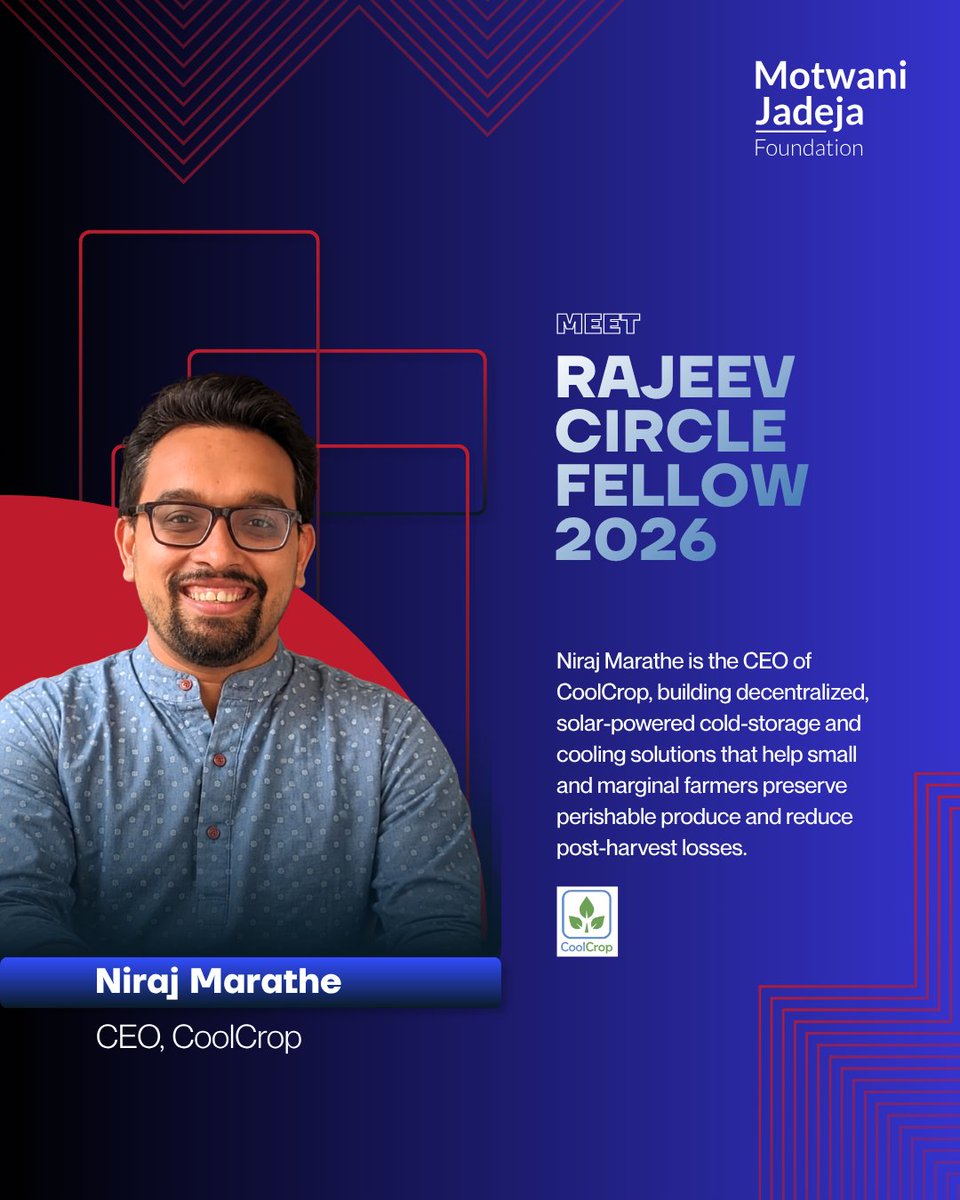
Niraj Marathe, CEO of CoolCrop, is building solar-powered, decentralised cold-storage and preservation solutions for small farmers in India. The company works to help farmers avoid distress sales while providing services that can improve the value of harvested and stored produce.
Through this work, Niraj is applying technology to one of the most practical challenges facing India’s agricultural economy.
The Motwani Jadeja Foundation is pleased to welcome Niraj to the Rajeev Circle Fellowship 2026.
#RCF2026 #RajeevCircle #RajeevCircleFellowship #MotwaniJadejaFoundation #AgriTech
Cashless health insurance is legally sanctioned house arrest.
The doctor officially discharges you at 9 AM. You are fully recovered, your bags are packed and your family is ready to take you home.
Then the hospital administration steps in: "Sir, the insurance TPA approval is pending. Please remain seated in your room until we receive the final payment."
You then spend the next 8 to 12 hours held hostage in a ₹15,000-a-day hospital room.
You are no longer a patient but you are collateral. The hospital doesn't trust the insurance company to actually pay, the insurer is deliberately stalling to find a typo in your medical history to reject the claim and you are stuck in the middle of a corporate standoff.
We live in a country where UPI settles transactions in 300 milliseconds and automated trading algorithms move crores in a microsecond.
The system is designed to exhaust you. They want you so frustrated and desperate to go home that the next time you get sick, you just pay the cash upfront and file for a reimbursement which they will conveniently reject 45 days later citing "insufficient documentation."
If my policy is active and the hospital is in-network, the final discharge should be an instant and automated API settlement. Man I paid insurance company for this service.
Until we force insurers to adopt automated clearing, stop calling it a cashless facility.
Call it what it actually is: an extortion racket with a waiting room.
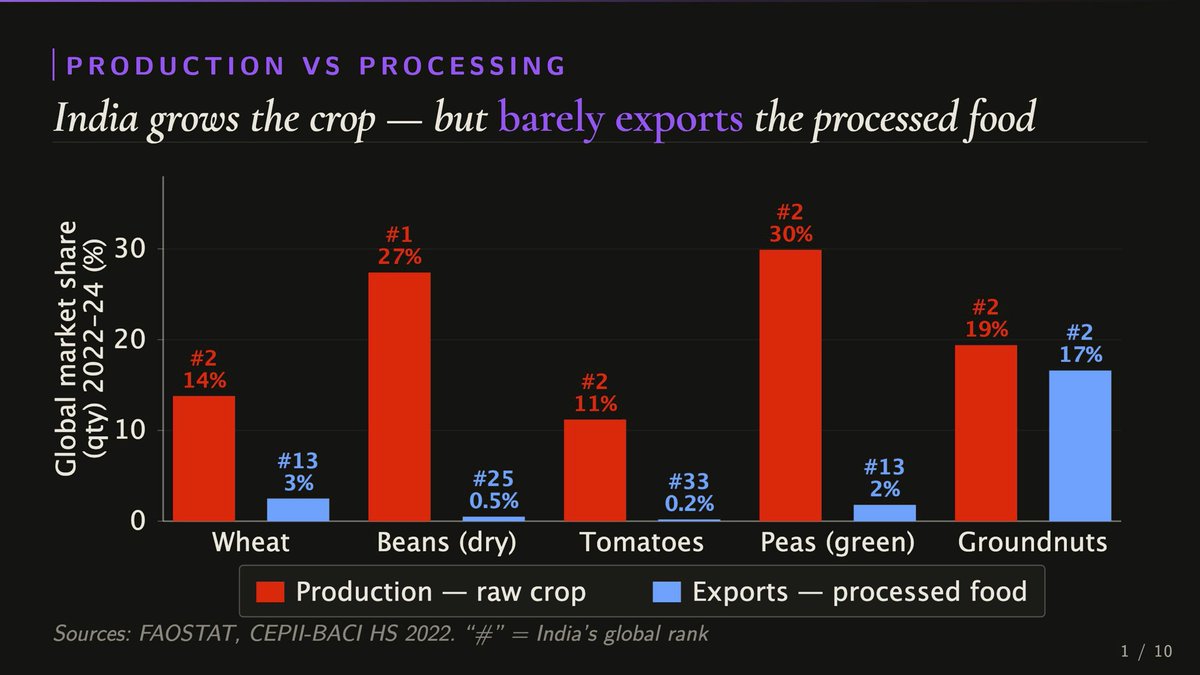
India produced 11% of the world’s tomatoes in 2022–24, but accounted for just 0.2% of processed tomato exports by volume.
Across many crops, agricultural abundance has not translated into processing strength. What needs to change? 1/8