I think the best way to do code reviews now is to do:
1) Will it break anything else reviews
2) Will it actually work reviews
And in priority order. Anything else is futile, if you want to keep up with the onslaught of PRs.
Choosing a research question has a disproportionate influence on downstream impact of your research.
I've been obsessing over what makes for a great research question, and here are my reflections:
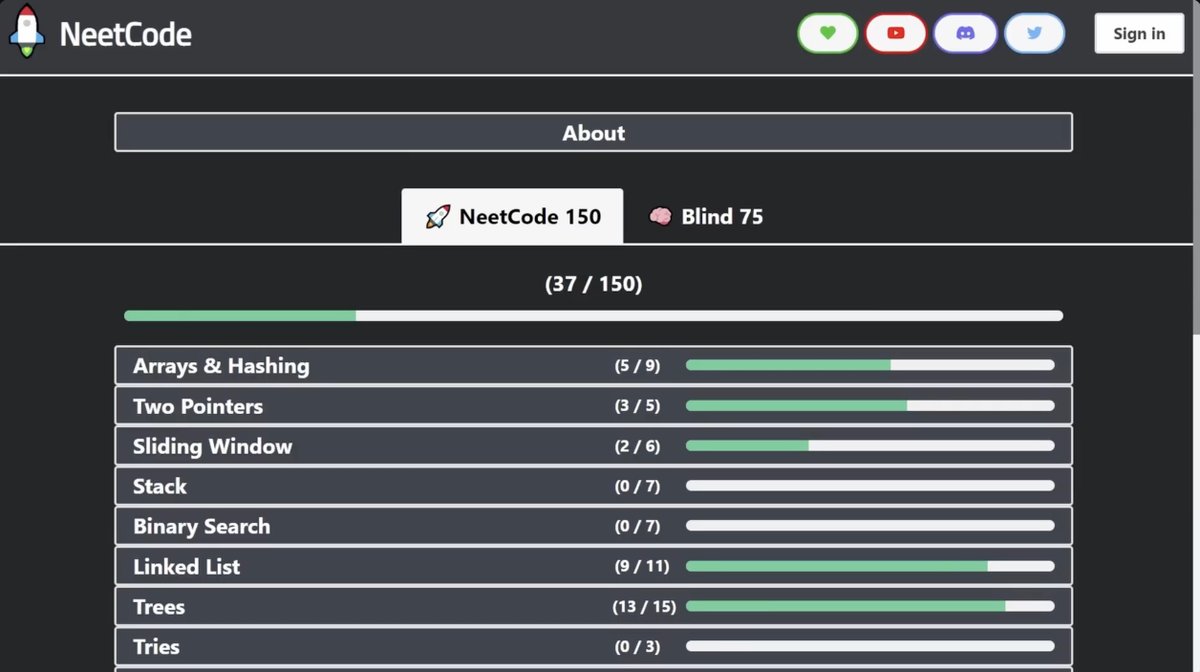
This is what NeetCode looked like in 2022 when I made it.
And it still went viral immediately. Because it was fast, functional & useful.
You could have the most beautiful design in the world, but no one cares if the app isn't useful.
You could have the ugliest design in the world, but that doesn't mean the UX is bad. Focus on what users actually care about.
Today I turn 55.
I’m the fittest, sharpest, and happiest I’ve ever been.
If I’m an outlier, it’s not because I’m built different or discovered a secret formula. The truth is far less glamorous:
It’s a million tiny choices, compounded over decades.
Here are 55 of them:
1. Walk 15+ miles a week, even if you do other exercise. Humans are uniquely made to move slowly over long distances—it’s critical to longevity.
2. Develop a writing practice. It’s the single best way to sharpen your mind. And remember, you don’t have to be a good writer to write. Start with 10 minutes a day.
3. Swap out your toothpaste, deodorant, lotions, soap, shampoo, and other personal care products for natural versions. Here’s a rule of thumb: Don’t put anything on your skin that you couldn’t safely eat.
4. If you have a positive thought about someone, don’t keep it to yourself—share it immediately. Encouragement defies the laws of physics: When you give energy, you also receive it.
5. Wear shoes with a wide forefoot (I like Topo Athletic) and wear toe spreaders around the house (search “yoga toes” on Amazon). Spine health begins with the feet.
6. Get sunlight regularly. Moderate sun exposure (without sunscreen) is hugely important for overall health.
7. Do a 3-minute deep (“ass to grass”) squat every morning. Deep squats are often called the anti-aging exercise. It’s been said that, “It’s not that you can’t do deep squats because you’re old, it’s that you’re old because you can’t do deep squats.”
8. Explore minimalism (it’s not what you think it is).
9. Set boundaries on toxic relationships. We tend to cling to relationships past their expiration date, and it takes a bigger toll on our health than we recognize.
10. Eat real food. Not too much. Don’t eat garbage. Binge occasionally. Fast occasionally. That’s the diet.
11. Learn about FIRE. It’s a great framework for financial success.
12. Don’t take antibiotics except in emergency situations. They’re massively over-prescribed and aren’t needed in most cases. Antibiotics have done untold damage to our guts, which is where health begins. Great natural alternatives are out there.
13. Get 8 hours of quality sleep each night. To optimize sleep:
—Don’t eat after 6pm
—Get blackout shades and cover LEDs with black tape
—No screens 2 hours before bed
—Try ashwagandha (an herb) to calm the nervous system
14. Stop drinking, even in moderation. People find all sorts of ways to justify drinking, but there’s no escaping the simple fact that alcohol is a toxin and it limits your potential.
15. Travel as much as possible. Nothing expands the mind like seeing the world. And travel doesn’t have to be expensive—the best experiences happen outside of fancy resorts, when you live like a local.
16. Let go of resentment. When you forgive someone, you release the prisoner, and the prisoner isn’t them… it’s you.
17. Show up on time, every time. Poor time management limits success more than most people realize. If you struggle with punctuality, stop everything else and fix that first.
18. Spend lots of time in nature and touch the earth. Humans evolved over 300k years to live in harmony with nature, and only recently have we retreated indoors. If you don’t spend time outside, you’re fighting biology (hint: You won’t win.)
19. Stop doing dumb things. As Leo Tolstoy said, “People try to do all sorts of clever and difficult things to improve life instead of doing the simplest, easiest thing—refusing to participate in activities that make life bad.”
20. Find your happy place and (eventually) move there. Most people live where they live because... that's where they live. We are products of our environment—choose yours carefully.
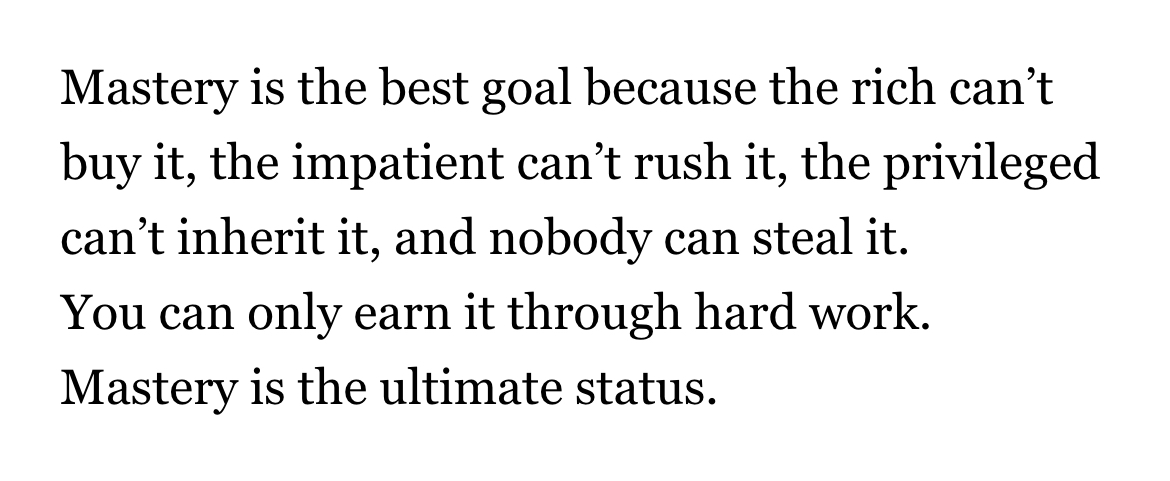
21. Find a hobby and pursue mastery. You can’t have a happy life without a passionate pursuit that isn’t your vocation. Your work—even if you enjoy it—isn’t enough.
22. Avoid mainstream medicine except as a last resort. The results are in—our healthcare (or more appropriately, sick care) system is badly broken and only makes people sicker.
23. Have a mindset of abundance. There is no advantage to being a pessimist—even if you’re right, it’s a miserable way to live. In a very real way… whatever you believe, you’re right!
24. Do hard things. Choose courage over comfort. Everything you want is on the other side of fear and hard work. As Jerzy Gregorik said, “Hard choices, easy life. Easy choices, hard life.”
25. Ignore haters. Hurt people hurt people. Negative/toxic people live in a prison of their own design. Don’t join them!
26. Say no. Protect your time and energy like it’s your most precious asset… because it is.
27. Become a water snob. As an alien said on Star Trek, humans are “ugly bags of mostly water.” You are what you drink—literally! We have Mountain Valley Spring water delivered in glass 5-gallon jugs and also have whole-house water filter (Aquasana Rhino).
28. Stop drinking sodas and sugary energy drinks. After a few weeks you won’t miss them, and a few months later they’ll seem disgusting. Refined sugar causes inflammation, which is the root of most disease.
29. If you’re over 35, find a good functional/longevity medicine doctor and start tracking your hormones. Modern life is hell on the endocrine system and restoring healthy hormone levels can change your life. As we get older, we either accept a slow decline in performance or we do something about it—choose the latter!
30. Develop a morning routine and follow it faithfully. Win the morning, win the day!
31. Invest in experiences, not things. People frequently regret buying things, but rarely regret investing in great experiences (especially when shared with loved ones). Remember, there’s nothing you can buy in a mall that you’ll remember in ten years.
32. Explore spirituality. It’s arrogant and small-minded to believe there’s nothing going on in our universe that is beyond our comprehension. We know less about our universe than an ant meandering on a sidewalk understands about this planet.
33. Have a strong bias toward action—doing rather than talking. If you ask a bunch of old people about their regrets, they’ll talk about the things they *didn't* do—the shots they didn’t take—more than the things they did do (even if it went wrong). As Wayne Gretzky famously said, “You miss 100% of the shots you don’t take.” Most people don’t take enough shots.
34. Stay lean. Men in particular are obsessed with muscle mass these days, but bulk doesn’t age well. The goal is to be strong but lean. The fittest guys in their 50s and beyond aren’t meatheads, they’re lean guys who are serious about a sport.
35. Curate your inner circle carefully. Surround yourself with people you admire and who challenge you to grow. Remember, we’re the average of our 5 closest relationships.
36. Be the fittest version of yourself. Your body is your only vessel for experiencing life—so treat it as such. Fitness isn’t working out a few times a week, it’s a lifestyle. The older you get, the more time you need to devote to your health.
37. Take the time to appreciate art and beauty in all its forms.
38. Think globally, but act locally. Too many people put their energy into far-away problems they don’t understand and can’t impact, while ignoring problems right under their nose. Want to change the world? Start at home.
39. Try psychedelics. It’s one of those things everyone should do at least once, and it might be the breakthrough you’ve been looking for.
40. Limit bad habits, including unhealthy thought patterns. We all have them—practice avoidance and find substitutes. Get professional help if needed.
41. Be a lifelong learner. Your brain is just like a muscle—if you don’t feed and flex it regularly, it will atrophy.
42. Find your purpose. People with a strong sense of purpose are happier and live longer. Lack of purpose sucks energy and magnifies depression.
43. Only take advice from people who embody the traits you want to have. Talk is cheap—emulate those who have DONE it.
44. The goal is not to retire and do nothing, it’s to build a great day-to-day life that you don’t need to escape. A life of leisure is a slow death. Happiness isn’t possible without a little struggle, uncertainty, and skin in the game.
45. Have fun! Do frivolous and silly things that make you smile. As George Bernard Shaw famously said, “We don't stop playing because we grow old; we grow old because we stop playing.”
46. Whatever you want to do or achieve in life, start NOW. Don’t fall victim to “someday thinking” because someday never comes.
47. Accumulate assets—things that grow in value over time. It’s the #1 habit of rich people, and it can be done in tiny chunks. Instead of spending $100 on an impulse purchase that has no lasting value, put that money into an index fund or Bitcoin. It becomes addictive (in a good way).
48. Don’t ignore the big 3 canaries in the coal mine for health:
—Low libido (and ED)
—Frequent sinus & respiratory issues
—Depression
These usually aren’t medical conditions in themselves, they’re symptoms of an underlying problem. Find a good doc (outside of the mainstream) and figure out the root cause.
49. Have a clear vision for your future. How can you decide which direction to go if you haven’t clearly defined the destination? It sounds obvious, but 95% of people haven’t defined their “Ideal End State” in detail and in writing. (Check out my thread on this topic.)
50. Make your own decisions. We live in an era where most of what society tells us is wrong. Don’t be afraid to break from societal norms—if people say you’re crazy, it’s a sign that you’re doing something right.
51. Get hardcore about mobility exercise. As you age, it’s usually the knees, hips, and lower back that limit physical performance. 30 min a couple times a week can spare you a lifetime of pain. YouTube is a great resource.
52. Go all in on family. Get married, stay married, have kids. Burn the boats. In the end, family is all that matters.
53. Be ruthless with your time. Money comes and goes. Time only goes. Audit your calendar ruthlessly—cut the trivial, double down on the meaningful, and spend your hours like your life depends on it. (Because it does.)
54. Have a strong bias toward action. Be curious, try things, meet people—it’s how you increase your surface area for serendipity, the most powerful unseen force in our lives.
55. Reinvent yourself every decade. Over time, we slowly drift off course from our priorities, values, and true identity. Take stock and don’t be afraid to hit the reset button. Bold, calculated moves made for the right reasons almost always pay off—usually even more than you can imagine.
🎁 P.S. If you enjoyed this post, would you give me a birthday gift? Repost or comment with the item number(s) you liked best?
The more you learn, the easier it gets.
The hardest part of anything is the beginning, when everything feels unfamiliar and complex. But learning compounds.
Each lesson builds on the last, making what once seemed impossible feel effortless. Keep pushing through the discomfort.
And you'll realize you're capable of far more than you thought.
Think of the mind as a river: the faster it flows, the better it keeps up with the present and responds to change.
The faster it flows, also the more it refreshes itself and the greater its energy.
Obsessional thoughts, past experiences (whether traumas or successes), and preconceived notions are like boulders or mud in this river, settling and hardening there and damming it up.
The river stops moving; stagnation sets in. You must wage constant war on this tendency in the mind.
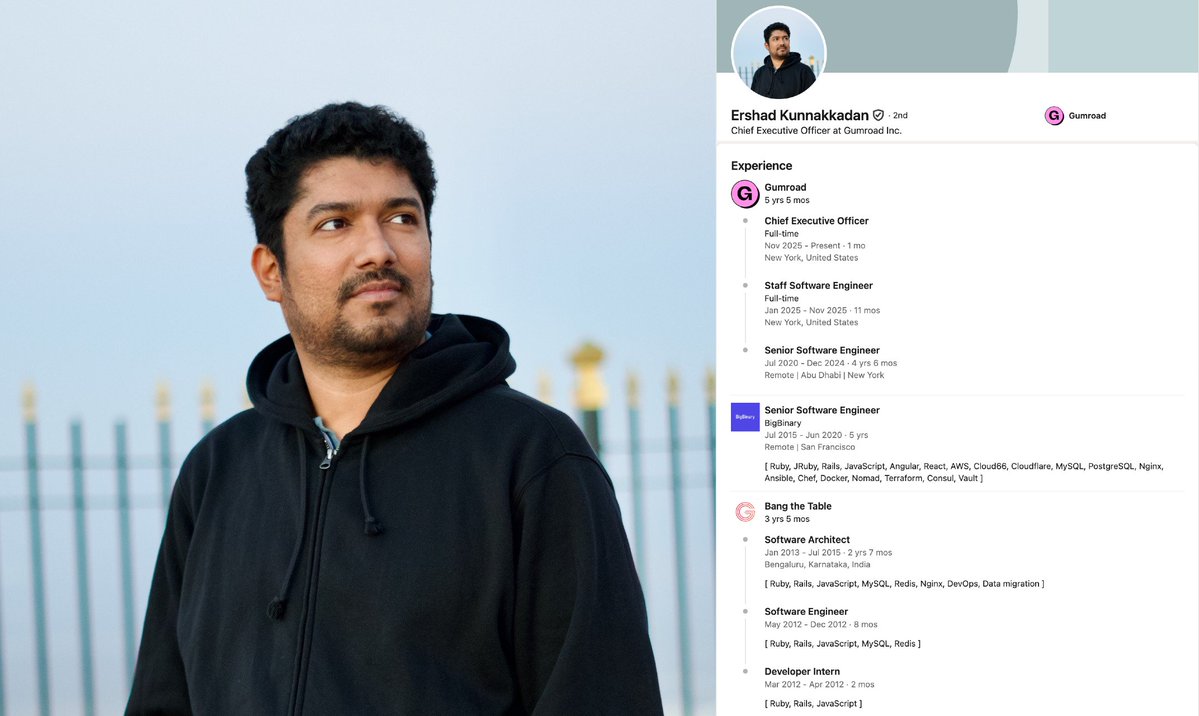
This man dropped out of a no-name college in India to be a software engineer and by 33, worked his way up to being CEO of a $100M+ company in New York.
Here's the never-before-shared incredibly inspirational story of Ershad Kunnakkadan:
> be middle class kid in random state school in Kerala, India
> get really into computers
> senior hands you Ubuntu 8.04 CD, whole new world
> starts contributing to SMC (a malayalam computing group)
> gets into blogging cause SMC seniors are into it
> go to no-name small private college in Kerala
> spend more time in terminals than classrooms
> shell scripting contests, Linux admin, security, virus cleaning, bots, paper presentations
> doesnt see a point to college exams
> drops out after 2nd year, promises family "I will earn a degree somehow"
> lands internship at small software co
> grows into being an architect
> found security bugs in Github and Prezi
> reads "Hackers: Heroes of the Computer Revolution" and the "The Google Story", dreamt of being in the US one day
> does Google Summer of Code
> earns a degree remotely from Bharathiar University
> gets remote job at BigBinary
> moves back to Kochi to be near family
> involved in local free software circles and workshops, events, meetups
> building a quiet dense body of work over loud personal brand
> gets introduced to Gumroad as a consultant first
> joins Gumroad as a senior engineer
> gets married
> moves to Abu Dhabi to be closer to wife's family
> does the boring crucial stuff - scalability, security, payouts, infra
> grows to being a staff software engineer at Gumroad
> support millions of users and $1B+ in creator earnings
> just focusses on self-improvement
> never once thinks about promotion
> moves to New York City on an O-1 visa
> Gumroad looking for a new CEO
> board looks around and its clear who is best fit for the job
> become CEO of a $100M+ gmv business
I just love the story of Ershad. No brands, no pedigree, no MBA, no loudness. When I asked him the quality that got him here, he said "reliability". A truly kind, quiet and generous person. Who loves computers. Dropping out when you're rich is trendy in America, but to see someone Indian drop out and work their way up into the top role is pure inspiration.
Don't worry if you don't have all the accolades and ornaments you see in people who achieve your dreams. Be a good person, and be reliable.
Different people are wired differently, but I basically agree.
Salesforce and Oracle were indeed built by money-motivated men. But Apple and Twitter were art projects. SpaceX and Tesla were engineering feats. And Bitcoin and Zcash are ideological campaigns.
So: money is a metric, but not the only one, and the “capitalism” part of technocapitalism has been stressed a bit too much in recent times. Because the drive to make great art, to advance science, to win in a just cause, will always produce more peak energy than the merely pecuniary. But then, on a daily basis, you have to eat too.
I think of it like cross country skiing. Sometimes you’re advancing with the right ski, and sometimes the left. So when the cause hits a setback, at least there’s a paycheck. But when there is no paycheck, you are driven by the righteousness of your cause.
The older I get, the more I realize you can get pretty far in life by just finishing things. The world is full of half-written books, half-built businesses, and half-kept promises. You stand out by closing loops. By doing what you said you’d do. By having the courage to finish.
One of my favorite lessons I’ve learnt from working with smart people:
Action produces information. If you’re unsure of what to do, just do anything, even if it’s the wrong thing. This will give you information about what you should actually be doing.
Sounds simple on the surface - the hard part is making it part of your every day working process.
Functions in your code should be no longer than five lines ... 🤦♂️
This has to be the stupidest practice I have seen many codebases follow. This just fills the codebase with a ton of tiny functions that do nothing important but call other abstract functions surrounded by some trivial logic.
Such a codebase is an absolute nightmare to understand and make changes to. Just imagine taking 79 clicks to just navigate and reach the place of interest, a sheer waste of time and effort. After a few taps, you will even forget where you began and how you end up here.
As a general rule of thumb, optimize the code for anyone to understand, extend, and modify today. Keep your functions large enough to be doing something substantial, but short enough to be reused at other places.
Remember, functions were introduced to programming languages to increase the reuse of business "logic".
a → b ≠ ~a → ~b.
Now on Desktop: Customizable chat folders
Keep healthy boundaries between friends & family or work & leisure.
Filter 1-on-1 and group chats, put all of your unread messages one place, or make project-specific folders for related chats.
Settings > Chats
Or right-click any chat