One should never play with other people's emotions but first it's important that one should stop playing with their own emotions. It will give immense mental peace. ☮️
INSTEAD OF WATCHING AN HOUR OF NETFLIX TONIGHT.
This 1 hour Stanford lecture by Joel Peterson will teach you more about negotiation and getting what you want than most people learn in years.
Bookmark it and give it an hour, no matter what.
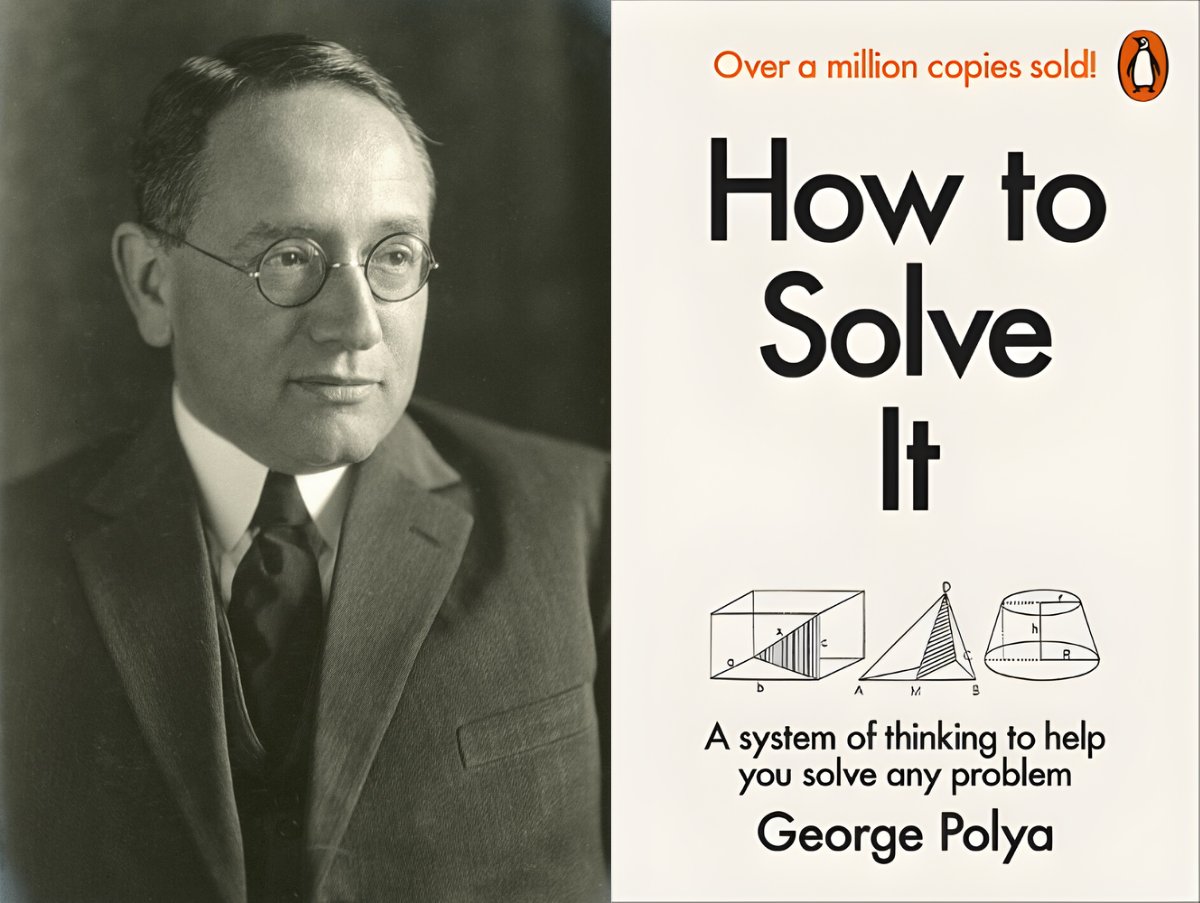
A Stanford mathematician spent 40 years watching brilliant students fail at hard problems.
Not because they were stupid.
Because nobody taught them what to do before they started solving.
His name is George Pólya.
His 1945 book has sold over a million copies and never gone out of print.
Marvin Minsky, the man who built the first neural network machine at MIT, said publicly that everyone should read it.
Most people have never heard of it.
The failure Pólya watched repeat itself for four decades was always the same.
A problem appears. The student feels anxiety. They immediately start calculating.
Not because calculating was the right move. Because it felt better than sitting with not knowing.
The calculation was almost always wrong.
Not from lack of skill. From lack of understanding what was actually being asked.
He called it the most neglected step in all of problem solving.
Step one is to understand the problem. Not skim it. Not assume you've seen something similar. Actually understand it.
His filter was one question: can you restate the problem in your own words without looking at it?
If you can't, you haven't understood it. You've only read it.
Most people skip this and spend hours stuck on a problem they never actually understood.
Step two is to make a plan. Not execute. Plan.
The pattern Pólya saw in every successful problem solver was the same. When something feels impossible, find a simpler version and solve that first.
Not because the simpler version is the goal. Because it gives you a method you can carry back.
He phrased it once with precision: if you cannot solve the proposed problem, try to solve a related one.
That question alone is worth more than most problem-solving courses ever taught.
Step three is to execute. Everyone thinks this is the whole game.
It is the third of four steps. Pólya spent the least time on it because it is the most obvious. Once you understand and have a plan, execution is mostly patience.
Step four is the one almost nobody does.
Look back.
Not to check the arithmetic. To ask: can I verify this with a different method? Can I use this method somewhere else? What would I do differently?
This is where the real learning lives.
Every expert Pólya studied had this habit. Every struggling student skipped from the answer to the next question, carrying nothing forward, starting from zero every single time.
His deepest insight was not a technique. It was a diagnosis.
Intelligent people feel bad at problem solving because they confuse reading a problem with understanding it. They confuse starting to work with having a method. They confuse getting an answer with having learned anything.
These are not the same things.
The students who get genuinely good at hard problems are not the ones who practice more.
They are the ones who slow down at the two moments every instinct tells them to rush.
The beginning and the end.
The problem was almost never as hard as it looked.
They just hadn't understood it yet.
🚨 Anthropic just showed a 27-minute workshop on how to actually do prompts for Claude.
Taught by the people who built it.
Free. No registration. No paywall.
I've seen $300 courses that don't cover what they teach in the first 8 minutes.
Watch it and bookmark it now.
Bloomberg Killers
After 6 years as an analyst, I have compiled a list of tools that replicate 95% of the Bloomberg Terminal at just 1% of the cost (plus a bit of elbow grease).
What would you add?
A lot of questions on How to Invest in International & US Markets
Did a deep dive for TheWrap🌯members a while back
Making the video public ⤵️
If you like this, please consider supporting us via subscribing to TheWrap🌯
https://t.co/a84pkcbEsD
"The richest 0.001% don't wear luxury."
Yes they do.
You're just too poor to know them... it’s not Dior, Louis Vuitton or Gucci.
Here are 7 brands that billionaires & royalties actually wear:
1. T𝗼m F𝗼rd
In 2018, Nassim Nicholas Taleb gave a 61-min masterclass on why systems fail when decision-makers don't share the downside.
685K views.
His frameworks:
- No downside, no discipline
- Moral hazard with better branding
- Fragility hides in incentives
12 insights: 🧵
Bet you can't watch 5 minutes of this without having a trading breakthrough. - MUST BOOKMARK
Mark Douglas - Trading in the Zone.
22 minutes. Full course. Must Watch.
Your edge isn't your chart. It's your mind. ⚡
In 1994, Peter Lynch gave a 1 hour masterclass on Stock Picking. He gives the secrets to his multibaggers:
Taco Bell - 42x Return
Ford Motors - 10x Return
Dunkin Donuts - 7x Return
Watch this here:
This 1 hour Yale lecture by Professor Ben Polak on game theory you will ever seen.
It will change how you think about decisions in negotiations, business, and everyday life.
In 14 minutes, this Anthropic engineer who wrote "Building Effective Agents" will
teach you more about building them right than most developers figure out on their own
in months.
Bookmark this for the weekend. Then read the builder's guide below.
Instead of watching an hour of Netflix, watch this 1 hour lecture on Bloomberg Terminal. It will teach you more about trading markets than a 2 month internship at Goldman Sachs or JPMorgan.
Every time you accepted a salary, chose a price, or walked into a negotiation, the other person was running GAME THEORY in their head.
You were guessing.
This 1-hour Yale lecture by Professor Ben Polak will permanently change how you read people and make decisions.
Most MBAs pay $150k to learn this. Yale posted it for free:
This 30-minute video by Ray Dalio will teach you how the economy actually works better than years of watching markets blindly.
Save this now. Watch it before your next big money decision.
Economic & market masterclass. 30 minutes. 75 years of real experience simplified. MUST BOOKMARK📌.
Instead of watching Netflix, watch this 1-hour Yale lecture by Professor Ben Polak.
It will change how you think about decisions in negotiations, business, and everyday life.