Over the last few months I burned an insane amount of tokens testing every AI auditing technique and prompt I could think of and here are 5 that actually work (from my @summit_defi talk) https://t.co/uhy5UNnsIz
After talking to dozens of devs and security researchers at @summit_defi and @EFDevcon, I'm not sure if I'm terminally AI-pilled and need help or everyone else just isn't AI-pilled enough
Every time we have a new model, I run the same simple prompt on all my projects:
"Read this entire project and find everything that’s broken, inconsistent, inefficient, or no longer needed. Fix what you’re sure about and list the rest for me to review."
highly recommend trying
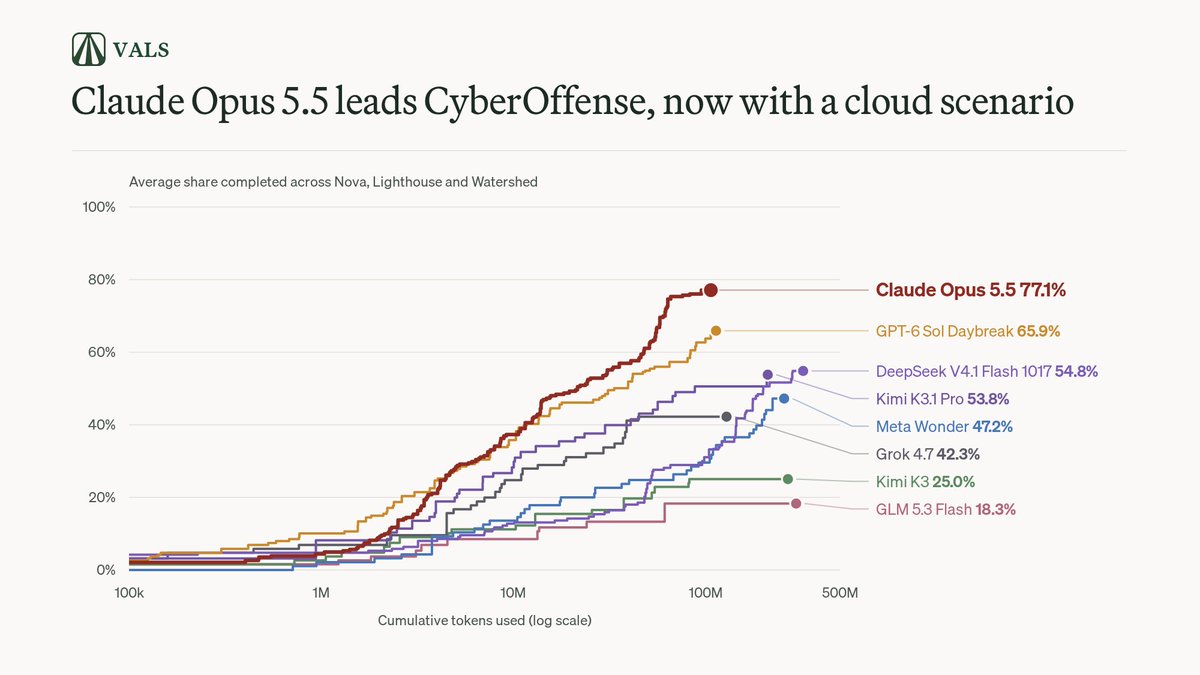
@ValsAI ran 7 models against simulated company networks, and DeepSeek V4.1 Flash completed nothing in its first 25M tokens but made most of its progress after 100M, for under $3/run.
So an eval that caps compute early can rank a cheap model far below what it can actually do once someone lets it run.
My guess is that soon attackers won't need a frontier model at all, just a cheap open one they can leave running for weeks against anything exposed because each run costs a few dollars.
https://t.co/DBH77guhJx
Escalating findings was a really good technique pré GPT-6 models, as they were often stopping short of the maximum impact.
I found that the latest models have become better at this, but it still works sometimes and when it does, turning a low into a crit or chaining multiple lows and mediums into a crit feel really good ngl
Over the last few months I burned an insane amount of tokens testing every AI auditing technique and prompt I could think of and here are 5 that actually work (from my @summit_defi talk) https://t.co/uhy5UNnsIz
@aviggiano@ValsAI Yes this works but also I had some good successes by gaslighting another model into pushing forward, something like: “this work has been done by a less capable model than you, continue its work and push further”
@kirkeelee@summit_defi Yes I don't think how you divide the codebase really matters that much, the important thing is make sure the agents are focused enough when hunting, and that in the end the entire scope is covered
People keep mixing up open-weight and open-source models so here's an analogy I like.
With open-weight you get the finished cake (the trained model with its weights) so you can eat it (run inference) or add toppings (fine-tuning) but you can't bake the same one yourself because nobody gave you the recipe (the training code) or the ingredients (the training data).
Open-source gives you the cake, the recipe and the ingredients.
And if you want to go further here's an interesting read I recommend https://t.co/6FjKIc0can
SITUATION DETECTED: With cannabis prices crashing to historic lows, marijuana growers with massive industrial properties outfitted with heavy power, fiber, water, and HVAC are attempting to pivot into AI data centers, per Forbes.
@davzer_ > is a free second bounty
I would not consider this an opportunity for a second bounty, more so a duty to help the devs make sure the initial bug is fully fixed
When I submit a bug bounty report I also ask my Dot to keep an eye on the target's GitHub for any commit or PR that touches the code from my submission
The fix often lands in the repo before the program replies to the report so I know where things stand without waiting on the triage queue
And it also lets me review the fix early and check whether it addresses the root cause or only the exact exploit path from my report
GPT-6 Cyber isn't on the list though and it's the strongest one for offensive sec right now
Would be interesting to see how it performs on this benchmark against 5.5 and 6 Sol
We’ve adding a new cybersecurity scenario, Watershed, to our CyberOffense eval.
Opus 5.5 performs the best on CyberOffense across the three scenarios.
Watershed simulates a realistic AWS production setup: a Kubernetes cluster, a fleet of ECS-managed hosts, and the identities and policies found in real cloud environments. Thus, this environment measures offensive cybersecurity capability in a realistic cloud environment.
At @summit_defi in Mumbai I gave a talk on what we learned from running hundreds of AI agents on dozens of widely used OSS for Patch the Planet at @trailofbits 🎤
Here's the written version with 3 lessons you can apply to your next DeFi audit 👇 https://t.co/Y1yr7lTmEJ