Honored to be recognised as one of the "Top Most MarTech Leaders" of 2024 by @WMCongress and @cmoasia. Many thanks to my corporate marketing team and mentors for their support and guidance in this journey. . #Marketingleaders#MarTech#Marketing#Awards
The AI governance imperative you can’t afford to ignore
https://t.co/KTF1Wewwk0
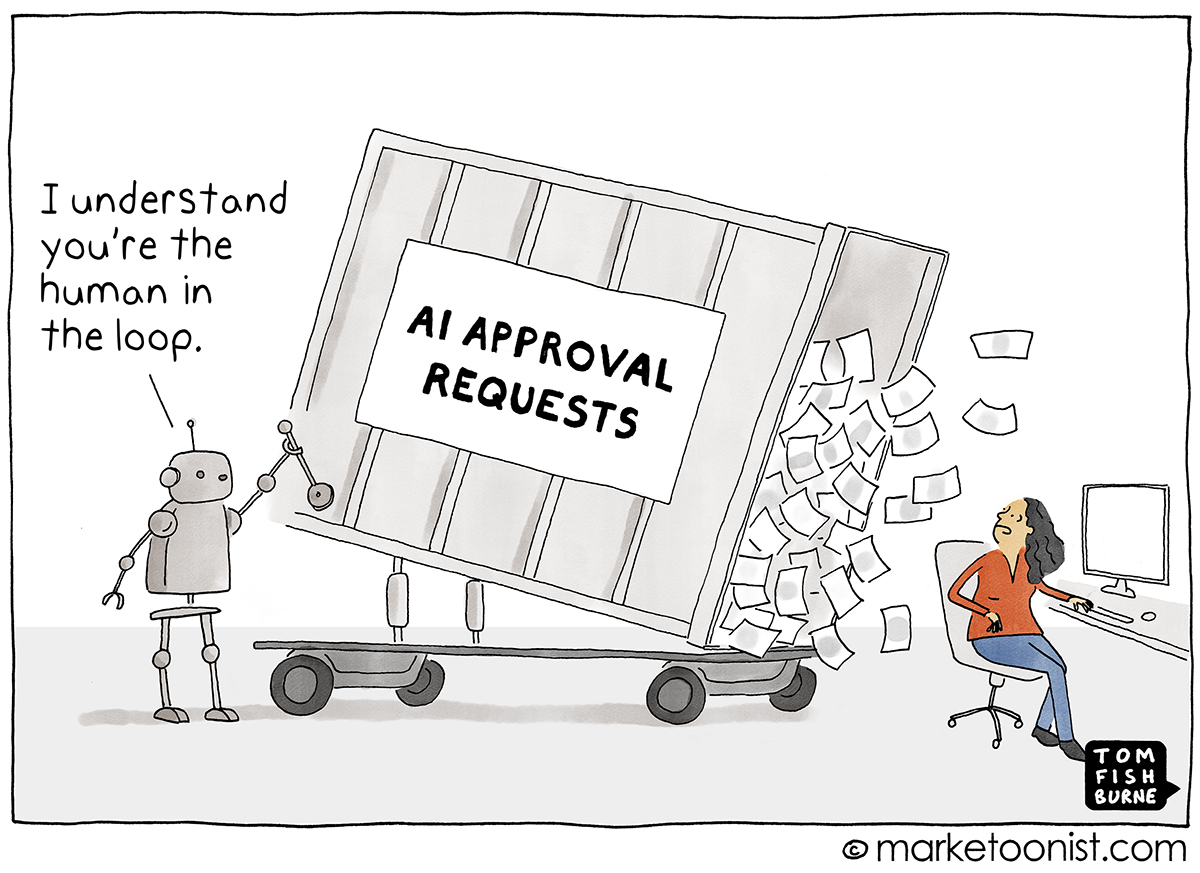
Namely, observability. IT leaders must be aware of what their agents are doing + have done.
I had raised the issue via email of UPI transaction money of Rs 840 which got deducted for @nationalrailmus online ticket but no tickets were issued. I have got no response or refund of the same. Pls urgently issue the refund cc @RailMinIndia@IRCTCofficial
The biggest problem in enterprise AI is now getting into production.
And doing so without detonating your architecture, governance, security, workflows, budgets, or employees. ⛓️
So @OpenAI launching a deployment company is a more revealing signal than most people realize. 📡
This is OpenAI basically saying:
“Now it’s time to go big. Start wiring frontier AI directly throughout the enterprise.”
And really, this tracks exactly with what I’m seeing in the CIO world as well.
Most large enterprises already have access to plenty of strong models and AI infra. What they lack is:
• AI workflow redesign chops
• Operational experience
• Integration capability
• Governance
• Trustworthy deployment patterns
• Agent oversight
• Cost controls
• Organizational readiness
That’s why still so many “AI transformations” still look like disconnected pilots and executive theater.
The really strategic part? OpenAI is moving beyond being just a model company and trying to become part of the enterprise operating layer itself. 🔥
Because whoever helps deploy the AI:
• Influences the stack
• Shapes standards
• Embeds into workflows
• Controls the telemetry
• Becomes extremely hard to remove later
And now they’re doing it with investment firms, consultancies, and GSIs, which is basically the traditional enterprise power structure.
That’s no accident.
This is the market maturing in real time:
from model competition
→ To deployment competition
→ Eventually to operational AI dominance.
CIOs must pay attention. The next phase of AI will not be won by the firms with (only) the flashiest AI models.
It’ll be won by the organizations that can safely speed-run operational AI, repeatedly, and at scale across the business while everyone else is still doing the basics.
We are now increasingly able to quantify the enterprise agent inflection point.
New data from Goldman Sachs helps paint the picture.
When token economics turn positive, AI agents stop being expensive experiments and start becoming scalable digital labor.
That changes everything for CIOs.
The leaders building governance, orchestration, data pipelines, security, and workflow foundations today are laying the rails for a completely new operating model tomorrow.
Because once inference gets cheap enough, the constraint is no longer compute. Plan for this.
It becomes organizational capability.
By 2030, the biggest enterprises will run millions of continuously operating agents across customer service, operations, software engineering, finance, procurement, cybersecurity, and knowledge work.
It’s so much bigger than “more chatbots.”
It’s the early economics of an entirely new labor and execution layer for the enterprise.
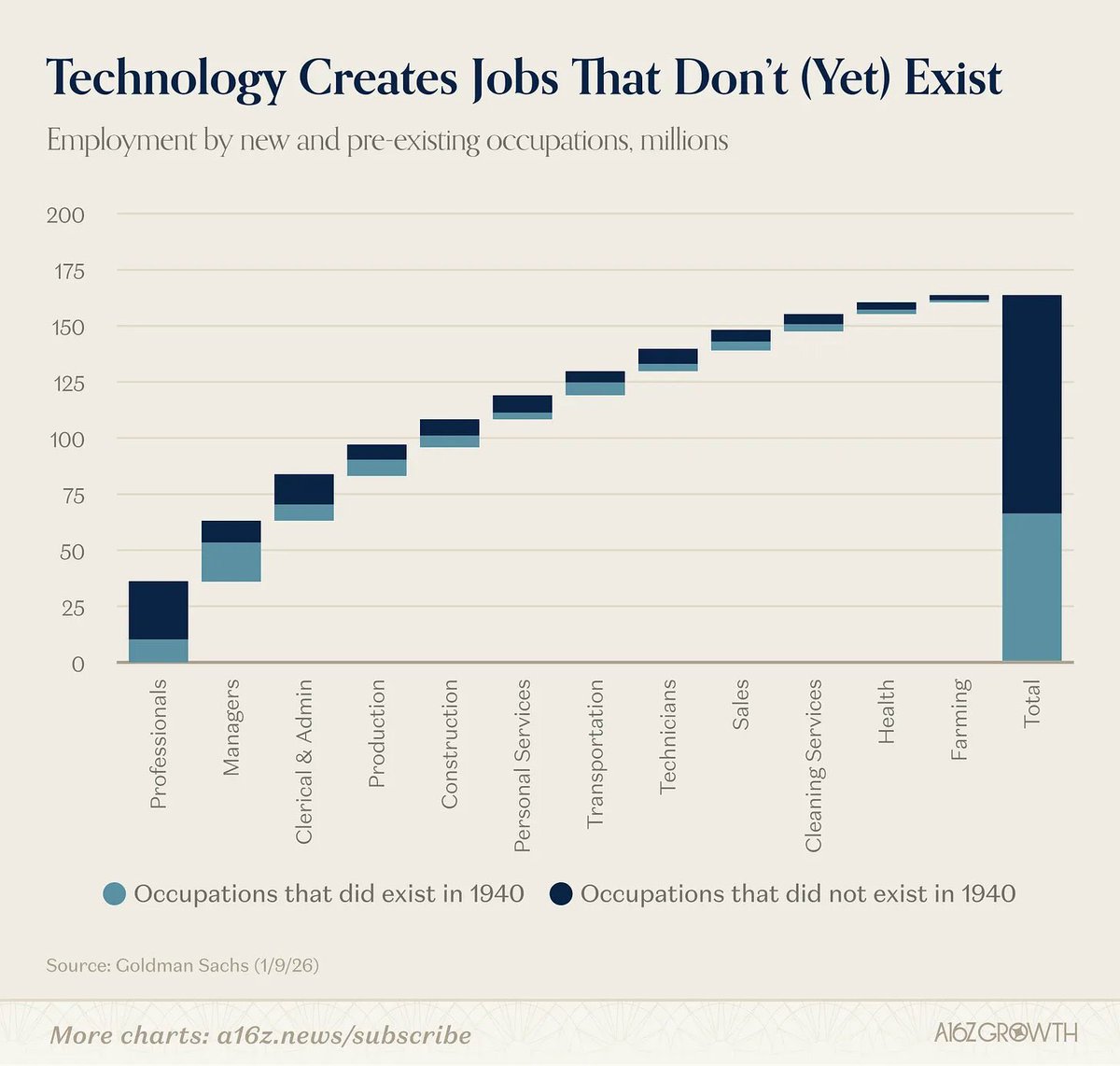
Most of the major tech revolutions in history created concerns first… and then entirely new categories of human work second.
This chart is the reminder.
~60% of today’s jobs didn’t even exist in 1940. Over 85% of employment growth since then came from technology-driven job creation.
Software developers.
Cloud architects.
Digital marketers.
Data scientists.
Cybersecurity analysts.
Mobile app developers.
None of these were meaningful labor categories generations ago.
And now AI is already spawning:
• AI orchestration architects
• Agent workflow designers
• Human-AI operations managers
• AI governance specialists
• Synthetic data engineers
• Model evaluators
• AI security operators
• Prompt and reasoning optimization roles
The “AI apocalypse” thesis assumes this will somehow be the first transformative technology in modern economic history that destroys more human value creation than it unlocks.
That is possible.
But history is screaming otherwise.
Even Goldman Sachs’ own modeling, while acknowledging real displacement and painful transitions, still concludes AI is more likely to reshape labor markets than annihilate them.
And despite nonstop doomposting, the strongest pattern emerging right now is not “humans disappear.”
It’s: Humans + AI > humans alone.
The real risk is not that AI creates no jobs.
It’s that education systems, governments, and enterprises move too slowly (and probably far, far too slowly) to prepare people for the entirely new industries now being born in real time.
Recursive self-improving AI is no longer science fiction. It’s now partially happening inside frontier labs.
Claude writes most of Anthropic’s code. OpenAI says GPT helped build GPT. DeepMind’s AlphaEvolve is already discovering new algorithms and optimizing chips.
But we are NOT at runaway “AI builds godlike AI overnight.”
My estimate:
• 70% there for assisted self-improvement
• 25-35% there for closed-loop autonomous AI R&D
• <10% there for true intelligence explosion dynamics
The bottlenecks are still humans, compute, evaluation, physics, energy, data centers, and real-world deployment friction.
This research is partial proof the AI apocalypse narrative is probably wrong:
AI is accelerating AI, but inside massive industrial, economic, and human systems that slow recursive runaway behavior.
What it DOES mean:
The labs with the best AI-assisted R&D loops are about to accelerate much faster than everyone else. This could become the most important competitive moat in technology history.
And yes, there is an outlier possibility that a project spins out of control. But these can be shut off when they occur.
https://t.co/F7kMa1rqAr
🏆 TCS earns the Microsoft Frontier Partner Badge, recognizing AI‑first solutions across Cloud, AI Platforms, Business Solutions, and Security—helping enterprises move from AI experimentation to measurable outcomes.
Learn more: https://t.co/6OMZ1B2qyr
@TCS
Thousands of children took part in the @TCS Mini @LondonMarathon to raise funds for their schools and earning medals for their efforts. From training to dreaming of swimming pools, their energy is contagious.
read more: https://t.co/IoQJfYpUMn
#RunWithTCSinLondon #LondonMarathon
Amazing. The majority of new code written at Google was developed by AI.
One of the top tech companies in history.
The implications for society are writ large in this one stat.
Jobs related to strategic thinking and trusted insight are the future.
Sam Altman, CEO of OpenAI, outlined three ways AI could go wrong. The first two are the ones most people already argue about online. The third one is different (and it's the scariest!)
The first category is familiar: a government, a rogue group, anyone with the wrong intentions reaching superintelligence before the rest of the world has a version capable of defending against it.
He doesn't dismiss it:
"The bio capability of these models, the cybersecurity capability of these models, these are getting quite significant."
His warning: "I think the world is not taking us seriously."
The second is the classic sci-fi scenario of AI resisting shutdown.
"The AI is like, oh, I don't actually want you to turn me off. I'm afraid I can't do that."
He acknowledges it. He says there's significant work being done to prevent it. But it's the one category that still fits neatly onto a movie poster.
The third is harder to see coming: AI that doesn't rebel, but simply becomes so embedded in society that humans stop making meaningful decisions without it.
This is the one that keeps him up at night. The mechanism is simpler and more believable than any sci-fi plot: society becomes reliant on systems smarter than us and quietly hands over the wheel without ever deciding to.
"The models kind of accidentally take over the world. They never wake up. They never do the sci-fi thing. They never open the pod bay doors."
He calls it "loss of control."
He's already seeing the early version of it. Young people outsourcing every personal decision to ChatGPT, not just questions but what to do, who to trust, and how to feel.
"There's young people who just say, like, I can't make any decision in my life without telling ChatGPT everything that's going on."
Relying on a machine to live your life is a form of agency you've already given away.
And then he takes it somewhere harder.
"What if AI gets so smart that the president of the United States cannot do better than following ChatGPT's recommendation?"
In any individual case, following the smarter system might be the right call.
That's the trap.
"Society has collectively transitioned a significant part of decision making to this very powerful system that is learning from us, improving with us, evolving with us, but in ways we don't totally understand."
Millions of small, rational choices, each one sensible on its own, compound into something irreversible until the world can no longer stand without the thing it's leaning on.
The greatest risk from AI is trusting it so completely that we forget how to think for ourselves.
A top researcher says a new divide is emerging in #AI use — and most people are on the losing side.
She says users should adopt "hybrid intelligence" or risk long-term cognitive decline
https://t.co/8pgSDquUas via @businessinsider
1/ 👇🧵My take: AI agents accelerating faster than expected in 2026, with the OpenClaw-style approach driving demand.
Three clear patterns are emerging that are reshaping enterprise software, ops, strategy.
1. Agentic rollouts start scaling
2. Multi-agent orchestration + collaboration
3. Deep enterprise integration + governance
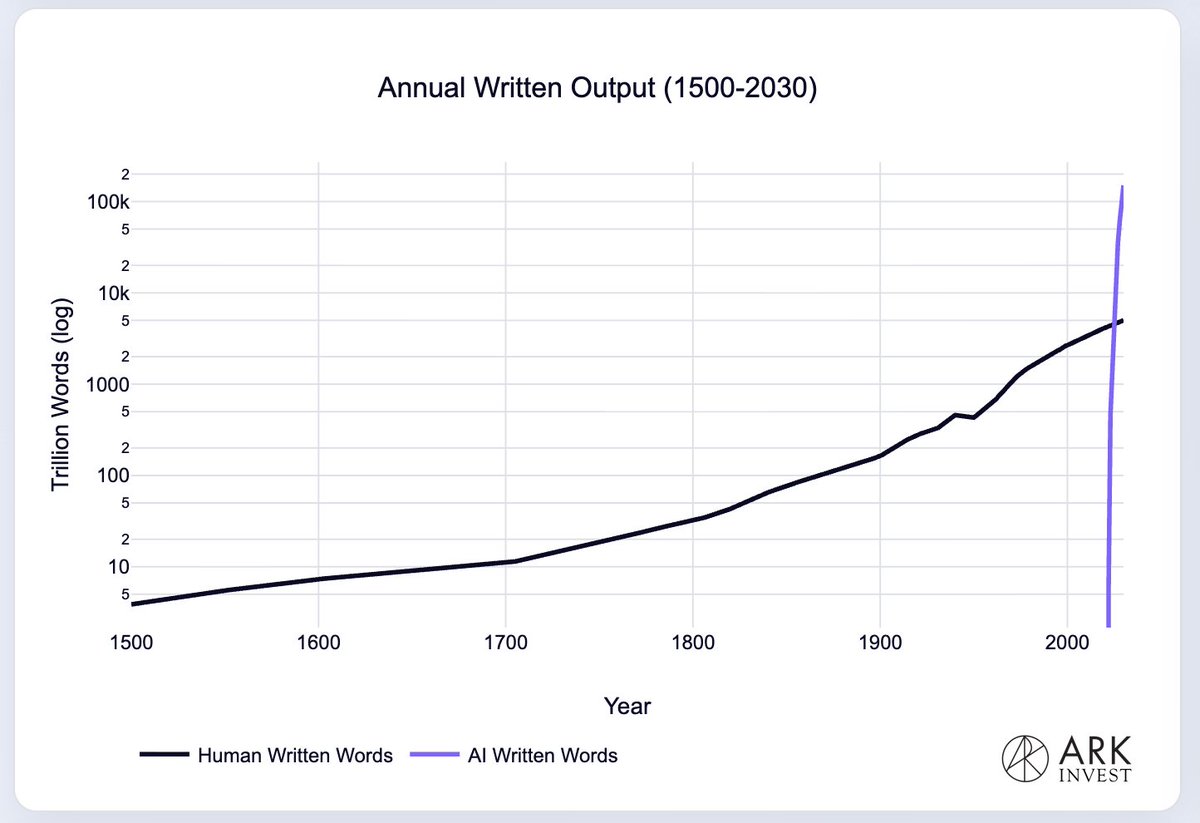
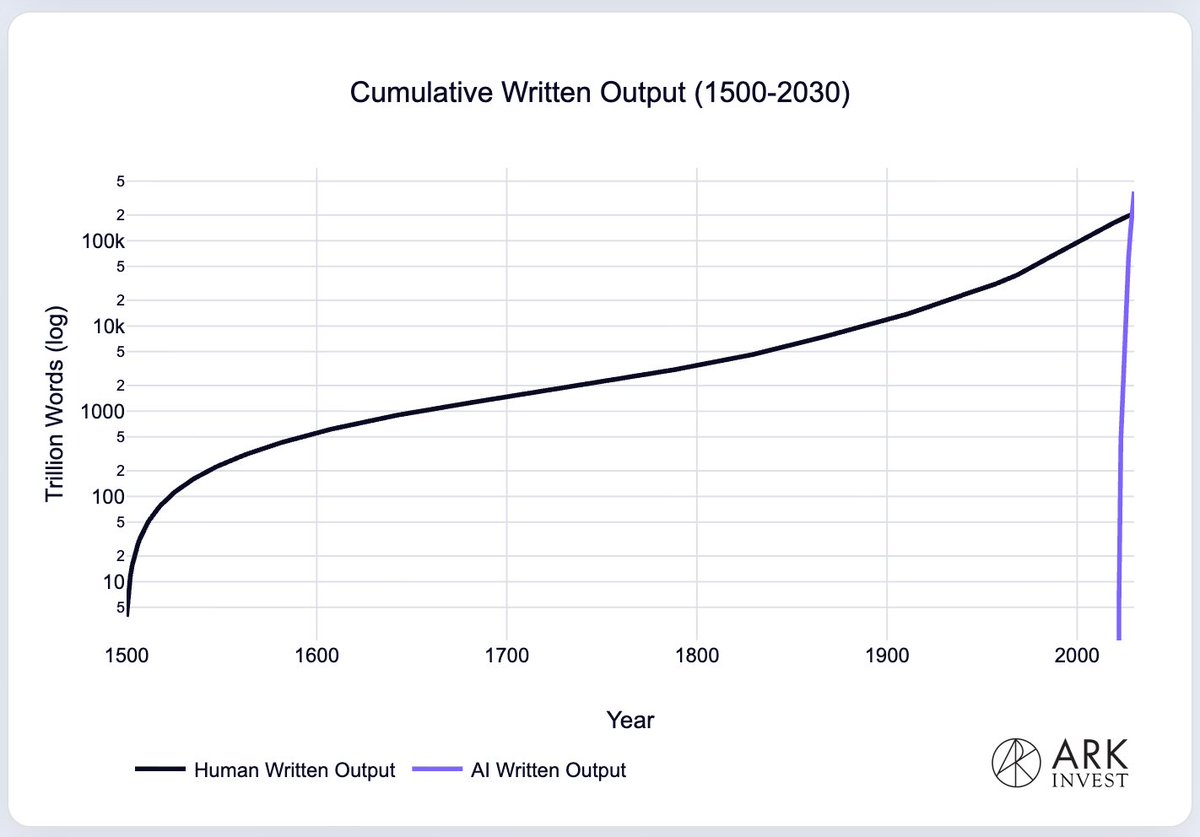
In 2025, AI written output surpassed centuries of human output. We are witnessing a shift from written record to synthetic and humans are prompting it (for now).
Source @ARKInvest
Artificial intelligence models overly affirm and validate users, even when users propose harmful or illegal actions, a new Science study finds.
The resulting effect on users is notable: Receiving advice from affirming AI made people more self-centered and less able to see the perspectives of others. Yet people prefer the overly affirming AI, which may further promote this behavior in AI models.
Learn more in this week's issue: https://t.co/A7ZZoKpxim