When confronted, TCS senior executives went into complete denial mode. Bonny Eappen (Vice President) and Suresh Muthuswami (Platforms President) received formal legal warnings but chose to investigate absolutely nothing. Instead, Eappen falsely certified in writing to Transamerica that no rebadged workers or third-party intellectual property were being utilized to build BaNCS. Meanwhile, internal counsel Vinod Verghese scrambled to secure liability indemnifications from the client, which Transamerica flatly refused to sign.
Phase 5: The Reckoning and the True Cost
The fallout was absolute. After an intense trial before U.S. District Judge Brantley Starr and a subsequent review by a Fifth Circuit appellate panel consisting of Judges Stephen A. Higginson, James C. Ho, and Cory T. Wilson, the hammer of federal justice fell heavily on the tech giant.
The courts confirmed that TCS had engaged in willful and malicious misappropriation. The judgment ultimately upheld against TCS totaled approximately $168.5 million:
• $56,151,583 in compensatory unjust-enrichment damages (calculated by financial expert Brian Napper).
• $112,303,166 in maximum exemplary damages.
Total: $168,454,749
In June 2026, the U.S. Supreme Court declined to hear TCS’s appeal, leaving the judgment intact.
Furthermore, the court imposed a humiliating 10-year independent monitorship at TCS’s expense, granting external auditors unfettered access to their U.S. software operations to ensure the stolen data was purged.
And the ultimate irony? Despite the massive intellectual property theft, TCS failed to convert a single legacy policy to BaNCS. Transamerica entirely terminated its relationship with TCS and crawled back to CSC to keep its platforms running. Despite its public-facing policies of “zero tolerance” for ethical breaches, TCS did not discipline or terminate a single employee exposed in the scandal.
This case shatters the myth that the dark arts of software piracy and corporate espionage belong to a bygone era or minor players. When a global giant is caught stripping a competitor’s infrastructure, lying to its anchor client, falsifying internal statements, and deleting its own data repositories to hide evidence from federal courts, it leaves a permanent stain on the collective reputation of the Indian tech workforce.
One has to admire NASSCOM’s remarkable sense of timing. Whenever foreign governments question Indian IT companies, statements appear within hours. When visa rules change, emergency meetings are called. When tax disputes arise, delegations are dispatched. But when a U.S. court delivers a judgment describing years of trade secret misappropriation by one of India’s largest IT firms, an unusual silence fills the room. Apparently, defending the Indian IT industry’s reputation is a priority except when the damage comes from inside the industry itself. Perhaps NASSCOM is still searching for the right words. Or perhaps it has concluded that “ethics” and “governance” are best discussed at conferences, not after court verdicts. Either way, the silence is speaking louder than any press release ever could.
Computer Sciences Corp. v. Tata Consultancy Services Ltd., 159 F.4th 429 (5th Cir. 2025); Computer Sciences Corp. v. Tata Consultancy Services Ltd., No. 3:19-CV-0970-X (N.D. Tex. June 13, 2024).
The email that cost #TCS $168.5 million and exposed a scandal that damaged its reputation worldwide.
In March 2019, a TCS employee accidentally copied Ashish Barnwal, a CSC employee supporting Transamerica, on an internal email chain. What landed in Barnwal’s inbox was not an ordinary email.
It contained excerpts from CSC’s proprietary Vantage system, confidential technical documentation, screenshots, and discussions aimed at understanding how key functionality worked inside a competitor’s platform.
That single mistake set off a chain reaction.
Within days, CSC launched a forensic investigation. What investigators uncovered would eventually lead to years of litigation, federal court findings of willful and malicious trade-secret misappropriation, a judgment of approximately $168.5 million against TCS, and a U.S. Supreme Court refusal to hear the company’s appeal.
Sometimes the most consequential corporate scandals do not begin with a whistleblower, a regulator, or a boardroom leak.
They begin with one email sent to the wrong person.
The glossy corporate brochures of the Indian IT sector love to talk about “global compliance,” “unrivaled integrity,” and “cutting-edge innovation.” But every so often, a window opens into the backrooms of these multi-billion-dollar empires, revealing a starkly different reality, one driven by aggressive shortcuts, systemic cover-ups, and an absolute contempt for intellectual property.
This is the investigative anatomy of the catastrophic legal war between Tata Consultancy Services (TCS) and Computer Sciences Corporation (CSC/DXC Technology). It is verified by the United States federal courts, backed by forensic data, and populated by dozens of insiders who engineered an elaborate code-ripping pipeline.
Phase 1: The Trap and the $2.6 Billion Mirage
The setup began in 2016. Transamerica, a massive U.S. insurance player, put out a multi-billion-dollar bid to overhaul its aging legacy software systems. For TCS, landing Transamerica as an “anchor client” was the golden ticket to entering the lucrative U.S. life insurance and annuities market. TCS wanted to deploy its own flagship software platform, BaNCS.
There was just one massive, unmentioned problem: BaNCS was completely unready for the U.S. market. It lacked the baseline, carrier-agnostic functionalities required to process complex American insurance policies.
To win the $2.6 billion contract, TCS promised an aggressive, highly ambitious timeline: converting 10.5 million insurance policies to BaNCS within three to five years. Because TCS didn’t have legal permission to access the source code of the existing platforms, the migration was contractually mandated to be a strict “black box conversion.” In plain terms, TCS was required to build its software blindly, using its own engineering.
Instead, TCS chose to steal the machine’s blueprint.
Phase 2: Ripping the “Keys to the Kingdom”
The legacy infrastructure at Transamerica belonged to its rightful owner, CSC, which had spent decades and hundreds of millions of dollars developing its proprietary platforms, Vantage and CyberLife. Under a Third-Party Access Addendum (TPAA), TCS consultants were permitted to touch CSC’s software solely for the routine maintenance needs of Transamerica, never to build a competing product.
The legal record reveals that the boundary was immediately and systematically obliterated.
Enter Rangarajan Sampathkumar. Armed with credentialed access to Transamerica’s internal servers, Sampathkumar acted as the pipeline’s excavator. He bypassed strict data-room restrictions and mass-downloaded more than 1,700 proprietary CSC engineering documents. These documents contained the highly guarded calculations, business rules, data models, and screens for Vantage and CyberLife.
Sampathkumar didn’t keep them to himself. He uploaded the massive haul to a shared internal TCS repository called Knowmax. On July 18, 2017, he blasted an email with a direct link to the stolen files to dozens of TCS employees, including Dipan Talukdar (TCS Offshore Head) and Arindam Paul (BaNCS Delivery Manager). Another employee, Pankay Agarwal, systematically forwarded the link across broader organizational requirements channels. To keep the stolen library neat, a TCS asset named Abhijeet Mate created a comprehensive index of the looted files.
Unrestricted offshore developers who had no legal right to touch CSC property were suddenly staring at the engine layout of their biggest competitor. Forensics later revealed that core manuals, including a 2,727-page CyberLife guide described by technical expert Paul Pinto as containing the “keys to the kingdom”, were resting on the laptops of non-rebadged employees like Shalini Kotian.
Phase 3: The Skype Logs and the Cover-Up Strategy
As TCS rushed to stitch together the gaps in BaNCS, the engineering team set up a virtual “drive-up service window”. Whenever the core BaNCS architecture team, led by Chief Architect Ayan Mustafi and Requirements Director Raghupathy N. Pasupathy, hit a wall, they seamlessly tapped “rebadged” assets (former Transamerica workers turned TCS employees) to pull proprietary algorithms from CSC’s code.
The insiders knew exactly what they were doing, and their internal communications crackled with the anxiety of getting caught.
When the offshore team ran into legal walls blocking them from accessing CSC’s COBOL copybooks, team lead Wayne Taylor messaged Mark Wisely and Bruce Gross, suggesting they “be creative”. Their version of creativity? Taking CSC’s original database copybooks, changing the name prefixes, making minor cosmetic field extensions, and passing off near-wholesale copies to offshore resources as completely “neutral” files.
In another instance, rebadged supervisor Chethan Setty held a Skype session with Andrew Lockhart after lifting a sensitive “rate of return” layout from the Vantage software.
“Hi Andrew, shared Vantage system documentation on VALR screen,”
Setty typed.
Then came the warning:
“Please do not share with BaNCS team. They are sensitive about anything Vantage.”
Lockhart replied:
“Gotcha, thanks for sending over. I have to remember all the new rules about what we can share.”
To further obscure the fraud, when TCS developers copy-pasted layout snapshots directly into corporate emails, they systematically stripped or cropped out the mandatory footer banners reading: “Computer Sciences Corporation Confidential and Proprietary Information.”
Phase 4: How the Fraud Imploded
The entire operation unraveled due to a single, sloppy mistake.
In March 2019, a TCS development group was passing around an email chain analyzing CSC’s highly unique, multi-million-dollar investment rate-of-return formulas to determine if they should “emulate” them directly inside BaNCS. In their haste, they accidentally cc’d Ashish Barnwal, a CSC employee who maintained a Transamerica email address.
Barnwal looked at his inbox in shock. Attached to the thread were raw screenshots of his own company’s protected source code and technical guides being openly traded by a competitor. He immediately escalated the leak to Kaushik Gupta, who flagged it to Account Manager Paul Ko. Within days, CSC’s senior executive management team, including Phil Ratcliff and Darren Klauser, launched an emergency forensic and legal offensive.
What followed was the corporate equivalent of burning the evidence. Realizing that legal discovery was imminent, TCS completely deleted and “decommissioned” both the Knowmax and Fresco internal repositories. They wiped out the databases, permanently destroyed the log histories, and ensured that nobody would ever know the true, staggering footprint of how many hundreds of their developers had used the stolen code.
'Why Labour Laws & POSH Rules Not Being Followed': Sena UBT's Priyanka Chaturvedi Questions TCS On Employee Safety After Pune Suicide Case - WATCH
#Pune#Mumbai#TCSsuicidecase
https://t.co/HV0pumdins
Mumbai, Maharashtra: On the TCS employee suicide case, Shiv Sena (UBT) leader Priyanka Chaturvedi says, "...The first question should be directed at TCS: when it earns significant revenue globally and employs thousands in India, why is it not following basic labour laws and POSH regulations?..."
Very disturbing and sad. You don't like the performance, use the methods available like feedback & ratings. Respecting another human being cannot be based on his/her performance or capabilities. Pls do your duty as manager properly without attachment, always respect individuals, have a clear distinction between performance and human dignity.
Amit Abhay Brahme was 48 years old. He worked at TCS Hinjawadi Pune. On 2 June 2026, he died by suicide. Before taking the extreme step, Amit allegedly left behind a suicide note describing the mental harassment he had been facing. Now, based on a complaint filed by his family, police have reportedly registered a case of abetment to suicide against three individuals, including two women employees.
According to the complaint, Amit was subjected to repeated humiliation, false allegations, reputational attacks, workplace harassment, and sustained mental pressure.
His family alleges that he was falsely accused of theft and fraud.
They claim legal notices were sent to him.
Defamatory emails were circulated.
He was allegedly threatened with negative feedback and adverse consequences at work.
The complaint further alleges that important projects were taken away from him, he was humiliated in front of others, and was repeatedly pressured to leave his job.
According to the family, Amit was already carrying immense personal responsibilities.
His wife was battling cancer.
He was managing significant family obligations.
Instead of support, he allegedly faced continuous mental harassment, humiliation, and hostility.
The pressure became unbearable.
And a family lost a husband, a father, a son, and a loved one forever.
What makes this tragedy even more disturbing is that this is not the first employee death connected with TCS Pune this year.
In January 2026, 24-year-old TCS employee Sujal Vinod Oswal was found dead within the TCS Hinjawadi campus.
Now, just months later, another employee is gone.
Two lives lost.
Two families devastated.
Two tragedies connected with the same corporate establishment within a span of a few months.
This cannot be treated as a routine occurrence.
NITES has formally written to the Hon’ble Chief Minister of Maharashtra, Shri Devendra Fadnavis, seeking an independent inquiry into the death of Amit Brahme and the earlier death of Sujal Vinod Oswal.
We have requested:
▪️ A High-Level Independent Inquiry Committee
▪️ A special inquiry into workplace practices, grievance mechanisms, and employee wellbeing systems
▪️ A detailed report regarding workplace harassment complaints, mental health support systems, employee assistance programmes, and corrective measures implemented after the January 2026 incident
▪️ A dedicated State-level helpline for IT and ITES employees facing workplace harassment, burnout, or psychological distress
This is not about prejudging anyone’s guilt.
The criminal investigation must take its own course.
But when an employee allegedly names colleagues in a suicide note and a family alleges prolonged workplace harassment, the matter cannot simply end with an FIR.
We must ask the larger question.
Did the system fail before the tragedy occurred?
Because no employee should feel so helpless, isolated, or broken that death appears to be the only escape.
Behind every employee ID is a human life.
And no family should lose a loved one because of what happens inside a workplace.
May his soul Rest in peace. Om Shanti 💐
#AmitBrahme #TCS #WorkplaceHarassment #ITEmployees #InformationTechnology #JusticeforEmployees #NITES #Pune #hinjawadi
Behind every employee ID is a human life. Amit Abhay Brahme was not just an employee. He was a son, a husband, a family member, and someone’s entire world. No family should ever receive a phone call saying their loved one will never return home from work.
NITES has written to the Hon’ble Chief Minister of Maharashtra, Shri Devendra Fadnavis, seeking an independent inquiry into this tragic case and a broader examination of workplace wellbeing, grievance redressal mechanisms, and employee support systems.
This is not about one individual alone. It is about ensuring that every employee is treated with dignity, respect, and humanity.
#AmitAbhayBrahme #EmployeeWellbeing #WorkplaceDignity #MentalHealthAtWork #ITEmployees #NITES #WorkplaceHarassment #EmployeeRights #CorporateAccountability #HumanLifeMatters #TCS #Pune #hinjawadi #JusticeforEmployees
@CMOMaharashtra@Dev_Fadnavis@TCS
When an employee allegedly names colleagues in a suicide note and workplace harassment is cited as a reason behind such a tragic death, society cannot simply move on. NITES has sought an independent inquiry from the Hon’ble Chief Minister of Maharashtra into the death of TCS employee Mr. Amit Abhay Brahme.
The objective is not to prejudge anyone, but to uncover the truth, examine workplace practices, and prevent future tragedies.
#JusticeForAmitBrahme #TCS #WorkplaceHarassment #MentalHealth #EmployeeRights #NITES
@CMOMaharashtra@Dev_Fadnavis@TCS
A family has lost a husband, a father, and a son.
Mr. Amit Abhay Brahme, a 48-year-old TCS employee, is no more. His death and the contents of the reported suicide note have raised serious concerns that cannot be ignored.
NITES has requested Hon’ble CM Shri Devendra Fadnavis to order an independent inquiry so that the truth emerges and justice is done.
No employee should suffer in silence.
#JusticeForAmitBrahme #TCS #WorkplaceHarassment #EmployeeRights #NITES
NITES has submitted a formal complaint to Hon'ble Chief Minister Shri Devendra Fadnavis seeking an independent inquiry into the tragic death of TCS employee Mr. Amit Abhay Brahme in Pune. Mr. Amit Abhay Brahme, a 48-year-old IT professional, allegedly died by suicide following workplace harassment and humiliation. It has been reported that he left behind a suicide note naming certain colleagues and detailing the harassment allegedly faced by him. Based on the complaint lodged by his family members, a criminal case has reportedly been registered and an investigation is underway.
Behind every employee ID is a human being, a family, and a lifetime of sacrifices. It is heartbreaking that a professional who spent years contributing to one of India's largest companies allegedly felt compelled to take such an extreme step. No employee should ever have to suffer in silence or feel that there is no avenue available to seek help and justice.
This is the second employee death connected with TCS Pune within a span of a few months, following the death of Mr. Sujal Vinod Oswal earlier this year in January. Two such tragedies within the same corporate establishment have caused deep concern amongst IT employees across Maharashtra and raised serious questions about workplace culture, employee support systems, and the effectiveness of grievance redressal mechanisms.
NITES has urged the Government of Maharashtra to constitute a High-Level Independent Inquiry Committee, direct the Labour Commissioner to conduct a special inquiry into workplace practices and employee support systems at TCS, and seek a detailed report from the company regarding workplace harassment complaints, mental health support mechanisms, and corrective measures undertaken after the earlier incident.
#TCS #Pune #Suicide #workplace #harassment #ITEmployees #InformationTechnology
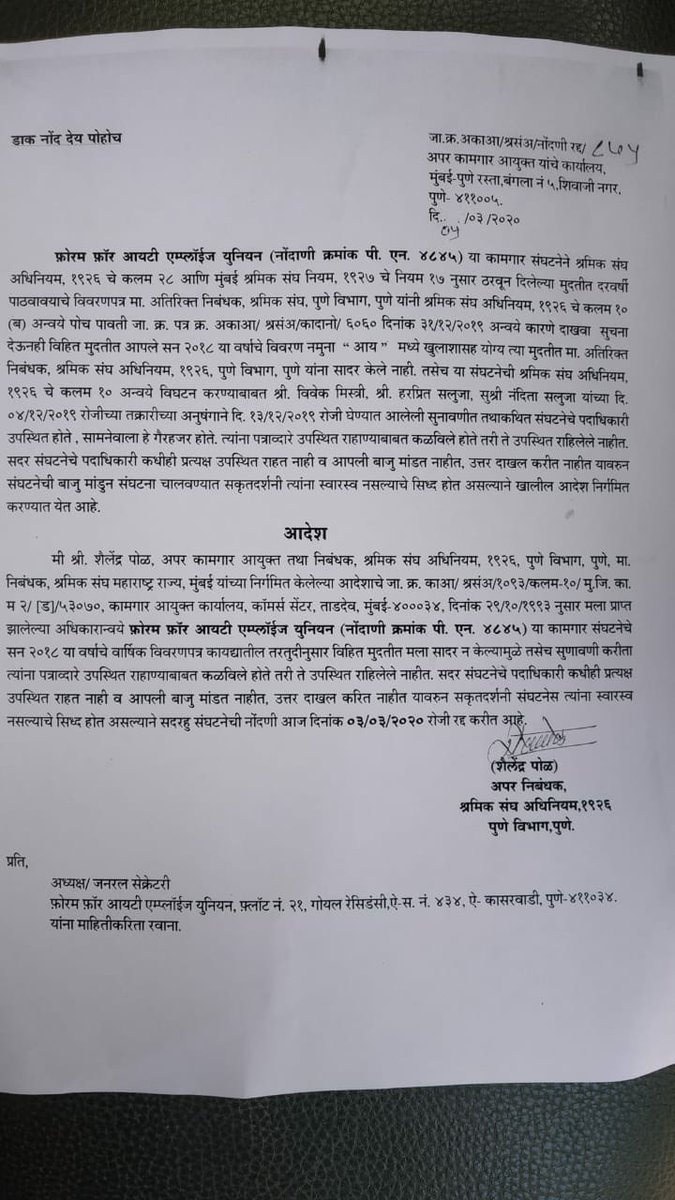
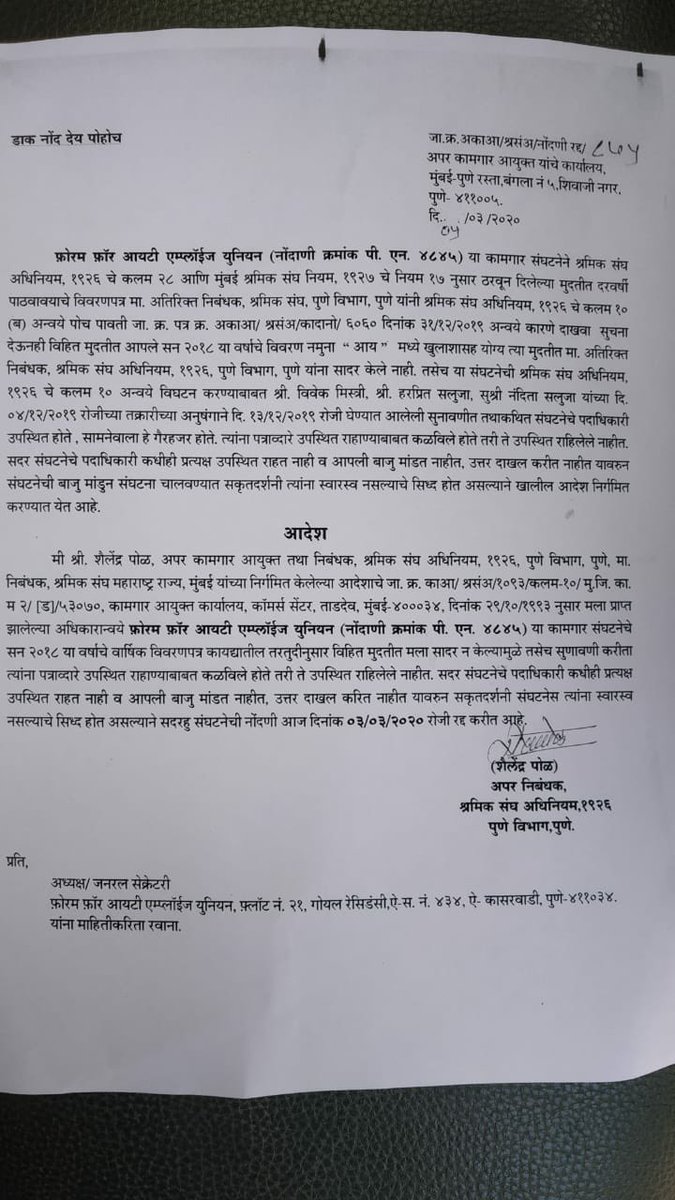
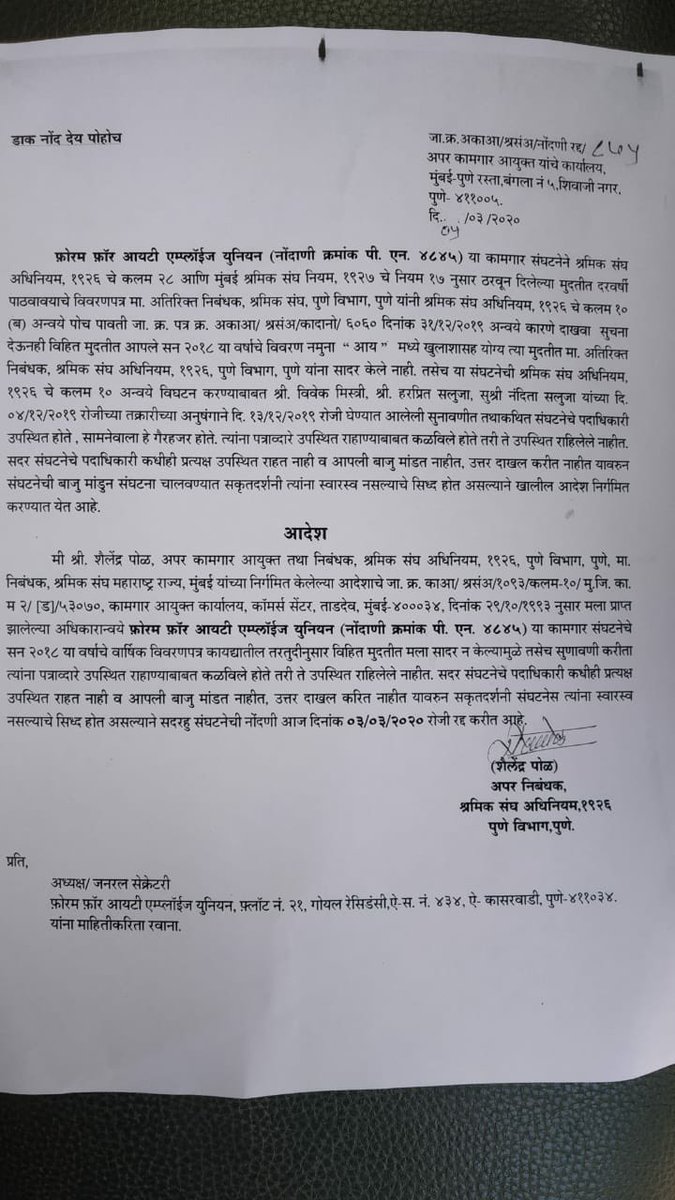
@IndiaToday@omkarasks Kindly do due diligence before promoting fraudulent organisations. Forum For IT Employees FITE was de registered by the Ministry of Labour Department Maharashtra for financial frauds.
@taripohe FITE Maharashtra is a deregistered organization for financial frauds. Please read the Maharashtra Labour Ministry Department order. Kindly do not tag us with fraudsters.
@ANI Kindly do due diligence before promoting fraudulent organisations. Forum For IT Employees FITE was de registered by the Ministry of Labour Department Maharashtra for financial frauds.