Sona BLW Precision Forgings Ltd
I spent time understanding the Sona–Denso partnership, JV structure, royalty flows and the long-term opportunity embedded in the relationship.
The real story is not just where the business is today, but where it could go if management��s long-term vision plays out.
Management has guided for ~10x revenue growth — from ₹3,555 crore in FY25 to ~35,000 crore over the next 10 years.
That is a very ambitious 26% CAGR target.
So I tried to reverse the math. If revenue reaches 35,000 crore by FY35, assuming ~22% EBITDA margins and ~13% PAT margins, PAT could be around 4,500 crore.
If the market assigns a 25–35x multiple at that stage, terminal market cap could be ~1.1–1.6 lakh crore. ( Just being conservative )
From today’s levels, that translates to roughly 2.5–4x over 9 years, or about 12–17% CAGR, assuming everything plays out as planned.
Full deep dive here:
https://t.co/QsnHof80D2
These are my personal research notes, not buy/sell recommendations.
Please do your own due diligence before investing.
Not all pharma segments have linear growth.
While generic markets face pricing pressure, niche segments like Oncology, Dermatology, and IVF act as lifestyle healthcare - commanding premium pricing and higher growth.
Here is a quick look at why these spaces stand out. 👇
Disc: Not a buy or sell recommendation, video is purely for educational purpose
Jaima Scientific Ventures LLP, SEBI RIA (INA000021030)
#PharmaSector #HealthcareInvesting
#AzadEnginnering inauguration of turbojet engine.
It’s an engineering marvel
Listen to Dr K Rajalakshmi Menon (DG Aeronautical systems at DRDO)
“It’s a diamond. And you know how precious it is? As I know, there are only two countries who have made this engine in the whole world”.
Proud to own this diamond in the portfolio
https://t.co/Z9cpSaVUmi
The Jantar Mantar protests came under fire, even from some ardent supporters of the cause, after several placards and posters were found to be misogynistic.
Neha Bora, one of the key leaders of the Jantar Mantar protest, explains how AISA responded to such posters and placards
China is doing gods work by blocking all this EV tech. Pain in the short term, unreal strategic independence long term. Hope it pays off for Amara Raja, Ola, Tata etc..
HD Hyundai withdraws from 4,000 Cr Joint Venture with Cochin Shipyard at Kochi. Their main focus is on grounding their massive facility at Thoothukudi. Ironically even Cochin Shipyard independently is coming at Thoothukudi...🙏🙌
https://t.co/P8cBvSJ60p
From "The Hindu" Chennai edition today. I attended this meeting. She speaks very well. Extremely articulate and logical. Able to convey her thoughts in simple words. A true GenZ leader. Fearless.
India set to approve $1.2 billion incentive plan to make construction and infrastructure equipment, to reduce dependence on China.
Reuters @Nikunj_Ohri and @ChagantiSingh report.
https://t.co/hIkNI8DeMD
𝗜𝗡𝗗𝗢-𝗠𝗜𝗠: 𝗔 𝗛𝗜𝗗𝗗𝗘𝗡 𝗚𝗟𝗢𝗕𝗔𝗟 𝗣𝗥𝗘𝗖𝗜𝗦𝗜𝗢𝗡 𝗘𝗡𝗚𝗜𝗡𝗘𝗘𝗥𝗜𝗡𝗚 𝗣𝗟𝗔𝗬
Indo-MIM is the world's largest manufacturer of precision components using Metal Injection Moulding (MIM), with a 6.8% global revenue market share in 2025.
In simple words, it makes tiny, highly complex metal parts that are difficult to manufacture.
Its products find applications across:
→ Defence
→ Aerospace
→ Medical devices
→ Automotive
→ Consumer electronics
🌍 The business is highly global.
It operates 15 manufacturing facilities across India, the US, UK and Mexico and serves customers across global markets.
📈 The company recently entered the public markets through a ₹3,812 Cr IPO, including a ₹500 Cr fresh issue.
The bigger story is not just the IPO.
It is the combination of:
Global customers + complex products + specialised technology + high entry barriers.
If Indo-MIM continues moving towards higher-value applications, this could become a very interesting long-term precision-engineering story from India.
What are your thoughts on Indo-MIM? 👀
#pharma A useful table to keep handy.
Share held by the top three distributors: United States 90–95%. Germany 95–97%. China's top four, 40–45%. India's top three, 8–10%.
Every large pharma market has already consolidated its distribution layer. India has not. That gap is a decade of acquisitions waiting to happen, and it is why the distributors are worth looking at separately from the drug makers.
SOURCE: Entero Healthcare IP
Last week we released a detailed blog on Entero: https://t.co/sqQ7mBUxHW
Disc: Not a buy or sell recommendation.
Jaima Scientific Ventures LLP, SEBI RIA (INA000021030)
There are companies in the listed space today which are doing one of a kind work in India. Few examples of the spaces they operate in
1. Metal injection moulding
2. Niche Aerospace bearings where there are 5 manufacturers in the world
3. Electrical Instrumentation + Thermal instrumentation companies
4. Largest fermentation capacity in India
5. Door manufacturers for AIRBUS planes
6. Waste to wealth businesses from oleochemicals to aroma to CBE.
7. Shunts & bi metals
8. Microwave and RF system market leaders etc
Multiple such unique businesses are emerging in the manufacturing sector today.
Take the unique framework from here
https://t.co/maLM1AP16s
Of late, You must have seen lot and lots of Hindi Influencers on Instagram praising Tamil Nadu CM @actorvijay@CMOTamilnadu. Most of the claims are either Fake or Exaggerated claims. Most these misleading video get 'views' in crores and 'likes' in Millions.
For some reason, Most influencers repeat the exact same script.
Here's such claim that TN CM Joseph Vijay appeals in High court that nobody in Tamil will be allowed to do a cow slaughter in Tamil Nadu?
No, This is Fake News! 'Thalapathy Vijay' did not appeal in court to stop or ban cow slaughter. In fact, the reverse happened. The state government challenged a court-ordered ban.
Look at the number of people repeating the same fake News.
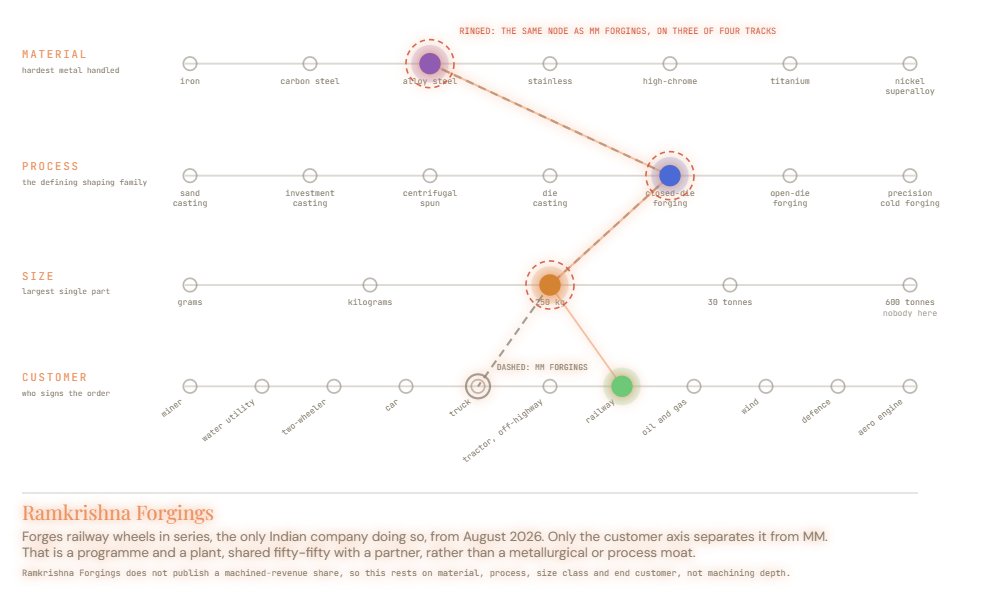
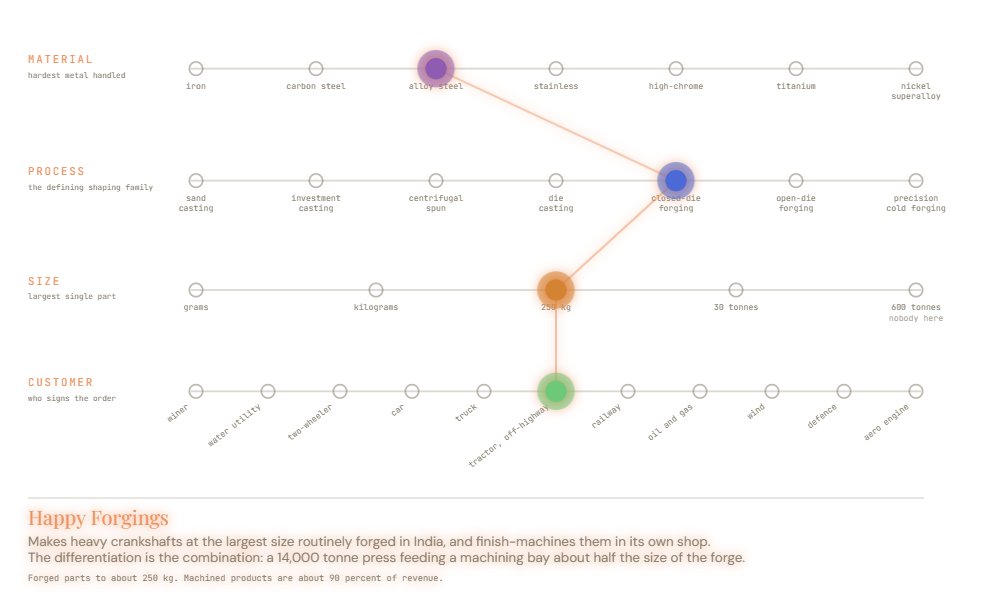
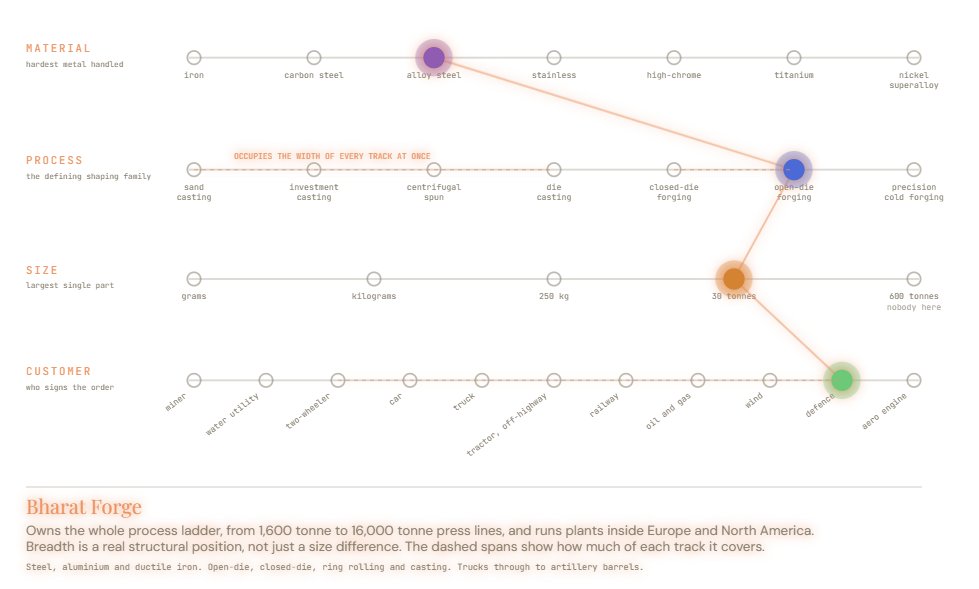
How does RK Forge, Bharat Forge, PTC Industries and Happy Forgings differ from each other? ⤵️
Learn about entire value chain of castings & forgings industry in detailed #TheWrap🌯 Industry Primer
https://t.co/W8JKAj0GW2
How different forging companies positioned:
Every transcript in this industry is describing the same pivot: value-add per kilogram is rising because order books are shifting from commodity automotive "metal bashing" toward IP-led defense, aerospace, and precision-machined components.
Disc: Not a Buy/Sell Recommendations.
#StockScans
MM Forgings boss said on their latest earnings call that big data center companies are now placing orders with Indian forging firms
Data centers need diesel generators as backup power, and every generator needs forged steel crankshafts. India wants to grow data center capacity from 1.8 GW today to 12 GW by 2030, means thousands of new generators will be needed.
Forging companies that can make heavy crankshafts, like MM Forgings with its new 16,500 ton press, are getting fresh business outside trucks or cars
Indian forging companies made 80% of their money from trucks and cars for years. Now tech giants like Google, Amazon, and Microsoft are building massive data centers in India, and each facility needs dozens of diesel generators for power backup.
These generators use forged crankshafts, same type forging firms make for heavy trucks. MM Forgings just put up world largest hot forging press and can now produce crankshafts up to 300 kg. Genset makers like Cummins are lining up as buyers. This is fresh demand from outside auto.
If you order backup generators for data centers today, you wait 42 weeks for delivery. Order books at major genset makers are full through 2028.
India added 258 MW of new data center capacity in H1 2026, up 59% from last year. Each new campus needs 40 to 60 diesel generators on site. Cummins India grew revenue 35% from data center backup orders.
When generator demand is this strong, forging companies that supply finished crankshafts become important vendors. MM Forgings posted Q1 FY27 sales of 427 crore, up 16%.
Just Yu have to scale the dots this will be Cyclical and will be run fast till the pressure exist okay
This Video is just a reference of how it made -- heavy crankshafts
https://t.co/TmZll6pbCS
Another exclusive story from today — the fate of half-built Rs 621 crore Anna Salai flyover hangs in balance as highways department, midway of the construction, finds snag in design in its DPR.
The flyover has been built from Saidapet to Nandanam, but no construction has happened after Nandanam till Teynampet.
Midway of the construction, highways dept realised that the metro foundations in the centre of the road weren’t straight but rather aligned slightly to the left or right. This made it impossible to highways to place central pillars on metro foundation as the flyover will be curvy. They then proposed a change of scope before elections, where they will replace portal pillars instead of central pillars. Portal pillars will have its pillars on the pavements on each side, and will have a central beam connecting the pillars across the road. In this pillars, highways can keep straight girders. Officials further realised central pillar means occupying carriageway and the width in Cenotaph Road and Anna Arivalayam was 28m & 32m respectively, while in Nandanam and Saidapet was 36m and 40m. Construction in the centre would have meant “creating a man made traffic chaos”.
The highways mentioned all this in the scope of change for 43 pillars in Nandanam-Teynampet stretch which approved only last month.
Now, the project which was supposed to be completed will be delayed until Feb 2027.
Growth triggers for Forging & Casting companies.
Europe's supply base is struggling. OEMs are shifting work to India.
Demand is moving beyond auto into energy, data centers, aerospace & semiconductors.
RK forging: Flooded with demand. Inquiries and RFQs are huge. North America and Europe are both firing.
Happy Forgings gets 60% of exports from Europe and says inquiry flow is huge.
Menon received RFQs and NDAs from Magna, Linamar and Allison after its US visit.
Heavy forging capacity is in shortage. Happy's 14,000-ton press takes 1.5 to 3 years to replicate.
RK's ring rolling is at 127% utilization and booked for 2 to 3 years.
NRB won the Sukhoi-30 spherical bearing order. Less than 5 companies globally can make it.
The next growth leg will come from higher value materials and products, not just basic forgings.
RK is moving into titanium and Inconel. Happy is moving from 200kg parts to 3 ton energy parts. Menon is entering larger EV and railway parts. NRB is expanding into aerospace and defence.
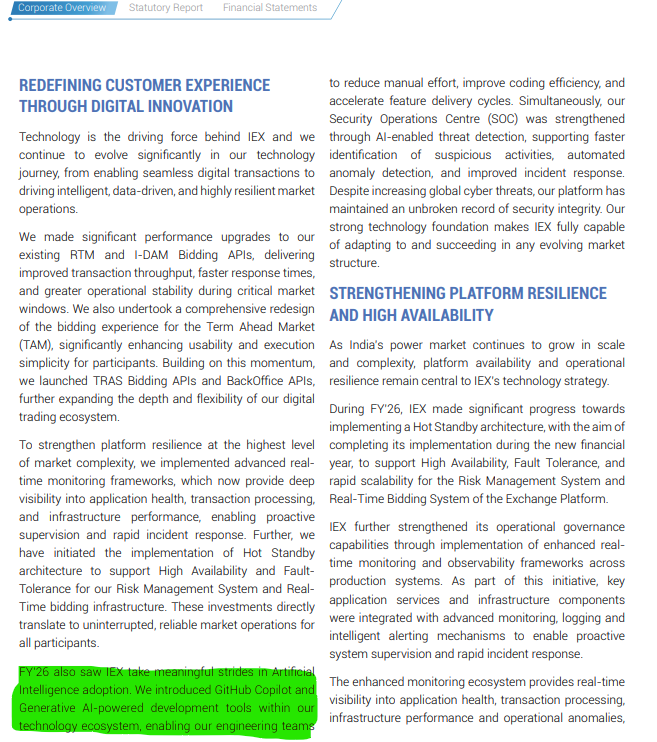
IEX 2026 annual report , my notes and thoughts
1)Theme of transformation is reshaping three critical elements of DISCOM operations: the timing of procurement decisions, the scheduling of State-allocated generation, and the daily optimization of supply-demand balance ( state discoms are increasingly using IEX not as a one time need but more of a long term planning partner , more important for many state discoms that are pivoting to profitability )
2) Mapping the IGX and ICX story , from exchange to the whole energy market ecosystem being built
In January 2026 IGX also signed a memorandum of understanding with Hindustan Petroleum Corporation Limited (HPCL) to develop regasification booking platform to enable market-driven booking of storage and regasification services at HPCL’s Chhara LNG Terminal.
3) On market coupling, CERC issued draft regulations in April 2026 proposing Grid India as the Market Coupling Operator. We continue to engage actively with the regulator, and through the legal process where warranted, to ensure that any structural change strengthens, rather than dilutes, the price discovery and efficiency that competitive markets have delivered for participants
broadly the whole story remains the same folks , over the long term if even if there is competition , incrementally the story for IEX remains very good in my opinion , I think they are focusing on positioning on capturing the incremental profitabilty on the table by creating a larger ecosystem of exchanges rather than just 1 , intersting times ahead here in my opinion
Timepass talk on Sunday
1. Marksans Pharma
Marksans Pharma is a globally focused consumer healthcare and generic pharma company with a dominant presence in OTC (over-the-counter) store brands. It manufactures and markets 350+ products across 2,000+ SKUs, primarily for regulated markets including the US, UK, Europe, Australia, and Canada. The company operates 4 manufacturing facilities (India, US, UK) with 26 billion units of annual capacity and is amongst the top 5 Indian pharma companies in the UK by revenue.
Top Growth Drivers
The company's growth is being propelled by four key engines. First, European front-end expansion is the most significant new driver, Marksans has acquired QliniQ in the Netherlands (contributing ₹44 crore in Q1FY27) and ABCnow in Germany (consolidating from Q2), while also establishing new entities in Ireland and Germany, with Europe revenue already surging 75% YoY. Second, product pipeline momentum remains robust with plans to launch 20–25 new products annually, 112 SKUs added in the US in FY26, and a target to double the portfolio in every country over the next 2–3 years. Third, manufacturing scale and operating leverage is improving as Goa Unit 2 (acquired from Teva) ramps toward ₹80 crore revenue, and the company aims to expand total Indian capacity from ~8 billion to 16 billion units per annum. Fourth, new geography entry through Canada (entity incorporated, filings underway) and continued strength in Australia/New Zealand (54% YoY growth in Q1 with new Rx brand launches under Nova Pharma) is diversifying revenue beyond the traditional US and UK markets.
How Big Could the Europe Opportunity Be?
Europe is rapidly emerging as Marksans' most exciting new growth frontier. In FY27, management expects the region to generate approximately ₹180 crore in revenue, a sharp step-up from the sub-€10 million historical run-rate at QliniQ, reflecting both the acquired base and roughly 40% organic growth expected. Looking further out, management has explicitly guided that they hope Europe can reach "about thousand odd crore" (~₹1,000 crore) within 3–5 years, driven by additional acquisitions and scaling the existing platform across more European countries. The strategic appeal is heightened by Europe's prescription-heavy market structure (80–90% Rx versus 50–50 in the UK), which offers higher-margin, stickier revenue streams compared to the company's traditional OTC-heavy portfolio.
Bottom line: Marksans offers a rare combination of high-teens revenue growth, expanding margins, net-cash balance sheet, and a clear M&A-driven geographic expansion roadmap, all at a scale where the company is transitioning from a niche OTC player to a multi-continent consumer healthcare platform.
Now, what's the anti-theis, that's for you to figure out!
2. Sona BLW Precision Forgings
Sona Comstar is executing a bold "Sona Comstar 2.0" strategy that aims to replicate its historical 10x revenue growth over the next decade. The company delivered its best-ever quarter in Q1 FY27 with 54% revenue growth, 49% EBITDA growth, and 45% PAT growth. What makes this growth particularly impressive is its quality and diversification, BEV revenue surged 107% YoY to ₹435 crore, now constituting 44% of automotive product revenue, while the company simultaneously won significant hybrid and ICE programs. The management has demonstrated exceptional capital allocation discipline, having invested ~₹2,750 crores across acquisitions (Comstar, NOVELIC, Railway Business) that now contribute roughly 40% of revenue, alongside organic innovation where over 35% of revenue comes from products that didn't exist seven years ago.
New Growth Verticals
The recently announced DENSO joint venture represents arguably the most important strategic partnership in the company's history, filling a critical gap in high-voltage electric and hybrid powertrain systems for passenger and commercial vehicles. This two-JV structure, where DENSO leads the 4-wheeler high-voltage segment and Sona Comstar retains control of the 2/3-wheeler segment with reciprocal royalty arrangements, provides access to world-class technology while validating Sona's own IP.
Equally significant is the company's early and substantive entry into Robotics and Physical AI, a market management believes could be transformational given AI's emergence as the next general-purpose technology. With three orders already secured (aggregating ₹6 billion, taking the vertical's total order book to ₹8 billion), and SOPs beginning as early as next quarter, this is no longer conceptual, it is a real business with customers. The company's net order book stands at a robust ₹240 billion (5.4x FY26 revenue), with 64% from automotive EV, providing multi-year revenue visibility.
Strong Market Position
Sona Comstar holds dominant market positions, 55-60% share in Indian PV differential gears, 80-90% in CVs, and 75-85% in tractors, while expanding globally with 7 of the world's top 10 PV OEMs and 3 of the top 10 EV OEMs as customers. The company maintains a negative net debt position (net debt/EBITDA of -1.06x), providing significant balance sheet flexibility for future investments. Despite near-term margin pressure from input cost inflation and product mix (traction motors carry lower margins), management expects progressive improvement from Q2 onwards as cost pass-throughs materialize. With 69 EV programs across 36 customers, a technology roadmap spanning mechanical to software capabilities under "EPIC Mobility," and a proven ability to both build and buy capabilities, Sona Comstar appears well-positioned to capture outsized value as mobility undergoes its most significant transformation in a century.
3. Finolex Cables
Finolex Cables is one of India's largest manufacturers of electrical wires and cables, with a dominant 23.9% market share in the organised wires industry. The company manufactures a comprehensive portfolio spanning electrical cables, power cables, communication cables (including optic fiber), switchgear, lighting, fans, water heaters, and conduit fittings. It operates five manufacturing facilities across India and sells through an extensive distribution network of ~800 distributors, ~5,000 channel partners, and ~2,15,000 retailers pan-India.
Top Growth Drivers
The company's growth is being propelled by four key engines. First, optic fiber and communication cables is the standout performer, Q1FY27 revenue surged 62% YoY with margins near 30% (which will normalize from Q2 on), driven by a global fiber shortage, AI/data center demand, and export opportunities to the US and Europe. The company is aggressively expanding fiber draw capacity from 4 million to 8 million km by Q2FY27 and cabling capacity from 8 million to 10 million. Second, electrical cables diversification continues with strong volume growth in auto cables, solar cables, agricultural cables, and flexible wires (all high double-digit growth), while the company is actively bidding for utility-side power cable projects and planning greenfield expansion once utilisation crosses 70%. Third, backward integration via preform manufacturing, the company has commissioned India's second preform plant (100 metric tons, equivalent to 4 million km fiber), eliminating import dependency, saving 5% duty, and creating potential for external sales; Phase 2 expansion is under evaluation given the demand boom. Fourth, FMEG scaling and channel expansion, despite Q1 headwinds from LPG shortages and PVC supply issues, the company maintains its ₹500 crore FMEG revenue target by FY28, with new product launches in fans and water heaters expected within 6 months and retail reach targeted to expand from 2,15,000 to 2,50,000 outlets.
How Big Could the Communication Cables Opportunity Be?
The communication cables segment is positioned for a step-change in scale and profitability. In Q1FY27, the segment generated ₹176 crore revenue (vs. ₹109 crore YoY), with exports contributing ₹35–40 crore. At full 8 million km fiber draw capacity and assuming $11/km fiber prices, management indicated potential revenue of ~$88 million (~₹730 crore) if selling only fiber, with an additional 25–30% value-add from cabling, implying peak potential revenue of ₹900 crore+ annually from this segment alone. The demand drivers are structural and global: AI-driven data center buildouts (hyperscalers investing $5–6 billion+ in India), 5G rollout completion by telecom operators, BharatNet Phase 3, and India's per capita fiber consumption at just 25 million km/year vs. China's 400+ million km, suggesting significant runway. Management also noted that fiber prices have risen from $5–6/km to $12–13/km currently, with premium fibers selling at $25–50/km, and that the global shortage is likely to persist. The company is also evaluating doubling preform capacity and has the technical capability to manufacture cables with fiber counts up to 14,000+ for data center applications.
The balance sheet is exceptionally strong, net worth of ₹5,099 crore, negligible debt (debt-to-equity near zero), and cash equivalents of ₹163 crore, providing capacity for the ₹300 crore annual capex plan without strain.
4. Kusumgar Limited
Kusumgar is an India-headquartered specialty engineered textiles and aerospace & defence solutions company with deep expertise in polyamide and polyester filament technology, polyurethane chemistry, and advanced fabric engineering. Founded in 1970 and listed on NSE/BSE in July 2026, the company manufactures high-performance fabrics for critical applications including parachute canopies, tactical clothing, camouflage systems, and bulletproof jackets, serving both as a fabric supplier and as a forward-integrated solutions provider for military and aerospace end-users. It operates six vertically integrated manufacturing facilities across Gujarat and Uttar Pradesh with a workforce of ~2,000, and holds the distinction of being one of only two global suppliers of zero-porosity parachute fabrics and the only Indian manufacturer of Kevlar filament fabrics.
The company's moat is exceptionally wide, four to five decades of accumulated technical know-how in engineered fabrics, extensive qualification and approval barriers that take years to clear, exclusive global partnerships providing access to proprietary IP, and co-development relationships that translate into long-term sticky recurring business.
Top Growth Drivers
The company's growth is being propelled by four key engines. First, aerospace and defence solutions expansion, Kusumgar has successfully forward-integrated from fabric supplier to complete systems provider (parachute systems, camouflage solutions, rapid deployment systems), driving a significant portion of the ~7-8x revenue growth seen over the last five to six years; ready parachute contracts were a major contributor to Q1FY27's 102% YoY revenue growth. Second, indigenization tailwinds in Indian defence, India is accelerating its shift toward indigenous defence manufacturing to reduce import dependency, and Kusumgar is deeply embedded as an incumbent supplier to the Indian military with decades of qualification barriers and approval cycles that make switching costs prohibitively high for customers. Third, outdoor and lifestyle fabrics scaling, the company is rapidly building partnerships with global outdoor and activewear brands entering or expanding in India, with product approvals progressing brand-by-brand and season-by-season; this segment offers more predictable, recurring demand compared to the lumpy defence business. Fourth, global defence spending and export growth, the company is a challenger in international markets with growing inroads into foreign militaries, and management explicitly views geopolitical tensions and heightened global defence budgets as a secular tailwind; exports already contribute ~10-15% of revenue and the company has put in place arrangements to mitigate tariff risks.
How Big Could the Aerospace & Defence Opportunity Be?
The aerospace and defence segment is positioned for sustained multi-year growth driven by structural indigenization and global rearmament. In Q1FY27, the company reported revenue of ₹247 crore (up 102% YoY) with EBITDA margins of 31%, though management cautions that Q4FY26 was an anomaly due to tariff-resolution-driven export shipments, and Q1FY27 is more representative of normalized quarterly run-rates. Over FY20-FY26, revenue grew at a ~35% CAGR while PAT grew at an even faster ~70%+ CAGR, reflecting the shift from lower-margin fabric supply to higher-margin integrated solutions. The addressable opportunity is substantial: India's defence budget continues to expand, with increasing emphasis on domestic procurement; Kusumgar's product portfolio spans parachutes, tactical clothing, sleeping bags, rucksacks, bulletproof jackets, camouflage nets, and stealth systems, all of which have both steady replenishment demand (consumables for standing armed forces) and surge demand during geopolitical escalations. Management also highlighted partnerships in stealth/camouflage and lightweight carbon-based materials with Russian and Japanese technology partners, which could open new premium product lines. While management deliberately avoids formal guidance due to tender unpredictability, they indicated FY25 and FY26 margin levels (~19-27% EBITDA) are reasonable benchmarks for FY27, with the business broadly on track for continued steady growth.
5. Solar Industries
Solar Industries is executing a compelling strategic pivot from a pure-play explosives manufacturer into a diversified defence-industrial complex, and the Q1 FY2027 numbers validate this thesis with force. The company delivered its highest-ever quarterly revenue (₹3,668 crore, up 70% YoY), EBITDA (₹1,024 crore, up 82%), and PAT (₹666 crore, up 89%), demonstrating that the defence vertical is not merely additive but multiplicative to profitability. With an order book of ₹21,350 crore, of which defence constitutes roughly ₹18,000 crore, the revenue visibility extends well beyond the current fiscal year.
Management has guided for ₹14,000 crore in annual revenue (up from ₹9,800 crore previously), and has explicitly flagged potential upward revisions after H1, suggesting conservatism in their base case. The ~28% EBITDA margin, which management characterizes as the "new normal," is being structurally supported by a higher mix of defence products, efficient supply chain management, and recent capacity expansions.
The defence segment is the critical engine for re-rating. It grew 123% YoY in Q1 and is targeting ₹4,500 crore for the full year. The Pinaka rocket system remains the anchor order, with extended-range variants (up to 75km) in final negotiation stages expected by H2. Beyond Pinaka, the Bhairavastra anti-tank guided missile is completing advanced trials with formal orders anticipated next year, while the 155mm artillery ammunition facility is being commissioned with initial revenue recognition in FY2028. These are not one-off contracts but platform-level opportunities that create annuity-like revenue streams and deepen the company's moat as India's first private-sector player in integrated defence manufacturing. The management's commentary on "increasing engagement with customers across domestic and international markets" implies export potential, which would further expand the addressable market.
The balance sheet provides strategic flexibility without compromising returns. With approximately $80 million in cash and equivalents, the company is actively evaluating greenfield projects, acquisitions, and startup investments to augment organic growth. The planned capex of ₹2,050 crore for FY2027 (₹450 crore already deployed in Q1) is directed at capacity expansion in high-growth geographies, Dhule in Western India, Dholpur in the North, and upcoming facilities in Odisha and South India, ensuring that volume growth is not constrained by infrastructure. International explosives growth of 65% YoY, led by South Africa and Australia, confirms that the global footprint in 90+ countries is more than a marketing claim; it is a scalable revenue base.
Now, what valuation offers you comfort is your own judgement!
That's all for this edition. Have a great Sunday!
Disclaimer: None or buy or sell recommendations. This publicly available information is shared for learning and education purposes.
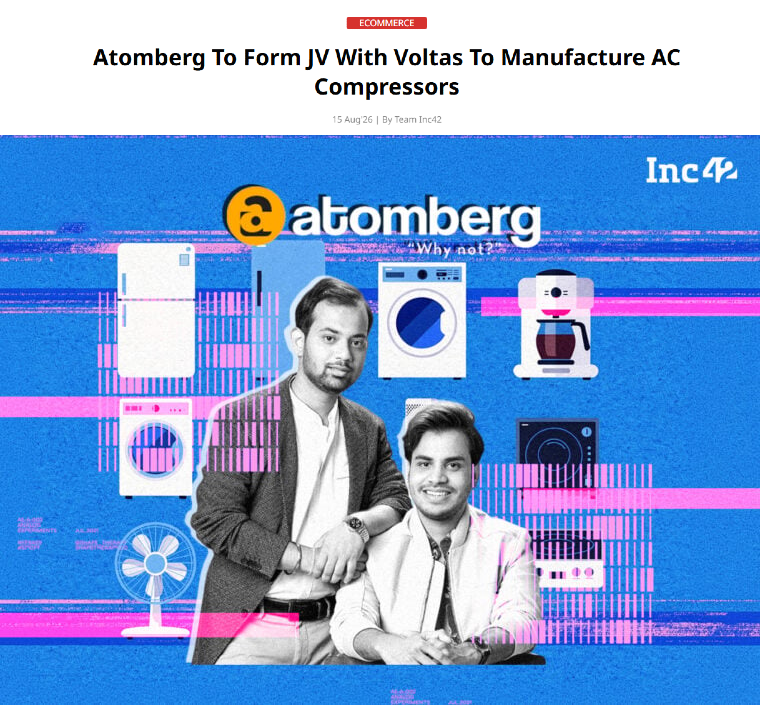
Voltas is Indias biggest AC brand with about 18.5% market share, selling over 2m units per year
They need compressors to make every single AC, India imports most of these from China. Government just capped those imports at 30% of last years volumes for FY27. So Voltas needs domestic compressor supply fast.
They partnered with Atomberg, Indian deep-tech startup that built rotary compressor tech from ground up using BLDC motor design. This is 50-50 JV where Voltas is anchor buyer and Atomberg brings engineering.
Both sides need each other equally
Voltas tried this exact same move with Chinese company Shanghai Highly back in 2022. Government blocked it under Press Note 3, which requires approval for investments from countries sharing land borders with India.
JV was terminated in April 2023, For 3 years after that, Indias top AC company had no local compressor partner. Now they found Atomberg, founded by IIT Bombay alumni, fully Indian, no foreign ownership complications.
Pattern is clear - India wants domestic manufacturing but will not let China own that supply chain
Only 10% of Indian homes have AC today. China sits at 80%. India sold about 15m AC units in FY25 and is on track for 28m by 2030. Every unit needs compressors, motors, controllers, heat exchangers.
Right now most of these parts come from China, Government is shutting that door step by step with import caps, QCO orders, and PLI incentives.
Companies like Voltas, Blue Star, Daikin are all racing to build backward into components. Atomberg JV is just 1 piece of much bigger reshuffling across Indian cooling supply chains.
Forex can be save multiple way in the next 5 year that will show up in the GOI Balance sheet :)
https://t.co/e5LPYjzxDr