i’ve published to neurIPS but i still can’t understand research papers
that’s why we made arXivisual to make every paper feel like a @3blue1brown video
🏆 winner @ TartanHacks ‘26
link: https://t.co/4noZCuhxTy
repo: https://t.co/Zq4ngYCVYB
built with: @AjithBondili@_rajshah6@armaangupt0
I think the disagreement is largely one of vocabulary.
I object to the use of "general" to designate "human level" because humans are extremely specialized.
You may disagree that the human mind is specialized, but it really is. It's not just a question of theoretical power but also a question of practical efficiency.
Clearly, a properly trained human brain with an infinite supply of pens and paper is Turing complete.
But for the vast majority of computational problems, it's horribly inefficient, which makes it highly suboptimal under bounded resources (like playing a chess game).
Let me give an analogy: in theory, a 2-layer neural net can approximate any function as close as you want. In practice, almost every interesting function requires a impractically large number of units in the hidden layer. So we use multi-layer networks (that's actually the raison d'être for deep learning).
Here is another argument: the optic nerve has 1 million nerve fiber. Let's make the simplifying assumption that the signals are binary. A vision task is therefore a boolean function from 1E6 bits to 1 bit.
Among all the possible such functions, what proportion are implementable by the brain?
The answer is: an infinitesimal proportion.
The number of boolean functions of 1 million bits is 2^(2^1E6), which an unimaginably large number, about 2^(1E301030) or 10^(3x1E301029).
Now, assuming that the human brain has 1E11 neurons, and perhaps 1E14 synapses, each represented on, say, 32 bits. The total number of bits to specify the entire connectome is at most 3.2E15. This means the total number of boolean function representable (computable) by the entire human brain is at most 2^(3.2E15).
This is a teeny-tiny number compared to 2^(1E301030).
Not only are we not general, we are *ridiculously* specialized.
The space of possible function is vast.
We don't realize it because most of those functions are unfathomably complicated to and us and look completely random.
I love this quote from Albert Einstein: "the most incomprehensible thing about the world is that the world is comprehensible"
It's pretty incredible that among all the random ways the world could be organized, we can actually find a way to understand a tiny part of it.
The part we don't understand, we call entropy.
Most of the information content of the universe is entropy: things we simply cannot understand with our feeble minds and choose to ignore.
We beat Nvidia’s cuBLAS kernels on B200s in 170 LOC.
Using zero CUDA. Just pure Mojo.
Here’s exactly how we went from 1% to 106% of Nvidia benchmark perf from scratch (with code) 👇🧵
Coming soon: bring any agent to your data in @marimo_io notebooks.
marimo is the first notebook to implement @zeddotdev's Agent Client Protocol — making it possible to use @AnthropicAI's Claude Code, @GoogleAI's Gemini, @OpenAIs Codex, or any other ACP-compatible agent.
OpenAI’s open models are live and already running on Groq. Try gpt-oss-20B and gpt-oss-120B today.
Groq delivers 128K context and built-in tools such as code execution and browser search. For the first time, developers and enterprises can deploy open models backed by OpenAI instantly, anywhere, at scale.
Start building now. Links in comments.
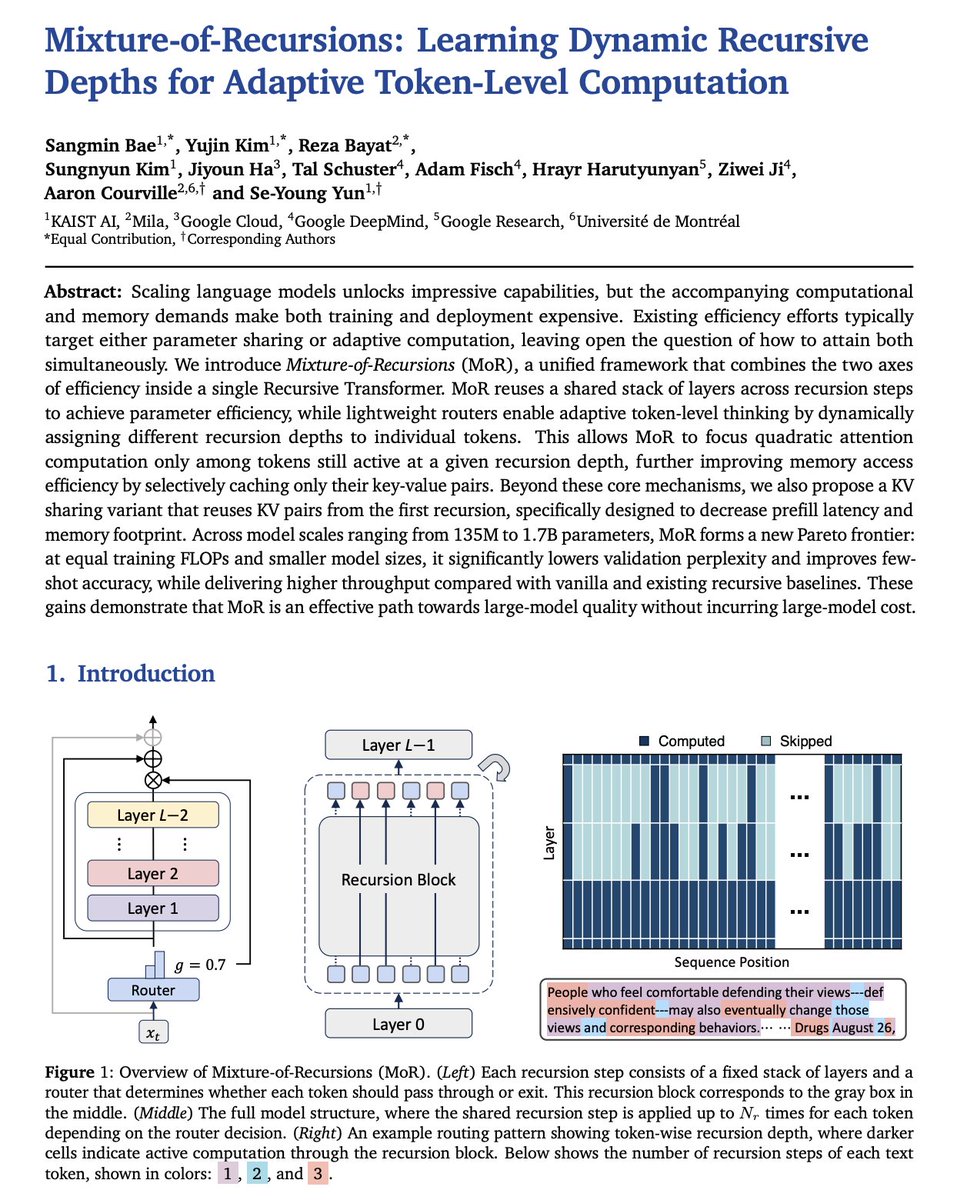
Google DeepMind just dropped this new LLM model architecture called Mixture-of-Recursions.
It gets 2x inference speed, reduced training FLOPs and ~50% reduced KV cache memory. Really interesting read.
Has potential to be a Transformers killer.
DX12 is 10 years old now. It's not modern anymore. Most of the complexity of DX12 and Vulkan APIs is simply not needed anymore. We don't need to support 13 year old Intel iGPUs and 12 year old mobile chips anymore. Metal 3.0 binding model is much more clean. Just GPU pointers.
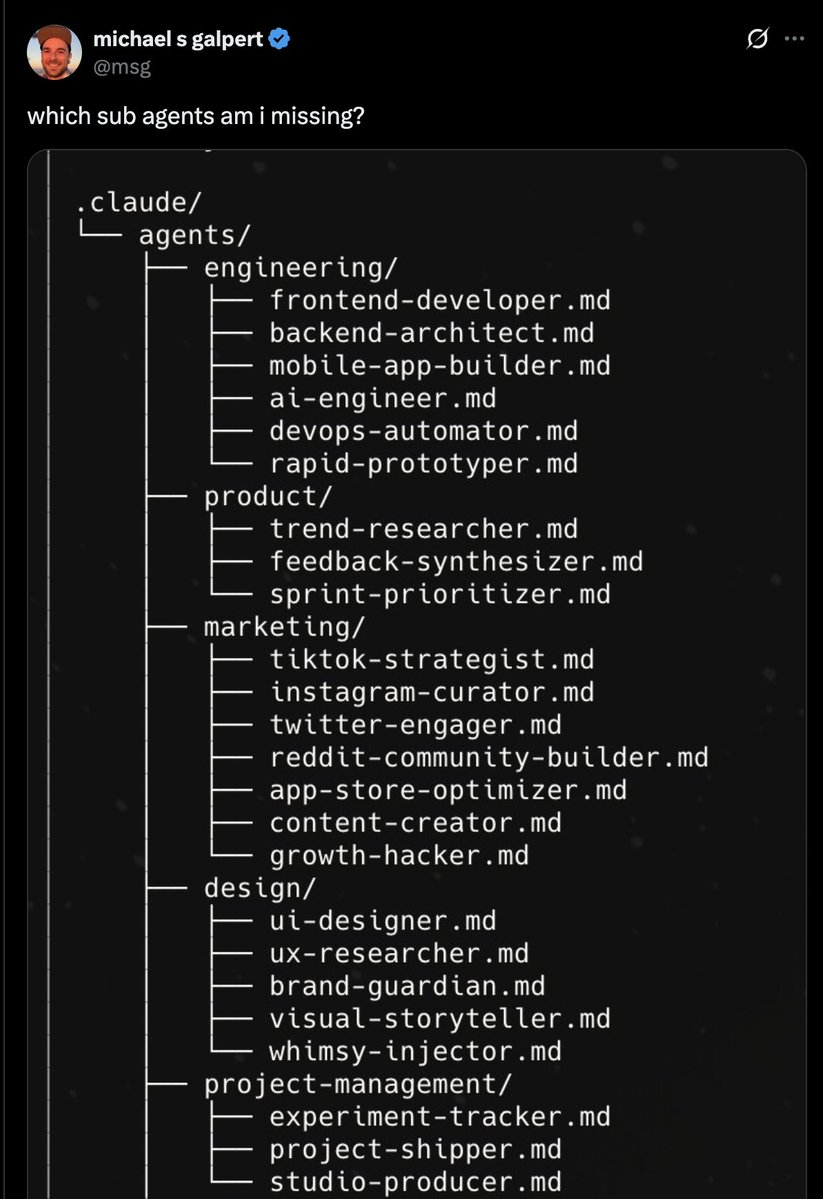
@Cursor works well if you know how to do architectural planning, but @roocode comes with an “Architect Agent” preconfigured to help design system components.
Sometimes the best AI tools aren’t the ones that move fast, they’re the ones that make you slow down and think.
This new sample demonstrates how to render a simple triangle using Vulkan 1.3 core features. It modernizes the traditional "Hello Triangle" Vulkan sample by incorporating Dynamic Rendering, Synchronization2, Extended Dynamic State, and Vertex Buffers
https://t.co/PSQHIdYVXM
We've announced cuTile, a tile programming model for CUDA!
It's an array-based paradigm where the compiler automates mem movement, pipelining & tensor core utilization, making GPU programming easier & more portable.
I'm proud of my stellar team for all their hard work on this!
📣 Announcing #NVIDIABlackwell DGX Personal Computers. #GTC25
AI developers, researchers, data scientists and students can prototype, fine-tune and inference large models on desktops.
Learn more ➡️ https://t.co/spraN9RBpP
Thank Brown ( Indian ) people for:
The Concept of Zero – the foundation of modern computing and digital systems
The Decimal Place-Value System – the cornerstone of global finance and advanced mathematics
Negative Number Arithmetic Rules – essential for algorithm design and higher-level computations
The Chakravala Method – a precursor to solving complex polynomial equations and cryptographic algorithms
Trigonometric Functions (Sine and Cosine) – critical to GPS, navigation, and signal processing
Infinite Series for π – paving the way for calculus and engineering simulations
Partition Function in Number Theory – fundamental to cryptography and combinatorial data analysis
The Raman Effect – revolutionizing molecular spectroscopy and materials science
Bose–Einstein Statistics – underpinning quantum computing, superconductivity, and superfluidity
The Chandrasekhar Limit – a pillar in astrophysics for understanding stellar evolution
The Saha Ionization Equation – vital for plasma physics and fusion research
The Raychaudhuri Equation – integral to black hole singularities and cosmological models
Black Hole Quasinormal Modes – key to gravitational wave research and astrophysical observations
Bhabha Scattering – advancing quantum electrodynamics and particle physics
Wireless Radio & Semiconductor Diode (J. C. Bose) – paving the way for radio broadcasting and modern electronics
Fiber Optics (Narinder S. Kapany) – at the heart of high-speed internet and data communication
The Mahalanobis Distance – used in machine learning, data mining, and pattern recognition
Dual-Phase Steel – enabling lightweight, high-strength materials for automotive and aerospace
Genetic Code & First Artificial Gene Synthesis (Har Gobind Khorana) – pioneering genetic engineering and biotech
Ribosome Structure Mapping (Venkatraman Ramakrishnan) – crucial for drug design and structural biology
ATP Mechanism & Drug Discoveries (Yellapragada Subbarow) – key to modern pharmaceuticals and chemotherapy
The Ramachandran Plot – a cornerstone in protein modeling and computational biology
Oral Rehydration Therapy (ORT) – a lifesaving intervention adopted worldwide
The Green Revolution (M. S. Swaminathan) – ensuring food security through high-yield crop strains
The Pentium Microprocessor (Vinod Dham) – critical to personal computing and modern CPU designs
Universal Serial Bus (USB) (Ajay V. Bhatt) – standardizing plug-and-play connectivity across devices
Web-based Email (Hotmail) (Sabeer Bhatia) – ushering in a new era of global communication
Digital Video & HDTV (Arun Netravali) – forming the bedrock of modern broadcasting and video streaming
MIMO Wireless Technology (Arogyaswami Paulraj) – powering 4G/5G networks and high-speed Wi-Fi
The Jaipur Foot Prosthetic – restoring mobility through a cost-effective and flexible design
Lunar Water Discovery (Chandrayaan-1) – marking a breakthrough for Moon exploration
The Mars Orbiter Mission (Mangalyaan) – setting a record for cost-effective interplanetary travel
The Aryabhata Satellite – igniting India’s journey into space research and technology
So the next time you use a number, open an email, stream a video, or marvel at a space mission, thank brown ( Indian) people.