we built an early flood warning system for nepal. 🇳🇵
on 26 august, a massive flood came down the bhotekoshi from tibet.
157 people died. hundreds are still missing.
nepal has gauges all along that river.
the last reading from rasuwagadi said:
“below warning level. steady.”
then all five gauges in the valley went offline within ten minutes of each other.
they still haven’t come back.
the monitoring existed.
the warning didn’t.
and for people living in remote parts of nepal, putting disaster data on a website isn’t enough.
they might not have twitter.
they might not have a disaster app.
they might not even have reliable internet.
but most people have a phone.
so we built notify.
notify continuously checks DHM gauges + NDRRMA data for floods and other natural disasters.
for floods, it watches how quickly rivers are changing upstream and estimates how long a dangerous surge could take to reach communities downstream.
when something looks dangerous, we try every way we can to reach the people in its path:
a phone call in nepali.
an sms.
an email.
you opt in once with your district + contact details.
after that, if a natural disaster could affect you, we try to make sure you hear about it before it reaches you.
the idea is p simple:
people shouldn’t need internet, twitter, or the right app open at the right time to know they’re in danger.
sometimes a phone call is more important than all of them.
free.
77 districts.
live now. 🇳🇵
https://t.co/3tcs3KfmgA
On 10 April 1917, Rajkumar Shukla brought Mahatma Gandhi to Bankipore (Patna), continuing his determined effort to make Gandhi witness the suffering of Champaran’s indigo peasants.
In Patna, Mazharul Haq played a crucial role.
1
She had just graduated from TISS, landed her 1st job, & travelled to Delhi for induction formalities.
Her friend Aman Singh was on the phone with her when the fire broke out. "I cannot forget those screams," he said.
Shrutika Baranwal, 25, had "a spark we require in the social sector." She didn't get the chance to use it.
Heartbreaking report by @Pallavi_Smart & @Drishti_jain02
https://t.co/iTnbrxHAFO via @IndianExpress
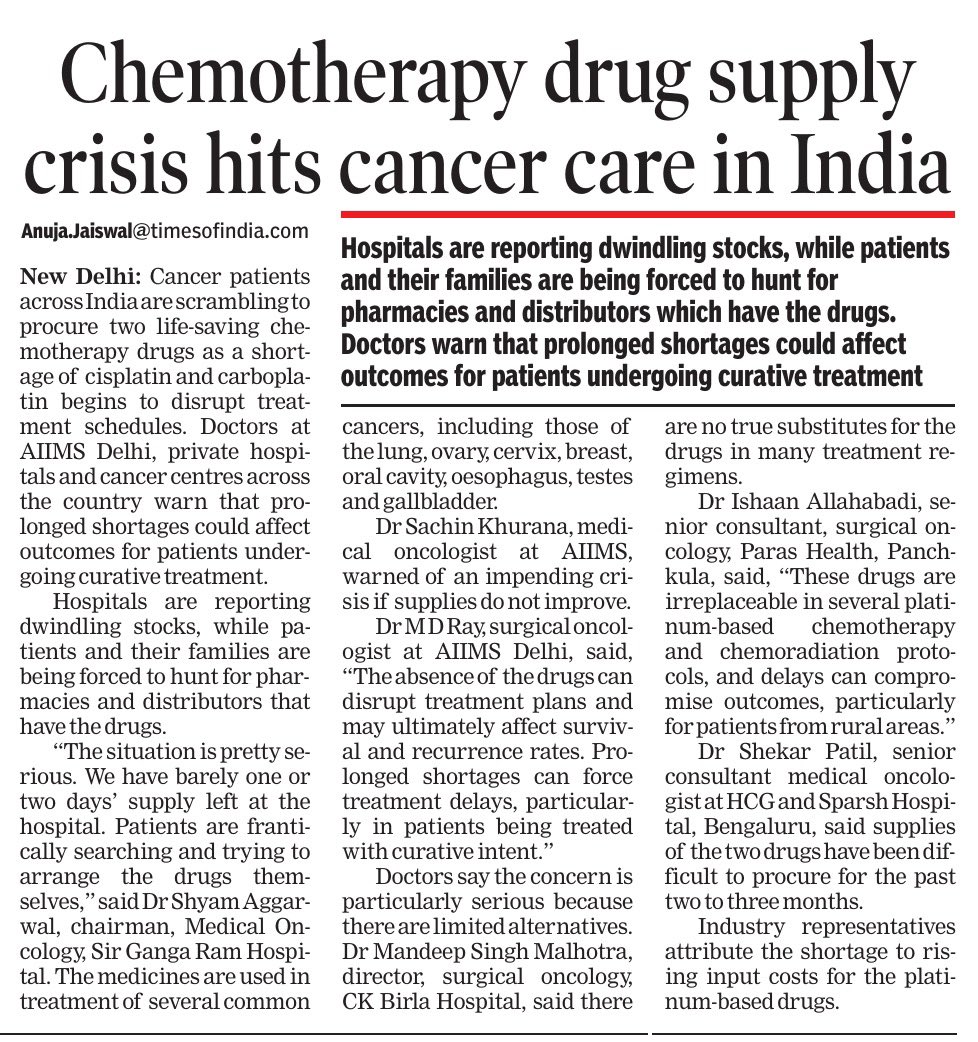
#Cancer patients across #India are scrambling for two life-saving #chemotherapy#drugs as a #shortage of #Cisplatin and #Carboplatin begins to disrupt treatment schedules, with some hospitals reporting only one to two days' supply left. Doctors at #AIIMSDelhi, #privatehospitals and #cancercentres across the country warn that prolonged shortages could affect outcomes for patients undergoing curative #treatment. Hospitals are reporting dwindling stocks, while patients and their families are being forced to search pharmacies and distributors in an effort to procure the medicines.
"The situation is pretty serious. We have barely one or two days' supply left at the hospital. Patients are frantically searching and trying to arrange the drugs themselves," said @drshyam_aggarwa , Chairman, Medical Oncology, Sir Ganga Ram Hospital. The medicines are used in the treatment of several common cancers, including those of the lung, ovary, cervix, breast, oral cavity, oesophagus, testis and gallbladder. @timesofindia
The over sexualization of breasts has a medical cost.
As a cancer doctor, I’ve seen women wait months before telling anyone about a breast lump because they were embarrassed, afraid, or worried about what people would think.
In India, far too many breast cancers still present at advanced stages. Not because the disease is inherently aggressive, but because stigma delays the first conversation.
Early breast cancer is often curable.
Silence and stigma is the real killer.
Inhuman ways people from this region travel for basic needs deserves a sociological study. BGP’s neglected belt urgently needs a daily superfast regular train to major metros-not weekly, slow or “special” tokenism. Citizens cannot continue to live like subjects of the state.
Please arrange to approve BGP vande Bharat via sbg ,new train from Bhagalpur to Delhi ,trains for Amritsar Pune Hyderabad Bangalore ? for how long Bhagalpur JMP region will be neglected ? Please understand the hardships of people @RailMinIndia@EasternRailway@AshwiniVaishnaw
Time for #Bihar to make cancer a notifiable disease. A crucial public health step, would be a meaningful legacy move before your tenure ends, @NitishKumar.
Angika phrase of the day-
“Hai kothi ke dhaan hau kothi”
Literal meaning- Moving grain from one silo to another.
Actual meaning- Doing jackshit, but appearing (and feeling) productive.
Solution to this problem is surprisingly hidden within #Hotstar itself. One can switch to Indian Sign Language in the settings and voila, you have a bit sophisticated old school radio style calm Hindi Commentary (different frm mainstream feed) at your disposal !
"Bharat ke east mein bhi hum hain, Bharat ke west mein bhi hum hain, is tournament mein best bhi to hum hi hain.”
Makes any sense? Lazy, cringe, painfully childish rhyme passed off as commentary. 1.4 billion people, yet not one decent Hindi commentator.
Top things heard and seen at the world book fair , Bharat Mandapam
1. “Trolley wala suitcase lana chaiyye boss bohot kitabe leni hai”
2. A girl buying books as wedding favours for her upcoming ceremony (bought a copy of Sheher mein Gaon woohooo)
3. “Ek baar amazon pe check kar discount”
4. “Kitabe achi hai khane kay stall khas nahi hai”
5. A mother to her child “yes you can buy as many books no budget limit”
6. “Bhai ek baar hinge chala kay dekh achi janta show hogi”
7. “200 page ki kitab hai yahan hi pad deta hu poori no need to buy”
8. “Fashion game mast hai reader ladkiyo ka”
Adding a few
-cheapest books in the entire book fair are still sold outside book fair near Supreme Court Metro Station
-the best instagrammable points are located at: theme pavilion, hall 4/5reception & the hall connecting ally
-"bhaiya chetan bhagat jaisa kuch dikhao"
We have opened up our skies to the world.
The first touchdown at #NMIA marks a defining moment as Navi Mumbai International Airport welcomes its first commercial flight with a ceremonial water cannon salute, officially commencing scheduled passenger operations.
#NaviMumbaiInternationalAirport #Aviation #OpeningDay #AvGeek
I was in fifth grade when I learned to read my parents' silence.
They were talking in the kitchen, late at night, in that particular hush that parents use when they think children are asleep. I caught fragments. Bombay. Tests. Something about a doctor. The next morning, everything was normal. Chai, school, the shop. But I had heard the frequency shift.
It was 2004. My father was 39. We had just moved out of the room behind our kirana store—a chawl on the outskirts of Panaji—into a proper apartment. Our first EMI. Things were looking up in the way they do for Indian middle-class families who have spent years looking at the same ceiling: slowly, carefully, one calculated risk at a time.
Then the diagnosis. Stage 3 follicular lymphoma.
I didn't know what lymphoma meant. There was no internet to tell me, no Google to spiral into. Cancer was a word from movies—something that happened to people in cities, in dramatic hospital scenes with violins. Not to shopkeepers in Goa. Not to fathers who opened shutters at 7 AM and counted change at night.
They kept me in the dark. The logic was simple: don't disturb the boy's studies. So I went to school. I came home. I did homework. And in the margins of this ordinary life, my father was taking buses to Mumbai for chemotherapy.
I still don't fully understand how he did it. A biopsy, then a bus. Chemo, then the overnight journey back. Tata Memorial to Kadamba bus stand. The same man who winced when he cut his finger slicing onions was now traveling eight hours each way with poison in his veins, because what else was there to do? Goa didn't have the facilities. We didn't have the money for flights or hotels. So he sat on buses, probably in pain I can't imagine, probably next to someone complaining about the AC being too cold.
My mother ran the shop. Not "helped out"—ran it. Wholesale orders, inventory, customers, credit books, all while her husband was in the jaws of something that might kill him. New scans kept showing the cancer spreading. The word "spreading" did a lot of work in those days.
And I? I was a child. Which means I was selfish in the way only children can be—not out of cruelty, but out of not knowing. My father was alive and not going bald like he did so I assumed things were now fine. I was still in the dark.
I remember crying for days because I wanted a geared cycle. All my friends had them. The fancy ones with the grip shifters. I needed it for school, I argued. I needed it because everyone else had one. I remember my parents' faces when I wouldn't let it go—that particular exhaustion of people who cannot explain why they're saying no, because the explanation would break something.
Every rupee mattered. I didn't know that yet. I didn't know that they were borrowing money from friends, from family, sometimes from customers at the shop—the same aunties who haggled over soap prices were quietly lending us cash to keep my father alive. That's the thing about the Indian middle class: the safety net is made of relationships. Of people who've known you long enough to trust you'll pay them back, eventually. No paperwork. Just faith, and shame, and gratitude all mixed together.
My father then spent 40 days in Mumbai for radiation. He stayed with my aging grandparents in a small flat while I finished my exams and my mother kept the shop open. I don't know what those 40 days were like for him. He never talked about it. Men of that generation don't. They just endure, and then they come home, and life continues as if nothing happened.
The magnitude of what was happening to my family didn't hit me until years later. No health insurance, of course—it was unheard of for people like us. The treatment, the travel, the lost income from the shop, the interest on loans that weren't from banks. It drained us completely. Not metaphorically. Actually. The kind of drained where you stop going to movies. Where eating out becomes a memory. Where "vacation" is a word other families use.
Miraculously—and I use that word carefully—things stabilized. By 2007, the cancer was in remission. Whether it was the radiation, the medication, or the wheatgrass cow dung milk ayurvedic concoctions my mother sourced from god-knows-where, I don't know. Probably all of it. Probably none of it. Cancer does what cancer does, and we tell ourselves stories about why.
But remission doesn't mean freedom. It means waiting. It means every annual checkup is a held breath. It means the knife never really leaves—it just hangs higher for a while.
It took us until 2015 to recover financially. Eleven years. A whole decade of my adolescence spent in the aftermath of something that happened in three months. That's the part nobody tells you about illness: the medical crisis has a timeline, but the financial crater doesn't. It just sits there, and you fill it in slowly, one repaid loan at a time, one favor returned, one customer you finally pay back.
In 2012, I got admits to colleges abroad. Good ones. The kind of opportunity that I'd dream about for my children.
My mother sat me down and gently suggested I reconsider. She didn't say "we can't afford it." She said: "What if it comes back?"
The knife, always dangling.
She was right to think it. I knew she was right. So I gave the BITSAT, got into BITS Pilani with a generous scholarship from the Goa government, and made it through. It was the practical choice. The safe choice. The choice you make when you've learned that life can pivot on a diagnosis.
It did come back. In 2022, the lymphoma transformed—DLBCL this time, more aggressive—and everything we'd feared for eighteen years arrived all at once. My father went through treatment again. CAR-T therapy, a clinical trial. Brief remission. Then not.
He passed in 2023.
But the thing I think about now, the thing that connects that fifth-grade boy crying about a cycle to the man I became: when it came back, I was ready.
Not emotionally—you're never ready for that.
But financially. I could go all out. Best doctors. Best facilities. No borrowed money from customers. No buses to Mumbai. When the bill came, I could pay it.
The CAR-T didn't work. Cancer won anyway. But I sleep at night. I sleep because I know I did everything that could be done. There's no version of me lying awake wondering: what if I'd had more? What if I could have afforded that other treatment? That guilt would have eaten me alive. It would have been worse than grief.
I think about this when people ask me why I care so much about money. Why I write about financial security. Why I'm building what I'm building.
It's not ambition. It's not greed. It's not even wisdom.
It's trauma response.
The boy who cried about a geared cycle grew up to understand something about money that no finance book teaches: it's not about the stuff. It's about what happens when the phone rings and someone says the word "biopsy." It's about having options when you have no good choices. It's about not borrowing from the aunty who buys soap from your shop.
My father ran a kirana store. He woke up early. He counted change at night. He took buses to chemo because that's what was available to him. He never complained. He came home and opened the shop the next day.
I don't know what he would think about me writing this. He wasn't the type to share. But I think he'd understand why I'm sharing it: because somewhere, there's a family in a small town, getting a diagnosis, doing the math, realizing the numbers don't work.
I want them to know they're not alone. And I want the version of me that comes after them—the child who doesn't fully understand yet—to grow up in a world where this story is a little less common.
That's all. Now go, get some insurance and take your parents out for dinner while they're still around.