My daughter is now owner of a few #Bitcoin, while my son folio has lots of #dogecoin. Base amount of investment is the same. After 10 years, we shall see who owns who.
A Short History of OpenAI
On Friday, OpenAI ousted its co-founder Sam Altman as CEO. While OpenAI cites a lack of consistent candor in Altman’s dealings with the board as the key reason for his removal, there is widespread speculation about other motives behind his termination. These range from disputes concerning the profit vs nonprofit motives of the company to the discovery of artificial general intelligence, a type of AI that can surpass human intelligence for most tasks.
We wanted to look back at the history and corporate structure of OpenAI to understand how we got here. Here’s the story:
Inception and Early Strides (2015-2018)
OpenAI was initially founded in 2015 by Sam Altman, Elon Musk, Ilya Sutskever and Greg Brockman as a non-profit organization with the stated goal to “advance digital intelligence in the way that is most likely to benefit humanity as a whole.” The company assembled a team of the best researchers in the field of AI to pursue the goal of building AGI in a safe way.
The early years of OpenAI were marked with rapid experimentation. The company made significant progress on research in deep learning and reinforcement learning, and released ‘OpenAI Gym’ in 2016, a toolkit for developing and comparing reinforcement learning algorithms.
OpenAI showcased the capabilities of these reinforcement learning algorithms through its ‘OpenAI Five’ project in 2018, which trained five independent AI agents to play a complex multiplayer online battle arena game called ‘Dota 2’. Despite operating independently, these agents learned to work as a cohesive team to coordinate strategies within the game.
A crucial development occurred in June 2018. The company released a paper titled "Improving Language Understanding by Generative Pre-Training", which introduced the foundational architecture for the Generative Pre-trained Transformer model. This later evolved into ChatGPT, the company’s flagship product.
Transition From a Non-Profit (2019)
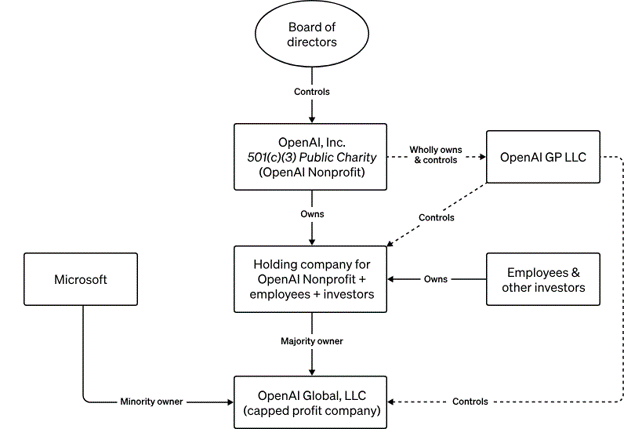
In 2019, OpenAI transitioned from a non-profit to a “capped-profit” model. According to the company’s blog post, OpenAI wanted to increase its ability to raise capital while still serving its mission, and “no pre-existing legal structure they knew of struck the right balance”. Per the IRS, for-profit entities and not-for-profit entities are fundamentally at odds with each other, so in order to combine the two competing concepts, OpenAI came up with a novel structure which allowed the non-profit to control the direction of a for-profit entity while providing the investors a "capped" upside of 100x. This culminated in a $1Bn investment from Microsoft, marking the beginning of a key strategic relationship, but complicating the company’s organizational structure and incentives.
The non-profit entity, OpenAI Inc., became the sole controlling shareholder of the new for-profit entity OpenAI Global LLC, which answered to the board of the nonprofit and retained a fiduciary responsibility to the company’s nonprofit charter. Crucially, the board was responsible for determining when OpenAI attained artificial general intelligence (AGI), which the company defines as a “highly autonomous system that outperforms humans at most economically valuable work.”
The structure of OpenAI is outlined below:
Becoming ChatGPT (2020-2023)
In 2020, bolstered by new funding, OpenAI unveiled GPT-3, a large language model (LLM) capable of understanding and generating convincing human-like text. This was a watershed moment for OpenAI and the broader AI community. As the company grew, its LLMs continued to become larger and more intelligent.
However, OpenAI's innovation didn't stop with language models. In 2021, the company expanded its horizons by launching Codex, a specialized AI model for programming, and DALL-E, an AI system adept at creating original artwork from text descriptions.
December 2022 marked another major milestone for OpenAI with the release of GPT-3, laying the groundwork for the consumer-focused application ‘Chat-GPT’. Chat-GPT rapidly captured global attention, becoming the fastest app to amass 100 million users within just two months of its launch. Capitalizing on this success, OpenAI introduced a subscription model and unveiled its most sophisticated model yet, GPT-4, ~10x more advanced than its predecessor and capable of analyzing text, images, and voice. Further developer tools and a turbocharged version of GPT-4 were announced at the company’s Developer Day on November 6th, 2023.
Removing Sam Altman (2023)
On Friday, OpenAI announced that it was removing its co-founder Sam Altman as CEO, citing a lack of consistent candor in his communications with the company’s board. According to the company's official statement, the board “no longer has confidence in Altman’s ability to continue leading OpenAI.”
OpenAI’s board of directors has undergone numerous changes since inception. Elon Musk resigned from his board seat in 2018, citing a “potential future conflict of interest” with Tesla’s AI development for driverless cars. Elon later expressed disappointment over the company’s for-profit motivations and dealings with Microsoft. Since Elon’s departure, a number of other board members have left the company, including former congressman Will Hurd who cited a Presidential bid, LinkedIn co-founder Reid Hoffman over an investment conflict, and Neuralink director Shivon Zilis.
The remaining board members who removed Altman are:
- Adam D’Angelo - CEO of Quora
- Tasha McCauley - Co-Founder of Fellow Robotics and adjunct senior management scientist at RAND Corporation
- Ilya Sutskever - Co-Founder and Chief Scientist of OpenAI
- Helen Toner - Director of Strategy and Foundational Research Grants at Georgetown University’s Center for Security and Emerging Technology
Altman’s removal as CEO prompted the resignation of President and Co-Founder Greg Brockman and three of the company’s senior scientists. Reports suggest that this may have been orchestrated by the company’s other Co-Founder and Chief Scientist Ilya Sutskever over concerns that Altman was pushing to commercialize the company too quickly. Sutskever was recruited to OpenAI from Google in 2015 by Elon Musk, who describes him as “the linchpin for OpenAI being successful”.
A tweet from Greg Brockman confirms that Ilya was a key figure in Altman’s removal.
https://t.co/x2KgdNi3VN
Since OpenAI’s for-profit entity was ultimately accountable to the charter of its non-profit parent, its rapid commercialization may have conflicted with the company’s primary goal of developing AGI in a safe way. According to their 2019 IRS filings, OpenAI does not have a written joint venture policy but the company’s structure explicitly prioritizes the purposes of its nonprofit entity over maximizing profits, preventing OpenAI from engaging in activities that would jeopardize the company's non-profit status.
As of this writing at 3pm PST on 11/19/2023, there are reports that the board is negotiating for Sam’s return, though it remains to be seen how OpenAI overcomes the challenges of its competing profit and nonprofit interests.
Conclusion:
While the details of Altman’s removal are still unfolding, it is becoming increasingly clear that OpenAI’s convoluted corporate structure led to conflicting motivations and incentives within the company. There is a key learning here. Whether you are a for-profit or non-profit entity, there are tried and true corporate structures to help you achieve your stated goal. Because just doing that is hard enough as it is. But once you decide what the goal is, you should work as hard as possible to achieve it; you should never compound unnecessary risk into this journey like iterating on corporate structure. While it can make a hero out of lawyers, it is one of these unnecessary risks that’s only blindingly obvious in the rear view mirror.
Swamp-class “advisors” have duped Presidents from Reagan to Trump into believing that the White House needs Congress to fire federal employees & shut down regulatory agencies. That view is wrong. Next Wednesday, I will lay out detailed plans for shutting down *five* major federal agencies using executive authority under *existing* statutes. We will reduce federal employees by 75%, shut down redundant agencies, & rescind >50% of federal regulations which fail to meet the West Virginia v. EPA standard. This is the single most powerful lever to unleash the U.S. economy. All that’s required is a U.S. President with sufficient spine & knowledge to act.
11 AM EST at the America First Policy Institute Headquarters in Washington D.C. on Wednesday, September 13. We’re taking this movement to the next level.
CNN interviewing Vivek -- My summary.
CNN: Why do you say 9/11 was an inside job?
Vivek: I've never said that.
CNN: Oh yeah, here's a video of you not saying it.
(Plays video of Vivek not saying it.)
CNN: What do you have to say for yourself now, you conspiracy theorist?
Vivek: The video you played doesn't show me saying anything like what you said, and I have never said it or believed it.
CNN: Yes, but you can see why people might think you believe it was an inside job because of you never saying it, as the video shows.
Vivek: This feels like the way you treated another candidate I can think of.
I changed all of the words, but the summary is fair.
18-year-old Vivek Ramaswamy's 2003 graduation speech.
Couple things I noticed:
1️⃣He sounds the same then as now. Nothing groundbreaking here, but I've heard people question his authenticity. Clearly he's not faking it.
2️⃣ This is such a 'millennial' speech. For one, he mentions experiencing 9/11 together. I graduated in 2001, so I didn't watch 9/11 during school hours, but many did. Pivotal generational moment and exactly what I'd expect to hear from the first millennial Republican candidate for POTUS.
Vivek remains someone to watch. I don't think he has a chance while Trump is in the game, but he's not going anywhere either. I could be wrong. We'll see.👀
I will lead our nation forward from “neoconservatism” & “liberal hegemony” toward a secure homeland that protects the interests of its citizens. To protect the homeland we must achieve semiconductor independence from Taiwan, significantly reduced economic independence on China, stronger relationships with India, Japan, & South Korea, and stronger U.S. homeland defense capabilities to protect against cyber, super-EMP, and nuclear attacks. In the meantime, we will have absolutely *zero* tolerance for any breaches of our homeland or aggression in the Western Hemisphere, including Chinese spy balloons, Chinese spy bases in Cuba, intentional fentanyl poisoning, biological lab leaks, illegal border crossings, or any other encroachments of the U.S. homeland — and will make adversaries pay full-on hell if they do. I will unveil unprecedented specificity & detail of my foreign policy vision on Aug. 17 at the Richard Nixon Library. Protect the homeland first, America first. 🇺🇸
I was talking to a friend on the phone and she said she could never vote Republican because they want to take away abortion.”
I said “what’s so horrible about that?”
She said women should have the right to decide what happens to their own bodies.
ME: Did you feel that way when the government FORCED you to wear a mask and get the vaccine?
HER: That was different, that was saving lives.
ME: Not killing unborn babies is saving lives too.
SILENCE.
Then I said: Every time a black woman has an abortion she’s preventing a black child from being born. Is that a good thing?
SILENCE.
Then I said: Democrats want us to stay the minority in this country. That’s why they let drugs and guns come into our neighborhoods. And that’s why they encourage y’all not to reproduce.
She hung up on me.
.@Mike_Pence says today he was “deeply offended” that I don’t trust that the government told us the full truth in the 9/11 Commission Report. Well, I find it offensive that our government repeatedly lies to us. Here’s the TRUTH: the FBI quietly declassified documents in 2021 that definitively reveal the government lied to the public about basic facts of Saudi Arabia’s involvement in 9/11, until documents were declassified and they changed their story 20 years later.
Omar al-Bayoumi, a 42-year-old graduate student, welcomed, housed, set up bank accounts, and gave rent money to the first two Qaida hijackers after they landed in Los Angeles in January 2000. Al-Bayoumi claimed to have met the two terrorists entirely by chance: The 9/11 Commission report verified that Bayoumi’s altruism was in the name of hospitality, as he claimed.
The FBI, 20 years later, changed its story. In documents declassified last year, the Bureau affirmed that Bayoumi was in fact an agent of the Saudi intelligence service who worked with Saudi religious officials and reported to the kingdom’s powerful ambassador in Washington.
U.S. government officials continue to lie about other matters of public importance – the origin of Covid-19, knowledge about UAPs, Hunter Biden’s laptop, how our money is actually being spent in Ukraine, the Nashville trans shooter manifesto – with a complicit media that just accepts the prevailing narrative without question. This fuels rampant public distrust. There is no credible evidence that 9/11 was an “inside job,” but ironically, when the government systematically lies about Saudi involvement and the media runs interference, that lends plausibility to an otherwise unlikely claim.
There’s no such thing as a noble lie. With all due respect to the former VP, the reason the people don’t trust the government is because the government doesn’t trust the people.