Apple just made Docker Desktop optional on Mac.
And it is completely free.
This is apple/container. 26.5k stars no Github.
You can now run Linux containers natively on your Mac without installing Docker Desktop, without a background daemon hogging your RAM, and without paying $21 a month per developer for a commercial license.
Here is what it does:
→ Runs Linux containers as lightweight VMs directly on Apple Silicon using macOS 26 virtualization
→ Fully OCI compatible. Pull any image from Docker Hub, GitHub Container Registry or anywhere else
→ Written in Swift and optimised specifically for Apple Silicon. Faster and lighter than anything Docker Desktop does on Mac
→ Standard container CLI syntax. If you know Docker commands you already know how to use this
→ Push images you build to any standard container registry and run them anywhere
Docker Desktop charges $21 per developer per month for commercial use. Apple's version costs nothing and ships as open source under Apache-2.0.
Microsoft made Docker Desktop optional on Windows with WSL Containers last month.
Apple just did the same on Mac.
Docker is not going anywhere. But the era of paying for a GUI wrapper around containers on your own machine is quietly ending.
Repo here: https://t.co/uFJ867sul6
Today's "DeepSeek selloff" in the stock market -- attributed to DeepSeek V3/R1 disrupting the tech ecosystem -- is another sign that the application layer is a great place to be. The foundation model layer being hyper-competitive is great for people building applications.
No creamos, no innovamos y lo que proponemos es poner trabas burocráticas y/o restringir el acceso a la tecnología, dejando que políticos que, aceptémoslo, muy probablemente ni siquiera entienden el tema, sean los encargados de regular sin medir sus implicaciones 🤷♂️
Now is the best time in history to be a builder.
We are entering a golden age of building. Let’s use it to build things to make the country better!
🧵Here are some of the ideas we think will be especially cool to build in this golden age: https://t.co/0stLT7vUwm
"I'm in a cheap hotel in California which doesn't have a good internet or phone connection. I was going to have an MRI scan today but I'll have to cancel that!"
- New physics laureate Geoffrey Hinton speaking at today’s press conference where his #NobelPrize was announced.
This week, Google announced a doubling of Gemini Pro 1.5's input context window from 1 million to 2 million tokens, and OpenAI released GPT-4o, which generates tokens 2x faster and 50% cheaper than GPT-4 Turbo and natively accepts and generates multimodal tokens. I view these developments as the latest in an 18-month trend. Given the improvements we've seen, best practices for developers have changed as well.
Since the launch of ChatGPT in Nov 2022, with key milestones that include the releases of GPT-4, Gemini 1.5 Pro, Claude 3 Opus, and Llama 3-70B, many model providers have improved their capabilities in two important ways: (i) reasoning, which allows LLMs to think through complex concepts and and follow complex instructions; and (ii) longer input context windows.
The reasoning capability of GPT-4 and other advanced models makes them quite good at interpreting complex prompts with detailed instructions. Many people are used to dashing off a quick, 1- to 2-sentence query to an LLM. In contrast, when building applications, I see sophisticated teams frequently writing prompts that might be 1 to 2 pages long (my teams call them “mega-prompts”) that provide complex instructions to specify in detail how we’d like an LLM to perform a task. I still see teams not going far enough in terms of writing detailed instructions. For an example of a moderately lengthy prompt, take a look at Claude 3’s system prompt. It’s detailed and gives clear guidance on how Claude should behave.
This is a very different style of prompting than we typically use with LLMs’ web user interfaces, where we might dash off a quick query and, if the response is unsatisfactory, clarify what we want through repeated conversational turns with the chatbot.
Further, the increasing length of input context windows has added another technique to the developer’s toolkit. GPT-3 kicked off a lot of research on few-shot in-context learning. For example, if you’re using an LLM for text classification, you might give a handful — say 1 to 5 examples — of text snippets and their class labels, so that it can use those examples to generalize to additional texts. However, with longer input context windows — GPT-4o accepts 128,000 input tokens, Claude 3 Opus 200,000 tokens, and Gemini 1.5 Pro 1 million tokens (2 million just announced in a limited preview) — LLMs aren’t limited to a handful of examples. With many-shot learning, developers can give dozens, even hundreds of examples in the prompt, and this works better than few-shot learning.
When building complex workflows, I see developers getting good results with this process:
- Write quick, simple prompts and see how it does.
- Based on where the output falls short, flesh out the prompt iteratively. This often leads to a longer, more detailed, prompt, perhaps even a mega-prompt.
- If that’s still insufficient, consider few-shot or many-shot learning (if applicable) or, less frequently, fine-tuning.
- If that still doesn’t yield the results you need, break down the task into subtasks and apply an agentic workflow.
I hope a process like this will help you build applications more easily. If you’re interested in taking a deeper dive into prompting strategies, I recommend Microsoft's Medprompt paper (Nori et al., 2023), which lays out a complex set of prompting strategies that can lead to very good results.
[Original text (with links): https://t.co/UOtLDza1Vh ]
Language abilities != Thinking.
Or why LLMs such as ChatGPT can eloquently spew complete nonsense.
Their grasp of reality is very superficial.
https://t.co/rT2XhJB72G
This piece in the Atlantic comments on a paper by the MIT Cognitive Science crowd https://t.co/Q4OPaMnUKW
We’re developing a new tool to help distinguish between AI-written and human-written text. We’re releasing an initial version to collect feedback and hope to share improved methods in the future. https://t.co/4dQE3dX6vX
Summary of great research progress on #GoogleAI, including language models, computer vision, multimodal models, generative ML. We're building it all into current and upcoming products + APIs, look forward to sharing more with everyone soon. Stay tuned!
https://t.co/bGzLSfxZ0A
🟢 Did you know cooling homes and buildings accounts for about 10% of the world’s power demand?
Our AI system found ways to save energy during the process and run more efficiently - without sacrificing comfort. https://t.co/jldk7ImP4L
AI is eating software. I’ve said this for a while. Why? Traditional software never improves. AI enables ‘smart’ software to learn & improve constantly. The world runs on software and AI is changing everything. Yet few people see or understand the massive AI wave on the horizon.
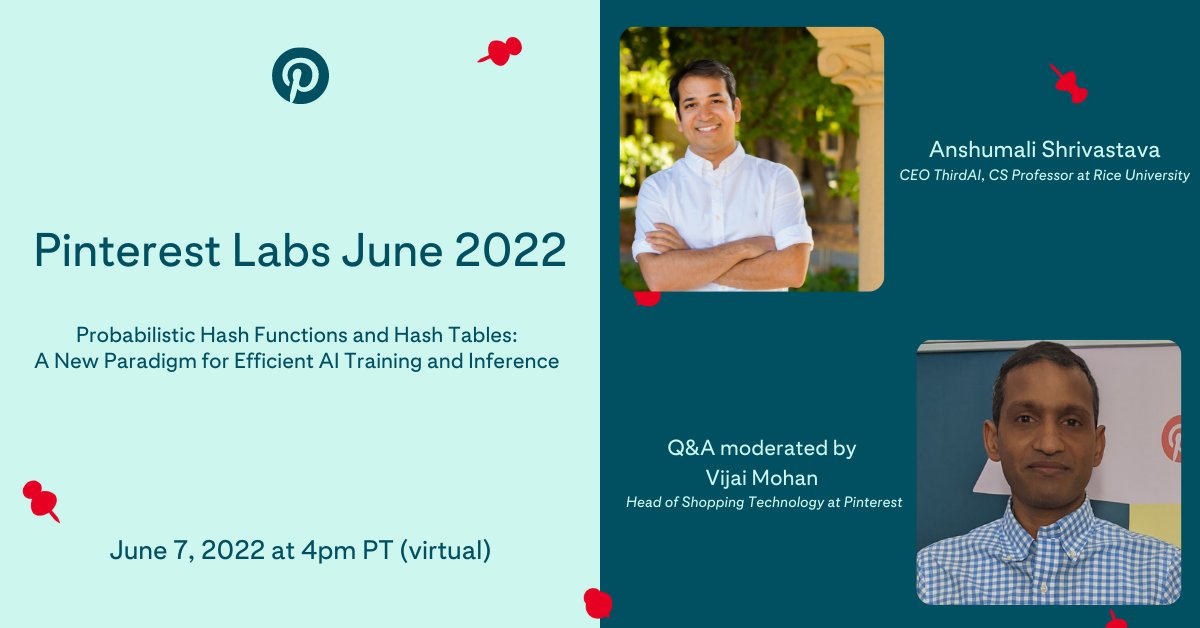
Join us June 7th for a Pinterest Labs Tech Talk! Our guest speaker, @Anshumali_ Shrivastava, will be giving a talk on Probabilistic Hash Functions and Hash Tables: A New Paradigm for Efficient AI Training and Inference. RSVP and learn more here: https://t.co/wX6lRdSXKM