LIBROS FUNDAMENTALES
A veces los lectores me piden que les recomiende libros de formación católica. He aquí los que considero fundamentales:
- Para empezar: “La fe explicada” (Leo J. Trese).
- Teología: “Manual de teología dogmática” (Ludwig Ott).
- Filosofía: “Curso elemental de filosofía” (Rafael Gambra).
- Mística: “Las tres edades de la vida interior” (Réginald Garrigou-Lagrange).
- Moral: “Teología moral para seglares” (Antonio Royo Marín).
- Biblia: Versión de Mons. Straubinger.
- Documentos del Magisterio: “La fe de la Iglesia católica” (Justo Collantes).
- Doctrina Social de la Iglesia: “La cuestión social” (Johannes Messner).
- Historia: “Historia de la Iglesia católica” (B. Llorca y R. García-Villoslada).
- Tomismo: “Diccionario teológico de santo Tomás” (José A. Martínez Puche).
- Agustinismo: “Nos hiciste, Señor, para ti: Kempis agustiniano” (San Agustín - compilación de ideas).
I am going to tell you about the single strongest predictor of heart attack that your doctor has probably never mentioned.
It is not LDL. It is not ApoB. It is not total cholesterol.
It is the ratio of your triglycerides to your HDL.
In 1997, Gaziano published in Circulation that this one ratio predicted a 16 fold increase in myocardial infarction in patients with no prior history of heart disease. Sixteen fold. No other lipid marker comes close (Gaziano, Circulation 1997).
So why has your doctor never brought it up? Because there is no drug to sell you.
No hace tanto nos encerraron, dejaron morir a muchos sin permitir despedirse de ellos, nos acosaron en el trabajo, nos señalaron, coaccionaron de mil maneras para vacunarse, y algunos de ellos pretenden pasar por amantes de la libertad. Un recuerdo a todos aquellos hijos de puta.
Melanoma was a rare disease within living memory. In 1935 an American's lifetime risk was one in 1,500. It is now about one in 33.
The sun has not changed.
Not better detection either. The dermatologist who published the 1,800 per cent rise went out of his way to rule that out, because the death rate was climbing alongside it.
Not a failure to cover up. Sunscreen went from nothing to a global industry across the exact century melanoma exploded.
Not sun exposure. A cancer registry across four Nordic countries and Australia found more melanoma in office workers than in the men who spent their working lives outdoors.
So something changed inside the skin rather than above it.
The omega-6 in American body fat went from 9 per cent in 1959 to 21 per cent by 2008, tracking the soybean oil supply almost exactly. That fat turns over on a half-life of roughly two years, so the skin you burned this summer was built out of the oil in your kitchen two summers ago.
And sunburn is an inflammatory reaction. The fuel for it is the omega-6 sitting in your cell membranes when the light lands.
Which is why four grams of omega-3 a day let volunteers take 36 per cent more UV before they burned, in a double-blind trial. Why fish oil cut the inflammatory signal in irradiated human skin by more than 60 per cent. Why mice fed seed oil burned worse than mice fed omega-3 under the same lamp.
It is also why my inbox fills up every June. People two and three years into carnivore, fair-skinned, no cream, hours outside, telling me they come in pink now instead of scalded. I stopped burning somewhere in year two and assumed I had imagined it. Thousands of people reporting the same change, in the exact direction the mechanism predicts, is not a coincidence. It is data nobody has bothered to collect.
The trial nobody wants to fund is two groups, one lamp, one kitchen running on sunflower oil and one on butter.
Fifty years of advice about what to put on your skin. Not one word about what you built it from.
Hoy se vuelve a poner El Mundo por Montera el profesor Damián Galerón para charlar sobre el llamado “aviso” anunciado en Garabandal. No se lo pierdan.
“El Aviso de Garabandal o el colapso del futuro”. Hoy, a partir de las 23h. https://t.co/8ynlWY7nvJ
Kim Dotcom knows what it’s like to be spied on. He’s a hacker, and therefore an expert on digital surveillance. He watched our new docuseries on internet privacy, so we invited him to talk to us. What followed was very dark. Watch:
@dejanirasilveir ella voluntaria ¿no? los demás ya elegimos por nosotros mismos. se llama empatía suicida. algún día habrá que dar un golpe encima de la mesa y acabar con estos nazis.
@Gsnchez ¿Cuándo se darán cuenta las empresas que uno de Recursos Humanos no está capacitado para seleccionar a los mejores Tech? Lo único que son capaces es de hacerlo al revés. :D
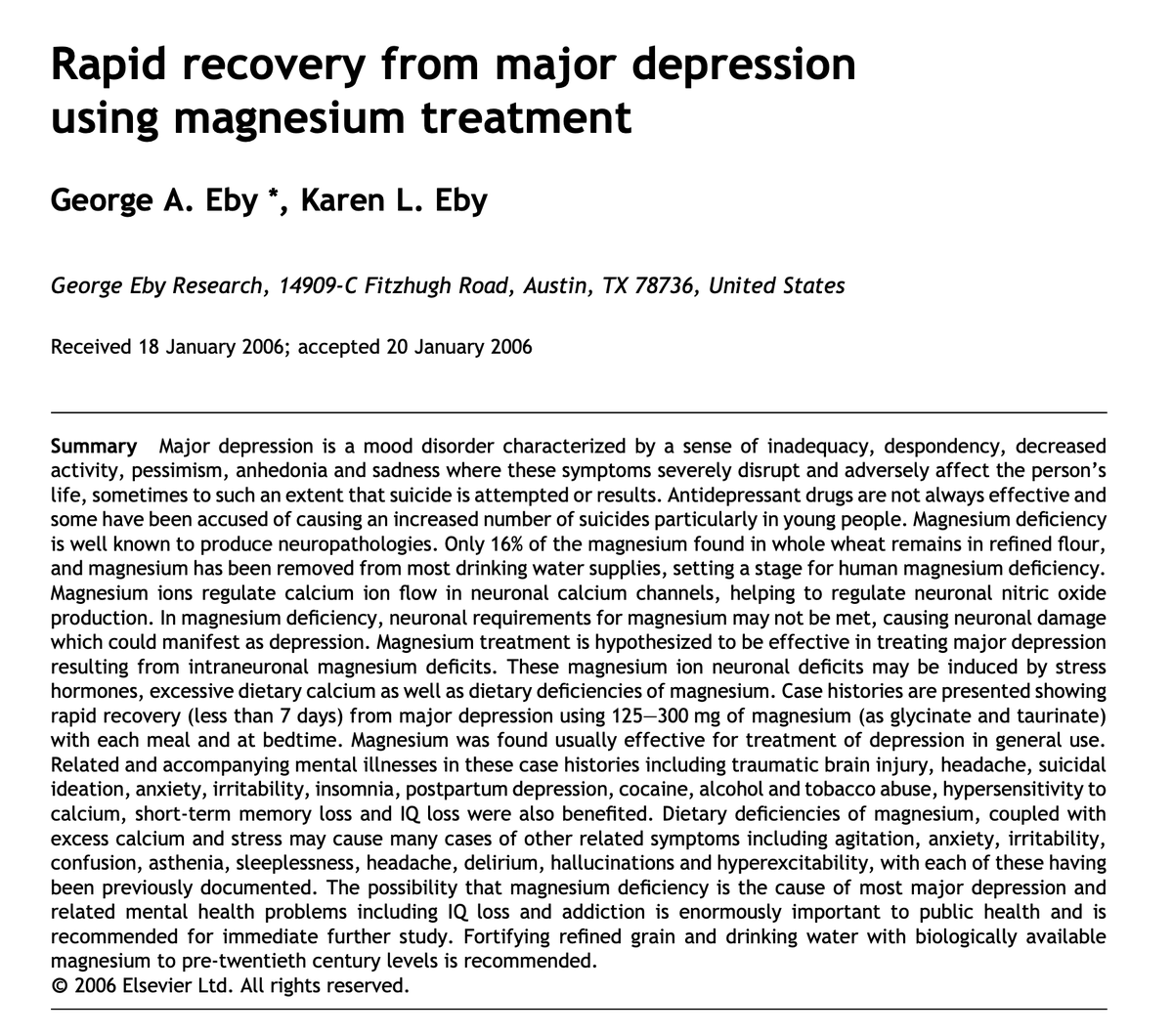
Magnesium rapidly reverses depression - case series.
Multiple people who had chronic depression recovered within 7 days.
125-300 mg of magnesium (as glycinate or taurate) has broad spectrum benefits to mental health, benefitting:
• Brain injury
• Headache
• Suicidal ideation
• Anxiety
• Irritability
• Insomnia
• Postpartum depression
• Drug abuse
• Short-term memory loss
• IQ loss
Magnesium stores become depleted with chronic stress, a major hallmark of depression.
It acts as a calming factor in brain cells, preventing excess excitation, energy failure and cell death common in these conditions by antagonizing the effects of calcium.
@XSalaimartin@FerDiners Els economistes sou especialistes en predir el passat. No conec a cap fiable per predir el futur. Així que no crec que siguis el més adequat per retreure a un generador de text probabilístic quelcom que ni tu saps fer bé.
Linoleic acid is the whole argument, so here is how much of it was in whatever you cooked with this morning, and why the lower number is always the better fat.
- Safflower oil: 75%
- Sunflower oil: 65%
- Corn oil: 54%
- Soybean oil: 51%
- Rapeseed oil: 19%
- Olive oil: 10%
- Lard: 10%
- Beef tallow: 3%
- Butter: 2%
Read that as a stability ranking, because that is what it is.
Fat breaks at the double bond. That is the only place it can break. A saturated fat has none, which is why butter and dripping will sit in a hot pan and do nothing interesting. Oleic acid, the bulk of olive oil, has one. Linoleic acid has two, and two is not simply twice as fragile, because oxidation is a chain reaction: one broken bond throws off a radical that goes and breaks the molecule next to it, which breaks the next, and it runs until something stops it.
In a pan, that is aldehydes. Heat, oxygen and time, and the more double bonds in the pan the more of them you make. Sunflower oil produces them in quantities well beyond international safety limits at ordinary shallow-frying temperatures. Butter, olive oil and lard produce a fraction of the same, because there is almost nothing in them to break.
Cold, it still happens, only slower. In the bottle on the shelf. In your cell membranes, which get built out of whichever fatty acids turned up. In the fat under your skin, where linoleic acid has a half-life of around 680 days and oxidises the entire time it is sitting there.
Fine, concede it, linoleic acid is essential. The requirement is somewhere around one to two per cent of calories, and genuine deficiency has effectively never been recorded in a free-living adult, because arranging it is almost impossible. Sunflower oil delivers sixty-five.
Vitamin A is essential too. Nobody has suggested a pint of it.
@Snz_BTC NO OS FIÉIS DE UN TERCERO PARA GENERAR ALEATOREIDAD. Es muy sencillo generar algo que se parezca y no lo sea. Los incentivos económicos son demasiado apetitosos para confiar que NINGÚN fabricante sea confiable.