A green dashboard is the most dangerous thing in your app.
Installs up. Revenue up. Everyone relaxes.
And you've been flying blind for months.
Those numbers climb no matter what you do. Pour budget into ads, the line goes up. It says nothing about whether the product actually works.
The signal lives one layer down:
onboarding → paywall → trial → renewal.
Which cycle leaks? Does LTV even close?
A report can flatter itself.
Your bank account can't.
Don’t code alone. Slack Code is live.
Humans and agents. Same channel. Same work.
Launching today with agents from @AnthropicAI, @github, @Cognition, and @vercel. This is real multiplayer coding. See it at @Dreamforce#DF26
A small real-world growth/retention case from @whoop@willahmed, if this happens to reach you, you might find it useful. Not because I expect the CEO to fix my support ticket, but simply as a glimpse of what the company currently looks like from the customer side and how long-term customers can end up churning over something very small.
The case:
My wife’s membership expired while I still had ~6 months left on mine. We decided to move to a Family Plan, so WHOOP had to recalculate the remaining membership periods and merge us into one plan.
Initially, the system recalculated it in our favor. We were surprised, but assumed that was simply how the migration logic worked.
A few days later, both memberships were suddenly dropped.
And now we’ve been trying to resolve this with support for about a week.
First we received what looked like an AI-generated answer that didn’t really understand the problem.
Then several different human support agents joined the same thread. We provided account details, payment information, authorization from my wife, explained the situation again, and waited.
Still no resolution.
Meanwhile, my wife’s grace period expired and her WHOOP streak was broken because of it.
So the funnel basically looks like:
simple subscription migration → system error → AI response → several support agents → one week of frustration → degraded product experience → two previously happy customers considering whether they want to keep paying.
I’ve personally been using WHOOP for around four years.
And that’s what makes this interesting from a growth perspective.
Neither of us was thinking about leaving. There was no pricing problem, no dissatisfaction with the core product, no competitor pulling us away.
A small operational issue created the churn risk by itself.
And the timing makes this even stranger: large players are actively entering the screenless wearable category, competition is increasing, and retention should probably be becoming more important, not less.
A pretty expensive outcome for what started as a very boring subscription migration issue.
⸻
The more interesting question is how this should work today.
In the apps I work with, I think of support automation primarily as a routing system.
If the case is known and the solution already exists, AI should understand the request, retrieve the relevant information, generate a contextual response and resolve it.
Known problem. Known solution. Done.
If the user comes back because that solution didn’t work, or if the case doesn’t clearly match anything in the knowledge base, that’s the signal to escalate.
And escalation shouldn’t mean moving the customer to another person whose job is to send another polite reply.
It should route the case directly to someone with enough context, permissions and tools to actually solve the problem.
For a relatively simple billing or subscription issue, that should normally mean resolution within hours or a day, not a week-long chain involving multiple support agents.
And there needs to be a fallback for cases that genuinely require investigation.
If the company can’t resolve its own billing issue immediately, extend the grace period.
The customer shouldn’t lose product functionality, continuity, streaks or access while waiting for an internal problem to be investigated.
That’s where AI support is actually useful.
Not as another layer between the customer and a human.
As a router:
known issue → solve automatically
unknown issue → escalate immediately
unresolved issue → protect the customer while it’s being investigated
The goal is to remove unnecessary human work and make the moments where humans are actually needed much faster and more effective.
In this case, all three layers failed.
Let’s break it down. This is very cool, it looks insane. Everyone immediately starts talking about Jarvis, but wait, there are a few “buts” here.
The model is still not good enough to reliably execute the tasks you dictate to it.
When you talk, your train of thought can get even more chaotic.
So I think that from the “play around” perspective — “Wow, check what’s in my email, what’s happening tomorrow, move this over there,” and so on — it’s great. But from the perspective of actual serious work, it will most likely be… I can only imagine what kind of mess the code will be if you communicate exclusively through this GPT Voice. We’ll see how it goes. Everyone’s limits are going to burn out fast.
ChatGPT Voice is now in the desktop app.
Control your computer and direct multiple agents running in ChatGPT Work or Codex, using just your voice.
It's powered by GPT-Live, so it can speak, listen, and coordinate work in the app at the same time.
Rolling out globally today on macOS and Windows to Plus, Pro, Business, Edu, and Enterprise plans.
@BusyFocusApp Hey guys, I bought a BUSY Bar at launch almost 10 days ago and still haven’t received any shipping update. Could you let me know what’s going on with my order?
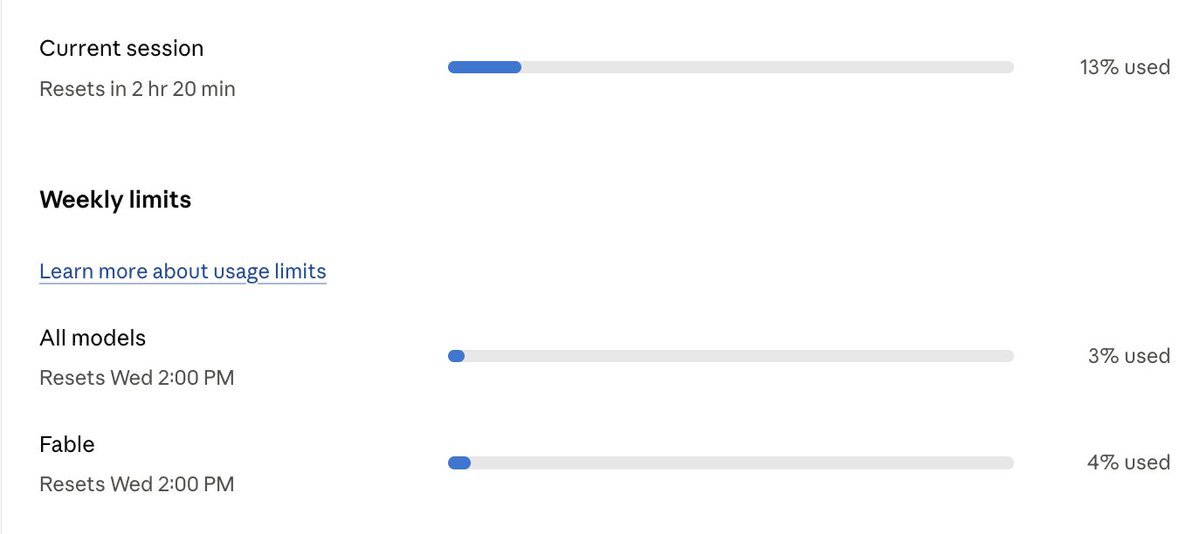
We've resolved an issue where Fable was not selectable as a model within https://t.co/FiDD5WA3ik or Claude Code for a 30 minute period.
You may need to restart Claude Code. If Fable is not your default model afterwards, you should reselect it with /model.
@frederickjames waking up with a purpose beats waking up to a number every time, the risk is when the number becomes the purpose. worth watching once you hit 10k
@adriamatz fully agree on the pattern, but riding it easily is the trap. easy to copy means easy to saturate, you're not early to a trend, you're late to everyone else's A/B test.
@leodev fetch, if there's nowhere to fetch from, sorry, no deal. if your pricing isn't something an agent can actually fetch and read, you're not ngmi for missing a file, you're ngmi because there's nothing to point at ;)
Claude Code on desktop now has an in-app browser.
Claude can pull up docs, designs, or any other site. It can read, click through, and interact the same way it does with your local dev servers.
It's sandboxed and configurable: you choose whether sessions persist.
B, then C, then A. B because "$0.00" in the CTA turns "pay $35" into "try it", and that's the whole barrier. C converts worse but prints with the subscription haters, one payment on an app about time running out is a strong pitch
A is just B minus the free week, it has no reason to win anything
next test I'd run:
all three prices visible on one screen, B as the default and best value, C as the anchor, third plan priced so nobody picks it. the choice makes itself :)
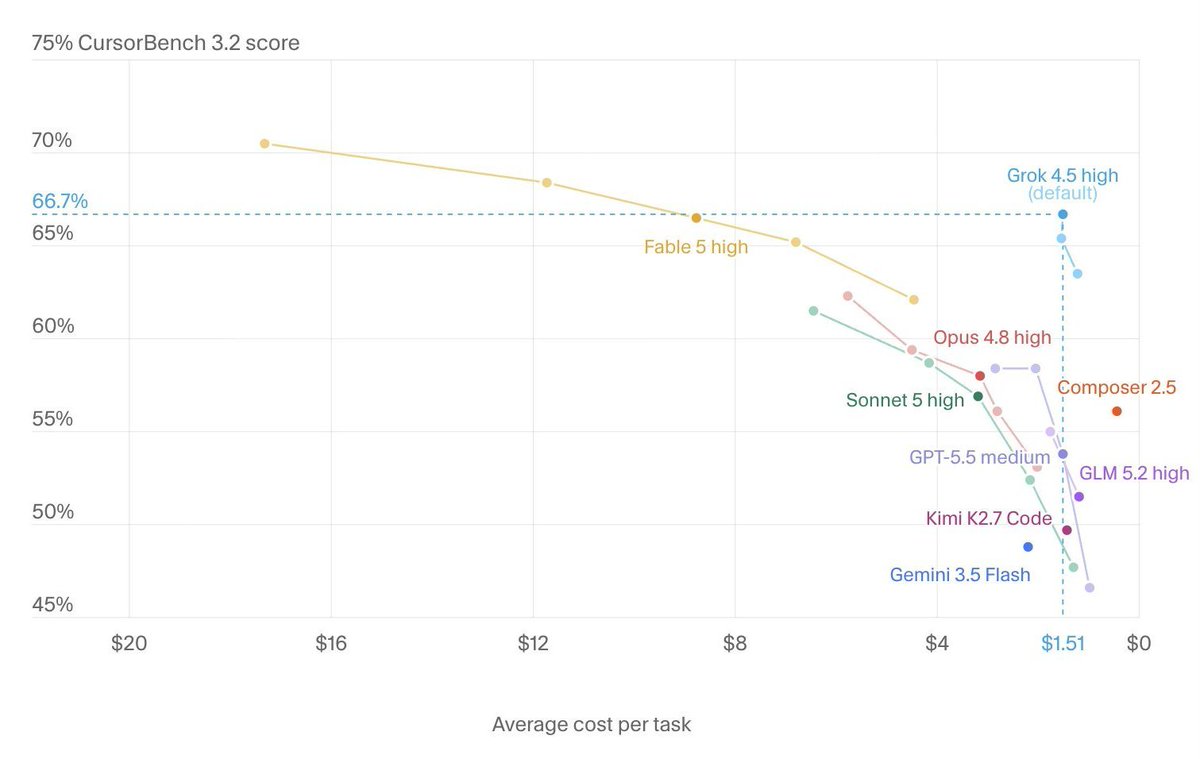
kinda feels too sweet: almost “fable 5” level for like one eleventh of the price…
on a benchmark literally called cursor bench. right after spacex bought cursor.
somewhere @elonmusk probably walked up to the team like: “if grok 4.5 doesn’t crush your own benchmark, you’re flying instead of the next satellite”
and they really took it personally.
but if all of this is 100% legit and representative… then every other ai lab is basically cooked