PUBLIC MONEY IS NOT EXECUTIVE PROPERTY: THE CONSTITUTIONAL TRUTH ABOUT CHAPTER TWELVE
Fellow Kenyans,
The bottom line of Chapter Twelve is simple: the Executive DOES NOT own public money, THE PEOPLE do.
Our 2010 Constitution intentionally strips the President and Cabinet of unchecked power over your taxes through six strict principles:
1) People Own the Funds: Government only administers public money; it never owns it.
2) Parliament Approves Spending: The Executive cannot spend a single shilling without explicit parliamentary authority.
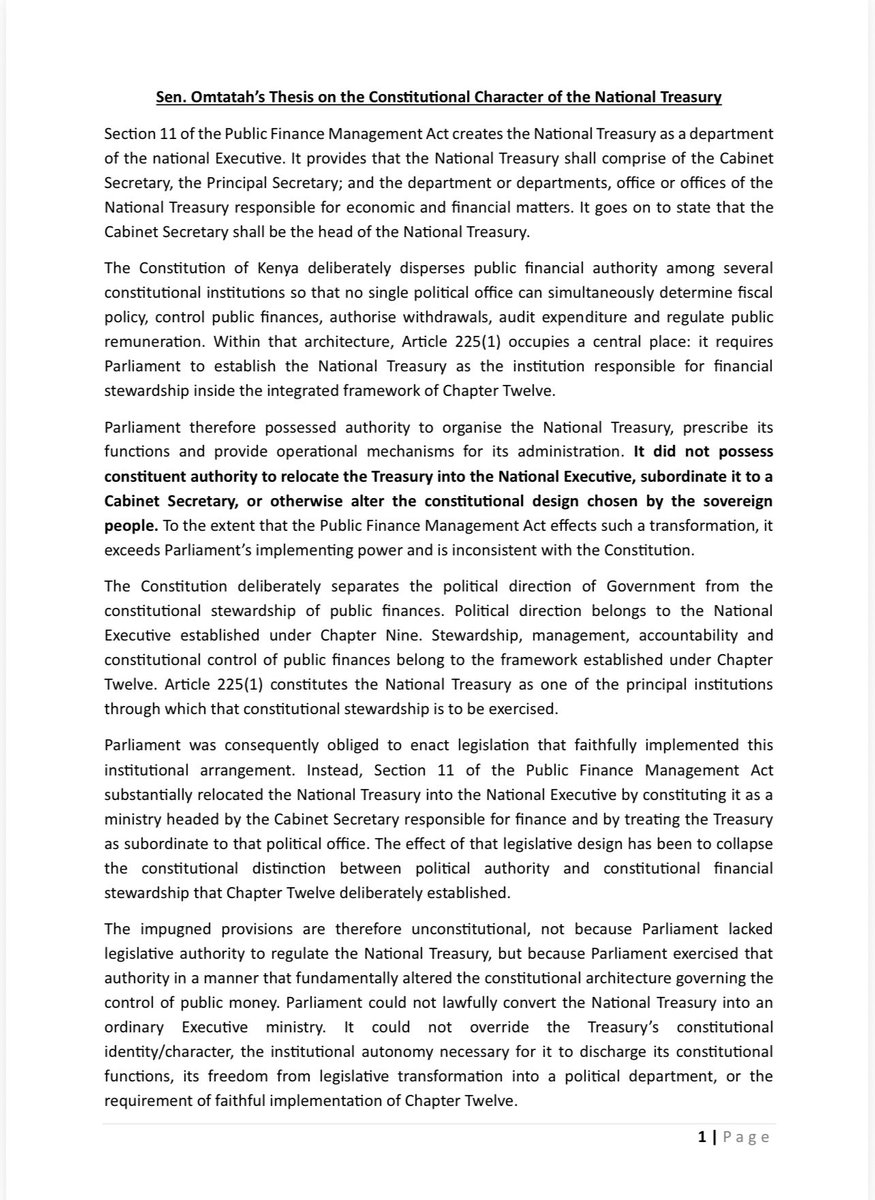
3) The Treasury is Independent: Under Article 225, the Treasury is an autonomous custodian, not a political department subordinate to the Executive.
4) Independent Oversight: The CRA, Controller of Budget, and Auditor-General ensure no single entity controls the financial chain.
5) Personal Liability for Looting: Under Article 226(5), any official who directs unlawful spending must pay it back from their own pocket, even after leaving office.
6) No Free-For-All Borrowing: Debt is strictly tied to legitimate budget deficits, not executive whims.
The power of the purse belongs to the people, not the Executive. We must defend our Constitution! #ReKe #GetitDone #KnowYourConstitution #ConstitutionKe2010
https://t.co/THmleX3KBq
FELLOW KENYANS, THE CONSTITUTION IS UNDER SIEGE! 🇰🇪
Our Constitution was designed with one clear principle. No single political office should have unchecked control over public money. That is why it separates political leadership from the management of the country’s finances.
Article 225(1) establishes the National Treasury as the constitutional custodian of public finances. Its role is too important to be left to politics alone.
Yet Section 11 of the Public Finance Management Act places the National Treasury under the National Executive and under the authority of a political Cabinet Secretary.
This is not a small legal issue. It goes to the heart of constitutional governance.
Parliament has the power to make laws that implement the Constitution. It does not have the power to change the Constitution through an ordinary Act of Parliament.
When the independence of public financial management is weakened, the checks that protect taxpayers’ money are weakened too.
The Constitution must remain above politics. Every law passed by Parliament must respect it.
If we fail to defend Chapter Twelve today, we risk eroding one of the most important safeguards for accountability and responsible use of public resources.
The Constitution belongs to all of us. Defending it is a duty we all share.
The promise that university will now be free for all sounds like progress but when it comes months to an election, after years of complaints about a broken funding model, Kenyans are entitled to ask, is this policy or politics?
For years, universities have been running on deficits, students have been locked out or saddled with loans, and the new student‑centred funding model has left families choosing courses they can afford rather than those they qualify for. Half of public universities are already potentially insolvent, and HELB can fund barely a fifth of first‑years under current allocations.
If the State could not sustainably fund the existing model, how does it suddenly find resources to fully fund every KUCCPS‑placed student without a clear legal framework, costed plan and honest conversation about trade‑offs in health, housing and other services? A constitutional government must not dangle free rights as campaign bait while hiding the fiscal maths from the very citizens expected to pay the bill.
I stand with students, parents, lecturers and workers who want real reform, not last‑minute promises. We demand transparent costings tabled in Parliament, a credible financing law, and guarantees that any move towards universal higher‑education funding will not collapse already struggling institutions or deepen inequality between those in public and private universities.
Free, quality university education is a legitimate aspiration but it must be built openly, sustainably and with citizens at the centre, not announced from a rally podium as a political surprise. Kenyans deserve more than applause lines, they deserve a plan.
First it was the unmarked cars during the protests, then Malava, now Ol Kalou. The script is always the same: mask up, use cloned plates, terrorize citizens, and then issue a PR statement promising "investigations". We are tired of the gaslighting.
Chants of “Wantam” and “Ruto Must Go” ring across Nairobi CBD as football fans gathered for the FIFA World Cup Final between Spain and Argentina use the public viewing event to express dissatisfaction with President William Ruto’s regime ahead of the 2027 General Election.
I keep saying this. Anyone with a payslip has no business voting for Ruto!
You have a personal reason not to. He has stolen part of your pay to enrich himself and his cronies in the pretext of building affordable houses which you and me can’t even afford to buy
One year since 12-year-old Bridgit Njoki Wainaina was shot and killed inside her own home during the 2025 Saba Saba protests, her family is still asking the most basic question in any constitutional democracy. Who pulled the trigger, and who will be held to account?
I stand with Bridgit’s family, friends, classmates and every victim of police brutality whose pain has been normalised and whose cases have been delayed, diluted or ignored. Never again shall Kenyans be killed by trigger-happy officers for expressing their rights on the streets.
The Constitution does not permit stray bullets and unknown officers. It demands truth, individual responsibility and institutional reform. Our duty is to defend the right to life, to peaceful assembly and to equal protection of the law, especially for children who should be safest in their homes.
I call upon the IG, IPOA and the ODPP. Account for every life lost during the protests, publish the status of all investigations involving police killings, and prioritise charges against officers implicated in excessive and lethal force. Justice for Bridgit is justice for every Kenyan who has paid with blood for daring to speak.
To Bridgit’s family, you are not alone. We will continue to memorialise her and insist that reparations for victims carry the same weight as consequences for perpetrators. Kenya must choose, impunity or a future where no parent has to bury a child because an officer treated a protest as war.
These men terrorised Ol Kalou residents for weeks,
On voting day, they upscaled their terror - they walked with firearms, branding them.
They had firearms, pistols, tear gas, tasers.
They handcuffed people, attacked citizens, voters, and targeted journalists.
#TheOlKalouCrimeScene @Karanja_Ibrah