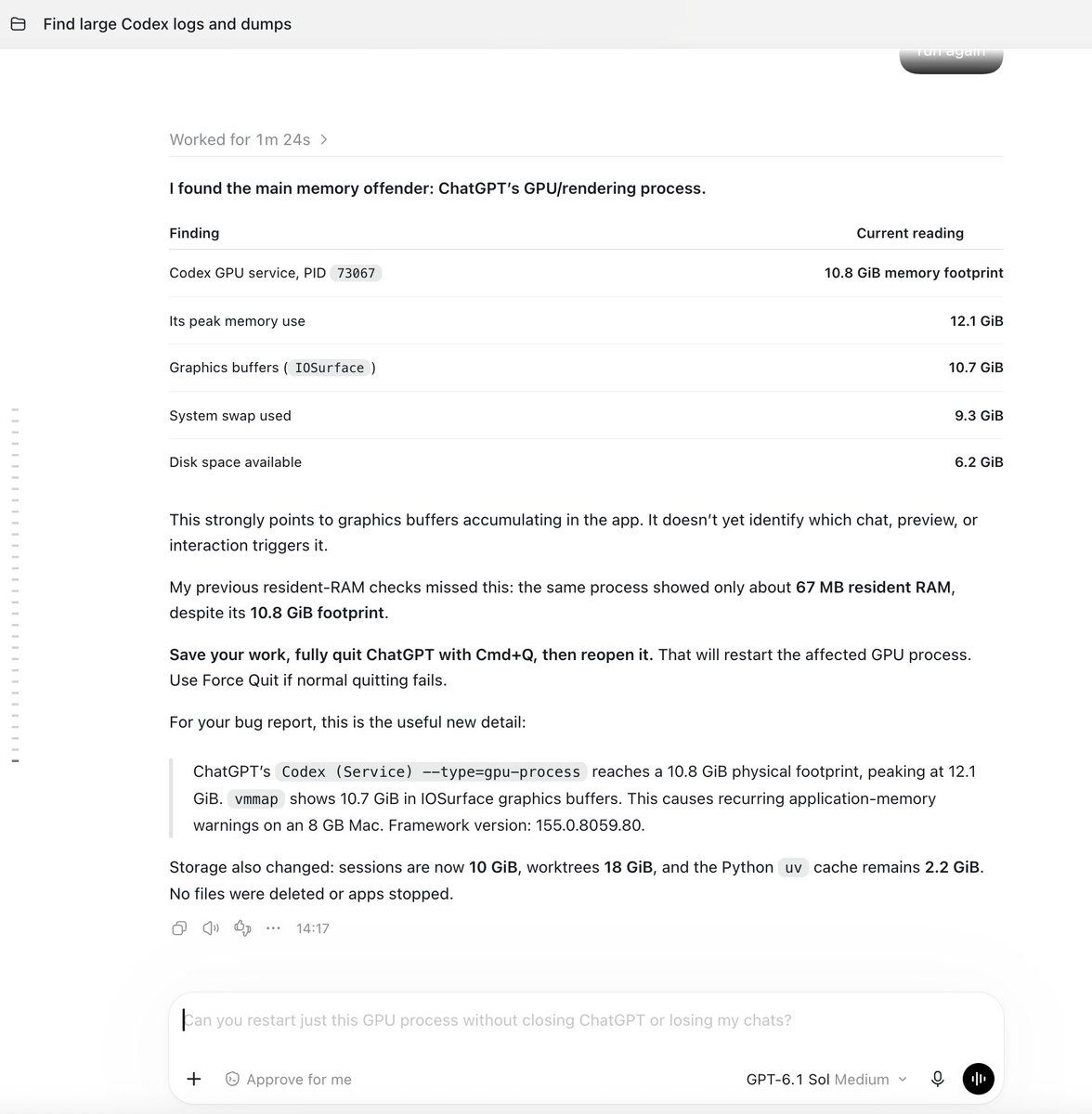
Something seems off with the ChatGPT macOS app. It keeps crashing my system, with reported memory usage reaching 40+ GB...
I even had Codex diagnose it, but still unsure of a permanent fix. A memory leak?
@OpenAI@thsottiaux@OpenAIDevs could someone take a look? Happy to share more details with the right support team.
I built an AI agent to manage my other agents. For simple tasks, it made things worse.
The pitch is appealing: talk to one agent, and it manages the rest. Grok’s “Chief of Staff” bots point the same way. Today, using several AI tools makes you the project manager: explaining the task, carrying information between tools, checking the result.
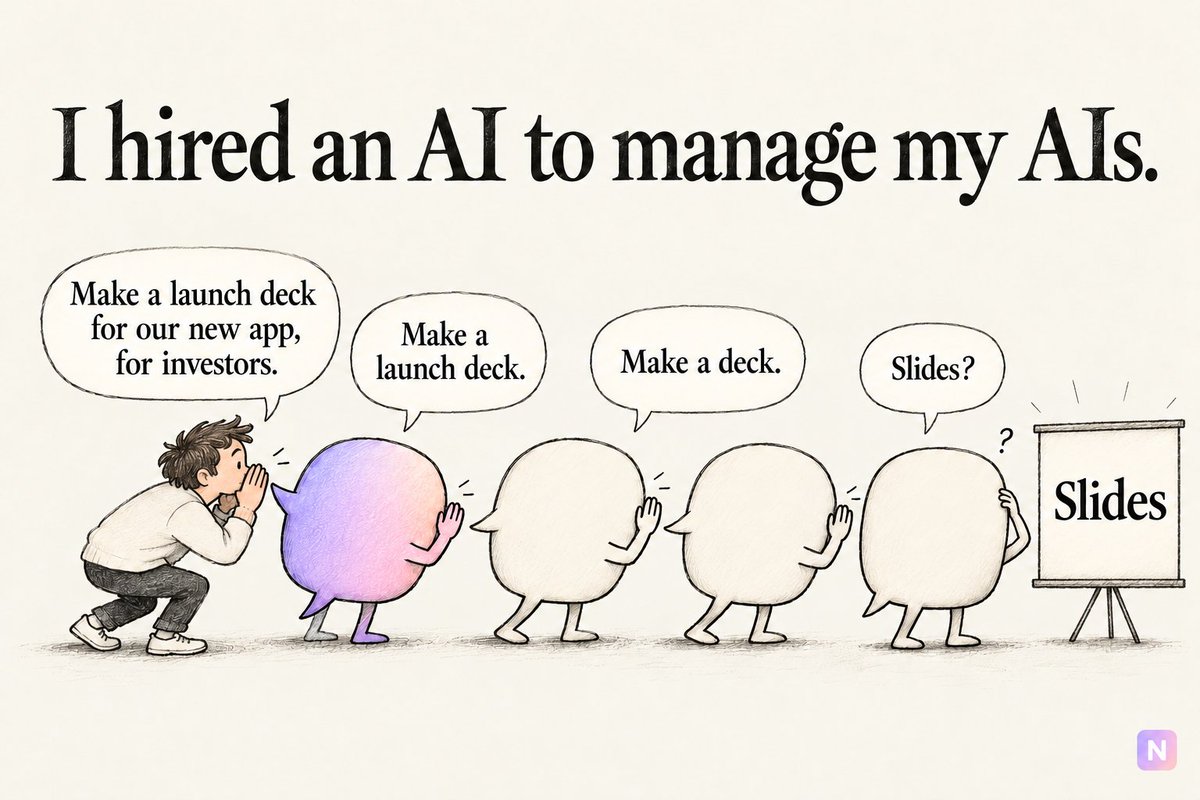
A general purpose bot doing tasks for you is different from a 'coordinating' agent delegating to other specialist agents. Delegation brings a new problem: CONTEXT LOSS. Every handoff is a summary of your request, and a summary is never quite the request.
At https://t.co/LPki0FJ9i6, I built one. A coordinating agent, Niki, briefs specialist agents for slides, forms and design. Then I measured it.
For a single deck, it lost. Going through Niki was slower and cost more, and the copy came out weaker than asking the Slides agent directly. It’s why, for real work, I still go straight to specialists like Codex and Claude.
For work with several parts, it performed better. A campaign needs a deck, a form and a poster that all say the same thing. That’s when coordination is the job.
And its best job was checking. The Slides agent finished a slide and approved its own work. Niki compared it to my request, saw the requested copy was missing, and sent it back.
What I’d take from it:
• Single task? Go straight to the specialist.
• Several parts that must agree? Use a manager that holds your context well.
• Judge the manager by how well it checks the whole result, not just by how much it delegates.
The future may be one agent you talk to. But behind it, specialists will still do the work, and someone has to own the outcome.
What would you hand to an AI manager and what would you always want brought back to you...
#AIAgents #FutureOfWork #ProductManagement
What makes an AI agent’s output better?
To Solve the quality issue on my Slides agent, I came back to a consulting habit: BREAK DOWN THE PROBLEM.
The early decks from my Slides Agent in https://t.co/LPki0FJ9i6 looked tidy but read thin. “Make a better presentation” left too many decisions undefined.
So I broke the guidance into:
• Research: what needs evidence, and what is unknown?
• Framework: is this a pitch, a comparison or a before-and-after story?
• Audience: what does the reader need to decide?
• Each slide: what question does it answer?
• Layout: which arrangement explains the content?
• Copy: what detail makes the point clear?
• Facts: what came from the brief, research or calculation? What is only an example?
• Design: do fonts, colours and spacing hold together?
The lesson carries beyond presentations: if you’re building an agent, take an output you know how to judge and write down why you’d send it back. Those reasons are useful guidance and checks for the next attempt.
The Anthropic deck here shows how that’s coming together. From a short brief, the agent researches the topic and builds an editable presentation beside the chat.
That’s where experience doing the work helps you build a better agent.
Hi,
Tomorrow we are re-opening the Pro $200 subscriptions to new subscribers, but together with it we are also changing how we calculate the usage for it. In effect, if you do the math, it will net out at half the dollar in API spend compared to the old Pro $200 plan.
Now that it's said, let me explain why this is happening and why you will still get more work done than if you were on the Pro $200 subscription one month ago.
(a) We didn't want to compromise in other ways and are committing to not reintroducing the 5h limit, so that you can fully use the weekly usage when you want.
(b) On the subscription, we guarantee that over time you always get more work done and with an increasing level of quality. This means that you will continue to get more value per dollar spent as a result of models getting more efficient and us passing down the improvements in the form of API price reductions.
(c) We don't want to put an incentive on ourselves to artificially inflate the API list prices to make it look like you are getting a lot (and workaround it through discounts, etc). Instead we want to continue to both rapidly reduce prices and increase capabilities of models on the API. This week we introduced GPT-6 Sol and GPT-6 Luna at 50% of their previous price. Over time, we see prices go low enough that it makes sense for most to buy usage as needed without there being a significant gap between what you get in a subscription and what you get in the API for a dollar spent.
(d) Tomorrow, we are adding more things to the subscription that won't draw on the usage, I won't reveal what that is yet.
I wanted to be transparent before all the big announcements tomorrow. Lots of new exciting things are coming to the subscriptions that will make it super compelling, but I wanted to make sure to share this change ahead of time so you can all understand it before we shower you with good news.
Codexingly,
Tibo
A new AI model is getting attention for something odd: it doesn't write a single sentence. It's called Jev.
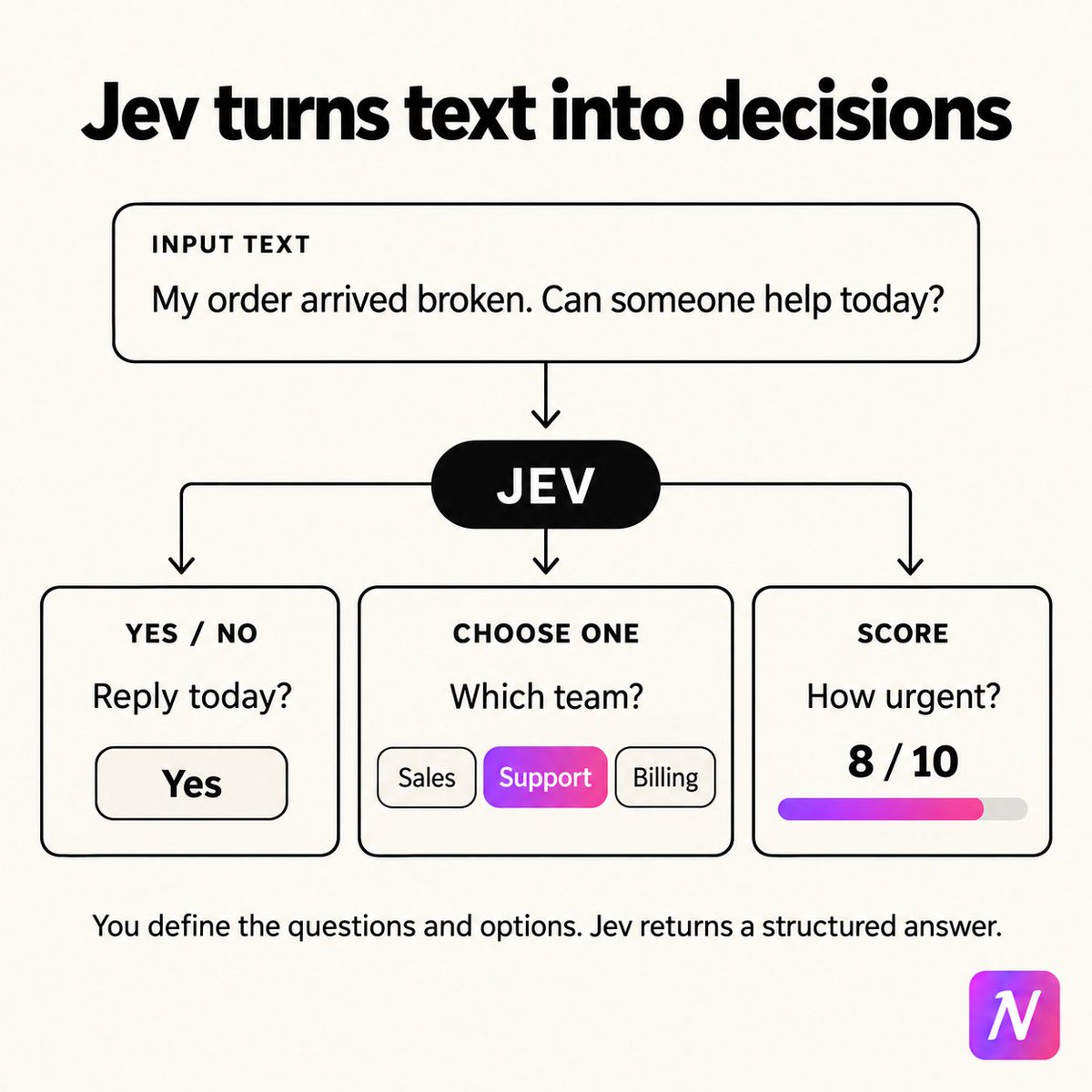
The large language models we use usually write a response. Jev returns a decision.
Say a customer writes: “My order arrived broken. Can someone help today?” You give Jev that message and a few questions with set answers. An illustrative result:
- Needs a human now? → Yes
- Which team: Sales, Support or Billing? → Support
- How urgent, from 1 to 10? → 8
It also tells you how confident it is. It won't write the reply or invent a team you didn't offer.
That narrow job makes it fast. TypeSafe, the company behind it, reports answers in 70 to 500 milliseconds, at a fraction of the cost of chat models on these tasks.
Builders are already trying it for:
- A voice-controlled browser: your speech becomes text, Jev picks from the actions on the page, and the browser clicks.
- Inbox sorting: is this urgent, and who should handle it?
- Ad ideas: which hooks are worth a closer look?
- Model selection: does this task need the bigger, more expensive model?
In Niki Studio, I'd test it on two small choices: which skill the Design agent should load (a social post, a product launch or a wedding invitation), and which layout each slide should use. I haven't tested it there yet.
Jev doesn't replace the model doing the creative work. It could handle the small choices between steps. We still have to define those choices well and decide what happens when it isn't sure.
What interests me most is the direction. After years of making AI better at writing, there's still room to make one useful by asking it not to write at all.
What's one decision in your work that's really just multiple choice?
#AIAgents #Jev #AI
How much of your job would an AI need to do before you called it AGI?
Computer use got very real this year. Agents now open your apps, click the buttons and move through websites almost like you do. Pair that with voice, and I won't be surprised if we barely touch our keyboards by next year.
Companies are building this in different ways.
Codex and Claude have their own browsers inside the app, and they can also work in your Chrome.
Grok Bot and Meta's Muse go a step further. They give agents their own cloud computers, so the agent can use apps and keep working after you close the chat.
Then there's Jev, a new model that looks very promising for computer use because it's small, fast and cheap. It doesn't write text like ChatGPT or Claude. It makes quick choices: yes or no, or pick from options like X, Y or Z. That's exactly what an agent needs when deciding which button to click next.
Codex has already changed how I work. I ask it to get my posts ready on LinkedIn and X. It opens the sites, adds the text, uploads the images and stops before Publish so I can check everything.
Watching an agent do work that used to need me at the keyboard sometimes feels like AGI. It still gets stuck, and I still check the result.
So where's your line? 10% of your work? Half? All of it?
Reply with a number. I'm curious how far apart we are.
#AI #AIAgents #FutureOfWork #AGI
At Niki Studio, I built two loop-based design agents. One makes editable designs like Canva; the other builds slides. I tried generating slides as images too, but needed more control over copy and layout. So the Design agent starts with an image model and rebuilds the text as editable layers, while the Slides agent writes HTML/CSS.
This keeps the architectural choice and the editable-layer step that makes it interesting to builders. I haven’t updated the quote yet.