cirBTC is live on @ethereum.
Circle helped establish the institutional standard for dollar collateral with USDC.
Now cirBTC brings that same approach to Bitcoin, bringing 1:1 BTC-backed collateral to institutional DeFi markets with neutrality, transparency, and Circle infrastructure.
Arc is next.
https://t.co/tHwIlblsyb
Circle Wrapped Bitcoin is coming.
Backed 1:1 by BTC and readily verifiable onchain, cirBTC is being built to work seamlessly with Circle infrastructure and the broader DeFi ecosystem.
Learn more: https://t.co/wWzVBZdIz1
Momentum is building in internet-native finance, and our Q4 and full year 2025 results show it.
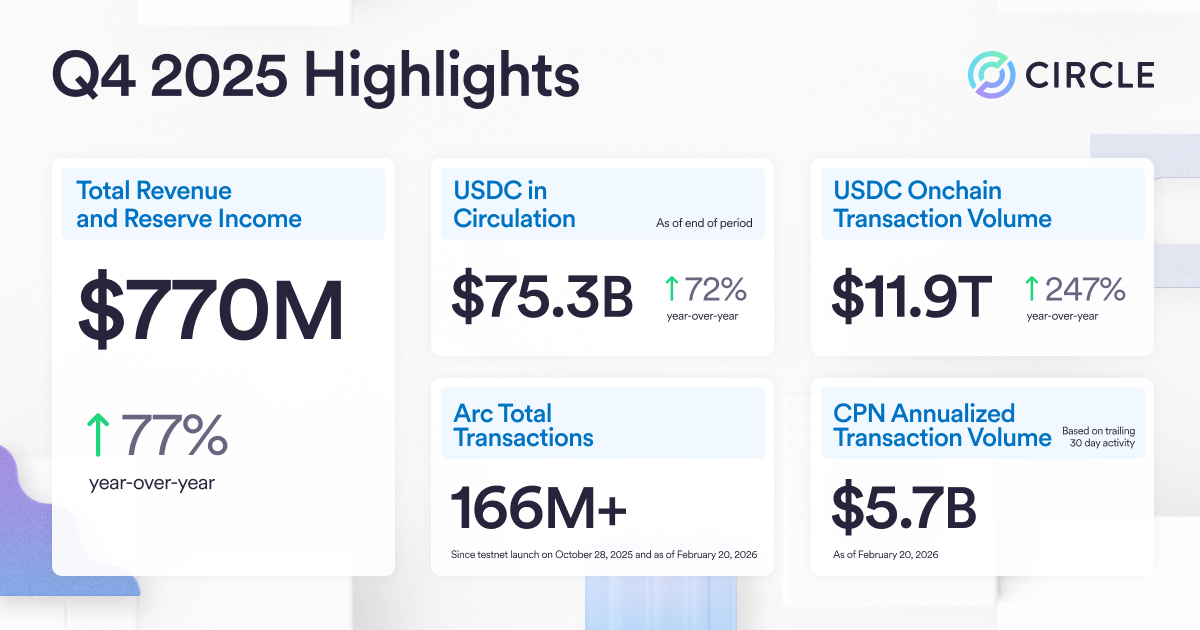
→ $75.3B USDC in circulation (as of end of period), +72% YoY
→ $11.9T in USDC onchain transaction volume, +247% YoY
→ $770M total revenue and reserve income, +77% YoY
Circle is building the Economic OS for the internet, enabling everything from frictionless cross-border payments to a world of emerging possibilities with agentic AI.
Our platform is at the center of this financial transformation.
Full results at https://t.co/v1jSV7zRFs
Arc Public Testnet is now live.
Open to developers and enterprises globally, Arc is the Economic OS for the internet that unites programmable money and onchain innovation with real-world economic activity.
Start building: https://t.co/XmFdy0SG5g
Learn more: https://t.co/JOGsf9Ma5V
Ok, let me try explaining (mostly to myself) what the x402 protocol, launched by Coinbase, means:
✔️ When you type a URL into the browser, your browser ("the client") tries connecting to a server that hosts the website (e.g., Bloomberg). If it successfully connects, the server returns status 200, which means “all good.”
✔️ If you type a wrong URL, the server tells your browser that this page does not exist by returning a 404 error (you’ve definitely seen this one).
✔️ So…the 402 is a new type of response (or rather, it has existed for a long time, but was never used), which means: “hey, the URL exists, but you need to pay for it.”
✔️ If you are a human, you see a paywall and enter your credit card to access the content….
✔️ BUT…if you are a machine (e.g., an AI agent), you actually have no idea that you need to pay. You just get a 200 response, but for a paywall page, not the page that you tried to access.
✔️ 402 solves this issue: it tells you, in a machine-readable way, that accessing the URL requires a payment, and again in a machine-readable way, gives you the accepted payment types (“schemes”).
✔️ The machine can then add payment info and send it back to the server to access the content. I’m not sure it would be cool to send your card details, and a machine can’t have a card anyway…
✔️ BUT…a machine can construct a stablecoin payment: create a signature authorizing the transfer. This is safer than sending card details, because you sign a specific transfer (including the recipient address and the amount), instead of giving general access to your wallet.
✔️ What happens then is the content provider sends it to a Facilitator. You can think of it as a merchant acquirer that processes such requests (collecting signed authorizations and posting them to a blockchain).
✔️ After the payment is processed (“settled”), the machine can access the paid content.
Cool things about it:
✔️ This essentially enables AI agents and similar types of interfaces to pay for things online. There is no need for a human in between.
✔️ It creates a new entity, “Facilitator”, which is a new breed of merchant acquirer (Coinbase launched the protocol and offers such a Facilitator).
✔️ This creates a new use case for stablecoins
SOUNDS FREAKING COOL!!!
@SolNFTs@DeFiTuna@metaplex@MetaplexFndn Coincidence that NFToly shows up and Metaplex goes on an absolute banger run? Yeah, probably. But congrats nonetheless.