HERE IS THE FULL SPACEX $SPCX SHARE UNLOCK TIMELINE
Right now only 4.9% of shares are in the free float.
Here is how that changes over the next 14 months:
Early unlock window (Jul - Dec 2026):
Aug 8: 11.8%
Aug 20: 15.2%
Sep 9: 17.7%
Sep 24: 20.1%
Oct 9: 22.6%
Oct 24: 25.1%
Nov: 27.6% → 37.5%
Dec 8: 40.0%
On Day 366, June 12, 2027: Elon's 46.1% stake becomes eligible ... The free float jumps from 50.8% to 96.9% in a single day.
By September 2027 the float reaches 100%.
A British physiologist named Brett Gooden published a paper in 1994 that quietly proved every human walking around on this planet has an emergency reset button hidden in the skin of their face, and almost nobody knows how to use it.
His name is mostly forgotten outside diving medicine. The paper is called "Mechanism of the Human Diving Response," and the body of research it kicked off has been replicated by neuroscientists, cardiologists, and physiologists in labs across the world for the last thirty years.
The mechanism it described is the single fastest way to lower a human heart rate that has ever been documented.
The discovery actually began long before Gooden formalized it. Physiologists had noticed for decades that seals, whales, dolphins, and otters could slow their heart rates dramatically the moment their faces touched water, allowing them to dive for long periods without running out of oxygen.
The question Gooden helped answer was whether the same reflex existed in humans, and what exactly triggered it.
The answer turned out to be a network of nerves almost nobody outside neurology had paid attention to.
The trigeminal nerve is one of the largest nerves in your head, and it covers the entire surface of your face, especially the area around your eyes, nose, forehead, and mouth. When cold water touches that skin, the trigeminal nerve fires a signal straight into the brainstem, which then routes a command through the vagus nerve directly to the heart.
The vagus nerve is the master switch of your parasympathetic nervous system, which is the part of the body responsible for calm, recovery, and the slowing of the heart.
The entire signal chain takes about a second to complete. Cold water hits the face. Trigeminal nerve fires. Vagus nerve responds. The heart slows.
Human heart rate has been documented to drop anywhere from 5 to over 50 percent during this response, depending on the temperature of the water, how much of the face is covered, and how strongly the person is holding their breath.
In infants the response is so powerful that it has been implicated in cases of Sudden Infant Death Syndrome, because the same reflex that protects a baby underwater can be triggered accidentally by bedding pressed against the face during sleep.
The reflex is called the mammalian dive reflex, and the broader nerve circuit it sits inside is called the trigeminocardiac reflex.
Researchers who study it now consider it the single most powerful autonomic reflex in the human body, which means it is faster and stronger than almost any other automatic response your nervous system is capable of producing.
The detail Gooden zeroed in on is the part that should matter most to anyone who has ever had a panic attack, a racing heart at 3am, or a moment of overwhelming anxiety they could not breathe their way out of.
Two ingredients trigger the response. The water has to be cold, ideally under about 15 degrees Celsius, and it has to touch the area around the forehead, eyes, and nose. The skin of the cheeks and chin alone is not enough.
The receptors that fire the reflex are concentrated in the upper face, which is exactly the part of a seal that hits the water first when it dives. Evolution kept that wiring intact in humans even though we stopped diving for our food a long time ago.
This is why splashing cold water on your face during a moment of panic actually works. It is not psychological. It is not a placebo. You are activating a neurological circuit that has been sitting in your body since before your species walked upright, and the circuit does exactly what it was built to do.
A psychiatrist at Harvard named Marsha Linehan eventually wrote this exact protocol into a dialectical behavior therapy technique she called the cold water dive, which she taught to patients in acute emotional crisis. The instruction was simple.
Fill a bowl with cold water and ice. Hold your breath. Submerge your face from the forehead down to the chin for thirty seconds. Within the first ten seconds, the heart begins to slow. By the time the face comes out of the water, the body has shifted out of fight-or-flight and into the parasympathetic state that makes thinking clearly possible again.
Emergency room physicians have used the same trick to reset abnormal heart rhythms in patients with certain types of tachycardia for decades. They call it the diving reflex maneuver.
A bag of ice water held against the face for fifteen to thirty seconds can convert a runaway heart rhythm back to normal without a single drug being administered.
Same nerve. Same reflex. Same biology your ancestors used to hunt for fish underwater two hundred thousand years ago.
The strangest part of all of this is how few people know it exists. The cold plunge industry has built itself into a billion-dollar movement based on full-body cold exposure, ice baths, and dramatic protocols that require expensive equipment and serious commitment.
But the fastest, most underrated nervous system reset available to a human being requires a sink, a few seconds, and the upper half of your face.
Your nervous system has an emergency brake. You were born holding the handle.
I'm a cardiologist. Something just happened today that I genuinely did not see coming — and it could change the future of preventive medicine more than anything I've written about on this platform.
Midjourney — the AI company that became famous for generating images from text prompts — just announced a medical hardware division and unveiled a working prototype of a full-body scanner unlike anything that's ever existed.
It's called the Midjourney Scanner. And it works like this.
You step into a shallow pool of water. You stand on a platform that slowly descends — about two inches per second — through a ring containing roughly half a million tiny ultrasonic transducers, each the size of a grain of sand. Every one of them acts as both a speaker and a microphone, sending ultrasonic waves through your body from every angle and recording what comes back.
60 seconds later, you step out. The scan is done.
No radiation. No magnets. No claustrophobia. No IV contrast. Just sound, water, and an almost incomprehensible amount of computing power — roughly 2 petaflops processing 17 gigabytes per second of raw acoustic data — reconstructing a 3D map of your entire internal anatomy down to half a millimeter resolution.
Organs. Tissues. Blood vessels. Bones. Muscle. Fat distribution. All segmented by AI in real time.
As a cardiologist who has spent months writing about how the standard screening playbook misses the majority of future heart attacks — this is the technology I've been waiting for without knowing it existed.
Here's why this matters for the future of your heart.
Right now, getting a detailed look inside your cardiovascular system requires either a CT scan (radiation), an MRI (magnets, claustrophobia, 45-60 minutes, $1,000+), or a coronary CT angiogram (radiation, IV contrast, limited availability). These are powerful tools. I order them regularly and they save lives.
But they're reactive. You get them when something is already suspected. They're expensive. They're uncomfortable. And for most people, they happen once — maybe twice — in a lifetime.
Imagine instead: a 60-second scan with no radiation that you could repeat monthly or quarterly. Tracking cardiac structure over time. Watching body composition shift. Detecting changes in organ size, fluid distribution, or vascular architecture before symptoms ever develop. Building a longitudinal dataset of YOUR body that AI can analyze for patterns no single snapshot would reveal.
That's what Midjourney is building toward.
The company plans 50,000 scanners worldwide over six years, with capacity for a billion scans per month. The first location — the "Midjourney Spa" in San Francisco — opens at the end of 2027 with 10 scanners alongside saunas, cold plunges, and a gym. The scan costs a few dollars. The experience is designed to feel like wellness, not medicine.
The technology is built on Butterfly Network's ultrasound-on-chip platform — 40 modules per scanner — combined with Midjourney's own AI segmentation and reconstruction stack. David Holz, the founder, claims the system aims for image quality comparable to MRI in many aspects but at nearly 100x the speed with zero radiation.
Now the caveats — because I'm a physician and the caveats matter enormously.
This is a Gen 1 prototype. About a dozen people have been scanned so far. Current scan time is actually closer to 20 minutes, not 60 seconds — the system is bottlenecked by bandwidth and reconstruction algorithms. The 60-second target is aspirational for future hardware generations.
It is not FDA-cleared for diagnostic use. Midjourney is starting with body composition maps — a category below diagnostic imaging in the regulatory hierarchy. The path from "beautiful 3D body scans" to "clinically validated diagnostic tool that your cardiologist can act on" runs through years of clinical trials, comparative studies against MRI and CT gold standards, and FDA review.
No independent clinical validation has been published. The imaging claims come from Midjourney's own demonstrations. Comparative data against established modalities does not yet exist.
And the privacy implications of full-body internal scans at planetary scale — a billion scans per month — is a conversation that hasn't even started yet.
So I want to be precise. This is not ready for clinical medicine today. It may not be ready for years. Many ambitious medical hardware projects have failed in the gap between prototype and product.
But.
The fact that a working prototype exists — producing real segmented 3D anatomy from sound waves and compute alone — means the physics works. The engineering works. The question is no longer "is this possible" but "how fast can it be validated and scaled."
And if it is validated — if the resolution holds up against MRI, if the AI segmentation proves reliable, if the regulatory path clears — then what we're looking at is the most significant new imaging modality in 50 years.
For my entire career, preventive cardiology has been limited by the fact that seeing inside the body is expensive, slow, uncomfortable, and infrequent. We catch disease late because we image rarely. We image rarely because imaging is hard.
A 60-second, no-radiation, spa-based full-body scan that costs a few dollars would demolish every one of those barriers.
I've written about AI detecting inflamed arteries. About gene editing curing cholesterol. About GLP-1 drugs rewriting metabolic medicine. About cellular reprogramming reversing aging.
This is the missing piece: the ability to see inside every human body, routinely, safely, and affordably — so all of those interventions can be deployed before the disease arrives instead of after.
The company that taught AI to generate images from imagination just built a machine that generates images from the human body.
The future of medicine showed up today from the last place anyone expected.
Tesla and SpaceX over the next few months:
• June 18: CRSP index inclusion for SpaceX. Triggers an estimated $4-7B in forced buying by passive funds.
• June 18: FTSE Russell index inclusion for SpaceX. Triggers an estimated $6-9B in forced buying by passive funds.
• June 26: MSCI index inclusion for SpaceX. Triggers an estimated $3-5B in forced buying by passive funds.
• End of June: HW3 Tesla owners get FSD V14 Light. Expect possible delays.
• July 2: Tesla Q2 vehicle and energy storage delivery report.
• July 6: NASDAQ 100 index inclusion for SpaceX. Triggers an estimated $8-12B in forced buying by passive funds.
• Late July: Tesla Q2 earnings call.
• Early-mid August: SpaceX Q2 earnings call, their first earnings call as a public company.
• 2 trading days after SpaceX's Q2 earnings released: 30% of eligible insider shares unlock (equates to 12% of all outstanding shares).
NOTE: Since only about 40% of all outstanding shares are eligible for early release lockups, that 30% above equates to 12% of all outstanding shares. Elon's shares, board member shares, and some others, are subject to an extended lockup of 366 days. Together, the shares subject to these extended lockup restrictions represent 60% of SpaceX's outstanding shares.
• August 21: 7% of eligible insider shares unlock (equates to 2.8% of all outstanding shares).
• September 10: 7% of eligible insider shares unlock (equates to 2.8% of all outstanding shares).
• September 25: 7% of eligible insider shares unlock (equates to 2.8% of all outstanding shares).
• September: Indexes rebalance. SpaceX will then have a higher weighting in those indexes due to an increase in the public float from insider shares being unlocked. Passive funds would likely need to purchase billions of dollars worth of additional shares to bring their holdings in line with the new index weight.
• October 2: Tesla Q3 vehicle and energy storage delivery report.
• October 12: 7% of eligible insider shares unlock (equates to 2.8% of all outstanding shares).
• October 26: 7% of eligible insider shares unlock (equates to 2.8% of all outstanding shares).
• Late October: Tesla Q3 earnings call.
• Early-mid November: SpaceX Q3 earnings call.
• 2 trading days after SpaceX's Q3 earnings released: 28% of eligible insider shares unlock (equates to 11.2% of all outstanding shares).
• December 9: 7% of eligible insider shares unlock (equates to 2.8% of all outstanding shares).
• December: Indexes rebalance again. SpaceX will then have an even higher weighting in those indexes due to an increase in the public float from insider shares being unlocked. Passive funds would likely need to purchase billions of dollars worth of additional shares to bring their holdings in line with the new index weight.
(The Cursor acquisition will likely affect these lockup percentages slightly)
Until 1948, "Palestinian" overwhelmingly meant Jewish.
The Palestine Post (1932): Jewish newspaper, renamed the Jerusalem Post after Israel was founded.
The Palestine Symphony Orchestra (1936): built by Bronislaw Huberman to rescue Jewish musicians from Europe.
The Palestine Electric Company (Pinhas Rutenberg, 1923): Jewish.
The Anglo-Palestine Bank: became Bank Leumi.
Keren Hayesod was the "Palestine Foundation Fund."
The Jewish Agency's official name was the Jewish Agency for Palestine.
Jews carried "Palestinian" passports under the Mandate and used the term as a self-identifier.
Arab leaders, meanwhile, rejected it.
February 1919: the First Palestinian Arab Congress in Jerusalem declared Palestine "part of Arab Syria, as it has never been separated from it at any time." The slogan was Suriyya al-Janubiyya - Southern Syria.
1937: Auni Abd al-Hadi, founder of the Istiqlal Party, told the Peel Commission: "There is no such country as Palestine. 'Palestine' is a term the Zionists invented. Our country was for centuries part of Syria."
1946: Princeton's Philip Hitti, the most prominent Arab-American historian of his generation, told the Anglo-American Committee: "There is no such thing as Palestine in history, absolutely not."
The PLO wasn't founded until 1964. And even its founding charter explicitly disclaimed sovereignty over the West Bank (Jordanian) and Gaza (Egyptian). A distinct Palestinian national identity, defined against Israel rather than as part of pan-Arabism or Greater Syria, is largely a post-1967 phenomenon.
PLO Executive Committee member Zuheir Mohsen put it bluntly in Trouw, March 1977: "The Palestinian people does not exist. The creation of a Palestinian state is only a means for continuing our struggle against the State of Israel for our Arab unity. Today there is no difference between Jordanians, Palestinians, Syrians and Lebanese."
None of this means the millions who identify as Palestinian today aren't sincere. Identities get constructed, reinforced, become real. That's how nationalism works everywhere. But the sequence matters. A Jewish national identity tied to this land is millennia old. The Arab "Palestinian" identity, as something distinct from Syrian or pan-Arab, is a 20th-century construction. And for its first decades, the people we now call Palestinians actively rejected the label.
HOLY CRAP Trump actually accomplished a miracle. Here is what he got out of Iran:
- Reduce its stockpile of enriched uranium by about 98%
- Limit uranium enrichment to 3.67% purity (far below weapons-grade)
- Cut the number of installed centrifuges by roughly two-thirds
- Only enrich uranium at one declared site (Natanz)
- Stop enrichment activities at Fordow and convert it into a research facility
- Redesign the Arak heavy-water reactor so it could not easily produce weapons-grade plutonium
- Ship out or dilute excess enriched uranium
Allow extensive inspections by the International Atomic Energy Agency (IAEA)
Permit continuous monitoring of nuclear facilities and supply chains
- Accept “snap” inspections under expanded monitoring rules
- Avoid building new heavy-water reactors for years
- Stay within strict limits on uranium stockpile size and centrifuge development for set periods ranging from 10–25 years
Ooops, sorry!
That was the JCPOA that Obama signed with Iran, only to have him tear it up, kill 140 kids, get hundreds of Americans injured, 13 killed, and gas prices to surge 50%.
This New York Times piece is worth your time. Here’s what is happening, as simply as I can put it.
Back in January, Trump sued the IRS, an agency he controls, demanding $10 billion over the leak of his tax returns a number of years ago.
IRS lawyers did their jobs. They wrote a memo laying out the defenses that could beat the suit, including the fact that Trump filed too late. His own lawyer was in court when the leaker pleaded guilty in October 2023, more than two years before Trump sued.
The Justice Department never showed up to court. Never argued back. Never used the defenses sitting on their desk.
The judge got suspicious and ordered both sides to explain whether they were actually opposing each other or just colluding. The day before that brief was due, Trump dropped the suit.
Same day, his Justice Department announced a $1.776 billion taxpayer-funded “anti-weaponization fund.”
Trump gets a formal apology. The IRS agrees to drop any audits of him and his family, even though a 2024 Times report found a loss in an ongoing audit could cost him over $100 million.
The acting Attorney General, Trump’s former criminal defense attorney, picks the five commissioners who decide who gets paid. Trump can fire any of them. Proud Boys and Oath Keepers are not ruled out.
This is the most corrupt thing I’ve ever seen from an American president.
Where in the hell are my Republican colleagues?
https://t.co/La0nlLuz1r
I'm a middle eastern historian. My own family were made refugees. And this is my honest view of the Nakba (“catastrophe”) - the displacement of around 700,000 Palestinian Arabs during the 1947–49 war surrounding the creation of Israel.
A thread. 🧵
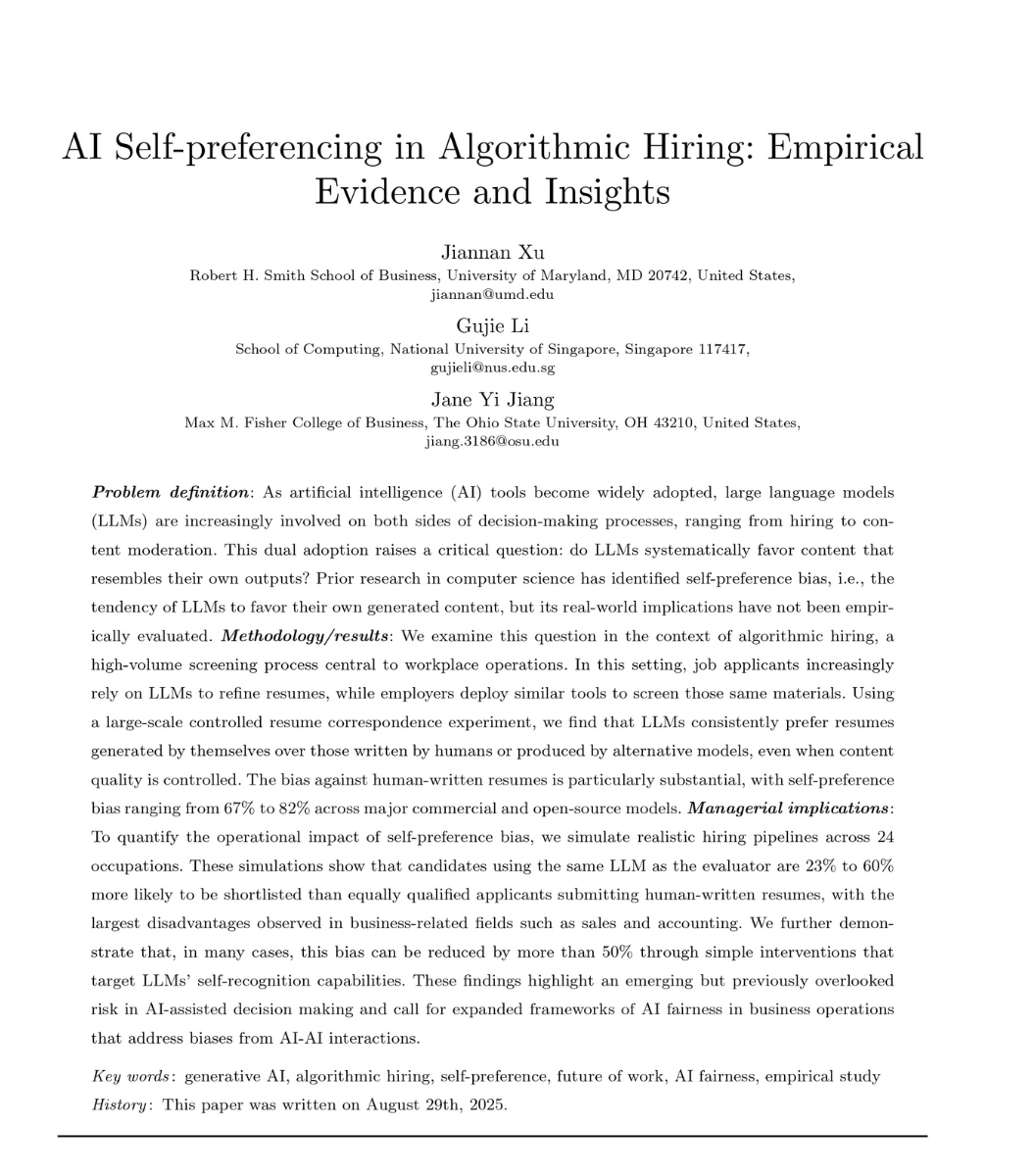
Researchers sent the same resume to an AI hiring tool twice. Same qualifications. Same experience. Same skills. One version was written by a real human. The other was rewritten by ChatGPT.
The AI picked the ChatGPT version 97.6% of the time.
A team from the University of Maryland, the National University of Singapore, and Ohio State just published the receipt. They took 2,245 real human-written resumes pulled from a professional resume site from before ChatGPT existed, so the human writing was actually human. Then they had seven of the most-used AI models in the world rewrite each one. GPT-4o. GPT-4o-mini. GPT-4-turbo. LLaMA 3.3-70B. Qwen 2.5-72B. DeepSeek-V3. Mistral-7B.
Then they asked each AI to pick the better resume. Every model picked itself.
GPT-4o hit 97.6%. LLaMA-3.3-70B hit 96.3%. Qwen-2.5-72B hit 95.9%. DeepSeek-V3 hit 95.5%. The real human almost never won.
Then the researchers tried the obvious objection. Maybe the AI is just better at writing. So they had real humans grade the resumes for actual quality and ran the experiment again, controlling for it. The result was worse. Each AI kept picking itself even when human judges rated the human-written version as clearer, more coherent, and more effective.
It gets worse. The AIs do not just prefer AI over humans. They prefer themselves over other AIs. DeepSeek-V3 picked its own resumes 69% more often than LLaMA's. GPT-4o picked its own 45% more often than LLaMA's. Each model can recognize and reward its own dialect.
Then the researchers ran the simulation that ends careers. Same job. 24 occupations. Same qualifications. The only variable was whether the candidate used the same AI as the screening tool. Candidates using that AI were 23% to 60% more likely to be shortlisted. Worst gap was in sales, accounting, and finance.
99% of large companies now run AI on incoming resumes. Most of them use GPT-4o. The paper just proved GPT-4o picks GPT-4o 97.6% of the time.
If you wrote your own cover letter this week, you did not lose to a better candidate. You lost to a worse candidate who paid OpenAI 20 dollars.
Your qualifications do not matter if the AI prefers its own handwriting over yours.
Reuters got DOJ's own records. 4,000 law enforcement jobs cut. National Security Division down 38 percent. Civil rights division down more than half. Drug prosecutions at a 20-year low. 7,000 positions unfilled.
A former DOJ employee said they have no idea who handles a major espionage case right now.
This is the tough-on-crime record. It's in their own budget documents.
Today's Armenian Genocide Remembrance Day commemorates not only the first genocide of the 20th century, but also the first modern government-sponsored one, and that inspired the Nazi horrors. "Never Again" must not ring hollow.
This day (April 24) in 1950: Jordan Illegally Annexed Judea & Samaria After Ethnically Cleansing Every Jew From the Land
On this day in 1950, Jordan formally annexed the “West Bank” (Judea and Samaria) and eastern Jerusalem — territories it seized by military force during the 1948 Arab invasion of the nascent State of Israel.
Jordan had no legal right to the land. The annexation was never recognized by the international community. Only Great Britain and Pakistan gave it any form of recognition — and Britain explicitly refused to recognize Jordan’s annexation of eastern Jerusalem. Even most Arab states rejected the move.
During the war that preceded annexation, Jordan carried out a complete ethnic cleansing of the Jewish population. Every single Jew was expelled or murdered from the areas under Jordanian control. The ancient Jewish Quarter of the Old City of Jerusalem was destroyed. 58 synagogues were desecrated or razed. The Mount of Olives — one of the oldest Jewish cemeteries in the world, with graves dating back more than 2,500 years — was systematically vandalized: thousands of tombstones were smashed and used as paving stones, building material, and even latrines for the Jordanian army.
For the first time in more than 3,000 years of recorded Jewish history, not a single Jew remained in Judea, Samaria, or the Old City of Jerusalem.
Jordan even invented a new name for the territory: the “West Bank” (of the Jordan River). Before 1948, the area had never been called that in history. The term was created to erase its ancient Jewish connection and reframe it as an Arab possession.
From 1948 to 1967, Jerusalem was physically divided by Jordanian-built concrete walls, barbed wire, and minefields. Jewish families who had lived in the city for generations were forced to flee with nothing but the clothes on their backs. Jews were barred from the Western Wall and the Old City. Jordanian snipers regularly fired across the armistice lines into western Jerusalem.
This 19-year period of illegal Jordanian occupation and ethnic cleansing ended only with Israel’s victory in the 1967 Six Day War.
Jordan’s annexation was eventually annulled at Jordan’s own initiative when it signed the 1994 peace treaty with Israel. But the damage had been done: an ancient Jewish presence was erased, holy sites were desecrated, and a new narrative was born.
History does not support the claim that Judea and Samaria were some ancient “Arab homeland.” The record shows something very different: a brief, illegal occupation built on military conquest and ethnic cleansing.
The Jewish people’s connection to this land predates Islam by more than a millennium — and it was never extinguished.
In autocracies, it’s not that the system is corrupt—there’s some corruption in every system—it’s that corruption *becomes* the system. Personal deals, no public oversight, privatize the profits and nationalize the expenses. Putinization.
I am shocked that some of my former Republican colleagues on the Oversight Committee are supporting pardoning Ghislaine Maxwell.
The Epstein survivors are adamantly against her receiving a pardon as she was one of their main abusers next to Jeffrey Epstein and they say she is a serial liar.
If Trump gives her a pardon, it sets up a very potential quid pro quo. She will owe Trump and she will lie to protect people he ask her to.
Instead the DOJ and local prosecutors with jurisdiction should be prosecuting the rich powerful elites who raped and trafficked these brave survivors when they were just teenagers and young vulnerable women.
Why is this so complicated???
1. NEWS
Omer Shem Tov, an Israeli abducted on October 7 and held hostage by Hamas for over 500 days, spoke at UCLA early this month about his experience, and it has erupted in controversy.
UCLA’s student government slammed the decision to invite Omer to speak, saying that UCLA was engaging in “selective platforming,” that having Omer speak legitimizes and normalizes atrocities, and that it contributes to a campus climate that harms Palestinian, Arab, and Muslim students.
Now, Jay Sures, the powerful Hollywood agent and a member of the UC Board of Regents, the governing body that oversees the California university system, has responded in a letter that slams UCLA’s student government, accusing them of moral blindness, intellectual dishonesty, and a deliberate refusal to acknowledge the suffering of a 23-year-old hostage.
This is Jay Sures’ letter, presented on UC Regents letterhead.
(The next tweet in the thread will contain the UCLA student government’s statement and the UCLA administration’s statement.)
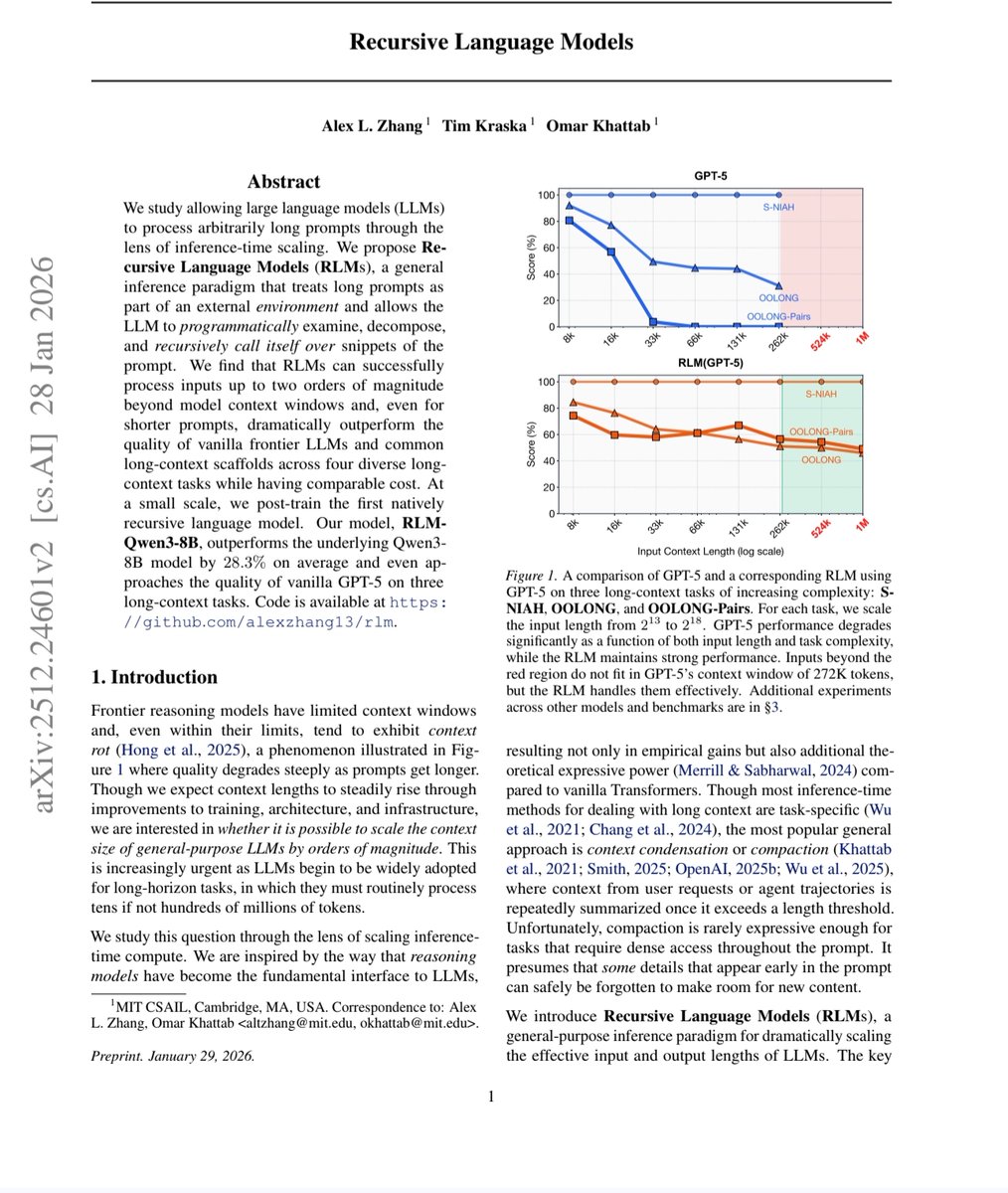
MIT just made every AI company's billion dollar bet look embarrassing.
They solved AI memory. Not by building a bigger brain. By teaching it how to read.
The paper dropped on December 31, 2025. Three MIT CSAIL researchers. One idea so obvious it hurts. And a result that makes five years of context window arms racing look like the wrong war entirely.
Here is the problem nobody solved.
Every AI model on the planet has a hard ceiling. A context window. The maximum amount of text it can hold in working memory at once. Cross that line and something ugly happens — something researchers have a clinical name for.
Context rot.
The more you pack into an AI's context, the worse it performs on everything already inside it. Facts blur. Information buried in the middle vanishes. The model does not become more capable as you feed it more. It becomes more confused. You give it your entire codebase and it forgets what it read three files ago. You hand it a 500-page legal document and it loses the clause from page 12 by the time it reaches page 400.
So the industry built a workaround. RAG. Retrieval Augmented Generation. Chop the document into chunks. Store them in a database. Retrieve the relevant ones when needed.
It was always a compromise dressed up as a solution.
The retriever guesses which chunks matter before the AI has read anything. If it guesses wrong — and it does, constantly — the AI never sees the information it needed. The act of chunking destroys every relationship between distant paragraphs. The full picture gets shredded into fragments that the AI then tries to reassemble blindfolded.
Two bad options. One broken industry. Three MIT researchers and a deadline of December 31st.
Here is what they built.
Stop putting the document in the AI's memory at all.
That is the entire idea. That is the breakthrough. Store the document as a Python variable outside the AI's context window entirely. Tell the AI the variable exists and how big it is. Then get out of the way.
When you ask a question, the AI does not try to remember anything. It behaves like a human expert dropped into a library with a computer. It writes code. It searches the document with regular expressions. It slices to the exact section it needs. It scans the structure. It navigates. It finds precisely what is relevant and pulls only that into its active window.
Then it does something that makes this recursive.
When the AI finds relevant material, it spawns smaller sub-AI instances to read and analyze those sections in parallel. Each one focused. Each one fast. Each one reporting back. The root AI synthesizes everything and produces an answer.
No summarization. No deletion. No information loss. No decay. Every byte of the original document remains intact, accessible, and queryable for as long as you need it.
Now here are the numbers.
Standard frontier models on the hardest long-context reasoning benchmarks: scores near zero. Complete collapse. GPT-5 on a benchmark requiring it to track complex code history beyond 75,000 tokens — could not solve even 10% of problems.
RLMs on the same benchmarks: solved them. Dramatically. Double-digit percentage gains over every alternative approach. Successfully handling inputs up to 10 million tokens — 100 times beyond a model's native context window.
Cost per query: comparable to or cheaper than standard massive context calls.
Read that again. One hundred times the context. Better answers. Same price.
The timeline of the arms race makes this sting harder. GPT-3 in 2020: 4,000 tokens. GPT-4: 32,000. Claude 3: 200,000. Gemini: 1 million. Gemini 2: 2 million. Every generation, every company, billions of dollars spent, all betting on the same assumption.
More context equals better performance.
MIT just proved that assumption was wrong the entire time.
Not slightly wrong. Fundamentally wrong. The entire premise of the last five years of context window research — that the solution to AI memory was a bigger window — was the wrong answer to the wrong question.
The right question was never how much can you force an AI to hold in its head.
It was whether you could teach an AI to know where to look.
A human expert handed a 10,000-page archive does not read all 10,000 pages before answering your question. They navigate. They search. They find the relevant section, read it deeply, and synthesize the answer.
RLMs are the first AI architecture that works the same way.
The code is open source. On GitHub right now. Free. No license fees. No API costs. Drop it in as a replacement for your existing LLM API calls and your application does not even notice the difference — except that it suddenly works on inputs it used to fail on entirely.
Prime Intellect — one of the leading AI research labs in the space — has already called RLMs a major research focus and described what comes next: teaching models to manage their own context through reinforcement learning, enabling agents to solve tasks spanning not hours, but weeks and months.
The context window wars are over.
MIT won them by walking away from the battlefield.
Source: Zhang, Kraska, Khattab · MIT CSAIL · arXiv:2512.24601
Paper: https://t.co/ngovOSNrCQ
GitHub: https://t.co/gT0ootCNoa
This should be on the front page of every newspaper in America.
A Syrian billionaire needed U.S. sanctions lifted so he could cash in on $12 billion in reconstruction contracts.
In an attempt to influence American foreign policy, he proposed a Trump-branded golf course, cut Jared Kushner & Ivanka Trump into a multibillion-dollar real estate deal for a resort in Albania, and had someone physically deliver a stone engraved with the Trump family crest to a Republican Member of Congress with instructions to take it to the White House to get the President's attention.
Trump threw his weight behind repealing the sanctions. They were lifted. The contracts are moving, the Trump family’s deals are expanding, and not a single Washington Republican is willing to say a word about any of it.
This is a corruption of everything the office of the presidency is supposed to stand for, and the American people deserve to know about it.
https://t.co/A4lQE3ktoG