Calling early career (0-10 years of an independent group) researchers in working Infectious Diseases to submit papers to this special issue that I’m co-guest editing @ACS_Infectious. Details below:
Early Career Researchers in Infectious
Diseases https://t.co/rMIuodWE8F
My graduate student Rhea writes a magnum opus review on the role of gene regulatory mutations in #AMR. She posits that antibiotics increase demand for gene expression and regulatory mutations mitigate it to facilitate adaptation. Out now @GeneticsGSA
https://t.co/nsNnFdInPv
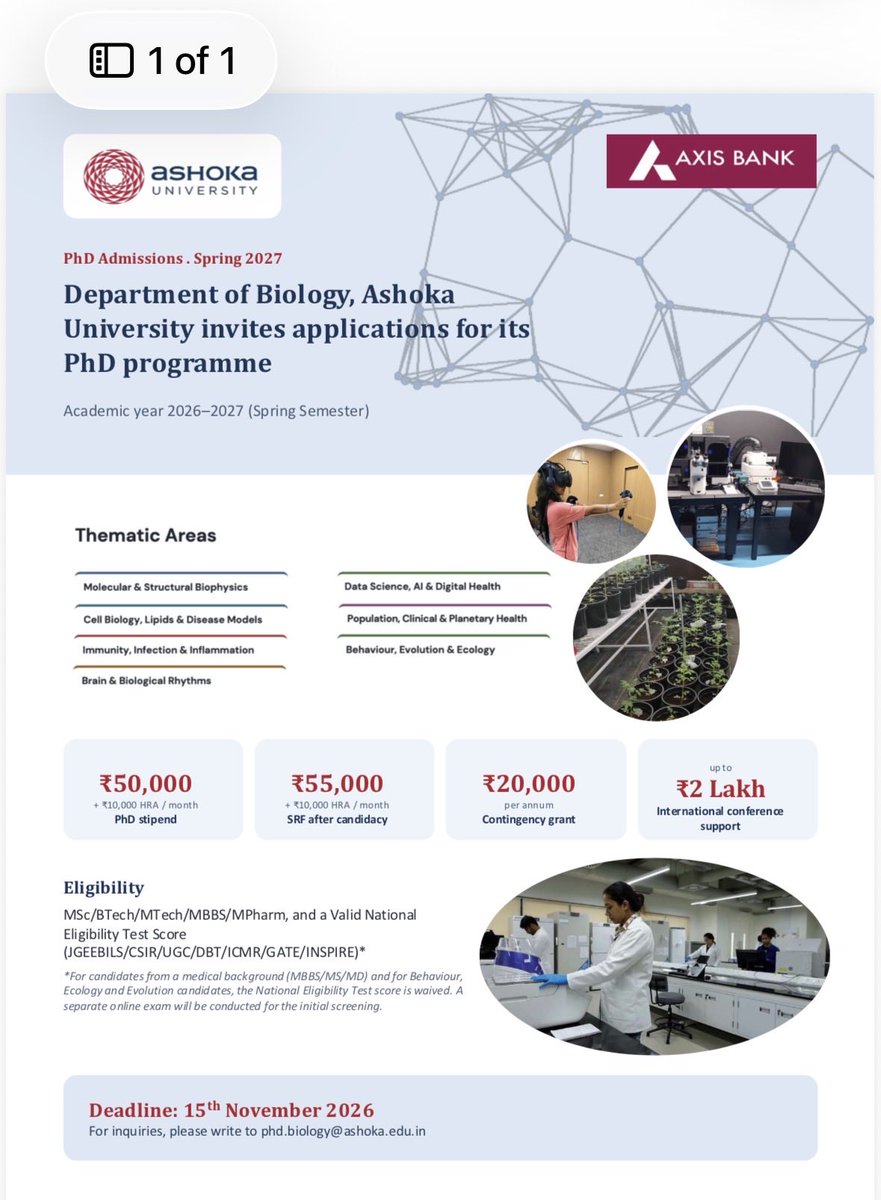
@IISERPune PhD admission forms for the Jan 2027 session are now LIVE.
The last date to apply is 18th Oct 2026.
For details and to apply, check the link below.
https://t.co/iCGdG67jdx
Do help spread the word.
@careiiserpune की VOICE फ़ेलोशिप में वैज्ञानिकों और ज़मीनी स्तर पर काम कर रहे पत्रकारों के बीच सीखने-साझा कर���े का शानदार सिलसिला जारी है। इस दौरान Nishad Matange ने फ़ेलोज़ के साथ बैक्टीरिया और वायरस जैसे महत्वपूर्ण बायोलॉजिकल विषयों पर बेहद उपयोगी चर्चा की।
जानकारी, संवाद और सीखने-सिखाने से भरपूर यह एक शानदार सेशन रहा।
@nutshal @JamwalNidhi
Applications are now open for the 19th Young Investigators’ Meeting at Mohali (#YIM2027)
The Young Investigators’ Meeting brings together young investigators and postdoctoral fellows from India and overseas for five days to exchange ideas and foster mentorship, networking, and collaboration in the life sciences.
With @IiserMohali and @NABI_India, Mohali, as local hosts, the meeting is coming to Mohali, Punjab.
📅 22–26 February 2027
⏳ Apply by: 30 September 2026
Apply here: https://t.co/9dkMPuZJZc
#YoungInvestigatorsMeeting #LifeSciences #EarlyCareerResearchers #IndianLifeScience
@DBTIndia@DBS_IISERM@IndiaDST@ANRFIndia@ICMRDELHI@ugc_india@INYAS_INSA
A new study in the August issue of #GENETICS provides insights into the microevolution of highly related Wolbachia genomes in #mosquitoes, revealing a strong link between genetic and cytoplasmic incompatibility pattern diversity.
🦟 📷️ Julien Amoros
🔗 https://t.co/ZrGNnrLfYd
This work may help explain why certain bacterial strains are more often associated with AMR variants than others.
Thanks for @India_Alliance@ANRFIndia and @IISERPune for financially supporting this work.
Latest study from the Bugs and Drugs Lab led by is now online @PLOSBiology
We investigate how pre-existing polymorphisms in a signalling pathway in E. coli alter the capacity for evolving antibiotic resistance.
https://t.co/PraG2DyoyG
We now exploit this system to ask a fundamental question, how do near-neutral sequence variants alter the propensity for AMR evolution. We show that epistasis between standing polymorphisms and adaptive mutations are a powerful force determining the evolution of resistance.
#Congrats to Dr. Chandrashekhar Borkar, faculty member in #BiologyDepartment, on receiving the prestigious #IBRORisingStar Award from the International Brain Research Organization @IBROorg!! Wishing him continued success as he begins his research journey at #IISERPune!
https://t.co/jsZ7ESHjWY
Our work on gene duplication as a transient mode of resistance acquisition covered by Saral AI. Do take a look at the video and the original article here: https://t.co/yoDdlh5OOo
Dr. Gayathri Pananghat, IISER Pune, shows how students move beyond classrooms and become part of real research environments early in their academic journey.
⏰ Last chance—apply for IAT 2026 before April 13, 2026
Apply now: https://t.co/izME2XL2OQ