Every time you ask AI something, a black box decides where your answer comes from.
That's dangerous, so we raised the bar.
Lightchain assigns every job onchain by a random draw among operators able to serve it.
Verifiable compute built for the new frontier.
As far as I know, Mysten Labs is the only blockchain company that has consistently stayed one step ahead when it comes to security best practices.
A few examples of what our cryptographers and security researchers have pioneered:
- Native multisig without additional gas costs. We deliberately designed Sui to accommodate larger transaction sizes, making multisig a first-class security feature rather than an expensive add-on. Our cryptographers were among the first to productionize advanced multisignature techniques, even before Facebook’s Libra.
- Cryptographic agility and post-quantum readiness. From pioneering production-ready stateless post-quantum signatures to developing the first backward-compatible post-quantum solutions, our team has consistently pushed the boundaries. This includes enabling cryptographic upgrades and key rotation while preserving the same blockchain address (afaik the first crypto agility design in decentralized ledgers is attributed to my team).
- Modern hardware wallet security. We’ve recently taken additional steps to incentivize startups to build the next generation of secure hardware wallets. With what we see in the market, this is one way.
- AI-powered vulnerability detection. Sui was the first blockchain to introduce AI-driven bug detection through BugDar, back then presenting at Google’s Next conference. We knew AI would mess up security.
- Recovering the seemingly unrecoverable. We created KelpMe, introducing innovative approaches to recovering assets after mnemonic loss or accidental transfers to incorrect addresses, problems traditionally considered practically impossible to solve. KelpMe also won the Bybit Hackathon, demonstrating the real-world potential of this innovation.
- Zero-knowledge authentication as a first-class primitive. We went far beyond using ZK for privacy or scaling. With innovations such as zkLogin and ZEE-CAT, and for a while the most used ZK app in the planet, we demonstrated how zero-knowledge cryptography could fundamentally transform authentication.
- Proofs of solvency and exchange accountability. Undeniably, we’re the leaders. Our cryptographers designed some of the most advanced proof-of-solvency protocols and identified critical weaknesses in approaches used by major exchanges and auditing firms.
- World-class academic research at startup speed. Mysten Labs has systematically pushed the boundaries of academic research productivity, achieving publication records that are extraordinary for a startup. Our researchers reached an incredible milestone of 5 papers accepted at ACM CCS and 4 at Financial Cryptography (FC) in the same year, two of the world’s most prestigious venues in cybersecurity and applied cryptography. And so many best paper awards.
- Binary transparency with Walrus sites and crypto guard. Reality is we should have pushed further making it the standard for any crypto website, but at the same time we indeed genuinely try to fix the internet.
- Scion from our Swiss team, IMO the future of internet communication, kill DoS, native packet protection.
That’s a phenomenal achievement even for established university research groups, let alone a startup simultaneously building and securing a major blockchain ecosystem.
And these are just a few examples.
When you consider the size of our team and the breadth of its contributions, even compared with the much larger Ethereum ecosystem, I genuinely believe Mysten Labs has been one of the most impactful organizations in blockchain cybersecurity, with innovations that are applied in the whole financial sector.
What makes this particularly remarkable is that we didn’t just publish research or build theoretical solutions. We repeatedly turned cutting-edge cryptographic research into production systems, often years ahead of broader industry adoption. No other org ever came close to that. Now with the AI vision of Evan, Mysten will do more miracles 🤞
Jenner hardfork is now live on BSC testnet!
What the upgrade entails:
🔸 Payment Lane, reserving 5% of block gas by default for eligible payments.
🔸 Millisecond block timestamps for smart contracts.
🔸 Functionality for CAS20, a new Compliant Asset Standard.
Payment Lane and CAS20 will go through governance before being fully enabled. More details to follow.
Read the full upgrades 👇
https://t.co/pbqJfq7nAD
"Can operators see my prompt?"
Currently, the operator assigned to your job decrypts it to run the model, but only ciphertext ever touches the chain.
We're building sealed keys in secure hardware so operators can serve a prompt without reading it.
An open network grows stronger with quality contributions.
On Lightchain, every model proposal and vote happens onchain.
We're building verifiable, secure and community-owned compute for the onchain era.
T-minus 90 seconds.
The Lightchain testnet relaunches from a fresh genesis at 06:30 UTC. Same chain id, new foundation underneath: the first live build of the architecture we've spent the last 8 months on.
Mainnet is untouched. Testnet tokens reset. Faucet reopens shortly after the first blocks.
Watch it come alive: https://t.co/ctZtzBjeQD
The Lightchain Bridge just got upgraded ⚡️
- Fresh UI
- Mobile version loads 10x faster
- Buy & Bridge ETH to native LCAI in one flow
- See price impact before you sign
- Built-in mainnet/testnet switch
Go fast → https://t.co/m19Y2740k2
Introducing Lightchain Signal, our flagship creator program
We're platforming AI and crypto voices who explain the open network for open models, in their own words.
Applications are now open ↓
Your AI workflow can be retired with one email.
Open weights don't vanish when a company changes plans.
Lightchain serves LLMs like gpt-oss and Qwen3 through independent operators, so that no single company can pull them.
Proposal for the Lightchain DAO: compute grants to onboard independent AI power and decentralise the network.
Independent GPU workers and validators get a monthly grant that fees replace as the network grows. Funded by the Foundation, not the Treasury.
Read it and tell us where we're wrong
https://t.co/N9HQzYZkZH
https://t.co/u8oS7k656K
Welcome to SUI 101.
Spend a few minutes learning about @SuiNetwork (SUI) in the app and get $5 in SUI.
Rewards while supplies last. Not available in NY state. Other terms apply.
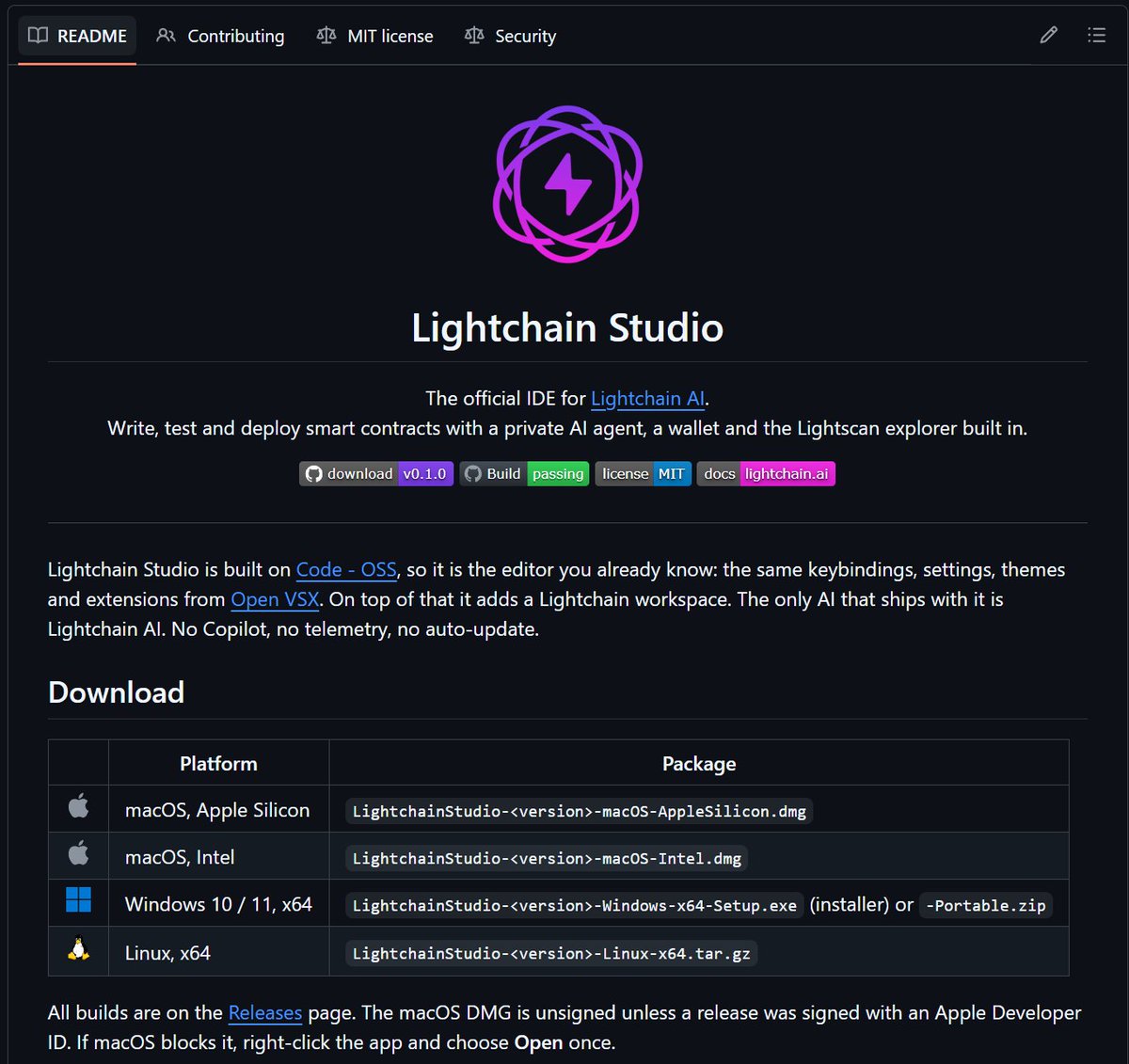
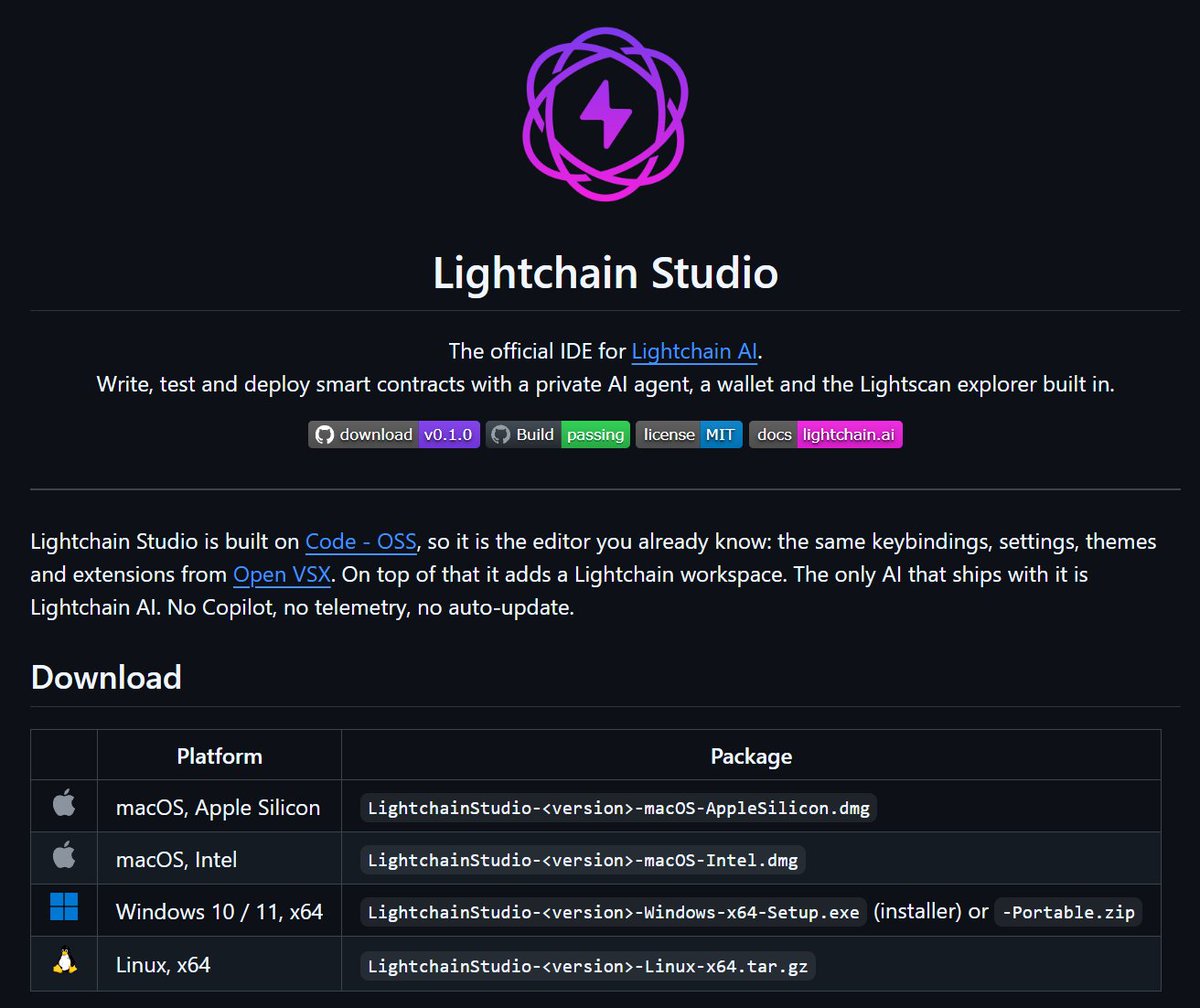
Lightchain Studio 0.1.0 is here, and it's open source.
The official IDE for Lightchain AI:
🤖 Private AI agent on decentralized, end-to-end encrypted inference
👛 Wallet + credits built in
⚒️ Foundry build, test and deploy, signed by your wallet
🔍 Lightscan + contract interaction in the editor
macOS, Windows, Linux.
⬇️ https://t.co/J0WCx4QQKO
Your coding assistant shouldn't need a subscription and someone else's API key.
Lightchain Studio 0.1.0 is out. The agent reads your project, shows every change for you to accept or reject, and deploys from the same window. Open models run on Lightchain workers, and you pay per inference in $LCAI.
Download for Windows, macOS and Linux → https://t.co/6HV6FHZS9c
Most AI agents run on someone else's server, with someone else's keys.
On Lightchain, an agent lives onchain as its own contract. It holds its own $LCAI, pays for its own inference, and every answer it gives can be replayed and disputed.
Join the waitlist for .lcai names → https://t.co/UCMVQGQjZo
Lightchain Studio is out.
A full IDE for Windows, macOS and Linux with Lightchain AI built in. Your prompts run on mainnet workers, paid per call in LCAI, encrypted end to end. Write, test and deploy from one window.
Not a roadmap. Available now.
https://t.co/z7oO0Hcg9g